AMLR Solutions
  AMLR Consultation
 EUDI Wallet
 Onboarding
 Ongoing Monitoring
 FRAML
FRAML KYC
KYC KYB
KYB KYI
KYI Age Assurance
 Workforce IAM
 Candidate Verification
 Account Takeover
 Bonus/ Promotion Abuse
 Chargeback Fraud
 Deepfake
 Document Fraud
 Fraud Networks
 Impersonation Fraud
 Money Mule Activity
 Multi-Accounting
 Party Fraud
 Regulatory & Compliance Risks
 Synthetic Identity Fraud
 Adult Content
 Banking
 Crypto
 Fintech
 Forex
Forex Compliance
 Fraud prevention
 Trust & safety
 Global expansion
 Compliance Officers
 Developers
 Fraud Analysts
 Product Managers
 Journey Builder
  Global Trust Platform
 Customer Profiles
 Vendor Comparison
 IDV Case Management
 AML Case Management
 Regulatory Reporting
 Agentic Rule Builder
  AI Compliance Co-Pilot
  Fraud Analytics
 Fraud Hub
  OCR
OCR Shufti AI
 Bank Account Verification
  Biometric Duplication
 Database Checks
 Document Intelligence
 Government ID
 Mobile Driver's License
 NFC
NFC Selfie Liveness
 Brand Personalisation
 Deployment Options
 Identity Methods
 IDV Modes
 Multi-tenancy
 On-Premise IDV
 Secure Capture
 Shufti MCP









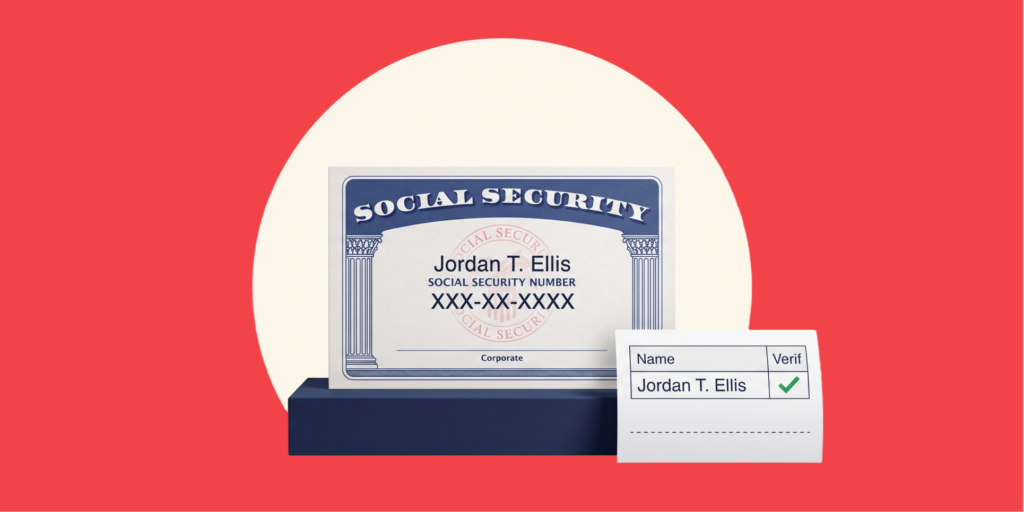
What Is a Social Security Number (SSN)?
Key takeaways
- SSN verification confirms whether a Social Security Number matches the holder’s name and date of birth in SSA records, but it does not prove the person’s identity.
- Businesses verify SSNs through document checks, SSNVS, consent based eCBSV and CBSV, and third party verification APIs, depending on the use case.
- Employers mainly use SSNVS for wage reporting, while banks and regulated businesses rely on eCBSV and layered identity verification for KYC and AML compliance.
- SSN validation, SSN verification, and SSN lookup are different processes, each serving a distinct purpose in identity and compliance workflows.
- A valid SSN match alone cannot prevent identity fraud, which makes document verification, biometric checks, and ongoing monitoring essential.
- Synthetic identity fraud continues to rise, making risk based identity verification and compliance with CIP, KYC, AML, and FCRA more important than ever.
- The most effective strategy combines SSN verification with document authentication, biometric verification, and continuous fraud monitoring.
An SSN is written in the format AAA-GG-SSSS. Historically the first three digits (the area number) reflected the state or region where the number was issued, the middle two were the group number, and the final four were the serial number.
Since 25 June 2011 the SSA has assigned numbers through randomisation. The area number no longer signals geography, which removed a predictable pattern that fraudsters had exploited. A few structural rules still hold and are useful as a first validity screen:
- An SSN never begins with 000, 666, or 900 to 999.
- The group number is never 00, and the serial number is never 0000.
- Numbers used in advertising or well known fakes (for example 078-05-1120 or 219-09-9999) are permanently invalid.
What SSNs are used for: tracking lifetime earnings and work history, calculating retirement and disability benefits, identifying taxpayers, running background checks, and confirming identity attributes during regulated onboarding.
What Is SSN Verification?
A crucial nuance: SSN verification is not the same as identity verification. Confirming that an SSN, name, and date of birth match SSA records tells you the combination is legitimate. It does not confirm that the person presenting it is the true owner. A stolen but genuine SSN will still return a match. This distinction drives every serious compliance decision later in this guide.
For onboarding teams, SSN verification does three practical things: it catches typos and transposed digits before they reach wage or tax filings, it surfaces inconsistencies that indicate synthetic identity fraud, and it provides an auditable data point inside a broader identity verification workflow.
SSN Lookup vs SSN Verification vs SSN Validation
These terms are used loosely online, which fuels confusion (and a lot of low quality SSN checker and SSN validator tools). Here is the accurate distinction.
| Term | What it actually does | Typical use |
| SSN validation | Checks that a number is structurally possible (correct length, not in a forbidden range). It does not confirm ownership. | First pass filter in software before any authoritative check. |
| SSN verification | Confirms the SSN, name, and date of birth match SSA or other authoritative records. Returns match or no match. | Onboarding, wage reporting, KYC and CIP. |
| SSN lookup / search | Retrieves records associated with a known SSN and name (for example reverse lookups tied to name and address). | Background screening and investigations, under a permissible purpose. |
Note: an SSN lookup by name alone is not legitimately possible. Genuine services require the name and the number together, plus a lawful permissible purpose.
Why Verify a Social Security Number?
Verifying an SSN protects accuracy, prevents fraud, and keeps records clean. For employers, a mismatched SSN causes wage reporting errors and possible IRS penalties. For financial institutions, SSN verification is a required building block of KYC and AML compliance and a frontline defence against identity based fraud. The threat environment makes the case on its own:
- The US Federal Trade Commission logged more than 1.1 million identity theft reports in 2024, a 9.5 percent rise on the prior year, inside 6.5 million total consumer reports.
- Industry estimates attribute up to 80 to 85 percent of new account fraud to synthetic identities, one of the fastest growing financial crimes in the country.
- Deloitte projects synthetic identity fraud losses could reach USD 23 billion by 2030, and the Federal Reserve has put the average charge off at roughly USD 15,000 per case.
- Children’s SSNs are targeted disproportionately because they are clean slate numbers with no credit history.
The cost of getting it wrong is concrete: W-2 name and number mismatches can trigger IRS penalties for employers, and a single synthetic identity that clears onboarding can sit dormant for months before a bust out that writes off every credit line at once.
The Core SSN Verification Methods
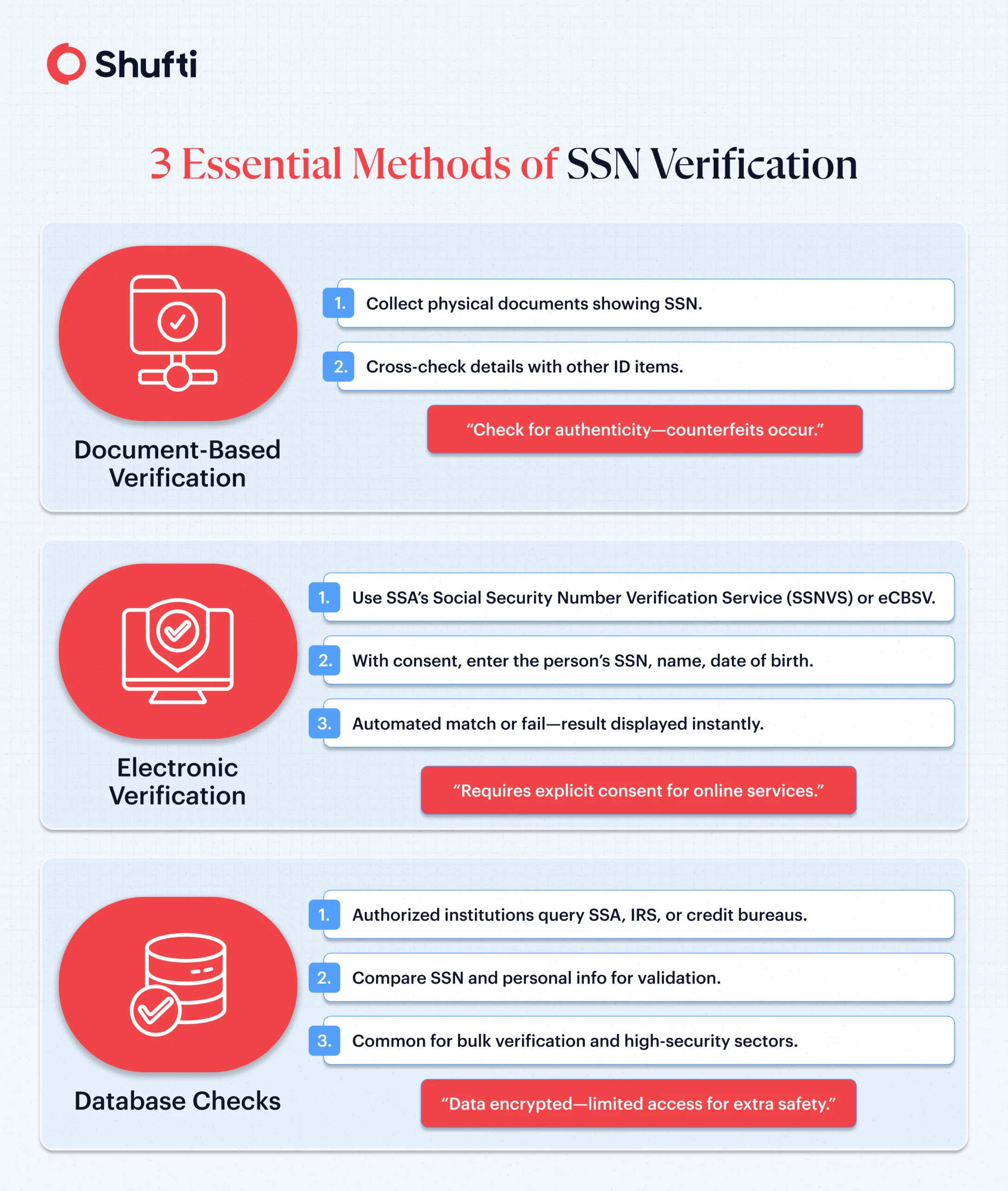
Electronic checks are fast at flagging mismatches, but on their own they rarely satisfy a full Customer Identification Program. Most programmes combine an electronic method with document or biometric review. There are five methods in practical use.
1. Document based SSN verification
Reviewing an official document that displays the SSN and comparing it with the number the person provided. Accepted documents include:
- Social Security card (issued by the SSA).
- W-2 form (Wage and Tax Statement).
- SSA-1099 (Social Security Benefit Statement).
- Pay stubs that display the SSN, and, in limited cases, a benefit verification letter from the person’s Social Security account.
Document review is strongest when paired with authenticity analysis and a second identity document. On its own it is vulnerable to forgery, which is why document verification software now checks security features, fonts, templates, and tamper signals rather than a human eyeballing a scan.
2. Consent based verification: CBSV and eCBSV
The SSA offers two consent based services that return a simple match result against its own records:
- CBSV (Consent Based SSN Verification): the legacy service, typically used for batch checks with a signed SSA-89 consent form.
- eCBSV (Electronic Consent Based SSN Verification): a real time API built for automated onboarding, which accepts electronic signatures on consent. Covered in detail below.
3. Database cross reference checks
Cross referencing the SSN, name, and date of birth against authorised databases (SSA, IRS, or major credit bureaus). This underpins background screening and reverse lookups and makes impersonation harder, but access is tightly restricted and requires a lawful permissible purpose plus, in most cases, the individual’s written consent.
4. Non documentary electronic verification (SSNVS)
The Social Security Number Verification Service (SSNVS) lets registered employers confirm that an employee name and SSN match SSA records for wage reporting only. It is free, accessed through Business Services Online, and must not be used for pre employment screening or any non wage purpose.
5. Automated verification via third party APIs
Verifying SSNs directly with the SSA is free but slow and manual at scale. Most businesses connect a third party identity verification provider by API, which processes large volumes quickly, layers on document and biometric checks, and returns an audit trail. This is where a platform such as Shufti fits.
SSN verification methods compared
| Method | Confirms ownership? | Speed / scale | Consent needed | Best for |
| Document based | Partially (with authenticity checks) | Manual, slow | Implicit at collection | Onboarding, employment |
| SSNVS | No (match only) | Batch up to 250,000 | For wage reporting | Employers, payroll |
| CBSV | No (match only) | Batch | Yes (SSA-89) | Legacy institutional checks |
| eCBSV | No (match only) | Real time API | Yes (electronic) | Banks, fintech onboarding |
| Third party API | Yes (when layered with ID and biometrics) | Real time, high volume | Yes | Regulated KYC / AML at scale |
Suggested read: why a match is not enoughA genuine SSN can still be stolen. See how synthetic identities are built from real numbers, why they clear basic checks, and how layered verification catches them before onboarding.
How eCBSV Works
eCBSV was created under Section 215 of the Economic Growth, Regulatory Relief, and Consumer Protection Act to help combat synthetic identity fraud. Two conditions are easy to miss and matter for compliance:
- Permitted entities only. Access is limited to financial institutions and their approved service providers, each holding an Employer Identification Number and a signed certification.
- Permissible purpose only. Requests are allowed in connection with a credit transaction or a circumstance described in Section 604 of the Fair Credit Reporting Act. Using eCBSV for general employment or tenant screening, without a qualifying basis, is outside the terms.
Pricing. eCBSV uses an annual, tiered subscription based on estimated transaction volume rather than per check billing. The schedule below took effect on 7 April 2025.
| Estimated annual transaction volume | Annual subscription (effective 7 April 2025) |
| Lowest tier (up to 10,000 requests) | Around USD 5,100 |
| Mid tiers (scaled by volume) | Set by SSA published schedule |
| Highest tier | USD 5 million and above |
How Employers Verify SSNs
Employers verify SSNs to file accurate wage reports and avoid name and number mismatches with the SSA and IRS. The standard route is free:
- Register for Business Services Online (BSO) with the SSA.
- Use SSNVS to enter the employee’s name, SSN, and (optionally) date of birth.
- Receive a match or no match result. For volume, upload a batch file of up to 250,000 name and SSN records.
How Banks and Financial Institutions Verify SSNs
Banks verify SSNs as part of a Customer Identification Program (CIP) mandated by the USA PATRIOT Act and implemented through FinCEN rules. Under the CIP rule, a covered institution must collect and verify four data points for each customer:
- Name
- Date of birth
- Address
- Identifying number (for US persons, generally the SSN; an ITIN or other accepted TIN may apply)
Banks typically verify the SSN through eCBSV or a third party provider, then corroborate ownership with document and biometric verification. They must keep records for at least five years after account closure and screen customers against sanctions lists as part of ongoing AML screening.
Employer vs bank SSN verification at a glance
| Dimension | Employer | Bank / financial institution |
| Primary purpose | Accurate wage and tax reporting | KYC, CIP and AML compliance |
| Common method | SSNVS (free, wage reporting) | eCBSV or third party API |
| Legal driver | IRS / SSA wage reporting rules | USA PATRIOT Act, FinCEN CIP rule |
| Consent basis | Employment relationship | Explicit customer consent |
| Depth required | Name and SSN match | Match plus identity and biometric proof |
How to Verify an SSN Online: Step by Step
- Confirm your permissible purpose and obtain written consent where required.
- Choose the right service: SSNVS (employers, wage reporting) or eCBSV and CBSV (permitted entities, credit related).
- Enter the individual’s name, SSN, and date of birth (single entry or batch upload).
- Review the result. eCBSV returns a yes or no and identifies any non matching element.
- Log the check, store the record securely, and escalate no match cases for review rather than automatic rejection.
Verify SSNs in the US →
Can I Verify an SSN Myself? Can I Find My SSN Online?
Can I find my SSN online?
No. There is no legitimate service that displays your Social Security Number online, and any site that claims to should be avoided. To recover a lost number, check personal documents (SSN card, W-2, tax return) or request a replacement card from the SSA.
Can I verify an SSN myself?
Individuals cannot run authoritative third party checks on other people. Businesses can, but only with a permissible purpose and (for most database and consent based methods) the individual’s written consent. Free SSN validator and SSN lookup sites that promise instant results without consent are unreliable and often unlawful to use.
Lost Social Security card?
Request a replacement through your Social Security account or your local SSA office. You do not need the physical card to verify a number for onboarding, because the underlying SSN is what is checked.
SSN vs TIN vs EIN vs ITIN vs PTIN
An SSN is one type of Taxpayer Identification Number. TIN is the umbrella term the IRS uses, and the SSN is the version issued to individuals by the SSA. The others serve different taxpayers and purposes.
| Number | Full name | Issued by | Who it is for |
| TIN | Taxpayer Identification Number | IRS (umbrella term) | Any taxpayer; a category, not a single number |
| SSN | Social Security Number | SSA | US citizens and eligible residents |
| EIN | Employer Identification Number | IRS | Businesses and other entities |
| ITIN | Individual Taxpayer Identification Number | IRS | Individuals not eligible for an SSN (begins with 9) |
| ATIN | Adoption Taxpayer Identification Number | IRS | Children in a pending US adoption |
| PTIN | Preparer Tax Identification Number | IRS | Paid tax preparers |
What the Death Master File Is (and Why It Matters)
A public version, the Limited Access Death Master File, is distributed under a certification programme to organisations with a legitimate fraud prevention need. It contains tens of millions of records dating back decades. For onboarding and payments teams, a DMF check is a cheap, high value screen: a live application against a deceased SSN is a strong fraud signal, and paying benefits or refunds to a deceased identity is a common, avoidable loss.
IRS vs SSA Verification
Both the IRS and the SSA support number verification, but for different jobs. The IRS TIN Matching program helps payers confirm a name and TIN combination before filing information returns (such as 1099s). The SSA services (SSNVS, CBSV, eCBSV) confirm SSN, name, and date of birth against Social Security records.
| Feature | SSA verification | IRS TIN Matching |
| Confirms | SSN, name, and date of birth match | Name and TIN combination for reporting |
| Main services | SSNVS, CBSV, eCBSV | Interactive and bulk TIN Matching (e-Services) |
| Typical user | Employers, banks, permitted entities | Payers filing 1099 and similar returns |
| Purpose | Wage reporting, KYC, fraud prevention | Accurate information return filing |
Invalid, Fake, and Non Matching SSNs: What Happens Next
What is an invalid SSN? A number that breaks the structural rules (wrong length, a forbidden prefix such as 000, 666, or 900 to 999, or a known advertising number). Validation software rejects these before any authoritative check.
What is a fake SSN? A structurally plausible number that is fabricated, belongs to someone else, or is stitched into a synthetic identity. A fake can pass validation and even return a match if it is a real number stolen from another person, which is exactly why verification alone is not enough.
What happens if an SSN does not match? A no match is a flag, not a verdict. It can result from a maiden name, a data entry error, a recent legal name change, or an SSA record lag, as well as from fraud. Best practice is to escalate for manual review, re confirm the details with the individual, and only then decide, never to auto reject or take adverse employment action on a single no match.
Synthetic Identity Fraud and the Dark Web SSN Trade
Synthetic identity fraud combines a real SSN (often a child’s, a senior’s, or a recent immigrant’s) with a fabricated name, date of birth, and address to build a Frankenstein identity. Because the SSN itself is genuine, it can pass a basic check. Fraudsters then nurture the identity, opening small credit lines, paying on time, and building a credit file over months before a bust out in which every line is maxed and abandoned.
The economics are stark. Industry sources attribute up to 80 to 85 percent of new account fraud to synthetic identities, Deloitte projects USD 23 billion in annual losses by 2030, and the Federal Reserve has flagged that generative AI is accelerating the threat by making fake documents and profiles cheap to produce. Decades of data breaches mean genuine SSNs are widely traded on dark web markets, frequently bundled with names and addresses.
The defensive lesson is consistent: matching an SSN is necessary but not sufficient. Detecting synthetic identities needs pattern analysis, document authenticity, biometric verification, and ongoing monitoring after onboarding, not a one time number check.
Common SSN Verification Errors
- Transposed or mistyped digits that create a false no match. Always allow a correction and re-check step.
- Name mismatches from marriages, divorces, hyphenation, or cultural name order, which are common and rarely fraud.
- Using the wrong service for the purpose (for example SSNVS for hiring decisions), which is a compliance error even when the data is right.
- Treating a match as identity proof, the single most consequential mistake, because a stolen SSN still matches.
- Insecure handling of SSNs over email, SMS, or unencrypted storage, which creates breach and liability exposure.
Is SSN Verification Enough for KYC and AML?
No. SSN verification is a valuable component of KYC and AML, but it was never designed to authenticate a person. Its limits are well documented:
- It confirms a match, not that the presenter is the true owner. A stolen genuine SSN passes.
- Not everyone has an SSN (some new residents, minors, and non qualifying individuals), so it cannot be the universal key.
- It reveals no alternative or additional identities a person may hold.
- SSN fraud is widespread, and numbers are cheap to buy once breached.
This is why FinCEN and CIP rules require verifying the whole identity, not just the number. For US persons, KYC generally requires collecting a TIN (usually the SSN), then verifying identity through documents, biometric verification, and risk based customer due diligence.
Regulations Governing SSN Verification
SSN collection, use, and verification sit inside a stack of US laws. The table summarises the ones compliance teams cite most.
| Regulation | What it governs for SSN verification |
| USA PATRIOT Act (Section 326) | Requires financial institutions to run a Customer Identification Program (CIP). |
| FinCEN CIP rule (31 CFR 1020.220) | Sets the four data points to collect and verify, including an identifying number (SSN/TIN). |
| Bank Secrecy Act / AML framework | Underpins KYC, CDD, and ongoing monitoring obligations. |
| Fair Credit Reporting Act (FCRA) | Defines permissible purpose for many SSN based background and credit checks, and frames eCBSV use. |
| Privacy Act of 1974 | Restricts how federal agencies collect and disclose SSNs. |
| Gramm-Leach-Bliley Act (GLBA) | Imposes privacy and data security duties on how firms handle SSNs. |
| Economic Growth, Reg. Relief and Consumer Protection Act (S.215) | Created the eCBSV service to fight synthetic identity fraud. |
This is general information, not legal advice. Confirm obligations for your sector and jurisdiction with qualified counsel.
Combining SSN with Document and Biometric Verification
Because an SSN match cannot prove presence or ownership, robust programmes anchor the SSN inside a layered check. A common risk based sequence:
Document verification: authenticate a government issued ID (for example a US driver’s licence) and detect tampering.
Biometric verification: a selfie plus liveness check confirms the person is real and matches the ID photo.
SSN corroboration: match the SSN, name, and date of birth against authoritative sources under a permissible purpose.
Screening and monitoring: sanctions and watchlist screening at onboarding, then ongoing monitoring for changes.
Layering this way keeps friction low for genuine users (a selfie and an ID photo take seconds) while closing the gap that a bare SSN check leaves open.
The Future of Digital Identity Verification
Three shifts are reshaping how SSNs fit into identity assurance. First, generative AI is industrialising synthetic identities and fake documents, pushing firms toward AI assisted fraud detection and stronger liveness. Second, reusable and verifiable digital identity (mobile driving licences, digital credentials) is starting to reduce reliance on any single number. Third, regulators and providers are moving toward continuous, risk based assurance rather than a one time check at onboarding.
The SSN will remain a core US identifier for tax, credit, and benefits, but its role is narrowing to one corroborating signal inside a broader, biometric led, continuously monitored identity stack.
How Shufti Verifies Social Security Numbers
Shufti treats the SSN the way modern compliance requires: as one layer in a verified identity, not a shortcut. The flow closes every gap this guide describes.
Verify the person first: Shufti authenticates a US driver’s licence through document verification, then confirms a live human with face verification and liveness detection.
Corroborate SSN ownership: Shufti checks the SSN against supporting evidence such as an SSN card, W-2, or SSA-1099, using last four digit handling to reduce data exposure.
Match and flag: names and dates of birth are compared across sources, inconsistencies are flagged, and, where permissible, attributes are cross checked against authorised databases under a clear permissible purpose.
Prove compliance: every step produces an auditable trail for KYC, CIP, and AML screening, with ongoing monitoring after onboarding.
This risk based approach supports faster onboarding, early detection of synthetic identities, and strong KYC and AML compliance without slowing genuine customers. Shufti verifies identities across 240+ countries and territories, so US SSN checks sit inside the same platform teams use for global identity verification and business verification.
Request a demo →
Frequently Asked Questions
What does SSN mean, and why is it important?
SSN stands for Social Security Number, a nine digit identifier issued by the US Social Security Administration (SSA). It is used for tax reporting, Social Security benefits, employment, credit history, and identity verification. For regulated businesses, an SSN is a key identifier used in Customer Identification Program (CIP), KYC, and AML compliance.
How can I check if my Social Security Number is valid?
A valid SSN follows the correct nine digit format and does not begin with 000, 666, or 900 to 999. Structural validation alone does not confirm ownership. Authorised organisations can verify whether an SSN matches the holder's name and date of birth through SSA approved services such as eCBSV, with the individual's consent.
Can I find or verify my Social Security Number online?
No. There is no legitimate online service that displays your full Social Security Number. If you have lost it, refer to documents such as your SSN card, W-2, or tax return, or request a replacement card from the SSA. Authoritative SSN verification is only available to eligible organisations for approved purposes.
How do businesses verify Social Security Numbers?
Employers typically use SSNVS for wage reporting, while financial institutions and other authorised organisations use eCBSV or trusted third party verification providers. A robust process also combines SSN checks with identity document verification, biometric authentication, and fraud screening to reduce identity theft and synthetic fraud.
Is SSN verification enough for KYC and AML compliance?
No. SSN verification only confirms that an SSN matches official records. It does not prove the person presenting the SSN is its rightful owner. To meet KYC, CIP, and AML requirements, businesses should combine SSN verification with document verification, biometric checks, sanctions screening, and ongoing monitoring.
What is eCBSV, and how is it different from SSNVS?
Both services are provided by the SSA but serve different purposes. SSNVS is a free service for employers verifying employee names and SSNs for wage reporting. eCBSV is a paid API that lets eligible organisations verify whether an individual's SSN, name, and date of birth match SSA records for identity verification purposes.
What happens if an SSN does not match or appears fraudulent?
An SSN mismatch does not automatically indicate fraud. It may result from data entry errors, name changes, or outdated records. However, invalid, stolen, or synthetic identities can also trigger mismatches. Businesses should investigate discrepancies through manual review and additional identity verification before making onboarding decisions.
How does SSN verification help prevent identity fraud?
SSN verification helps detect invalid or mismatched Social Security Numbers, identify synthetic identities, and reduce account opening fraud. When combined with document verification, biometric authentication, sanctions screening, and ongoing monitoring, it forms an important layer of a comprehensive identity verification and AML compliance program.