AMLR Solutions
  AMLR Consultation
 EUDI Wallet
 Onboarding
 Ongoing Monitoring
 FRAML
FRAML KYC
KYC KYB
KYB KYI
KYI Age Assurance
 Workforce IAM
 Candidate Verification
 Account Takeover
 Bonus/ Promotion Abuse
 Chargeback Fraud
 Deepfake
 Document Fraud
 Fraud Networks
 Impersonation Fraud
 Money Mule Activity
 Multi-Accounting
 Party Fraud
 Regulatory & Compliance Risks
 Synthetic Identity Fraud
 Adult Content
 Banking
 Crypto
 Fintech
 Forex
Forex Compliance
 Fraud prevention
 Trust & safety
 Global expansion
 Compliance Officers
 Developers
 Fraud Analysts
 Product Managers
 Journey Builder
  Global Trust Platform
 Customer Profiles
 Vendor Comparison
 IDV Case Management
 AML Case Management
 Regulatory Reporting
 Agentic Rule Builder
  AI Compliance Co-Pilot
  Fraud Analytics
 Fraud Hub
  OCR
OCR Shufti AI
 Bank Account Verification
  Biometric Duplication
 Database Checks
 Document Intelligence
 Government ID
 Mobile Driver's License
 NFC
NFC Selfie Liveness
 Brand Personalisation
 Deployment Options
 Identity Methods
 IDV Modes
 Multi-tenancy
 On-Premise IDV
 Secure Capture
 Shufti MCP














TL;DR
- Banks are the primary channel criminal networks must use to move money.
- FinCEN assessed a record $1.3 billion penalty against TD Bank for AML failures.
- AML software checks customers and transactions against sanctions, PEP, and watchlist data.
- Banks deploy it at onboarding and during continuous ongoing monitoring.
- AI-assisted risk scoring reduces false positives that overwhelm analyst capacity.
Banks sit at the center of every major money laundering operation. Not because they invite it, but because criminal networks have to move money through the financial system at some point. When a bank’s AML controls fail, the consequences are concrete. FinCEN assessed a record $1.3 billion penalty against TD Bank for allowing its AML program to deteriorate for over a decade. For compliance teams, this is the operating reality: manual processes and outdated systems are not just slow. They are an institutional liability.
AML screening software is how modern banks close that gap.
What Is AML Screening Software?
AML screening software is a technology platform that checks customers, transactions, and business entities against structured risk databases: sanctions lists, politically exposed persons (PEP) registries, adverse media sources, and global watchlists in real time or near-real time.
Banks deploy it at two critical points in the customer relationship. First, during onboarding, when a new customer or business is assessed for risk before any account is opened. Second, during ongoing monitoring, where existing customers and their transaction activity are continuously checked against updated risk data as the relationship develops.
Unlike manual compliance review, where individual analysts look up names and run checks case by case, AML software applies consistent rules at scale. A mid-sized bank onboards hundreds of customers a day. Running each one through dozens of watchlists by hand is not a viable compliance strategy, and regulators evaluating a bank’s AML program know exactly what a functioning automated system looks like versus one that has been patched together.
The Scale of Financial Crime Banks Are Dealing With
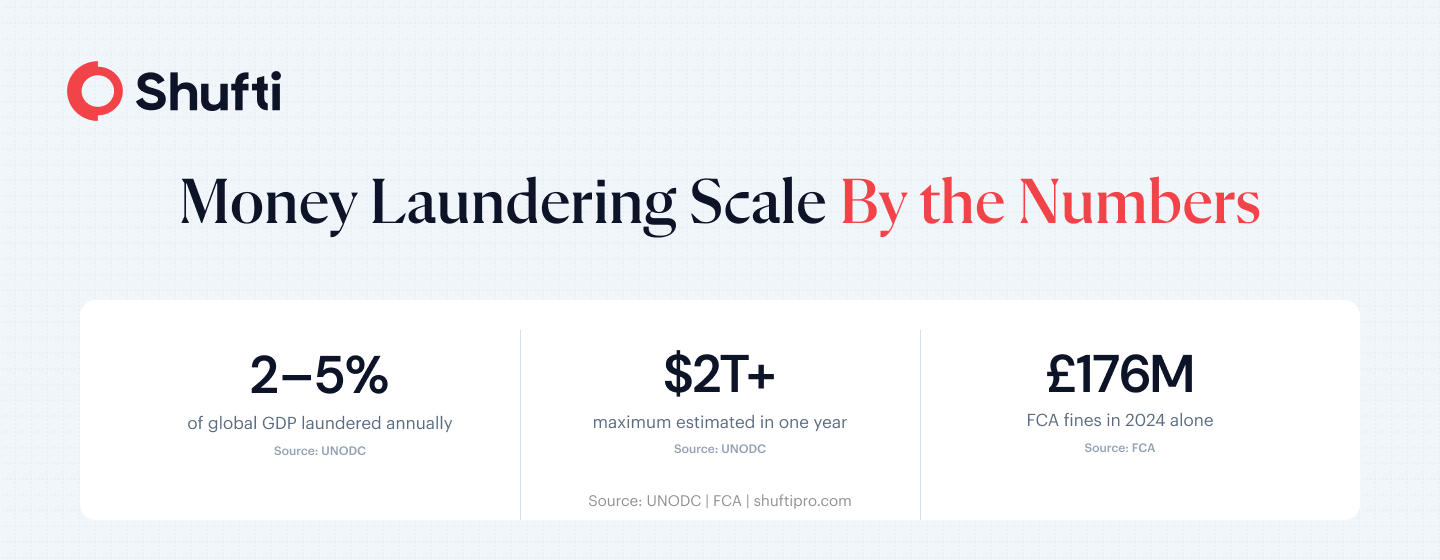
According to the United Nations Office on Drugs and Crime (UNODC), between 2% and 5% of global GDP is laundered each year, an estimated $800 billion to $2 trillion passing through the financial system in a single year. Banks are the primary channel through which that money must eventually move.
Regulators have responded with sustained enforcement. In 2024, the Financial Conduct Authority issued total fines exceeding £176 million across financial services firms, a significant proportion tied to AML control failures. Across jurisdictions, the pattern holds: weak controls attract regulatory attention, and regulatory attention leads to penalties that far exceed what adequate compliance infrastructure would have cost.
Core Capabilities AML Screening Software Provides to Banks
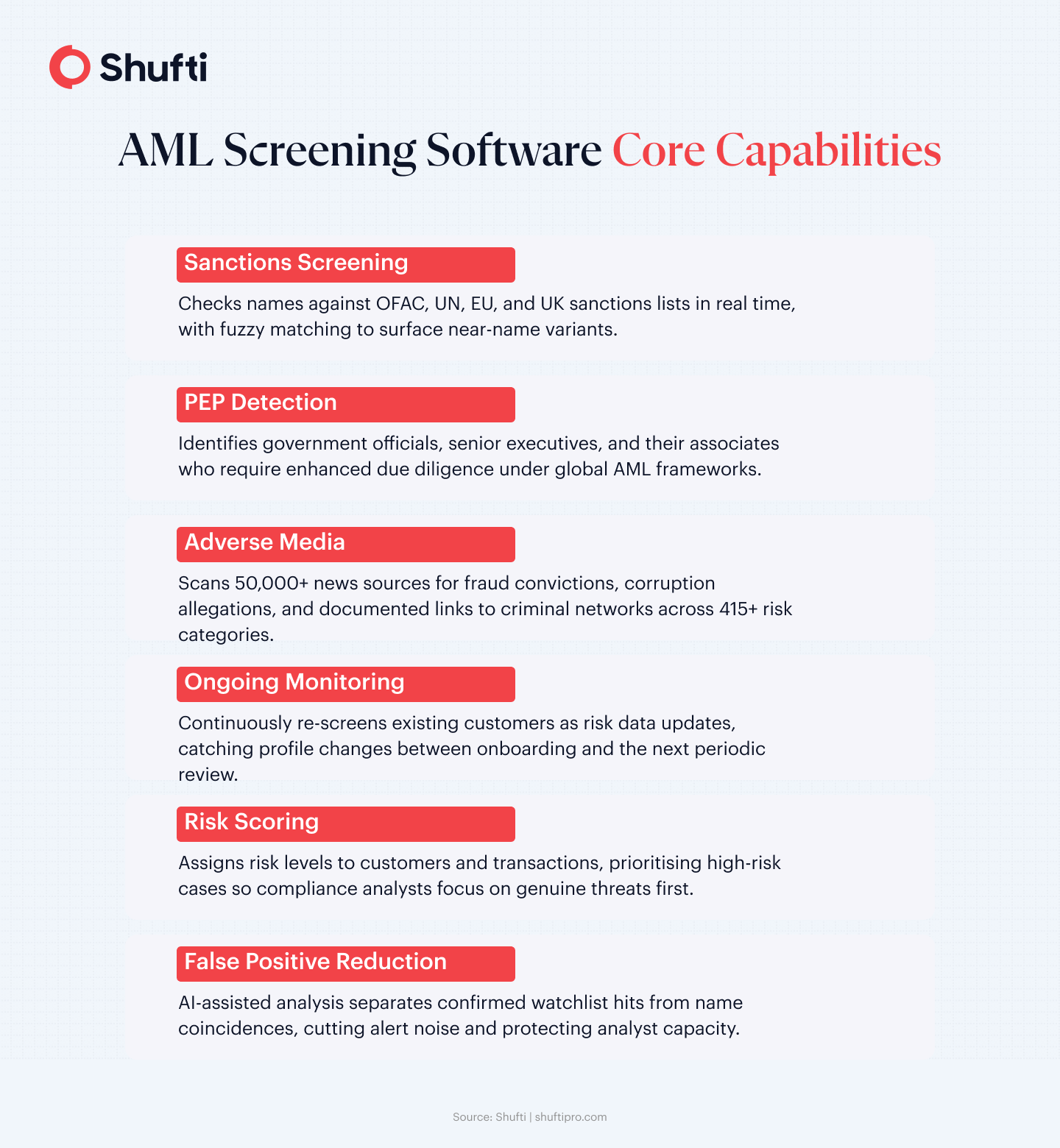
A complete AML software solution covers several distinct screening functions, not just a single check against one list. Here is what compliance teams should expect from a production-grade platform.
Sanctions and watchlist screening
Sanctions and watchlist screening checks customer and transaction data against lists maintained by OFAC, the UN Security Council, the EU, the UK’s OFSI, and dozens of national-level regulators. A confirmed match triggers a review alert. A near-match (where a name is spelled differently or transliterated from another script) requires fuzzy matching logic to surface without generating a flood of false positives that overwhelm analyst capacity.
PEP screening
PEP screening identifies whether a customer holds a position of public trust: a government official, a senior executive at a state-owned enterprise, or a senior judicial figure, along with their immediate family members and close associates. PEPs are not automatically prohibited from banking relationships, but they require enhanced due diligence under most AML frameworks globally.
| Capability | What it does |
| Sanctions and watchlist screening | Checks data against OFAC, UN, EU, OFSI lists with fuzzy matching |
| PEP screening | Flags public-trust holders, family, and associates for enhanced due diligence |
| Adverse media screening | Scans news and records for fraud, corruption, criminal links |
| Ongoing monitoring | Continuously re-screens existing customers as risk profiles change |
Adverse media screening
Adverse media screening scans news sources and public records for negative coverage associated with a customer or entity: fraud convictions, corruption allegations, or documented links to criminal networks. A platform covering tens of thousands of news sources across multiple languages gives compliance teams the kind of context that sanctions lists alone cannot provide, particularly for customers who are not yet on a formal list but whose public record raises legitimate concerns.
Ongoing monitoring
Ongoing monitoring is what separates a point-in-time check at onboarding from an operational AML program. Risk profiles change after a relationship opens. A customer who was clean at onboarding may appear on a watchlist six months later. Continuous screening catches those changes rather than waiting until the next scheduled periodic review.
How AML Software Works When It Flags a Suspicious Activity?
When AML software identifies a potential match, it does not immediately freeze an account or block a transaction. The technology routes the case to a review queue where a compliance analyst assesses it.
The analyst works through three questions: Is the match genuine (a confirmed sanctions hit versus a name coincidence)? What does the customer’s transaction history show in context? Does the pattern meet the threshold for filing a Suspicious Activity Report (SAR) with the relevant regulator?
This workflow (screen, alert, review, file) is what regulators look for when auditing a bank’s AML program. The software must produce a clear audit trail: who reviewed the case, what decision was made, and on what basis. Without that documentation, even a technically solid screening system can fail a regulatory examination because examiners cannot assess whether controls were actually applied.
Reducing false positives is where technology selection has the most direct impact on team capacity. Legacy rule-based systems flag large volumes of transactions, many of which turn out to be low-risk, tying up analyst time on noise rather than genuine suspicious activity. AI-assisted platforms apply risk scoring and contextual analysis to filter down to cases that actually warrant attention, which makes a measurable difference in how compliance teams allocate their resources.
Regulatory Requirements That Make AML Software Non-Negotiable for Banks
Banks operate under multiple overlapping AML frameworks. The FATF’s 40 Recommendations set the international baseline, requiring risk-based customer due diligence, ongoing monitoring, and SAR filing across all member jurisdictions. In the United States, the Bank Secrecy Act mandates documented AML programs at all federally regulated financial institutions. European banks must comply with successive EU AML Directives, with requirements continuing to expand under the EU’s new Anti-Money Laundering Authority (AMLA).
Compliance teams cannot satisfy these frameworks manually at scale. AML software is not supplementary infrastructure. It is the primary mechanism through which a bank demonstrates that its controls are functioning, consistently applied, and documented to a standard that holds up under examination.
For banks operating across multiple jurisdictions, the compliance burden compounds further. Each regulator expects evidence that screening is happening in real time, that false positives are being managed, and that the institution’s risk appetite is reflected in how the software is configured. A generic, unconfigured solution that treats all customers the same does not satisfy a risk-based approach requirement.
How Shufti Supports Bank AML Compliance
Shufti’s AML Screening platform gives banks access to 100,000+ AML data sources, 3,500+ global watchlists, and 2.6 million PEP profiles spanning 215+ sanction regimes. Adverse media coverage extends to 50,000+ news sources across 415+ risk categories, with data updated every 15 minutes, so compliance teams are working from current information rather than a snapshot from the previous day.
The platform connects KYC identity checks, AML screening, and KYB corporate verification through a single API, removing the integration complexity that comes with running separate vendors for each compliance layer. For banks managing high onboarding volumes, configurable workflows allow risk rules to be tuned to specific customer segments or jurisdictions rather than applying a generic cascade across the entire customer book.
For further reading on how these requirements translate into daily operations, the AML Compliance overview, guide to AML screening, and guide to sanctions compliance cover specific use cases in more detail. For teams with a dedicated focus on politically exposed persons, this PEP screening guide is a useful companion read.
Frequently Asked Questions
What is AML screening software?
Technology that automatically checks customers and transactions against sanctions lists, PEP databases, and watchlists to identify financial crime risks at onboarding and during ongoing monitoring.
How do banks use AML tools to prevent money laundering?
Banks run real-time screening during customer onboarding and across ongoing transactions, route flagged cases to compliance analysts for review, and file Suspicious Activity Reports with regulators when suspicious activity is confirmed.
Is AML screening mandatory for banks?
Yes. Banks globally must comply with the FATF's 40 Recommendations, the Bank Secrecy Act in the US, and EU AML Directives, all of which require documented, functioning screening programs.
How does AML software reduce false positives?
Modern platforms apply AI-assisted risk scoring and fuzzy name matching to distinguish confirmed watchlist hits from coincidental name similarities, reducing the volume of low-risk alerts that consume analyst time.
What happens when AML software flags a suspicious transaction?
The flagged case enters a compliance review queue where an analyst assesses whether the match is genuine, reviews transaction context, and determines whether to file a suspicious activity report with the relevant regulator.