AMLR Solutions
  AMLR Consultation
 EUDI Wallet
 Onboarding
 Ongoing Monitoring
 FRAML
FRAML KYC
KYC KYB
KYB KYI
KYI Age Assurance
 Workforce IAM
 Candidate Verification
 Account Takeover
 Bonus/ Promotion Abuse
 Chargeback Fraud
 Deepfake
 Document Fraud
 Fraud Networks
 Impersonation Fraud
 Money Mule Activity
 Multi-Accounting
 Party Fraud
 Regulatory & Compliance Risks
 Synthetic Identity Fraud
 Adult Content
 Banking
 Crypto
 Fintech
 Forex
Forex Compliance
 Fraud prevention
 Trust & safety
 Global expansion
 Compliance Officers
 Developers
 Fraud Analysts
 Product Managers
 Journey Builder
  Global Trust Platform
 Customer Profiles
 Vendor Comparison
 IDV Case Management
 AML Case Management
 Regulatory Reporting
 Agentic Rule Builder
  AI Compliance Co-Pilot
  Fraud Analytics
 Fraud Hub
  OCR
OCR Shufti AI
 Bank Account Verification
  Biometric Duplication
 Database Checks
 Document Intelligence
 Government ID
 Mobile Driver's License
 NFC
NFC Selfie Liveness
 Brand Personalisation
 Deployment Options
 Identity Methods
 IDV Modes
 Multi-tenancy
 On-Premise IDV
 Secure Capture
 Shufti MCP

















Screening the UN consolidated list is not enough. The US (OFAC), EU, UK (OFSI), Canada, and Australia each maintain independent autonomous sanctions programmes, and a counterparty clean on the UN list can still appear on any of these.
TL;DR
- Autonomous sanctions are restrictive measures imposed without UN Security Council authorisation.
- UN sanctions consensus hit an all-time low of 1.25% in March 2025.
- The US, EU, UK, Canada, and Australia account for most autonomous designations.
- Russia faced more than 16,000 individual measures from these five jurisdictions by 2025.
- Lists update as events require, so screening must run continuously, not just at onboarding.
UN sanctions consensus reached an all-time low of 1.25% in March 2025, a clear signal that major economies are choosing to act without waiting for a multilateral agreement. When the Security Council cannot align, countries move alone, and the compliance burden lands on every regulated business caught in the middle.
Autonomous sanctions are restrictive measures that a country or regional bloc imposes independently, without authorisation from the United Nations Security Council (UNSC). They can target individuals, entities, vessels, or entire sectors and are shaped entirely by the issuing jurisdiction’s foreign policy objectives rather than by international consensus.
The United States, Australia, the UK and many other EU member states are the most common jurisdictions to impose autonomous sanctions in order to advance their foreign policy motives. Their combined financial reach means most regulated businesses already carry an obligation to screen against autonomous regimes, whether or not they have mapped that obligation explicitly.
What are autonomous sanctions?
Autonomous sanctions are unilateral or regionally agreed restrictive measures applied outside the UN sanctions framework. When a government designates a person, entity, vessel, or sector, it publishes that designation on its official autonomous sanctions list. Any person or company subject to the issuing jurisdiction’s laws is then prohibited from providing funds, assets, or services to the designated target. The practical compliance implication is real. A counterparty that clears the UN consolidated list can still be designated under a country’s autonomous list, and vice versa. Screening against one list while ignoring the other is not a defensible position, and most financial regulators now make that expectation explicit.
How autonomous sanctions lists work
Each regime maintains its own designation and delisting process, operating on its own timeline and governed by its own legal framework. In the year 2025, there was an increase of 701 individuals in the EU sanctions list. That growth is driven almost entirely by autonomous designations, not by new UNSC resolutions. A sanctions screening programme built on a single consolidated feed will miss regime-specific designations unless the underlying data aggregates across all active autonomous regimes.
Why do countries use autonomous sanctions instead of UN sanctions?
Countries use autonomous sanctions when the UNSC cannot reach consensus, or when a government needs to respond faster than the multilateral process allows. Both conditions arise regularly, and neither is likely to ease given the current geopolitical trajectory. The preference for autonomous action is not a recent development, but the pace at which countries are exercising that option has accelerated sharply.
The Security Council’s veto structure means any one of the five permanent members can block a sanctions resolution. When geopolitical alignment collapses, that veto is exercised. The Russia-Ukraine conflict illustrated this most clearly. Russia’s permanent UNSC seat made coordinated UN sanctions unachievable, so the US, EU, UK, Canada, and Australia responded with autonomous measures instead. By 2025, Russia had become subject to more than 16,000 individual sanctions measures from those five jurisdictions.
Speed is the second driver. A government can designate a target within days of a triggering event. A UNSC resolution requires rounds of diplomatic negotiation, typically measured in weeks. For counterterrorism and human rights cases, that gap is operationally material, and autonomous regimes exist precisely to close it.
Which jurisdictions impose the most autonomous sanctions?
The US, EU, UK, Canada, and Australia account for the overwhelming majority of autonomous sanctions designations globally. Each operates through a distinct legal and administrative structure, and each maintains its own list independently, which means a business with customers or counterparties in multiple jurisdictions faces several simultaneous autonomous regimes, not one.
| Jurisdiction | Framework/administrator |
| US | OFAC, running over 30 sanctions programmes |
| EU | Council regulations, coordinated by the EEAS |
| UK | Sanctions and Anti-Money Laundering Act 2018; 4,733 designations end-2024 |
| Australia | Autonomous Sanctions Act 2011, enforced by the ASO within DFAT |
The US administers its programme through the Office of Foreign Assets Control (OFAC), which runs over 30 sanctions programmes covering country-based and list-based restrictions. The EU issues autonomous sanctions through Council regulations, with the European External Action Service coordinating implementation across member states. The UK operates its own framework under the Sanctions and Anti-Money Laundering Act 2018, following its departure from EU frameworks post-Brexit. At the end of 2024, the UK’s consolidated list held 4,733 designations across individuals, entities, and vessels (OFSI Annual Review 2024–2025).
Japan, South Korea, Switzerland, Singapore, and New Zealand have also developed autonomous programmes, many of them accelerated by the Russia-Ukraine conflict. Each adds a jurisdiction-specific list that a global compliance programme must account for separately.
Who enforces Australia’s Autonomous Sanctions Act?
Two statutes underpin Australia’s autonomous sanctions framework. The Autonomous Sanctions Act 2011 (Cth) establishes the designation power, and the Autonomous Sanctions Regulations 2011 govern how those powers are applied in practice. The Australian Sanctions Office (ASO), operating within the Department of Foreign Affairs and Trade (DFAT), is the primary regulator. Under the Act, the Minister for Foreign Affairs designates individuals and entities. The ASO has published and maintained Australia’s Consolidated List since the Act came into force in 2012. Australia’s enforcement model relies solely on criminal penalties. A maximum sentence of 10 years’ imprisonment applies to individuals who breach sanctions obligations. There is no civil penalty track, unlike the US and UK regimes that combine civil and criminal enforcement, which shapes how Australian compliance teams structure their internal controls.
How often are autonomous sanctions reviewed and updated?
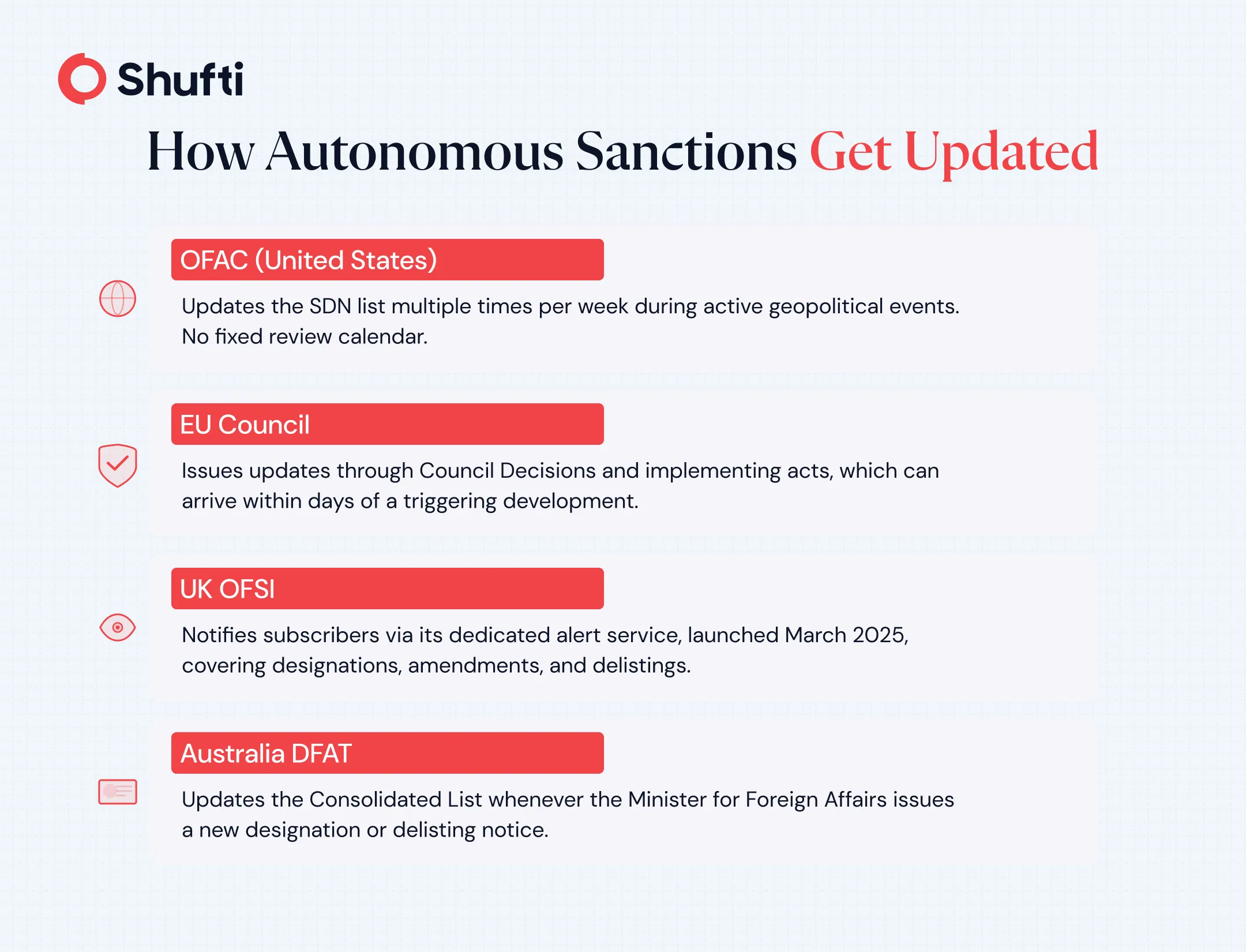
Autonomous sanctions lists are updated as events require, not on a fixed calendar, and that unpredictability is itself a compliance risk that point-in-time screening cannot absorb. The gap between when a designation is published and when a business’s screening system reflects it is where exposure accumulates.
OFAC publishes changes to its Specially Designated Nationals (SDN) list multiple times per week during active geopolitical events. The EU revises its sanctions regulations through Council Decisions and implementing acts, which can arrive within days of a triggering development. The UK launched a dedicated sanctions alert service in March 2025, notifying subscribers of new designation packages, legislative amendments, and delistings in near real time.
Australia’s Consolidated List updates whenever DFAT issues a new designation or delisting notice. A customer who was clean at onboarding can appear on a revised autonomous sanctions list within the same business week. Screening programmes that run only at account opening carry a structural gap that most financial regulators now treat as insufficient for high-risk customer categories.
A solid understanding of how global AML sanction lists are structured across different regimes, combined with clarity on which watchlists your business is obligated to cover, is foundational to building a programme that holds up to regulatory scrutiny.
How Shufti helps compliance teams screen autonomous sanctions regimes
Screening across multiple autonomous sanctions regimes creates a data problem and a matching problem at the same time. A raw feed from each regime still leaves compliance analysts reconciling transliterated names, partial entity records, and designation dates that differ across jurisdictions. The volume of updates across OFAC, EU, UK, Australian, and secondary regimes is too high for manual reconciliation to stay current.
Shufti’s sanctions screening covers 215+ global sanctions regimes, including OFAC SDN, UN Security Council, EU Consolidated, UK HMT and OFSI, Canada OSFI, and Australia DFAT. Data refreshes every 15 minutes, so a mid-week OFAC update reaches your screening stack the same day the designation is published. Name matching runs across 80+ languages with transliteration support, which matters when screening entities originally designated in Cyrillic, Arabic, or Mandarin against Latin-script customer records.
For businesses that must also screen corporate entities as well as individuals, Shufti’s business AML screening extends the same multi-regime coverage to legal entity records, ownership structures, and ultimate beneficial owner (UBO) profiles. A single audit trail replaces the manually reconciled output of separate feeds from different data providers. Knowing what effective sanctions screening looks like in practice helps identify where a single-feed or point-in-time approach leaves gaps before a regulator does.
Screening across autonomous sanctions regimes without consolidated data and continuous updates creates gaps in compliance programmes that surface during audits. Shufti’s AML screening covers 215+ sanctions regimes through a single API that refreshes every 15 minutes, with transliteration-aware name matching to keep false positives manageable. Book a demo to see how the coverage maps to the specific autonomous regimes your business is obligated to screen.
Frequently Asked Questions
Why do countries use autonomous sanctions instead of UN sanctions?
Countries use autonomous sanctions when the UN Security Council cannot reach consensus, most often because a permanent member exercises its veto. Autonomous regimes also allow faster action. A government can designate a target within days, while a UNSC resolution typically takes weeks of negotiation. Both limitations make autonomous sanctions the practical tool in most active geopolitical disputes.
Which countries impose the most autonomous sanctions?
The US, EU, UK, Canada, and Australia maintain the most extensive autonomous sanctions programmes. The US operates through OFAC, the EU through Council regulations, and the UK through its Sanctions and Anti-Money Laundering Act 2018. Russia was subject to more than 16,000 individual measures from these five jurisdictions by 2025, making it the most heavily sanctioned country in the world at that point.
How often are autonomous sanctions reviewed?
Autonomous sanctions lists are updated as events require, with no fixed review schedule. OFAC publishes changes to its Specially Designated Nationals list multiple times per week during active geopolitical events. The EU updates through Council Decisions, the UK through a real-time alert service launched in March 2025, and Australia through DFAT designation notices. Businesses must screen on a continuous basis, not only at customer onboarding.
Who enforces the Autonomous Sanctions Act?
The Autonomous Sanctions Act 2011 (Cth) is enforced by the Australian Sanctions Office (ASO), a division of Australia's Department of Foreign Affairs and Trade (DFAT). The ASO publishes the Consolidated List and monitors compliance. Breaches are prosecuted as criminal offences.