AMLR Solutions
 AMLR Consultation
 Onboarding
 Ongoing Monitoring
 FRAML
FRAML KYC
KYC KYB
KYB KYI
KYI Age Assurance
 Workforce IAM
 Candidate Verification
 Account Takeover
 Bonus/ Promotion Abuse
 Chargeback Fraud
 Deepfake
 Document Fraud
 Fraud Networks
 Impersonation Fraud
 Money Mule Activity
 Multi-Accounting
 Party Fraud
 Regulatory & Compliance Risks
 Synthetic Identity Fraud
 Adult Content
 Banking
 Crypto
 Fintech
 Forex
Forex Compliance
 Fraud prevention
 Trust & safety
 Global expansion
 Compliance Officers
 Developers
 Fraud Analysts
 Product Managers
 Advanced Journey Builder (AJB)
 Global Trust Platform
 Customer Profiles
 Vendor Comparison
 IDV Case Management
 AML Case Management
 Regulatory Reporting
 Travel Rule Protocols
 Agentic Rule Builder
 AI Compliance Co-Pilot
 Fraud Analytics
 Fraud Hub
 OCR
OCR Shufti AI
 Bank Account Verification
 Biometric Duplication
 Database Checks
 Document Intelligence
 Government ID
 Mobile Driver's License
 NFC
NFC Selfie Liveness
 Brand Personalisation
 Deployment Options
 Identity Methods
 IDV Modes
 Multi-tenancy
 On-Premise IDV
 Secure Capture











Key takeaways:
- Spain recorded an estimated EUR 7.4 billion in scam losses in 2024, raising the compliance stakes for any business that onboards customers digitally
- SEPBLAC mandates customer due diligence for banks, crypto providers, real estate firms, and other obliged entities under Law 10/2010
- Royal Decree 255/2025 accelerates Spain’s digital DNI rollout, changing what electronic verification systems must support in the near term
- MiCA brought virtual asset service providers in Spain under KYC standards aligned with traditional financial institutions from December 2024
- Remote onboarding is permitted by SEPBLAC provided the platform meets its technical approval requirements
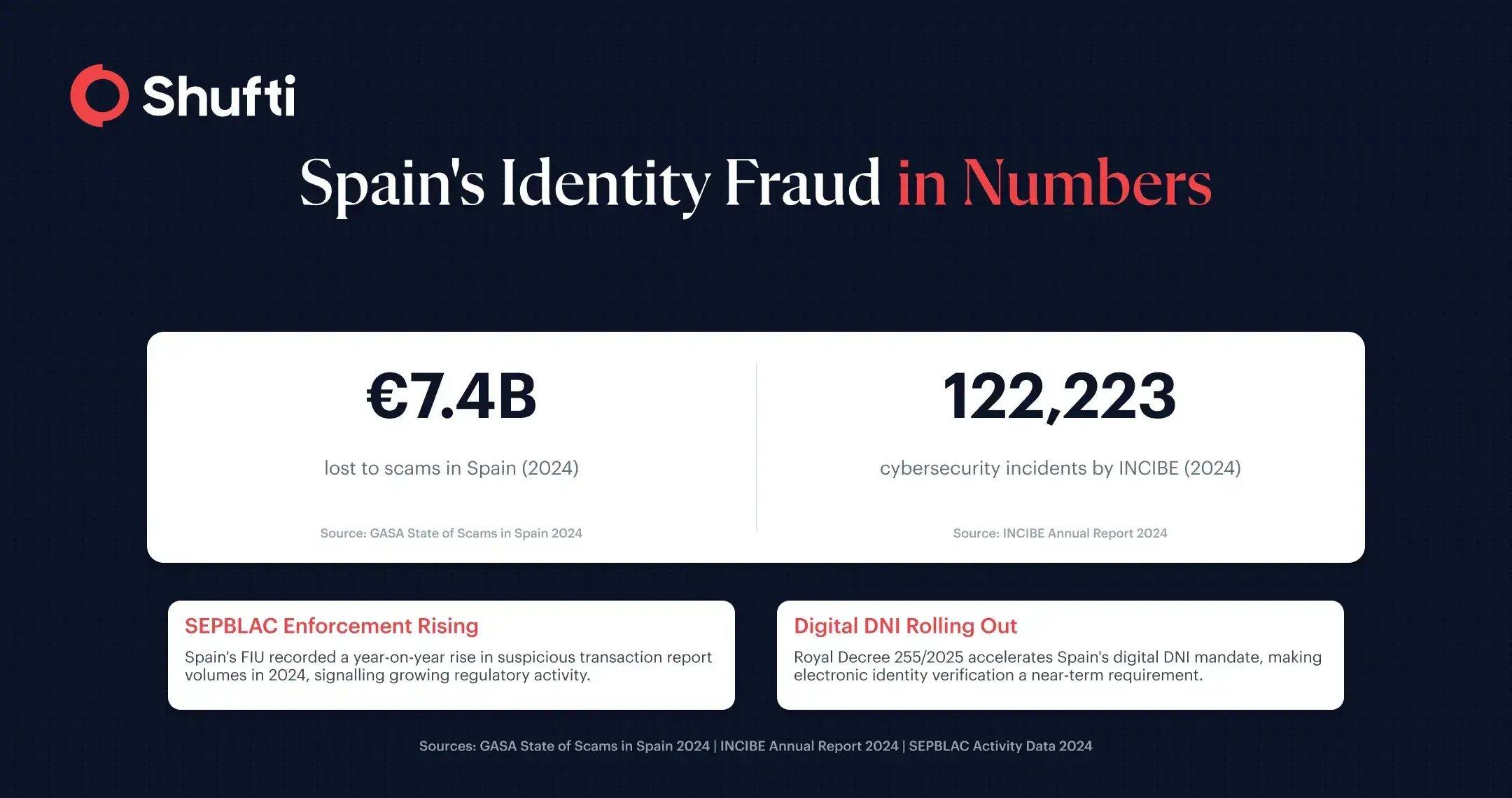
Spain’s digital economy is growing faster than its fraud defenses can keep up. In 2024, scammers stole an estimated EUR 7.4 billion from Spanish consumers. The Global Anti-Scam Alliance found that one in six people in Spain was targeted in a single year. Over the same period, Spain’s national cybersecurity institute, the Instituto Nacional de Ciberseguridad , recorded 122,223 cybersecurity incidents, many of them linked to identity fraud.
For businesses operating in Spain, those numbers translate directly into compliance exposure. The Servicio Ejecutivo de la Comisión de Prevención del Blanqueo de Capitales e Infracciones Monetarias (SEPBLAC) has raised its enforcement activity, and fines for inadequate customer due diligence have reached eight figures. This guide covers what identity verification in Spain actually demands under Law 10/2010, as interpreted by SEPBLAC, and given the current fraud environment.
Identity verification in Spain is the process by which businesses confirm that a customer is who they claim to be, using government-issued documents, biometric checks, or database cross-references. Spanish law, primarily Law 10/2010 on the Prevention of Money Laundering and Terrorist Financing, makes this process mandatory for banks, fintech firms, real estate agents, and other regulated sectors.
What SEPBLAC requires for identity verification in Spain
SEPBLAC, Spain’s financial intelligence unit (FIU) and anti-money laundering (AML) supervisor, operates under Law 10/2010 and its implementing Royal Decree 304/2014. Since 2020, remote digital onboarding has been permitted, but it must meet technical standards that SEPBLAC reviews and approves. SEPBLAC’s 2024 activity data shows a year-on-year rise in suspicious transaction report (STR) analysis, signalling that the regulator is working through a growing volume of compliance alerts from obliged entities.
Standard customer due diligence
For most customer relationships, SEPBLAC’s due diligence framework requires collecting and verifying a full legal name, date of birth, and address, alongside a copy of a valid government-issued document. For Spanish nationals, the Documento Nacional de Identidad (DNI) is the primary identifier. Foreign residents typically present a Tarjeta de Identidad de Extranjero (TIE) or a valid passport. Royal Decree 255/2025, enacted in March 2025, accelerates the rollout of Spain’s digital DNI, making electronic ID verification in Spain a near-term compliance requirement rather than a future planning item.
KYC verification in Spain follows a risk-based approach. The more complex or higher-value the customer relationship, the more evidence an obliged entity must gather. Standard due diligence covers identity authentication in Spain for most retail customers and satisfies the minimum requirements set out in Law 10/2010.
Enhanced due diligence for high-risk customers
When a customer is classified as high-risk, such as politically exposed persons (PEPs), non-resident relationships, those in cash-intensive sectors, or customers from higher-risk jurisdictions, SEPBLAC requires enhanced due diligence (EDD). EDD demands senior management approval, more detailed source-of-funds verification, and more frequent review cycles. Identity authentication in Spain at the EDD level typically means layering biometric confirmation on top of document review, so the person presenting the document is demonstrably the person named on it.
How the identity verification process works in Spain?
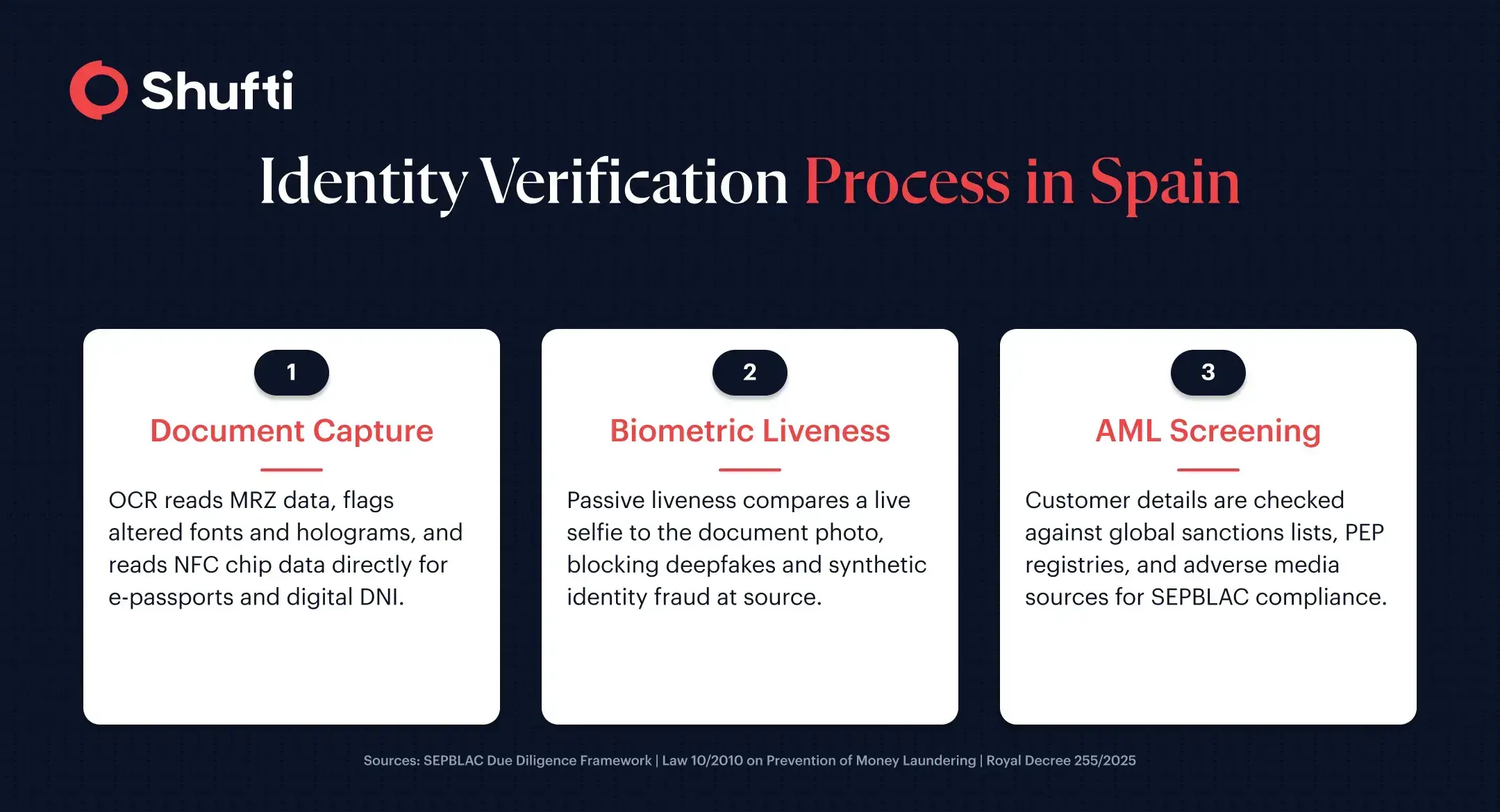
The identity verification process in Spain runs in three sequential stages for remote onboarding. Each stage adds a layer of assurance, and together they satisfy SEPBLAC’s technical requirements for digital customer acceptance.
Document capture and validation
A customer submits a scan or live photo of their DNI, TIE, or passport. Optical character recognition (OCR) extracts machine-readable zone (MRZ) data from the document, and the system compares those values against the visual inspection zones for internal consistency. The document is cross-checked against known fraud indicators, including altered fonts, mismatched holograms, and inconsistent security features. For documents with embedded chips, NFC verification reads chip data directly from the source, bypassing the image layer entirely. AI identity verification in Spain has made this stage considerably faster. Modern models flag document anomalies in milliseconds, catching forgeries that manual reviewers would miss at the volumes Spanish financial institutions process daily.
Biometric liveness detection
Once a document is validated, a biometric check confirms the person presenting it is the same individual pictured on it. A selfie or short video is captured and compared against the document photograph using facial recognition. Online identity verification in Spain increasingly depends on passive liveness detection, which analyses natural movement to confirm the user is physically present rather than presenting a still photograph or pre-recorded video. This step defends against deepfake-based attacks and synthetic identities, both of which Spanish investigators have flagged as growing fraud vectors in recent years.
Database cross-reference and screening
With document and biometric checks complete, the customer’s details are run against AML databases covering global sanctions lists, PEP registries, and adverse media sources. In Spain, this stage must also account for domestic sanction obligations and SEPBLAC’s reporting requirements. AML screening at this stage feeds directly into the suspicious transaction reporting obligations that SEPBLAC monitors. Results return to the compliance team within seconds, while the customer continues through the onboarding flow.
Which industries rely most on identity verification in Spain
Banking and financial services
Banks and neobanks operating in Spain are primary obliged entities under Law 10/2010. Know your customer (KYC) checks are mandatory at account opening, and periodic re-verification applies when a customer’s risk profile changes. The regulatory stakes are concrete. SEPBLAC fined CaixaBank €30 million for anti-money laundering failures related to a high-value real estate transaction. That enforcement action illustrated what inadequate due diligence actually costs in the Spanish market.
Crypto and virtual asset service providers
Spain transposed the Fifth Anti-Money Laundering Directive (5AMLD) requirements for virtual asset service providers (VASPs) into national law, and the Markets in Crypto-Assets Regulation (MiCA) applied across the European Union from December 2024. Spanish VASPs must register with the Banco de España and complete identity verification at a standard equivalent to traditional financial institutions. KYC verification in Spain for crypto businesses now mirrors banking requirements, with no carve-outs for decentralised platforms.
Online gambling and gaming
The Dirección General de Ordenación del Juego (DGOJ), Spain’s national gambling regulator, requires licensed operators to verify player identity before accepting the first deposit. Age verification and source-of-funds checks are mandatory at registration. ID verification solutions in Spain for gaming must combine document authentication, biometric liveness, and database checks. The DGOJ expects evidence these controls run consistently, not that they are logged as exceptions.
Real estate and professional services
Notaries, lawyers, accountants, and estate agents are all obliged entities under SEPBLAC’s framework. The sector carries elevated money laundering risk, as high-value property transactions are a recognised vehicle for layering illicit funds. Spanish digital ID verification for real estate has moved from paper-based workflows to digital processes, and regulators expect document authenticity checks rather than photocopies. The CaixaBank fine referenced above arose from exactly this context, making Spain’s property sector an active area of SEPBLAC scrutiny.
How Shufti helps Spanish businesses verify customer identities online
Compliance teams building onboarding flows in Spain typically face three simultaneous pressures. Document fraud is rising. Regulators expect biometric assurance. And customers abandon flows that take too long.
Shufti addresses that tension by combining document verification with biometric liveness detection in a single pass. The document capture stage handles DNI, TIE, passport, and NFC chip-enabled documents. The biometric layer uses passive liveness, so customers do not have to perform gestures or navigate additional steps. Digital identity verification in Spain can complete in under fifteen seconds this way, rather than the minutes a manual review queue takes.
For AML obligations, Shufti’s screening covers 100,000+ data sources and 3,500+ global watchlists, returning a result the compliance team can attach directly to the customer’s audit record for SEPBLAC review. Verify customers across Spain and 240+ countries from a single platform Request a demo.
Frequently Asked Questions
What documents does SEPBLAC accept for identity verification in Spain?
SEPBLAC accepts the Documento Nacional de Identidad (DNI) for Spanish nationals and the Tarjeta de Identidad de Extranjero (TIE) or a valid passport for foreign residents. Digital and NFC chip-enabled versions of these documents are accepted for remote verification when the platform meets SEPBLAC's technical approval requirements.
Is remote identity verification in Spain legal?
Yes. SEPBLAC has permitted remote identity verification in Spain since 2020, and businesses can verify identity online in Spain provided the platform meets the regulator's technical approval standards. Approved methods must include document authenticity checks and biometric confirmation.
What penalties apply for non-compliance with identity verification rules in Spain?
Fines vary by severity and entity type under Law 10/2010. Serious infringements can reach millions of euros. SEPBLAC's action against CaixaBank, resulting in a €30 million fine, illustrates the scale of enforcement the regulator is prepared to apply.
How does AI identity verification work for businesses in Spain?
AI identity verification Spain platforms use optical character recognition to extract document data, machine learning models to detect forgery indicators, and neural networks for biometric face matching. These systems process checks in seconds, surface anomalies human reviewers would miss at volume, and generate an audit log for regulatory submission.
Does MiCA change identity verification requirements for crypto businesses in Spain?
Yes. MiCA aligned virtual asset service providers with bank-grade AML obligations from December 2024. Spanish VASPs must now complete KYC verification in Spain to the same standard as financial institutions, covering document authentication, biometric liveness, and AML database screening throughout the customer lifecycle.