AMLR Solutions
  AMLR Consultation
 EUDI Wallet
 Onboarding
 Ongoing Monitoring
 FRAML
FRAML KYC
KYC KYB
KYB KYI
KYI Age Assurance
 Workforce IAM
 Candidate Verification
 Account Takeover
 Bonus/ Promotion Abuse
 Chargeback Fraud
 Deepfake
 Document Fraud
 Fraud Networks
 Impersonation Fraud
 Money Mule Activity
 Multi-Accounting
 Party Fraud
 Regulatory & Compliance Risks
 Synthetic Identity Fraud
 Adult Content
 Banking
 Crypto
 Fintech
 Forex
Forex Compliance
 Fraud prevention
 Trust & safety
 Global expansion
 Compliance Officers
 Developers
 Fraud Analysts
 Product Managers
 Advanced Journey Builder
  Global Trust Platform
 Customer Profiles
 Vendor Comparison
 IDV Case Management
 AML Case Management
 Regulatory Reporting
 Agentic Rule Builder
  AI Compliance Co-Pilot
  Fraud Analytics
 Fraud Hub
  OCR
OCR Shufti AI
 Bank Account Verification
  Biometric Duplication
 Database Checks
 Document Intelligence
 Government ID
 Mobile Driver's License
 NFC
NFC Selfie Liveness
 Brand Personalisation
 Deployment Options
 Identity Methods
 IDV Modes
 Multi-tenancy
 On-Premise IDV
 Secure Capture
 Shufti MCP









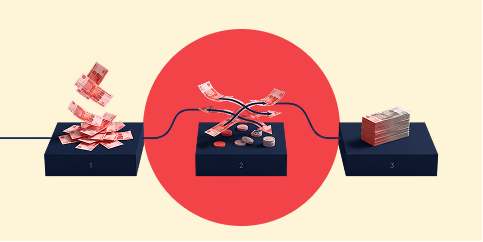
Money laundering moves through 3 stages: placement, layering and integration. Placement puts illicit cash into the financial system, layering hides where it came from through layers of transactions, and integration returns the money to the criminal, looking legitimate. Defined by the Financial Action Task Force (FATF), this three-stage cycle is the framework compliance teams use to detect and disrupt financial crime.
The scale is significant. The United Nations Office on Drugs and Crime (UNODC) estimates that 2 to 5 per cent of global GDP, between US$800 billion and US$2 trillion, is laundered every year. In most countries, money laundering is a serious offence. In the United States, for example, it can carry up to 20 years in prison and fines of up to US$500,000 or twice the value of the property involved.
Money laundering usually relies on complex shareholding structures and offshore accounts, and it exploits weaknesses in financial institutions: a lack of in-house KYC and AML controls, non-compliance with regulations, and manual transaction monitoring. This guide breaks down placement, layering and integration, the techniques criminals use at each stage, the red flags that expose them, and how Shufti’s AML checks detect activity across the full cycle.
What you’ll Learn:
|
What is money laundering?
Money laundering is the process of taking funds generated by criminal activity and making them appear to come from a legitimate source. The illicit earnings are reintroduced into the financial system for the criminal’s benefit through 3 stages: placement, layering and integration. Because the activity is layered and deliberately obscured, determining the true scope of a money laundering case is often difficult.
Money laundering is frequently linked to terrorism financing and other organised crime, so global authorities such as the Financial Action Task Force (FATF), the Financial Conduct Authority (FCA), the Hong Kong Monetary Authority (HKMA) and the Australian Transaction Reports and Analysis Centre (AUSTRAC) are concerned with both the source and the destination of funds. For this reason, AML compliance requirements evolve continually to limit the risk and keep criminals at bay.
What are the three stages of money laundering?
The three stages of money laundering are placement, layering and integration. Placement introduces illicit cash into the financial system, layering disguises its origin through complex transactions, and integration returns the funds to the criminal as seemingly legitimate wealth. This model, defined by FATF, is the standard framework AML teams use worldwide.
| Stage | What happens | Common techniques | Red flags | How AML checks detect it |
| 1. Placement | Illicit cash is introduced into the financial system. | Smurfing (structuring), cash-intensive businesses, cash smuggling, foreign exchange. | Frequent sub-threshold deposits, unexplained cash, third-party deposits. | Customer due diligence (CDD), cash-deposit monitoring, threshold alerts. |
| 2. Layering | The origin of the funds is disguised through complex transactions. | Cross-border wires, shell companies, asset trading, crypto chain-hopping. | Rapid movement between accounts, no economic purpose, high-risk jurisdictions. | Transaction monitoring, sanctions and PEP screening, network analysis. |
| 3. Integration | Laundered funds re-enter the economy as legitimate wealth. | Property and business investment, luxury goods, and false invoicing. | Wealth inconsistent with profile, opaque ownership, over- or under-invoicing. | Enhanced due diligence (EDD), source-of-funds checks, and ongoing monitoring. |
Stage 1: Placement
Placement is the first stage in money laundering, where illicitly earned funds are introduced into the legitimate financial system. The aim is to filter dirty money into the legal framework, so the original source can be disguised. This is often done by turning large amounts into small sums, which is harder to detect and can slip below a financial firm’s threshold checks. Money may be deposited into a bank account, used to buy financial instruments, or pushed through cash-intensive businesses such as casinos, real estate and gaming platforms, where the source of funds is easy to hide.
Common placement techniques include:
- Disguised deposits: breaking a sum into small portions and depositing them across single or multiple accounts over a short period, then transferring the funds into the criminal’s own accounts.
- Blending of funds: mixing illicit gains with legitimate income through cash-flowing businesses, so institutions cannot tell the difference.
- Cash smuggling: physically moving funds across borders, then funnelling them into foreign financial systems and back to previously held accounts.
- Foreign exchange: buying or trading foreign currencies with dirty money, usually in jurisdictions with weak financial regulations.
- Using financial instruments: buying travellers’ cheques, money orders and bonds with illicit funds, then cashing them back into other accounts to add a layer of financial history.
Stage 2: Layering
Layering is the second and most complex stage in money laundering, where criminals move funds through multiple transactions and accounts to obscure the origin of illicit earnings. The aim is to make it difficult for banks or regulators to establish where the money came from, so that by the end, the funds carry an apparently legitimate history. Shufti detects layering by monitoring transaction patterns in real time and screening counterparties against sanctions, PEP and adverse media lists.
Common layering techniques include:
- Cross-border wire transfers through multiple banks and jurisdictions.
- Shell and front companies that hold and move funds with no genuine trading activity.
- Buying and reselling assets such as securities, property and online assets.
- Crypto chain hopping and mixing services that swap funds between currencies and wallets.
- Trade-based laundering through over- and under-invoicing of goods.
Placement versus Layering: The Key Difference
Placement and layering are often confused. Placement is the act of getting illicit cash into the financial system. Layering is everything that happens next to disguise where that money came from. Placement deals with raw cash and physical exposure; layering deals with digital movement and complexity. A single deposit can be placement; a hundred transfers across five countries afterwards is layering.
Stage 3: Integration
Integration is the final stage in money laundering, where the cleaned funds re-enter the economy as apparently legitimate income. After passing through placement and layering, the money is moved back into the launderer’s accounts or invested in assets and businesses, so it can be spent without arousing suspicion. By this point, the funds have been distanced from their origin, so detection shifts from transaction patterns to the bigger picture: does this customer’s wealth match what is known about them? Shufti supports integration stage detection through enhanced due diligence (EDD) and source of funds verification.
Common integration techniques include:
- Buying property, then selling it to receive “clean” proceeds.
- Investing in or acquiring legitimate businesses.
- Purchasing luxury goods, vehicles and other high-value assets.
- False invoicing and loan-back schemes that disguise funds as earnings or repayments.
Is there a 4th stage of money laundering?
The classic model has three stages: placement, layering and integration. Some frameworks add a fourth element, usually the predicate offence that generates the illicit funds. Regulators, including FATF, treat money laundering as a three-stage cycle, so the fourth stage is best understood as added context rather than a separate regulatory definition.
Common money laundering techniques
Criminals adapt their methods as regulations and transaction monitoring solutions evolve. Some of the most common are:
Cash smuggling: Organised crime groups physically move illicit gains across borders, depositing funds in offshore banks or assets that attract less scrutiny, which makes it harder for regulators at home to trace the source.
Shell companies: Shell companies are non-operational entities created to disguise the real ownership of assets and move money laundering transactions. In most cases, they have no physical presence or employees, which makes them an effective way to hide the people and organisations behind the crime.
Real estate: Property is one of the sectors most exposed to laundering. Criminals integrate illicit funds into real estate, then sell the asset later for a profit, returning the money to the financial system as legitimate proceeds.
Why money laundering matters for businesses?
The clean money produced by the three stages is virtually indistinguishable from genuine funds, which allows criminals to spend illegal proceeds in legal ways and fund further crime. For businesses, the most damaging outcomes are reputational harm and regulatory action. A bank found to be involved through weak controls or non-compliance can face sanctions, fines and lost partnerships.
On a wider scale, the Financial Action Task Force (FATF) notes that money laundering can cause “inexplicable changes in money demand, prudential risks to bank soundness, contamination effects on legal financial transactions, and increased volatility of international capital flows and exchange rates due to unanticipated cross-border asset transfers.” Failure to detect and deter it can result in administrative and financial penalties, and in serious cases, imprisonment.
How AML checks detect and prevent each stage?
A robust anti-money laundering program helps businesses detect money laundering signs, assess risk and report to local financial intelligence units. An effective AML control system includes:
- Customer due diligence (CDD): before onboarding, customer due diligence gathers identifying information to verify identities and assess money laundering risk.
- Enhanced due diligence (EDD): for high-risk customers, EDD checks go a step further, including verifying the source of funds to confirm transactions are not tied to illicit money.
- Ongoing customer monitoring: ongoing due diligence keeps checking that customers do not expose the business to new risk over time.
- Independent AML audits: regular audits reveal gaps in AML checks and help improve compliance.
- Transaction monitoring: continuous monitoring detects suspicious patterns and flags dubious digital or fiat payments.
How Shufti helps detect and prevent money laundering?
Using predictive analytics, machine learning and AI, AML screening helps businesses detect laundering patterns and avoid becoming a channel for money mules. Not every case runs through all three stages; some repeat one or two steps many times, which is why AML checks need to be flexible and backed by transaction monitoring.
Shufti provides an AML screening solution to companies across 240+ countries and territories, identifying Politically Exposed Persons and sanctioned entities before they can move illicit funds into the financial system. The solution draws on 1,700+ watchlists and can screen large volumes of customers at once while monitoring activity over time.
Want to reduce money laundering risk and stay AML compliant? Book a demo today.
Frequently Asked Questions
What are the 3 stages of money laundering?
The three stages of money laundering are placement, layering and integration. Placement introduces illicit cash into the financial system, layering disguises its origin through complex transactions, and integration returns the funds to the criminal as legitimate-looking wealth. This three-stage model is defined by the Financial Action Task Force (FATF) and used by AML teams worldwide.
What is the difference between placement and layering?
Placement is the act of getting illicit cash into the financial system, for example, by depositing it in small amounts. Layering is what happens next: moving that money through complex transactions, transfers and shell companies to hide where it came from. Placement involves physical cash; layering involves disguising the trail.
Which stage of money laundering is easiest to detect?
Placement is the easiest stage to detect because it involves moving physical cash into the financial system, where deposit thresholds, customer due diligence and cash-monitoring controls apply. Integration is the hardest to detect, because by then the funds have been distanced from their criminal source and appear to be legitimate income.
What are the 4 stages of money laundering?
Money laundering is a severe crime worldwide and is carried out by undergoing four stages, including: - Placement: Illicit funds are introduced into the legal financial system. - Layering: To disguise the nature of transactions by concealing the source of funds. - Integration (Justification): To create a clean financial history of the proceeds of crimes. - Integration (Investment): To use laundered money for personal interest.
What are the most common money laundering techniques?
Common money laundering techniques include smurfing (structuring deposits below reporting thresholds), money muling, shell companies, trade-based laundering, real estate investment, and cryptocurrency chain-hopping. Criminals often combine several methods and repeat them to distance funds from their source.
How do AML checks detect the stages of money laundering?
AML checks apply different controls at each stage: customer due diligence and cash-deposit monitoring at placement, transaction monitoring and sanctions or PEP screening at layering, and enhanced due diligence and source-of-funds verification at integration. Shufti combines these controls in one platform to catch laundering across the full cycle.