AMLR Solutions
 AMLR Consultation
 Onboarding
 Ongoing Monitoring
 FRAML
FRAML KYC
KYC KYB
KYB KYI
KYI Age Assurance
 Workforce IAM
 Candidate Verification
 Account Takeover
 Bonus/ Promotion Abuse
 Chargeback Fraud
 Deepfake
 Document Fraud
 Fraud Networks
 Impersonation Fraud
 Money Mule Activity
 Multi-Accounting
 Party Fraud
 Regulatory & Compliance Risks
 Synthetic Identity Fraud
 Adult Content
 Banking
 Crypto
 Fintech
 Forex
Forex Compliance
 Fraud prevention
 Trust & safety
 Global expansion
 Compliance Officers
 Developers
 Fraud Analysts
 Product Managers
 Advanced Journey Builder (AJB)
 Global Trust Platform
 Customer Profiles
 Vendor Comparison
 IDV Case Management
 AML Case Management
 Regulatory Reporting
 Travel Rule Protocols
 Agentic Rule Builder
 AI Compliance Co-Pilot
 Fraud Analytics
 Fraud Hub
 OCR
OCR Shufti AI
 Bank Account Verification
 Biometric Duplication
 Database Checks
 Document Intelligence
 Government ID
 Mobile Driver's License
 NFC
NFC Selfie Liveness
 Brand Personalisation
 Deployment Options
 Identity Methods
 IDV Modes
 Multi-tenancy
 On-Premise IDV
 Secure Capture











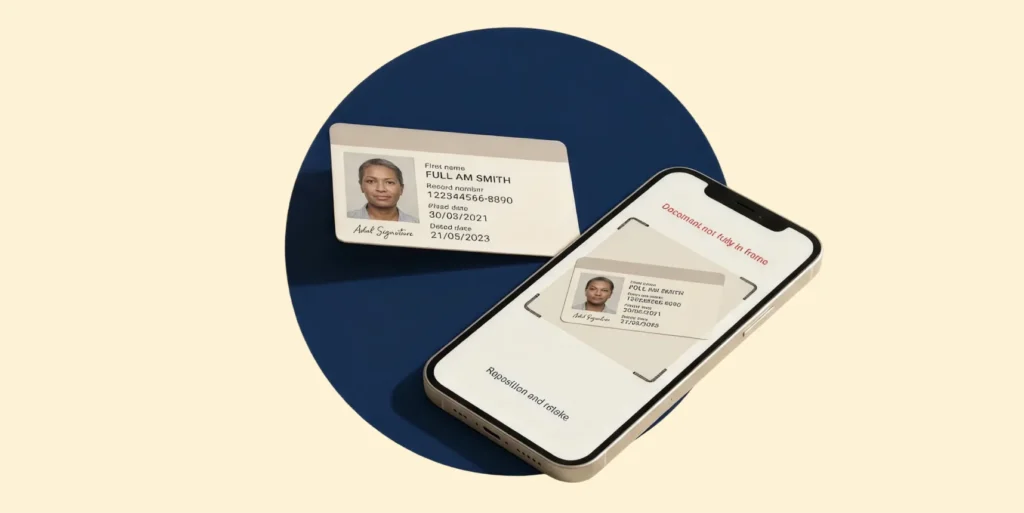
Most ID verification failures are not fraud. They are blurry photos, expired documents and address proofs that aged out. This post breaks down what actually drives rejections, who owns each fix, and which compliance changes now affect your flow.
Identity verification (IDV) is the gatekeeper of the digital economy, but it still stumbles far too often. The FTC’s Consumer Sentinel Network logged more than 1.1 million identity theft reports in 2024, and consumers reported $12.5 billion in fraud losses that year. Every failed check erodes trust, inflates acquisition costs and hands fraudsters an opening.
What follows is why Identity Verification fails and what actually fixes it.
Quick-look: top failure reasons
| Failure category | Share of rejections | Fast fix |
| Low-quality or incomplete document images | 34% | Real-time image-quality checks and capture guidance |
| Unsupported or expired documents | 18% | Up-to-date template library and expiry validation |
| Face mismatch or deepfake suspicion | 15% | Passive and active liveness |
| Address proof older than 90 days | 11% | Date validation and utility-data cross-checks |
| Form-fill typos and data mismatch | 9% | Auto-OCR and field autofill from the document scan |
| System or network errors | 8% | Edge caching and retry queues |
| Regulatory standard mismatch, for example NIST IAL2 | 5% | Continuous compliance testing |
Weighted global averages, Shufti platform analytics, January to April 2025.
Failure reason and who owns the fix
The table above tells you what is failing. This one tells you whose problem it is, which is usually the reason a known failure category stays unfixed for two quarters.
1. Document verification, new pitfalls and proven fixes
Document rejections are the largest single bucket, and most of them are caused by the customer’s camera rather than by anything suspicious.
1.1 Blurry, cropped or glare-affected images
Even with 12 MP phones, more than one-third of documents fail because text is not readable or corners are missing.
Fix: Shufti’s Image Assist overlay flags glare and missing edges before the shutter fires, and a three-second countdown plus a green border improves the share of usable captures.
1.2 Unsupported or expired documents
Out-of-scope student cards and cancelled passports still trigger 18% of rejections.
Fix: Maintain an AI-updated library of 10,000+ document templates and surface the accepted-document list in-flow.
1.3 Tampering and synthetic ID detection
High-resolution prints with swapped photos and AI-generated IDs are rising.
Fix: Add texture analysis, UV pattern checks and cross-database look-ups to spot anomalies fast.
2. Face verification, deepfakes and liveness
Deepfake tools get cheaper every quarter. The FBI’s 2025 Internet Crime Report carried its first ever section on artificial intelligence, covering 22,364 complaints and close to $893 million in losses, with voice clones, forged identity documents and believable video among the named tactics. A face check that only compares two images is not built for that.
| Common failures | Best-practice fixes |
| Obstructions such as masks and sunglasses | Ask the user to remove them, auto-detect occlusions |
| Poor lighting or colour cast | Real-time brightness and contrast meter |
| Replay attacks using video loops | Passive liveness on texture, combined with active challenges |
| GAN deepfakes | Depth capture on capable phones, micro-movement tests |
| Injected video that never passes a camera | Injection attack detection on the capture channel itself |
The last row is the one most flows are missing. Presentation attack detection asks whether a real person is in front of the lens. Injection attack detection asks whether the frames came from that lens at all. Deepfake detection and face verification need both.
3. Address verification, age and mismatch errors
Address proofs fail for two reasons, and neither is fraud in most cases.
- Proof older than 90 days. Three months is the common expectation across most firms’ own onboarding policies and is what many supervisors expect to see, though it is not a single universal rule. FinCEN, for instance, sets no blanket 90-day cap. Check the requirement that applies in your jurisdiction, then auto-read issue dates and block uploads that fail it.
- Address mismatch. Let customers update their address in-flow, or pull an eKYC registry to reconcile.
4. System-side failures and compliance gaps
These two account for 13 per cent of rejections between them, and unlike the categories above, the customer did nothing wrong.
4.1 API downtime and latency
Mobile traffic spikes can swamp your IDV endpoint, returning 5xx errors. Use edge nodes, exponential back-off and offline capture to save sessions.
4.2 Standards misalignment (NIST IAL2)
An October 2024 GAO audit found Login.gov still not fully aligned with NIST 800-63 requirements. Federal agencies have been working through those findings since, and the standard they are being measured against has moved. NIST published SP 800-63 Revision 4 as a final publication on 31 July 2025, replacing the draft that circulated in 2024. Run automated scripts that test evidence collection, crypto checks and data-retention controls against it.
5. How to increase your pass rate
- Explain the process up front. One explainer screen before the capture step reduces abandonment.
- Real-time validation. Autofill name and date of birth from the MRZ to kill typos.
- Contextual help. Inline micro-copy such as “tilt to remove glare”.
- Fallback channels. Offer video KYC or assisted upload.
- Continuous A/B testing. Track drop-offs weekly, iterate, repeat.
6. Regional pass-rate benchmarks
| Region | Median pass rate | Low-quality image rejects | Face mismatch rejects |
| North America | 89% | 28% | 11% |
| Europe | 85% | 31% | 13% |
| APAC | 82% | 36% | 16% |
| LATAM | 78% | 40% | 14% |
| MENA | 74% | 42% | 18% |
Source: Shufti platform analytics, 2.1 million checks, January to April 2025.
7. Key regulatory updates to watch
| Jurisdiction | Update | Relevance |
| EU | The Anti-Money Laundering Regulation (AMLR), Regulation 2024/1624, is adopted and applies from 10 July 2027. AMLA is operational and starts direct supervision of 40 large financial institutions on 1 January 2028. | Align document and liveness controls to the EU single rulebook ahead of 2027 |
| UK | The Digital Identity and Attributes Trust Framework reached production register status and has continued to iterate since. Check the current version before citing one. | Sets evidence-strength levels for identity service providers |
| FATF | Ongoing digital identity guidance, with biometric onboarding risk a recurring plenary theme. | Map controls to current FATF guidance |
| US | NIST SP 800-63 Revision 4 was finalised on 31 July 2025, and GAO findings on Login.gov set the direction for federal vendor scrutiny. | Expect stricter federal vendor audits against IAL and AAL levels |
Next steps, talk to the experts
Shufti’s verification stack covers document authenticity, biometric liveness and address checks in one flow, at 99.8 per cent accuracy and under three seconds, across 240+ countries and territories, mapped to AMLR, NIST 800-63-4 and FATF guidance.
Frequently Asked Questions
Why does my ID verification keep failing on mobile?
Most often it is a blurry or cropped photo. Show all four corners of the document, use natural light rather than overhead light, and hold the phone flat to the document to avoid glare across the data page.
How do I fix a failed KYC verification?
Retake clear photos, confirm your data matches the document exactly including middle names and hyphens, and check the document has not expired. If it fails again, the document type may not be supported, so check the accepted-document list before retrying.
How long does ID verification take?
Seconds. Shufti returns a verification result in under three seconds end to end, covering document authenticity, data extraction and the biometric match. Cases routed to manual review take longer by design.
What documents are accepted?
A valid government photo ID, which usually means a passport, national ID card or driving licence. Coverage runs to more than 10,000 document types across 240+ countries and territories, though the accepted list for any given flow is set by the business, not by the vendor.
Why did my selfie verification fail?
Face obstruction, poor lighting or an incomplete liveness challenge. A failed selfie check is usually a capture problem rather than an accusation, which is why a good flow allows a retry rather than a hard decline.
Is a failed ID verification the same as being flagged for fraud?
No, and the two should not be treated alike. Around a third of rejections come from image quality alone. A well-designed flow separates a soft failure, which invites a retry, from a hard decline, which goes to review. Treating every failure as suspicion is how businesses lose good customers.
How many retries should an IDV flow allow?
Enough that a genuine customer with a bad first photo is not lost, few enough that an attacker cannot iterate freely. Most flows settle on three attempts before routing to manual review or an assisted channel, with the retry counter tied to the session and the device rather than to the document.