


 AMLR Solutions
  AMLR Consultation
 EUDI Wallet
 Onboarding
 Ongoing Monitoring
 FRAML
FRAML KYC
KYC KYB
KYB KYI
KYI Age Assurance
 Workforce IAM
 Candidate Verification
 Account Takeover
 Bonus/ Promotion Abuse
 Chargeback Fraud
 Deepfake
 Document Fraud
 Fraud Networks
 Impersonation Fraud
 Money Mule Activity
 Multi-Accounting
 Party Fraud
 Regulatory & Compliance Risks
 Synthetic Identity Fraud
 Adult Content
 Banking
 Crypto
 Fintech
 Forex
Forex Compliance
 Fraud prevention
 Trust & safety
 Global expansion
 Compliance Officers
 Developers
 Fraud Analysts
 Product Managers
 Journey Builder
  Global Trust Platform
 Customer Profiles
 Vendor Comparison
 IDV Case Management
 AML Case Management
 Regulatory Reporting
 Agentic Rule Builder
  AI Compliance Co-Pilot
  Fraud Analytics
 Fraud Hub
  OCR
OCR Shufti AI
 Bank Account Verification
  Biometric Duplication
 Database Checks
 Document Intelligence
 Government ID
 Mobile Driver's License
 NFC
NFC Selfie Liveness
 Brand Personalisation
 Deployment Options
 Identity Methods
 IDV Modes
 Multi-tenancy
 On-Premise IDV
 Secure Capture
 Shufti MCP














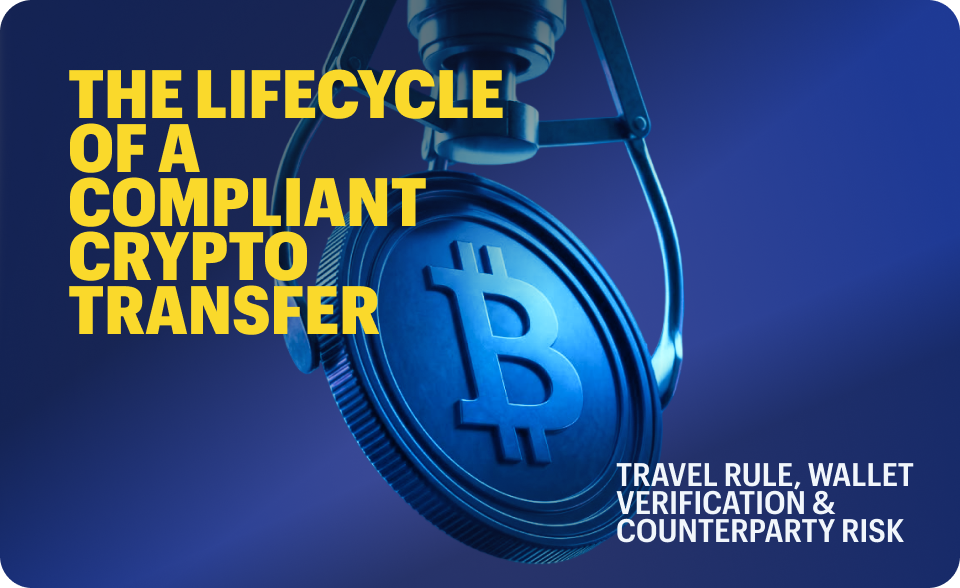
The Lifecycle of a Compliant Crypto Transfer : Travel Rule, Wallet Verification & Counterparty Risk
 Back
Back

The Lifecycle Of A Compliant Crypto Transfer

The Pre-settlement Challenge
A single crypto withdrawal isn't a single compliance event. It's a chain of them, being resolved in seconds before the transaction hits the chain, and once it does, there is nothing left to reverse.
Join us for a live conversation with FTAHK on what has to happen before a transfer settles, like exchanging counterparty data under the Travel Rule, proving a customer owns the self-hosted wallet they're withdrawing to, screening the destination and the VASP behind it, and keeping the risk picture current after value has moved.
Why does this matter?

In Hong Kong, this is already a live obligation
Under the SFC's VASP regime and the AMLO, the Travel Rule has been fully effective since 1 January 2024. It applies to virtual asset transfers of HKD 8,000 (~USD 1,000) and above, with full originator and beneficiary data required at or above that threshold.
And because settlement is immediate and irreversible, the SFC expects the counterparty data exchange to happen pre-transaction before the transfer executes, not concurrently and not after.

Everywhere else, the rules have moved from discussion to enforcement
FATF Recommendation 16 is live as the global baseline. The EU's MiCA enforces a zero threshold. VARA is actively inspecting in the UAE. MAS, FINTRAC, AUSTRAC and the FSA are all tightening supervision.
Wherever you operate, the question has shifted from whether you screened a transfer to whether you can produce the record that says you did.

The gap is operational
Compliance owes a defensible record for every transfer but often has no way to exchange counterparty data at volume. Engineering is told to "solve Travel Rule" and finds it's a network problem, not an API problem.
Fraud sees an unverified self-hosted wallet as a blind spot that KYC was never built to close. Three teams, one transaction, and no shared answer.
Four capabilities get sold as one. They aren't one
Travel Rule messaging, unhosted wallet verification, wallet screening and ongoing crypto monitoring each answer a different question, fail in a different way, and have to be evidenced separately.
Most stacks cover some of them well and assume the rest are covered too. Knowing exactly where yours stops is the first step.
Meet the Panel

Board member at Fintech Association of Hong Kong / Bullish
Priscilla Adams is the founder of Adams Advisory, specialising in digital asset and financial crime compliance. She spent four years as Group Compliance Director at Bullish, and began her career at HSBC embedding AML/CFT programmes across 19 Asian markets.
She is a board member of the Fintech Association of Hong Kong and founder and chair of the Digital Asset Integrity Forum, and contributes to the Wolfsberg Group, Interpol and the FATF Virtual Asset Contact Group.

Chief Information Officer, VDX
Andrew Davidson is Chief Information Officer at VDX and President of the OpenVASP Association, where he chaired the group that created the open Travel Rule Protocol (TRP). He also co-chairs the interVASP Standards Working Group behind IVMS 101, the de facto data standard for Travel Rule messaging, and has attended FATF Virtual Asset Contact Group meetings as a delegate.

Chief Compliance Officer, BIT
Wayne Chin is Chief Compliance Officer at BIT, with close to a decade leading compliance across Asia's largest technology and payments businesses. He has served as Head of Compliance for Lazada within Alibaba's International Commercial division, Head of Compliance for ByteDance Global Payment, and Regional Compliance Head at Tencent. Earlier in his career he held senior compliance roles at China Construction Bank and was Country Head of Anti-Money Laundering at JPMorgan Chase in Malaysia.

VP, Product Development & Marketing, Shufti
Raja Hassan Fayyaz is Chief Product Officer at Shufti, where he leads the teams building its identity verification, AML and fraud prevention products, working with clients including Mastercard, Stripe and Binance.
Before Shufti, he was Chief Development Officer at QuickBit, building a blockchain payment gateway handling over 20,000 transactions a month and custom crypto wallets for Bitcoin, Bitcoin Cash and Litecoin.
Watch the recording
Certifications
Independently audited and certified for enterprise-grade security and data protection.





LIVE EVENT
PIX Fraud 2026: Are Your Fraud Controls Ready for the Next Generation of Instant Payment Scams?


LIVE EVENT
First Annual Fintech Executive Roundtable in Cyprus | 2025



LIVE EVENT
Innovation Roundtable Summit 2025: Build vs Buy vs Partner vs Prompt






LIVE EVENT
Meet Shufti at the UK AI Showcase, London Tech Week 2026



LIVE EVENT
Built by Shufti: A Podcast on Compliance Lifecycle
20th August
Online
LIVE EVENT
The Lifecycle of a Compliant Crypto Transfer : Travel Rule, Wallet Verification & Counterparty Risk

LIVE EVENT
Beyond the First Check: How AMLR Extends KYC Across the Customer Lifecycle







Launch Verification Instantly
Get access to Shufti’s Self-Service Portal and start verifying users with flexible, usage-based pricing.
Get Started