AMLR Solutions
  AMLR Consultation
 EUDI Wallet
 Onboarding
 Ongoing Monitoring
 FRAML
FRAML KYC
KYC KYB
KYB KYI
KYI Age Assurance
 Workforce IAM
 Candidate Verification
 Account Takeover
 Bonus/ Promotion Abuse
 Chargeback Fraud
 Deepfake
 Document Fraud
 Fraud Networks
 Impersonation Fraud
 Money Mule Activity
 Multi-Accounting
 Party Fraud
 Regulatory & Compliance Risks
 Synthetic Identity Fraud
 Adult Content
 Banking
 Crypto
 Fintech
 Forex
Forex Compliance
 Fraud prevention
 Trust & safety
 Global expansion
 Compliance Officers
 Developers
 Fraud Analysts
 Product Managers
 Journey Builder
  Global Trust Platform
 Customer Profiles
 Vendor Comparison
 IDV Case Management
 AML Case Management
 Regulatory Reporting
 Agentic Rule Builder
  AI Compliance Co-Pilot
  Fraud Analytics
 Fraud Hub
  OCR
OCR Shufti AI
 Bank Account Verification
  Biometric Duplication
 Database Checks
 Document Intelligence
 Government ID
 Mobile Driver's License
 NFC
NFC Selfie Liveness
 Brand Personalisation
 Deployment Options
 Identity Methods
 IDV Modes
 Multi-tenancy
 On-Premise IDV
 Secure Capture
 Shufti MCP
















Key Takeaways
|
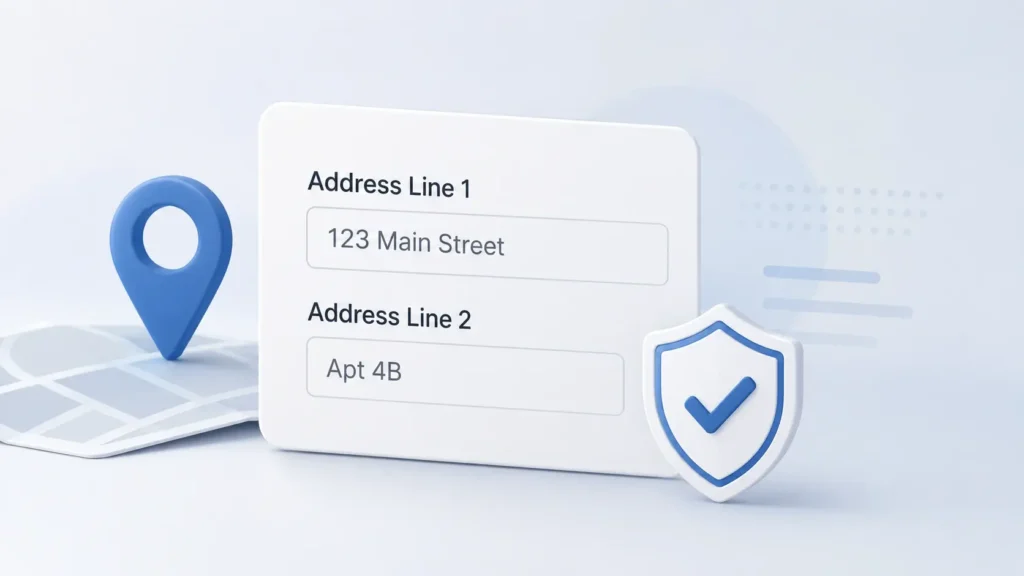
When you fill out an online form to open a bank account, complete a KYC check, or register for a financial service, you inevitably encounter two fields: Address Line 1 and Address Line 2. Most people fill them in without a second thought. But in the world of identity verification and KYC compliance, what goes in each field, and how accurately it is entered, can be the difference between a seamless onboarding experience and a failed verification.
This guide explains what address line 1 and address line 2 mean, how they differ, what each should contain, and critically how errors in these fields affect proof of address verification for KYC and AML compliance.
| Address Line 1 is the primary address field containing the building number, street name, and any unit information. Address Line 2 is an optional secondary field for additional details. In KYC verification, both fields must be accurate and consistent with submitted proof of address documents. |
Address Line 1 vs Address Line 2: Quick Comparison
|
Field |
What it contains | Example | KYC impact |
| Address Line 1 | Primary address data: building number, street name, street suffix, and sometimes unit number. | 123 Main Street Apt 4B |
Critical for matching user-submitted address data with proof of address documents. |
|
Address Line 2 |
Optional secondary details: apartment, suite, floor, building name, care of, or PO Box where accepted. | Apt 4B / Floor 3 / c/o Jane Smith |
Useful only if the verification system can parse and normalise it correctly. |
| City, state, postal code | Separate location fields, not address lines. | San Diego, CA 91911 |
Incorrect placement can break address parsing and reduce match accuracy. |
What Is Address Line 1?
Address Line 1 refers to the first and most important line of a postal address. It is the primary field used to locate a specific building or property and is the first thing an address verification system or a postal carrier looks at when routing correspondence or packages.
In the standardised address format used by postal authorities worldwide (including USPS in the United States and Royal Mail in the UK), Address Line 1 should include all the core components needed to uniquely identify a physical location:
- Building number or house number
- Predirectional (e.g. N., S., E., W.)
- Street name
- Street suffix (e.g. Street, Drive, Lane, Avenue)
- Postdirectional (if applicable)
- Unit designator and number (e.g. Apt 4B, Suite 200, Floor 3): if no separate unit field is provided
Example: In the address “123 Main Street, Apt 4B, San Diego, CA 91911” the address line 1 is 123 Main Street, Apt 4B. The city, state, and ZIP code go in their respective separate fields.
Address Line 1 Breakdown: What Each Component Means
Building Number
Every residential property, apartment, or commercial office in a developed country is assigned a unique building number. This number is typically displayed on the side of the building, on the curb, or on the letterbox/mailbox. In identity verification, the building number is the most critical component; even a single-digit error can result in the address failing verification.
Predirectional and Street Name
A street name can be a word, a number, or a combination of both. Streets are sometimes renamed over time, which means a single location may have multiple valid historic names. Robust address verification software tracks alias locations and flags outdated address names, ensuring that a customer who submits an old street name is not wrongly rejected during KYC.
Street Name Suffix
Street suffixes indicate the type of road (e.g. Street, Drive, Lane, Boulevard). There are hundreds of recognised suffixes, and they are often abbreviated in ways that are not always intuitive. The table below shows a selection of common suffixes and their abbreviations:
|
Suffix |
Abbreviation | Suffix |
| Street | ST |
Lane |
|
Drive |
DR | Circle (CIR) |
| Freeway | FWY |
Place (PL) |
|
Branch |
BR | Gardens (GDNS) |
| Junction | JCT |
Ridge (RDG) |
| Hill | HL |
Harbour (HBR) |
In KYC address verification, suffix mismatches (e.g. entering “Rd” instead of “Road” or omitting the suffix entirely) are a common source of verification failures. A well-designed address verification API normalises suffix variations automatically.
Unit Designator: Where to Place Apartment, Suite, or Floor Information
When a property houses multiple tenants or businesses, an apartment building, or an office block the unit number and type must be included in the address. This is one of the most misunderstood aspects of address formatting.
There are three acceptable places to include unit information in an address form:
- 1. In a dedicated secondary unit field: If the form has a separate field for apartment, suite, or floor number, use it. You only need to enter the number itself; the designator (“Apt”, “STE”) is not required in a separate field.
- 2. At the end of Address Line 1: If there is no dedicated unit field, append the unit designator and number to the end of address line 1. For example: 123 Main Street, Apt 4B. The designator is required here so the address system knows where the street ends and the unit begins.
- 3. In Address Line 2: While technically permissible, placing unit information in address line 2 is not recommended. It produces lower quality address data and is more likely to cause mismatches during identity verification.
What Is Address Line 2?
Address Line 2 is an optional secondary address field. It is designed to capture supplementary location information that does not fit into the primary address line, but its vague, open-ended nature is also the source of considerable confusion.
In practice, address line 2 is used (or misused) for a wide range of inputs:
- Apartment, suite, or floor numbers (when the user missed address line 1)
- Care of (℅) information (e.g. c/o Jane Smith)
- Building names or campus references
- PO Box numbers for business mail
- Delivery instructions which have no place in a structured address field
The inconsistent way people use address line 2 is precisely why many address form designers and UX practitioners recommend removing it entirely, replacing it with a clearly labelled unit/apartment field instead. When address line 2 is present but poorly labelled, users are unsure whether to put their apartment number there or leave it blank.
| KYC implication: When a customer’s submitted proof of address document shows a unit number that appears in address line 2 of their form submission but was omitted from address line 1, automated verification systems may flag the address as inconsistent. This is one of the most common causes of unnecessary KYC friction. |
Address Line 1 vs Address Line 2: Key Differences
|
Address Line 1 |
Address Line 2 |
| Required field in most forms |
Optional field |
|
Contains primary location data |
Contains supplementary location data |
| Building number + street name + unit |
PO Box, care-of, building name |
|
Parsed and validated by postal systems |
Often unstructured and unparseable |
| Critical for delivery and KYC verification |
Secondary, supplemental, often inconsistent |
|
Example: 123 Main Street, Apt 4B |
Example: c/o Jane Smith / PO Box 567 |
PO Boxes: Where Do They Go in Address Lines?
PO Box addresses are among the most complex to standardise because different rules apply depending on the type of mail and the entity receiving it.
Standard PO Boxes (Personal)
For personal PO Boxes, the PO Box number replaces the street address in Address Line 1. The recipient name goes above the address block, and Address Line 1 reads simply: PO Box [number].
Business PO Boxes
When mailing a business PO Box, the company name goes in Address Line 1, and the PO Box number goes in Address Line 2. This is one of the few accepted uses of address line 2 as a primary routing element.
Dual Address (Street + PO Box)
Some addresses include both a street address and a PO Box. In these cases, postal authorities (such as USPS) will prioritise whichever address appears in Address Line 1. If both are on the same line without separation, the PO Box typically takes precedence.
| KYC implication: PO Box addresses cannot always serve as valid proof of address for KYC/AML purposes. Most regulated industries require a verifiable residential or business street address. Shufti’s address verification workflow can identify PO Box addresses and flag them for manual review where regulatory requirements demand a physical address. |
Why Address Lines Matter in KYC and Proof of Address Verification
Address Line 1 and Address Line 2 are not merely postal conventions; they are core data inputs in any KYC Verification process or proof of address verification process. Here is why they matter:
1. Document Cross Matching
When a customer submits a proof of address document, a utility bill, bank statement, or government letter, the name and address on that document are cross-referenced against the address data they provided in the onboarding form. If address line 1 on the form reads “Flat 3, 42 Victoria Road” but the proof of address document shows “42 Victoria Road, Flat 3”, an automated system without normalisation logic may flag this as a mismatch.
Shufti’s proof of address verification uses AI-powered document analysis to recognise common address formatting variations across 240+ countries, minimising false rejections caused by formatting differences rather than genuine discrepancies.
2. Global Address Format Variation
Address Line 1 formats differ significantly across countries. In the UK, the property name often precedes the building number. In South Africa, the stand number is used instead of a street number. In Mexico, addresses may include a colonia (neighbourhood) within the address line itself. In Brazil, the CEP (postal code) format and street structure follow local conventions.
This is why Shufti’s international address verification engine is localised by country, applying the right parsing rules for each jurisdiction rather than forcing global addresses into a US-centric format.
3. AML and Sanctions Screening
Accurate address data, beginning with a well-structured address line 1, is essential for AML screening. Fuzzy or incomplete address data increases the likelihood of false negatives in sanctions and PEP screening where a slightly different spelling of a street name or a missing unit number causes a high-risk individual to slip through. Clean, validated address data reduces this risk.
4. Regulatory Compliance Requirements
Regulators including FATF, the FCA (UK), FinCEN (US), and the EBA (EU) require financial institutions to collect and verify the residential address of customers as part of Customer Due Diligence (CDD). An address that cannot be verified because of errors in address line 1 is not compliant address data; it is a liability.
Common Address Line Errors That Cause Verification Failures
The following are the most frequent address line errors encountered in KYC and identity verification workflows:
Formatting Errors
- Non-standard formatting: Addresses entered without standardized structure e.g. writing the unit number before the building number, or omitting the street suffix may fail automated parsing.
- PO Box in the wrong field: Placing a PO Box in address line 1 when a street address is required, or vice versa, leads to verification failure.
- Incorrect abbreviations: Using an unrecognised suffix abbreviation (“Blvd” instead of “Boulevard”, or an entirely wrong abbreviation) can cause the address to fail standardisation.
Typographical Errors
- Spelling mistakes: Misspelled street names are common, especially for streets with unusual or non-English names.
- Missing predirectionals: Omitting a directional indicator (e.g. “N Main Street” vs “Main Street”) can mean the address maps to a completely different location.
- Hyphenated building numbers: Some properties have hyphenated numbers (e.g. 56 998). Removing the hyphen produces an entirely different address and will fail verification.
Data Quality Issues
- Incomplete address components: Missing apartment numbers, missing street suffixes, or missing predirectionals leave the address ambiguous.
- Outdated street names: Streets are occasionally renamed. If a customer provides a former name, it may not match the current postal database record.
- Unit number in wrong field: Placing the unit number in address line 2 instead of address line 1 can cause cross-matching to fail against proof of address documents that list the full address on a single line.
How Shufti’s Address Verification Resolves Address Line Errors
Shufti’s address verification solution uses a multi-layer approach to validate address data, including the content of address line 1 and address line 2, against authoritative sources and submitted documents:
- AI-powered document reading: Shufti’s OCR and AI extract address data directly from proof of address documents (utility bills, bank statements, government correspondence) and cross-reference it against the customer’s form submission, tolerating common formatting differences without triggering false rejections.
- International address normalisation: Address line data is parsed and standardised according to the address conventions of the customer’s country, covering 240+ countries and territories.
- Real-time API validation: Address data submitted via online forms can be validated in real time through Shufti’s API, catching errors at the point of entry before they cause downstream verification failures.
- Completeness checks: Shufti’s system detects incomplete address line 1 entries missing unit numbers, absent street suffixes, and prompts users to correct them before submission.
- PO Box detection: Automated identification of PO Box addresses allows regulated businesses to apply appropriate policies where physical address verification is a regulatory requirement.
| Shufti’s proof of address verification is used by financial institutions, fintechs, cryptocurrency exchanges, and regulated businesses worldwide to meet KYC and AML address verification requirements. To see it in action, book a free demo |
Conclusion
Address Line 1 and Address Line 2 are deceptively simple form fields. In everyday use, most people fill them in without a second thought. But in regulated industries where identity verification, KYC, and AML compliance are mandatory, the accuracy and completeness of these fields directly affect verification outcomes.
Understanding what address line 1 should contain the building number, street name, suffix, predirectional, and unit information and knowing when and how to use address line 2 reduces verification failures, improves compliance data quality, and creates a smoother onboarding experience for customers.
Shufti’s address verification solution handles the complexity of global address formats, cross-matches submitted address data against proof of address documents using AI, and validates address lines in real time so that address formatting variations never stand in the way of compliant, accurate customer verification.
Frequently Asked Questions
What is address line 1?
Address Line 1 is the primary line of a postal address. It contains the building or house number, street name, street suffix, predirectional (if applicable), and unit number (if no separate unit field is provided). It is the most important address field in both postal delivery and identity verification.
What is address line 2?
Address Line 2 is an optional secondary address field, typically used for supplementary location information such as a PO Box number, care of name, or building name. It is not always present on address forms and should not be relied upon for primary address data.
What is the difference between address line 1 and address line 2?
Address Line 1 contains the primary, structured address data needed to identify a specific building. Address Line 2 is supplementary and unstructured, designed for secondary information. For KYC purposes, the most important data should always appear in address line 1.
What should I put in address line 1 vs address line 2?
Address Line 1 should contain: building number + street name + suffix + unit information (if no separate unit field). Address Line 2, if used, can contain a PO Box, care of name, or building name. Avoid placing your apartment number in address line 2 if address line 1 has space for it.
Can a PO Box go in address line 1?
Yes, for personal PO Boxes, the PO Box number typically goes in address line 1, replacing the street address. For business PO Boxes, the company name goes in address line 1 and the PO Box number in address line 2. Note that PO Box addresses may not satisfy proof of address requirements for KYC in regulated industries.
Why does address line 1 matter for KYC verification?
In KYC, the address provided in address line 1 is cross-referenced against proof of address documents. Errors, omissions, or inconsistencies in address line 1, such as a missing unit number or misspelled street name, can cause automated verification to fail, creating friction in customer onboarding and potential compliance gaps.