AMLR Solutions
 AMLR Consultation
 Onboarding
 Ongoing Monitoring
 FRAML
FRAML KYC
KYC KYB
KYB KYI
KYI Age Assurance
 Workforce IAM
 Candidate Verification
 Account Takeover
 Bonus/ Promotion Abuse
 Chargeback Fraud
 Deepfake
 Document Fraud
 Fraud Networks
 Impersonation Fraud
 Money Mule Activity
 Multi-Accounting
 Party Fraud
 Regulatory & Compliance Risks
 Synthetic Identity Fraud
 Adult Content
 Banking
 Crypto
 Fintech
 Forex
Forex Compliance
 Fraud prevention
 Trust & safety
 Global expansion
 Compliance Officers
 Developers
 Fraud Analysts
 Product Managers
 Advanced Journey Builder (AJB)
 Global Trust Platform
 Customer Profiles
 Vendor Comparison
 IDV Case Management
 AML Case Management
 Regulatory Reporting
 Travel Rule Protocols
 Agentic Rule Builder
 AI Compliance Co-Pilot
 Fraud Analytics
 Fraud Hub
 OCR
OCR Shufti AI
 Bank Account Verification
 Biometric Duplication
 Database Checks
 Document Intelligence
 Government ID
 Mobile Driver's License
 NFC
NFC Selfie Liveness
 Brand Personalisation
 Deployment Options
 Identity Methods
 IDV Modes
 Multi-tenancy
 On-Premise IDV
 Secure Capture









TL;DR
- The Philippines verifies identity through PhilSys, its national ID system, with close to 80% of the population registered as of December 2025.
- BSP Circular 1170 (2023) permits digital eKYC onboarding, with document checks for basic accounts and biometric verification for higher-limit accounts.
- The Philippines exited the FATF grey list on 21 February 2025 after strengthening its AML and counter-terrorism financing framework.
- AMLC still requires banks, remittance providers, casinos, and other covered persons to run due diligence, file suspicious transaction reports, and keep records for five years.
- A standard online identity check combines document verification, biometric liveness matching, and database checks against PhilSys and watchlists, usually completing in under 60 seconds.
- Shufti supports identity verification in the Philippines with document checks across 10,000+ ID types and eIDV checks against 235+ data sources as part of its coverage across 240+ countries.
The Philippines has moved from a fragmented, largely manual identity system to a structured digital framework faster than most markets in Southeast Asia. The PhilSys national ID program, updated BSP guidance, and the country’s February 2025 exit from the FATF grey list have collectively raised both the expectations and the baseline capabilities for identity verification in Philippine operations. Businesses onboarding Filipino customers now have better infrastructure to work with and clearer compliance obligations attached to using it.
This guide covers what that infrastructure looks like, what regulators require, and how the verification process works for companies operating in the Philippine market in 2025.
What is identity verification?
Identity verification is the process of confirming that a person is who they claim to be by checking presented credentials against authoritative data sources. In the Philippines, this includes document checks, biometric matching, and database cross-referencing against national registries and financial records.
The Philippine Digital Identity Foundation: PhilSys and National Coverage
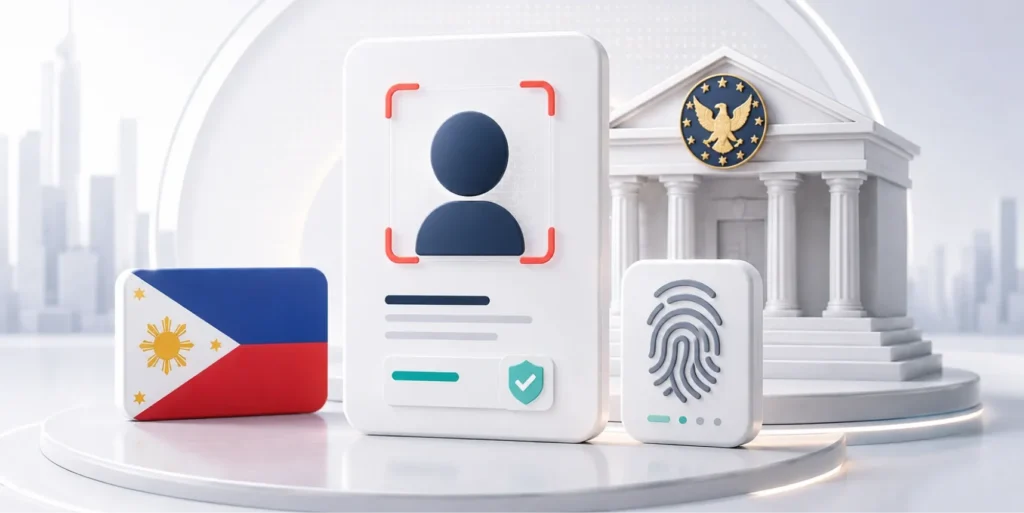
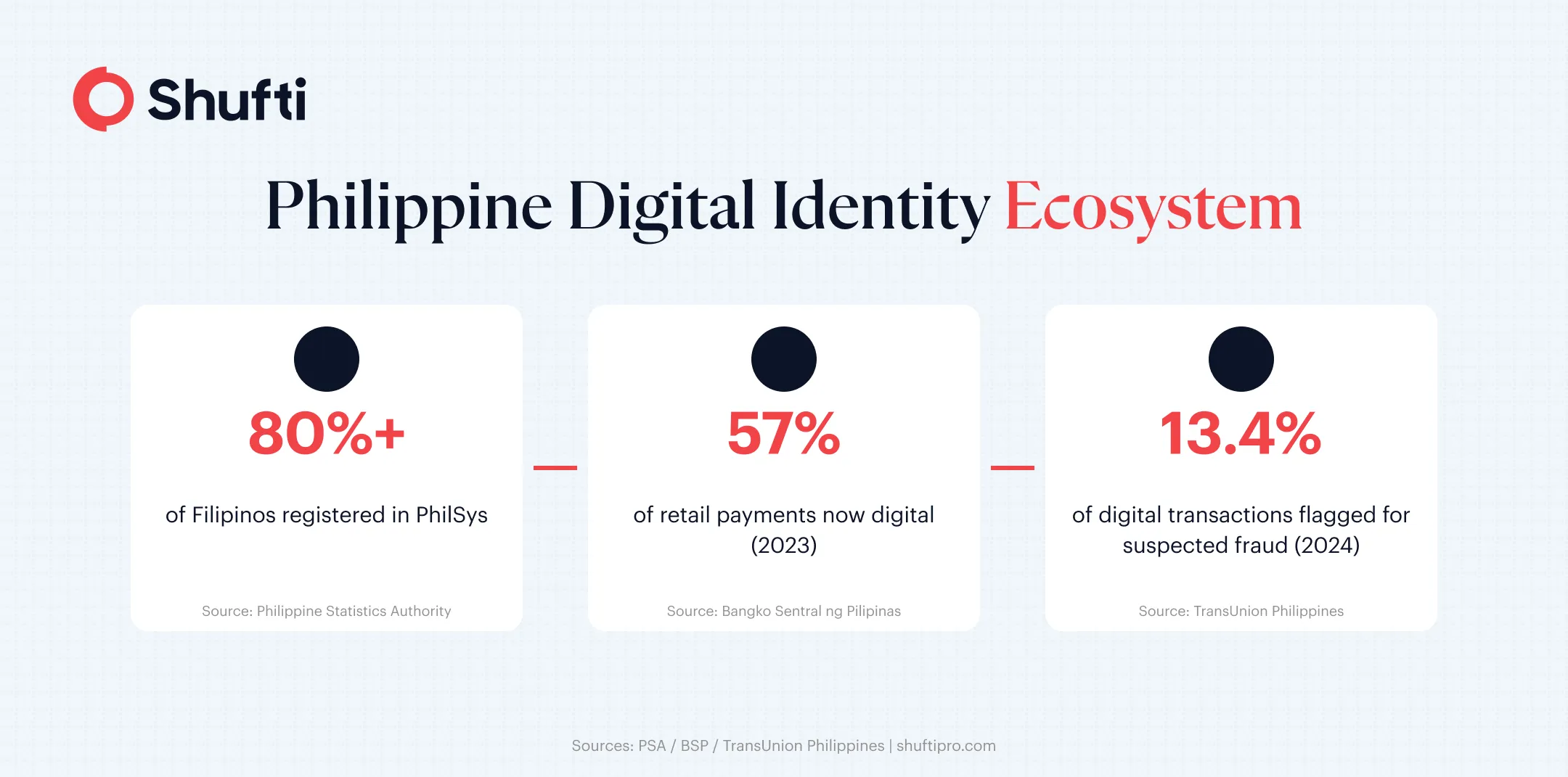
The Philippine Identification System (PhilSys), established under Republic Act 11055, is the country’s centralized identity infrastructure. Since its rollout, PhilSys has registered over 80% of the Filipino population, creating a national database for Philippine digital ID verification that financial institutions, government agencies, and regulated platforms can query.
Each PhilSys record holds a unique 12-digit PhilSys Number (PSN) alongside biometric data: fingerprints, an iris scan, and a front-facing photograph. That combination gives both document-based and biometric identity authentication workflows in the Philippines a common, government-issued source of truth to verify against.
PhilSys and Digital Onboarding
For financial institutions and digital platforms, PhilSys integration replaces the need for physical document submission in many onboarding flows. An applicant can verify through their PhilSys-linked credential rather than uploading a photocopy of a postal ID, and the assurance level is considerably higher. This infrastructure shift is what makes scalable electronic ID verification in the Philippines compliant rather than theoretical.
BSP’s 2024 Status of Digital Payments report found that digital transactions reached 57.4% of total retail payment volume that year, up from 52.8% in 2023.
The Fraud Context
Expanded digital adoption brings corresponding risk. With synthetic identity creation and account takeover surging in the Philippines. Online identity verification Philippines deployments must now treat these attack vectors as baseline requirements, not edge cases.
Regulatory Requirements: BSP Circular 1170 and AMLC Obligations
Two regulators set the compliance perimeter for identity verification in the Philippines. The Bangko Sentral ng Pilipinas (BSP) governs financial institutions, electronic money issuers, and digital banks. The Anti-Money Laundering Council (AMLC) administers AML/CFT obligations across all covered persons.
BSP Circular 1170: KYC Tiers and eKYC Permission
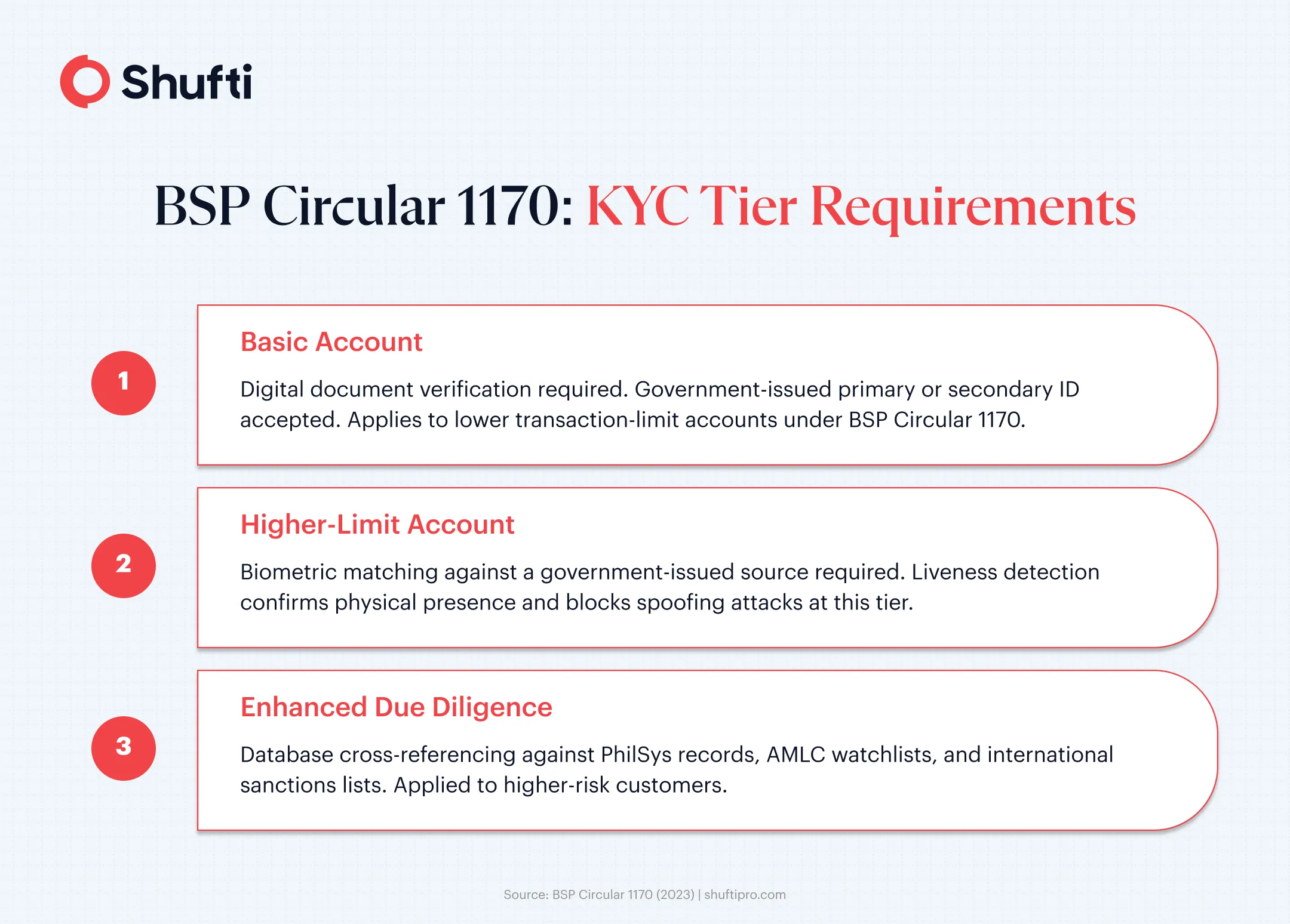
BSP Circular 1170, issued in 2023, is the operative standard for customer due diligence and KYC verification in the Philippines. It mandates that covered entities collect, verify, and maintain customer identity records at onboarding, applying a risk-based approach to determine the depth of verification required.
The Circular explicitly permits digital and remote onboarding via eKYC. In practice, this creates a tiered structure: lower-limit accounts may open with basic digital identity verification checks, while higher-limit accounts require biometric verification against a government-issued source. ID verification solution providers operating in the regulated sector must deliver outputs that map to these tier-specific requirements.
AMLC Obligations and the FATF Grey List Exit
The Philippines was removed from the FATF grey list in February 2025 after implementing legislative reforms and demonstrating improved AML screening practices across covered sectors. The exit lowers the country’s risk profile in international correspondent banking and simplifies cross-border compliance assessments for foreign businesses with Filipino customer bases.
Grey list removal does not relax AMLC obligations. Covered persons, including banks, remittance providers, casinos, and designated non-financial businesses, are still required to perform customer due diligence, file suspicious transaction reports, and retain identity records for five years after a relationship ends.
How the Identity Verification Process Works in the Philippines
For regulated businesses, the identity verification process in the Philippines follows a layered structure aligned with the BSP’s risk-based framework.
Document Verification and Biometric Matching
The first layer is document verification: extracting data from a government-issued ID (PhilSys national ID, passport, driver’s license, or Unified Multi-Purpose ID) and analyzing it for authenticity. Optical character recognition (OCR) extracts printed fields; forensic detection models assess fonts, holograms, and microprint patterns for signs of tampering.
The second layer is biometric matching. The applicant submits a live selfie, and the system compares facial geometry against the ID photograph. Liveness detection confirms physical presence, blocking printed-photograph and pre-recorded video attacks. For remote identity verification in the Philippines, compliance, particularly under BSP’s enhanced due diligence tier, requires this biometric step to be standard in regulated onboarding flows.
Database Cross-Referencing and AI-Powered Detection
Where higher assurance is required, identity authentication workflows in the Philippines extend to database checks: cross-referencing name, date of birth, and address against PhilSys records, AMLC watchlists, and international sanctions lists at the same time. AI identity verification systems in the Philippines use machine learning models to detect anomalies across these data points, surfacing inconsistencies that a manual reviewer would not catch.
A well-implemented verify identity online Philippines flow is completed in under 60 seconds. Document analysis, biometric matching, and database queries run concurrently rather than sequentially, which is what makes sub-minute turnaround achievable at volume without sacrificing compliance depth.
The BSP’s tiered framework is the regulatory logic behind this layered approach. Document-plus-selfie is sufficient for basic accounts; enhanced due diligence tiers require the database layer to close the assurance gap. Building that progression into an onboarding flow from the start avoids the costly re-verification cycles that arise when a platform later upgrades account limits and discovers the initial check no longer meets the required threshold.
Industries Where Digital Identity Verification Drives Growth
Demand for digital identity verification in the Philippines is concentrated in three regulated sectors.
Digital banks and neobanks depend entirely on remote onboarding. Every customer acquisition runs through a digital identity check, and a broken verification flow means a lost registration. BSP Circular 1170’s eKYC permission has made this viable at scale, but the biometric and database requirements for higher-tier accounts mean that low-friction ID verification solution Philippines implementations cannot compromise on assurance depth.
Electronic money issuers and remittance operators face AMLC reporting obligations alongside BSP KYC requirements. For these businesses, identity checks do not end at account opening. Ongoing monitoring, re-verification at activity thresholds, and suspicious transaction reporting are part of the compliance workflow throughout the customer relationship.
Online gaming and age-gated platforms are increasingly subject to identity authentication requirements in the Philippines under PAGCOR rules and platform integrity frameworks. The extension of formal identity verification to these sectors reflects a trend moving across Southeast Asia: compliance-grade identity checks are becoming expected for any platform that handles consumer transactions at scale.
The common thread across all three sectors is the same underlying pressure: more customers acquired through digital channels, with audit-ready verification records that satisfy both BSP inspections and AMLC review cycles.
How Shufti helps businesses verify customers in the Philippines
Scaling Filipino customer onboarding means working within a framework that is simultaneously more permissive about digital methods and more exacting about biometric assurance than it was three years ago. BSP Circular 1170 invites eKYC. It also sets specific thresholds for liveness detection and database verification that many legacy document-only stacks cannot meet.
Shufti covers both requirements from a single integration. Document verification reads PhilSys national IDs, passports, and driver’s licences against a library of 10,000+ document types. Where businesses need background database checks without adding selfie friction to lower-risk flows, eIDV cross-references identity data against 235+ trusted sources, including government and telecom records, in under three seconds with a consolidated audit trail that meets AMLC record-keeping requirements.
Ready to onboard Filipino customers compliantly from day one? Speak to the Shufti team.
Frequently Asked Questions
What government IDs are accepted for identity verification in the Philippines?
The BSP recognises primary government-issued IDs including the PhilSys national ID, passport, driver's licence, and Unified Multi-Purpose ID (UMID). Digital banks may accept secondary IDs for lower-tier accounts under BSP Circular 1170. Physical document submission is not required where a valid eKYC flow is in place.
Is online or remote identity verification permitted under Philippine regulations?
Yes. BSP Circular 1170 explicitly permits eKYC and digital onboarding for covered financial institutions. Higher-limit accounts require biometric verification against a government-issued source. The BSP sets specific reliability thresholds that verification outputs must meet for each account tier.
When did the Philippines exit the FATF grey list?
The Philippines was removed from the FATF grey list in February 2025 following legislative reforms and demonstrated improvements in AML/CFT enforcement. Covered entities under AMLC oversight retain their full customer due diligence and record-keeping obligations.
What is PhilSys and how does it support digital onboarding?
PhilSys is the national identification system established under Republic Act 11055, covering over 80% of the Filipino population. It stores biometric data alongside a unique PhilSys Number, giving businesses a government-issued identity anchor for digital onboarding without requiring physical document copies.
What does the identity verification process involve for Philippine digital banks?
Digital banks follow a tiered structure under BSP Circular 1170. Basic accounts require digital document verification. Higher-limit accounts require biometric matching and, for higher-risk customers, enhanced due diligence including database checks against PhilSys records, AMLC watchlists, and international sanctions lists.