AMLR Solutions
  AMLR Consultation
 EUDI Wallet
 Onboarding
 Ongoing Monitoring
 FRAML
FRAML KYC
KYC KYB
KYB KYI
KYI Age Assurance
 Workforce IAM
 Candidate Verification
 Account Takeover
 Bonus/ Promotion Abuse
 Chargeback Fraud
 Deepfake
 Document Fraud
 Fraud Networks
 Impersonation Fraud
 Money Mule Activity
 Multi-Accounting
 Party Fraud
 Regulatory & Compliance Risks
 Synthetic Identity Fraud
 Adult Content
 Banking
 Crypto
 Fintech
 Forex
Forex Compliance
 Fraud prevention
 Trust & safety
 Global expansion
 Compliance Officers
 Developers
 Fraud Analysts
 Product Managers
 Journey Builder
  Global Trust Platform
 Customer Profiles
 Vendor Comparison
 IDV Case Management
 AML Case Management
 Regulatory Reporting
 Agentic Rule Builder
  AI Compliance Co-Pilot
  Fraud Analytics
 Fraud Hub
  OCR
OCR Shufti AI
 Bank Account Verification
  Biometric Duplication
 Database Checks
 Document Intelligence
 Government ID
 Mobile Driver's License
 NFC
NFC Selfie Liveness
 Brand Personalisation
 Deployment Options
 Identity Methods
 IDV Modes
 Multi-tenancy
 On-Premise IDV
 Secure Capture
 Shufti MCP













Crypto records the highest share of remote onboarding fraud at 22.49%, ahead of fintech at 18.36% and forex at 17.18% across eleven sectors.
LONDON, United Kingdom, 2 September 2026 – Shufti, a Glocal identity verification, KYC, AML, and full compliance lifecycle platform, today published the Identity Fraud Report 2026, its annual analysis of identity fraud at remote onboarding, drawn from its production verification data across eleven industries in the first half of 2026.
The report finds that deepfakes and AI-generated identity fraud are no longer limited to individual fraud attempts. Organised crime networks and coordinated fraud rings are also increasingly using forged identity documents, synthetic identities, shared devices and controlled digital infrastructure to bypass KYC checks, facilitate financial crime and operate across multiple jurisdictions.
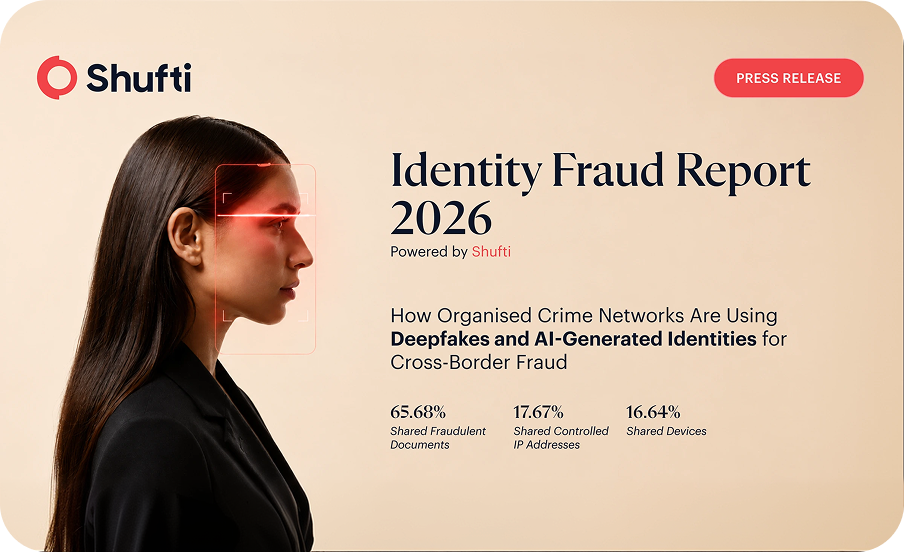
Among linked fraudulent verification attempts, 65.68% of attribute matches traced back to the reuse of the same forged identity documents, demonstrating how coordinated fraud rings repeatedly recycle manipulated identity assets across institutions.
One Forged Document Is What Ties A Ring Together
Generative AI has reduced the cost of producing a convincing fake identity, so one operator can recycle a single document, face, or device across many verification attempts. A document declined as forged at one institution is not spent. It returns under another name and on another device and is submitted again elsewhere, which places the exposure in the repetition rather than in any single submission.
- Matches between separate fraudulent attempts break down as reused fraudulent documents at 65.68%, shared controlled IP addresses at 17.67%, and shared devices at 16.64%. Document reuse is the strongest matching signal, because people legitimately share networks and devices.
- The largest connected cluster observed linked 70 identities across 13 devices, with a single device anchoring 16 verification events.
Organised Fraud Rings Operate Across Borders
2.01% of network fraud spanned more than one country, highlighting how AI-enabled identity fraud increasingly overlaps with cross-border financial crime and money laundering.
Within those cross-border groups, the typical interval between activity in one country and the next was 9 minutes 33 seconds, and the fastest observed was 38 seconds, a timing pattern inconsistent with physical movement between jurisdictions.
Once a ring crosses a border, no single institution or supervisor sees the whole of it, and an identity verification gap becomes an AML exposure downstream.
Crypto Records the Highest Share of Remote Onboarding Fraud
Identity fraud exposure varied more than fivefold across the eleven industries measured, tracking the sectors whose remote onboarding volume is highest rather than those under closest supervision.
- Crypto recorded the highest exposure at 22.49% of all verification requests, followed by fintech at 18.36%, forex at 17.18%, lending and investment at 17.08%, and iGaming at 12.45%.
- Deepfake document fraud accounted for 80.10% of AI-enabled fraud, the dominant attack instrument by a wide margin, ahead of synthetic identities at 12.31%, injected videos at 4.01%, and face swaps at 3.58%.
- Altered documents led the detection rate by attack instrument in nine of the eleven industries measured. Banking recorded a fraud rate of 4.24%, where replay and screenshot attacks remained the leading attack vectors.
The report cautions that a sector rate reflects attempted attacks and the controls applied to them together, so exposure describes attack pressure rather than relative security posture.
Additional Findings From The Shufti Identity Fraud Report 2026 Include:
- Attacks divide into presentation attacks, where a manipulated artefact reaches the system through the camera, and injection attacks, where images or video streams are inserted directly into the verification pipeline through virtual cameras, emulators, or frame injection.
- Because an injection attack never reaches a physical sensor, it is a software integrity problem as much as a document one, and controls built only for presentation attacks do not register it.
- Multi-identity account abuse concentrates in iGaming, forex and lending, where one operator can farm sign-up bonuses, evade self-exclusion or hold opposing positions across accounts that appear unrelated.
- The report closes with a four-part framework covering multi-layered verification, identity network intelligence, behavioural and continuous verification, and risk-based decisioning, alongside an evaluation checklist that compliance and product teams can put to any identity verification provider.
Methodology
The Shufti Identity Fraud Report 2026 draws on identity verification checks Shufti processed for its customers between January and June 2026 across eleven industries. For each industry, the identity fraud rate is calculated as confirmed fraudulent verification attempts as a share of the industry’s total verification requests during the reporting period. Each industry figure is confirmed fraud as a share of that industry’s own verification requests. To test whether separate attempts belong to one ring, the analysis takes attempts where the document was confirmed fraudulent, manipulated, or AI-generated, then looks for others sharing the same document, device, or IP address. No fraudulent attempt has been attributed to a named individual or organisation.
Download the full Shufti Identity Fraud Report 2026: https://shuftipro.com/resources/whitepapers-reports/identity-fraud-report-2026/
About Shufti
Shufti is a Glocal identity verification and full compliance lifecycle platform that combines document verification, biometric authentication, liveness, and deepfake detection with fraud ring detection and identity network intelligence inside one risk-based decision, so regulated businesses can meet KYC and AML obligations, onboard genuine customers quickly, and identify the coordinated networks operating behind remote onboarding.
Media Contact
Aroosa Virk
Brand and Communications Manager
Shufti
[email protected]