AMLR Solutions
  AMLR Consultation
 EUDI Wallet
 Onboarding
 Ongoing Monitoring
 FRAML
FRAML KYC
KYC KYB
KYB KYI
KYI Age Assurance
 Workforce IAM
 Candidate Verification
 Account Takeover
 Bonus/ Promotion Abuse
 Chargeback Fraud
 Deepfake
 Document Fraud
 Fraud Networks
 Impersonation Fraud
 Money Mule Activity
 Multi-Accounting
 Party Fraud
 Regulatory & Compliance Risks
 Synthetic Identity Fraud
 Adult Content
 Banking
 Crypto
 Fintech
 Forex
Forex Compliance
 Fraud prevention
 Trust & safety
 Global expansion
 Compliance Officers
 Developers
 Fraud Analysts
 Product Managers
 Journey Builder
  Global Trust Platform
 Customer Profiles
 Vendor Comparison
 IDV Case Management
 AML Case Management
 Regulatory Reporting
 Agentic Rule Builder
  AI Compliance Co-Pilot
  Fraud Analytics
 Fraud Hub
  OCR
OCR Shufti AI
 Bank Account Verification
  Biometric Duplication
 Database Checks
 Document Intelligence
 Government ID
 Mobile Driver's License
 NFC
NFC Selfie Liveness
 Brand Personalisation
 Deployment Options
 Identity Methods
 IDV Modes
 Multi-tenancy
 On-Premise IDV
 Secure Capture
 Shufti MCP















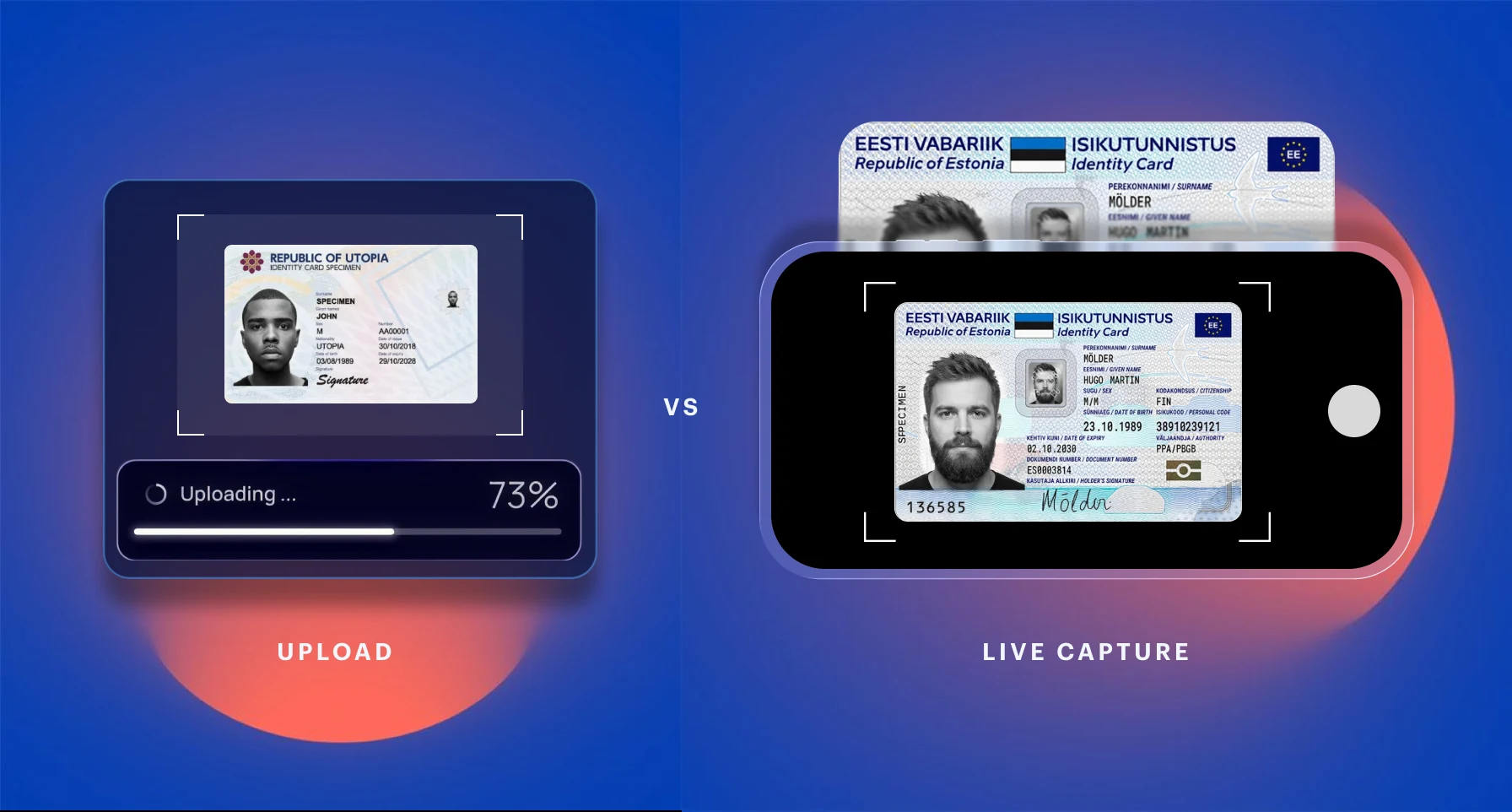
Document Upload vs Live Capture: What 29 Million Verifications Show
Uploads carry four times the fraud of live capture, and turn away 3.6 genuine customers for every fraudster stopped. Both numbers are measurable. Which one matters more depends on your business.
A growing number of verification vendors have stopped allowing it. They want a live capture taken inside the flow, and they describe the restriction as a security measure.
On the security part they have a case, and we will make it more bluntly than most vendors would in public. What almost nobody does is work out the other side of the ledger, which is that a ban turns away around 3.6 genuine customers for every fraudulent one it stops. That ratio holds whether you verify forty thousand people a year or forty million.
The right answer depends on your device mix, your risk appetite and the sector you operate in, and it is not the same answer for a consumer wallet and a private bank. These are the numbers the decision turns on, measured rather than asserted.
What is inside 100 uploaded documents.
Base: every 100 uploaded documents. The widths follow the measured rates exactly.
A ban on upload would block not only fraud but also the 62.22% genuine users.
Source: Shufti sample of more than 29 million document checks, January to June 2026, across multiple client deployments. Segments derive from a 37.78% upload rejection rate, of which 17.37 points are fraud caught by forensic checks.
Uploads carry four times the fraud, and twice the rejections
In a sample of 29 million document checks from the first half of 2026, forensic checks caught fraud on 17.37% of uploaded documents and 4.03% of live captures. Those two figures are made of three things, and it is worth seeing them separately.
Rejection analysis
Rejections by channel
As a share of each channel’s own attempts
Every rate is a share of that channel's own attempts, so each block adds up to the bold row beneath it. The three fraud categories overlap very slightly, which is why they come to 17.39 against a measured 17.37.
Read the two bold rows together and the shape of the problem changes. We reject uploads 2.4 times as often as live captures, but we catch fraud on them 4.3 times as often, and the difference between those multiples is photo quality.
Of the 22 points separating the two rejection rates, 13.34 are fraud and 8.72 are blur, glare, expired cards and photographs of the wrong page. So anyone quoting the full 22 points as a security gap overstates it by about two thirds.
That second block also punctures the idea that uploads are the frictionless option. One upload in five fails for reasons that have nothing to do with fraud, so a flow that takes files without checking them at the point of submission has swapped one kind of drop-off for another.
The reason sits in the mechanics rather than in anything about the people involved. Editing a document requires a file to edit, and a live capture never produces one. The image travels from the physical document to the camera to a decision without ever resting somewhere it could be opened, which is why file-based manipulation appears on the upload path and almost nowhere else.
That gap is real and it is not in dispute. What closing it costs is the other half of the decision, and few teams ever measure it.
Most upload fraud is copies and screenshots, not forgery
Ask most risk teams to picture upload fraud and they will describe a doctored passport, cloned hologram, altered date of birth. Look again at where that 17.37% comes from.

Of every 100 documents uploaded, around 9 are not original, 7 are photographs of a screen, and 1 has been altered or edited. Put another way, forgery is 7.2% of the fraud caught on the upload path. Copies and screen photographs are the rest.
Most policies are written against the opposite distribution. More than 90% of what we catch was never a live document at all, meaning a copy, a screenshot, or an image that has circulated long enough for someone to have seen it before.
These are the failures detection handles well. A photograph of a laptop screen carries moiré patterns and reflections that survive any amount of care on the fraudster's part, and a document already in circulation can be matched against documents already in circulation. The seventeen-fold figure on altered documents makes the better headline, but it describes just over 1 upload in 100, and building policy around it means solving for the wrong attack.
A ban stops the fraud you were already stopping
There is a quieter problem with the ban, and it holds even if you accept every risk figure above.
We caught the fraudulent uploads inside that 17.37%. A ban prevents nothing detection had not already prevented, so whatever it is worth sits entirely in the fraud that slips past today, and nobody in this industry publishes that number.
So the trade is asymmetric. On one side, a benefit nobody can currently size. On the other, a cost you can count to the decimal place.
Your device mix decides what a ban costs you
In this sample, 9.8% of genuine completions arrived as uploads, and you should be careful with that number, because these clients skew heavily to mobile and yours may not. The per-device rates travel better.
Calculate What an Upload Ban Could Cost You
Pick the profile closest to your traffic, or set your own genuine completion rate by device.
Pick a profile
Or Set where your genuine customers come from
If you block uploads, you risk blocking
of all your genuine customers.
Of all customers onboarded what % comes from live capture or upload on each device (Shufti sample)
91.0% live capture9.0% upload
40.8% live capture59.2% upload
94.5% live capture5.5% upload
90.2% live capture9.8% upload
Calculation: (mobile share × 9.04%) + (desktop share × 59.16%) + (tablet share × 5.52%). Per-device rates from the Shufti sample of more than 29 million document checks, January to June 2026.
Desktop is the only row that inverts, and the reason is physical. A webcam pointed at an ID held at arm's length produces exactly the blurred, glared image your own quality checks throw out, so most laptop users send a file instead.
Run those against your own traffic mix and the answer moves a long way. A consumer app onboarding almost entirely on phones lands around 10%, while a lender where a third of applicants apply on a laptop lands closer to 26%, on identical fraud controls.
For a business whose customers apply from work, that makes an upload ban close to a desktop ban.
Mobile matters just as much. Roughly one in eleven genuine mobile users uploads a file despite holding a phone with a perfectly capable camera, which tells you something useful about who they are. They are not evading anything. Their passport is simply in a drawer somewhere else at the moment you asked for it.
Some of them will switch to the camera. Nobody has measured how many.
The obvious objection to all of this is that those customers are not lost, only redirected. Close the upload path and they will take the photo you asked for.
Some of them will. The honest answer is that nobody knows what share, ourselves included, because this data covers what people did when both routes were open, not what they would do if one were taken away.
What it does show is that these were choices rather than accidents. Upload sat alongside live capture in the same flows, and 9.8% of genuine customers took it anyway. On desktop, 59.2% did. People do not pick the slower route with a working camera in front of them unless the camera is not working for them.
Three things keep the switch rate below 100%. A document that is not in the room cannot be photographed, whatever the flow asks for. A laptop webcam pointed at an ID at arm's length produces exactly the blurred, glared image your own quality checks reject. And every extra step costs you people, because noticing the upload button has gone, hunting down the document, finding decent light and starting again is a retry, and retries do not all finish. Even the customers who do switch meet an 11.69% quality rejection rate on the live capture path.
So a ban does not delete 9.8% of your genuine completions. It converts them from a completion you can count into a retry you cannot, and the true loss sits somewhere between zero and that figure.
Whoever proposes the ban should have to say where, with evidence. In most of the conversations we sit in, people put that figure at zero, and they assume it rather than measure it.
Measured as a filter, a ban has perfect recall and low precision
Underneath the security language, an upload ban is a fraud filter with a single rule.
Its recall is perfect, since refusing every upload catches every fraudulent one. Its precision is low, because 3.6 of every 4.6 documents it blocks belong to real customers. Teams judge every other fraud control on those two numbers. Few write a ban down in the same terms, because it arrives as policy rather than as a model.
Detection reaches the same decision with evidence attached, and the distance between the two is precision. Every vendor blocks fraud. Far fewer can tell you how many genuine customers they turn away doing it, and that number is what decides whether the fallback is worth having.
Not every vendor can tell a real document from a fake

The US Department of Homeland Security put seven document validation systems through its Remote Identity Validation Rally in 2025. False rejection of genuine documents ranged from 0.60% to 97.30% across those seven, and false acceptance of fraudulent ones from 0.88% to 76.68%. One system turned away almost every legitimate document it saw, while another let through three quarters of the fakes.
That spread is worth holding in mind when a vendor tells you uploads cannot be made safe, because the statement may describe their detection rather than the channel. Where a system cannot separate a genuine upload from a manipulated one, banning the channel is the only lever it has.
How to decide which user's can see a document upload option?
Keeping both routes open is not one decision. It is four, and together they separate a graded policy from an open door.
Which route you ask for first does the most work. Live capture carries roughly a quarter of the fraud rate, so flows that keep both usually open with it rather than putting the two side by side.
Timing decides how much volume moves. Put the fallback on screen at the start and it becomes a choice. Hold it back until someone has failed two or three capture attempts, or until the device reports no usable camera, and it reaches the people who need it without inviting everyone else along.
Risk tier decides who never sees it at all. Plenty of teams strip the fallback out entirely for high-value onboarding, a politically exposed match, or an account opened from a high-risk jurisdiction, reasoning that losing that customer costs less than getting them wrong. Where you draw that line is a matter of appetite, and it moves by sector.
The last lever is the one teams tend to inherit rather than choose. When an upload trips a forensic signal, failing it outright and escalating it to live capture or human review carry very different false-positive costs, and somebody picked one of those without necessarily deciding to.
All four rest on the same capability, which is a system that can tell a live capture from an upload from a photograph of a screen, and act differently on each. Without it there is no fallback to design, and the decision collapses back to allow or ban.

Shufti’s approach to document capture
We classify every image that reaches us as a live capture, an upload or a screen grab before verification runs, which is what turns a graded policy from an idea into something you can configure. High-value onboarding can require live capture while lower tiers accept uploads, with the heavier forensic layers concentrated where the risk actually sits.
On precision, DHS tested our selfie-to-document matching at a threshold set for a false match rate of one in ten thousand, and we returned a false non-match rate under 0.68% with no extraction failures on either image. That is a different problem from document forensics and we are not going to pretend otherwise. It is, though, what a precision claim looks like once somebody independent has checked it, which makes it a fair standard to hold any vendor to.
Five questions worth answering before you decide
Most of this comes down to whether anyone in the building can answer five questions.
What share of our genuine completions currently arrives by upload, broken down by device?
Without that, you are pricing one side of the trade at zero.
What is your false rejection rate on genuine uploads, at a stated false acceptance rate?
Has anyone outside your company measured that?
Can your system tell a live capture from an upload from a screen grab, and treat each differently?
What happens to a genuine customer who cannot take a live photo right now?
Methodology: Figures come from a selected sample of more than 29 million document checks drawn from January to June 2026 across multiple client deployments. Rates vary by sector, geography and customer profile, so they are best used to calculate against your own data rather than read as a forecast.