


 Face Verification
 Address Verification
 Document Verification
 Age Verification
 VideoIdent
 Fast ID
 eIDV
eIDV
 Consent Verification
 NFC Verification
 Business Verification
 Due Diligence
 Investor Verification
 E-Signature

 QES
QES
 AML Screening
 Transaction Monitoring
 Adverse Media
 Business AML Screening
 PEP & RCA
 Sanctions
 Watchlist
 Behavioural Biometrics
 Device Fingerprinting
 Biometric Face Authentication
 MFA
MFA
 Fraud Hub
 Onboarding
 Ongoing Monitoring
 KYC
KYC
 KYB
KYB
 KYI
KYI
 Age Assurance
 Identity Verification
 Workforce IAM
 Candidate Verification
 Compliance
 Fraud prevention
 Trust & safety
 Global expansion
 Product Managers
 Compliance Officers
 Fraud Analysts
 Developers
 Deepfake
 Bonus Abuse / Promotion Abuse
 Account Takeover
 Synthetic Identity Fraud
 Document Fraud
 Impersonation Fraud
 Multi-Accounting
 Fraud Networks
 Chargeback Fraud
 Money Mule Activity
 Party Fraud
 Regulatory & Compliance Risks
 Fintech
 Crypto
 iGaming
 Forex
Forex
 Social Network
 Marketplace
 Banking
 Gig Economy
 Blind Spot Audit
 Deepfake Detector
 Liveness Spoofs
 Document Originality
 Document Deepfake
 Global Trust Platform
 Journey Builder
 Case Management
 Shufti AI
 Fraud Analytics
 Vendor Comparison
 Brand Personalisation
 IDV Modes
 AI Compliance Co-Pilot
 OCR
OCR
 Secure Capture
 Deployment Options
 Identity Methods
 API Documentation
 Mobile SDKs
 Service Status
 Help Center
 Contact Us
 Technical Support
 Supported Documents
 Supported Countries
 Content library
 Blogs
Blogs
 News
News
 Reports
 Insights
 Knowledgebase
 ROI calculator
 About
About
 Career
 Press Release
 Certifications
 Partnership
 Awards
 Events & Webinar
 Interactive Demo
 Podcast Studio
 Spotlight Studio
OFAC Compliance for Fintech: Why Enforcement Is No Longer Someone Else’s Problem
TL;DR
- Fintechs processing payments, crypto, or cross-border transfers carry direct OFAC exposure.
- In December 2025, OFAC settled a $3.1 million case against wallet provider Exodus.
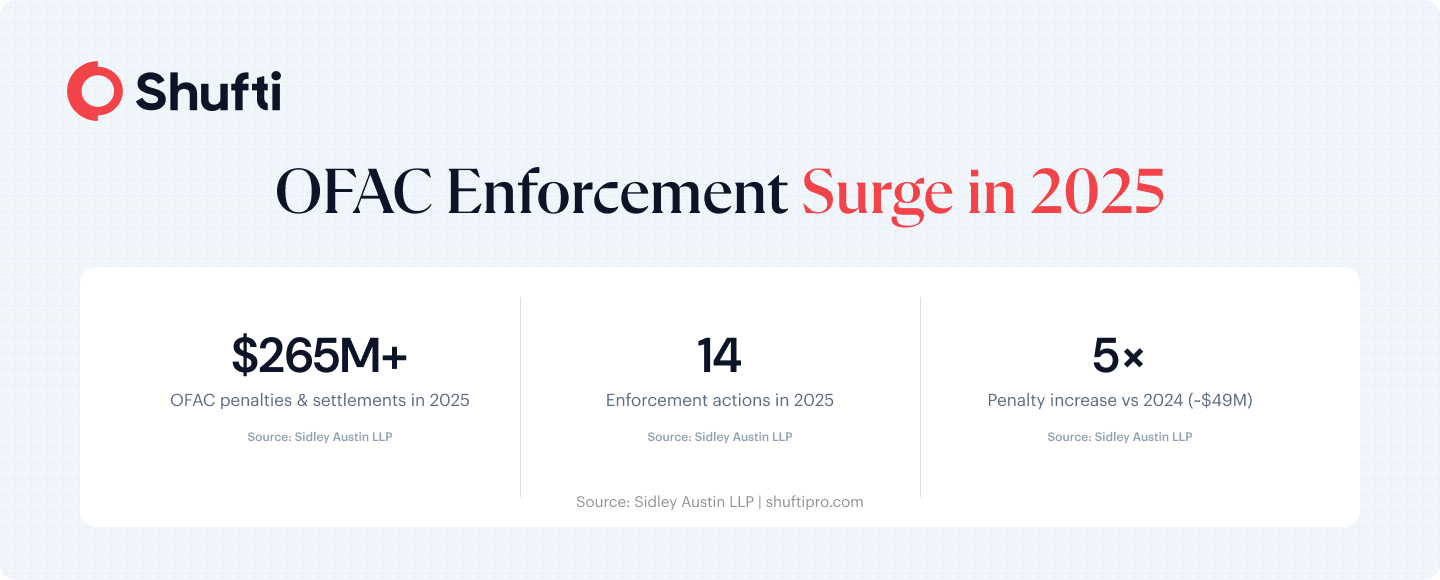
- Total OFAC penalties exceeded $265 million in 2025, up from roughly $49 million in 2024.
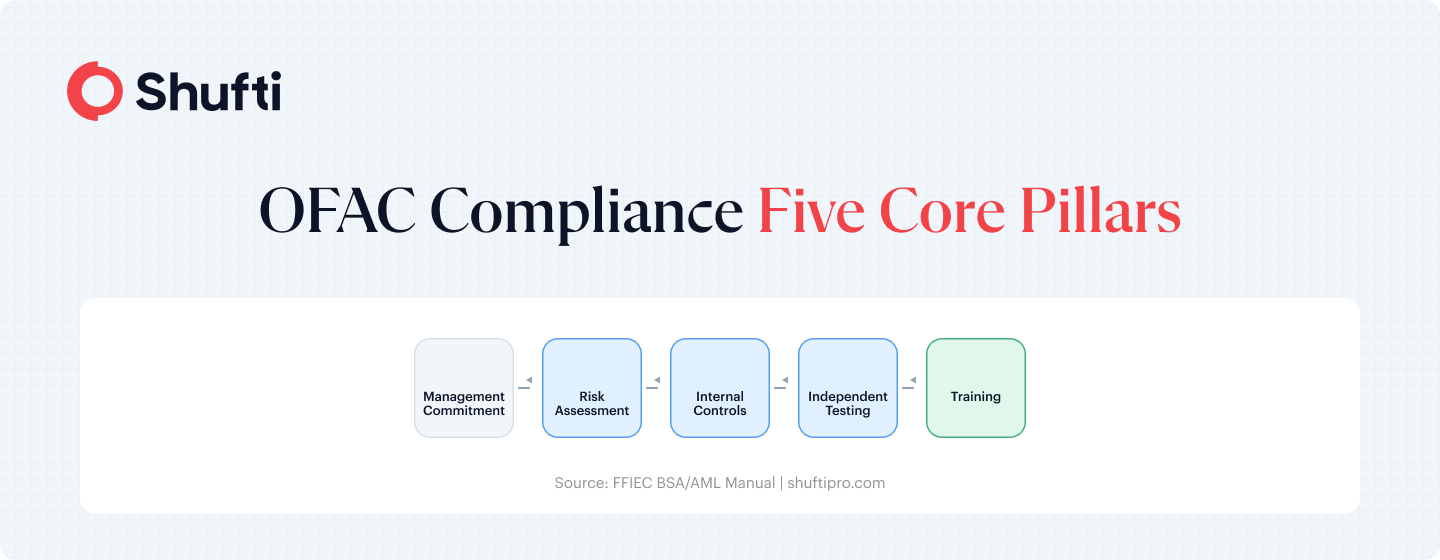
- A sound program rests on five components, from management commitment to training.
- Shufti refreshes OFAC, UN, EU, and UK list data every 15 minutes.
In December 2025, the Office of Foreign Assets Control (OFAC) settled a $3.1 million enforcement case against Exodus, a US-based non-custodial software wallet provider, for processing transactions involving users in comprehensively sanctioned jurisdictions. The wallet was not a bank, and the company was not a traditional financial institution. OFAC found violations regardless. Fintechs processing payments, digital assets, or cross-border transfers cannot treat sanctions compliance as someone else’s obligation, and the 2025 enforcement record makes that position harder to hold than it was at any prior point.
OFAC is a US Treasury office that administers and enforces economic and trade sanctions against targeted foreign governments, entities, and individuals. Every US person, including companies incorporated in the United States and their foreign branches, must comply with OFAC regulations. For most fintechs, the requirement covers screening against OFAC’s sanctions lists before processing transactions and blocking or rejecting any transaction involving a designated party.
What is OFAC and who does it apply to?
OFAC derives its authority from presidential emergency powers and statutes including the International Emergency Economic Powers Act (IEEPA) and the Trading With the Enemy Act (TWEA). Its primary enforcement tool is the Specially Designated Nationals and Blocked Persons (SDN) List, a database of individuals, entities, and cryptocurrency wallet addresses that US persons are prohibited from transacting with. OFAC also administers country-level sanctions programs covering Cuba, Iran, North Korea, Russia, and others, where entire categories of transactions are prohibited or require an OFAC license. Understanding who the rules reach, and through which structures is the first compliance question every fintech needs to answer.
Who is a “US person” under OFAC rules?
Under OFAC’s framework, a US person includes US citizens and permanent residents regardless of where they are located, entities incorporated under US law, and all persons physically present in the United States. Foreign branches of US entities are covered under most sanctions programs. Foreign subsidiaries face full coverage under country-specific regimes such as Cuba and North Korea. For fintechs with global user bases, this means OFAC screening applies to any transaction flowing through a US-incorporated entity or a US correspondent banking relationship, even where the fintech itself is headquartered outside the United States.
What does OFAC specifically require fintechs to do?
At a minimum, fintechs must screen customers, counterparties, and transactions against the SDN List and other OFAC-administered sanctions lists before those transactions are processed. Any property of a designated party that comes into the fintech’s control must be blocked and reported to OFAC within 10 business days. Transactions that are prohibited but do not involve blockable property must be rejected, also with a report filed within 10 business days. Records of blocked and rejected items must be maintained for at least five years. The FFIEC BSA/AML Manual notes that OFAC compliance is a separate and additional obligation from Bank Secrecy Act (BSA) and AML requirements, though a functioning fintech compliance program needs to address all three in an integrated way. For a closer look at what that means in practice for sanctions list screening, the global regimes involved go beyond the SDN List alone.
Why do fintechs face heightened OFAC enforcement risk?
OFAC’s 2025 enforcement calendar confirmed a shift in the agency’s targeting. Actions were brought against a digital asset exchange, a financial technology company, and a global electronic broker-dealer, demonstrating that OFAC’s sanctions compliance expectations apply across the financial sector. This matters for any fintech that assumed its regulatory exposure sat primarily with its banking partners rather than with its own compliance program.
How does the 2025 enforcement data reflect OFAC’s priorities?
According to Sidley Austin’s review of 2025 US sanctions enforcement, total OFAC penalties and settlements exceeded $265 million in 2025, compared with approximately $49 million in 2024. OFAC issued 14 enforcement actions, up from 12 in 2024, and issued three penalty notices rather than the single one issued in each of the two prior years. The 2026 review identified four consistent enforcement themes across the actions: Russia-related sanctions violations, liability for advisers and intermediaries acting as gatekeepers, rejection of overly formalistic ownership analyses, and heightened scrutiny of non-bank financial institutions, including digital asset businesses. The fourth theme is the one most directly relevant to fintech compliance teams.
Why do cross-border payments and crypto carry specific OFAC exposure?
A fintech processing high transaction volumes through a rules-based screening filter running on a list that updates on a weekly cycle carries three risks at once. False negatives can emerge from incomplete data coverage. False positives from imprecise name-matching logic create review backlogs. And there is a lag between when OFAC designates a party and when the screening system reflects that designation. OFAC’s Sanctions Compliance Guidance for the Virtual Currency Industry calls out geographic IP blocking and blockchain address screening as baseline controls for crypto-adjacent businesses, not optional enhancements. Missing either control makes a violation more likely and a voluntary self-disclosure less persuasive to OFAC when calculating the enforcement response.
Building an OFAC compliance program that holds up
OFAC does not require a specific program structure by regulation, but its Framework for OFAC Compliance Commitments and the FFIEC examination guidance point to the same five components as markers of a sound program. Designing around these components matters practically as well as regulatorily: OFAC weighs program adequacy when determining enforcement responses, which means a documented, functioning program can reduce the penalty outcome even when a violation has occurred.
The five core components
The FFIEC’s OFAC examination guidance identifies five elements that define a credible program. Management commitment means documented executive ownership, with the program’s scope and resources approved at a senior level. Risk assessment means mapping which products, customer types, and geographies carry the highest OFAC exposure so the screening program reflects actual risk rather than generic categories. Internal controls cover the policies, procedures, and technology for screening customers and transactions, identifying hits, resolving matches, blocking property when required, and filing reports within the 10-business-day window.
| Component | What it requires |
| Management commitment | Documented executive ownership, scope and resources approved at senior level |
| Risk assessment | Mapping products, customer types, and geographies by OFAC exposure |
| Internal controls | Screening, hit resolution, blocking, and 10-day reporting workflow |
| Independent testing | Objective review by internal audit or external party |
| Training | Role-specific instruction for onboarding, payments, and data staff |
Independent testing means an objective review of the program, proportionate to the fintech’s risk profile, conducted by internal audit or an external party. Training means role-specific instruction for any employee who touches onboarding, payments, or customer data. Compliance professionals building or auditing these programs can also find operational depth in the sanctions screening guide for compliance professionals, covering how each control typically performs in production.
Where do fintech OFAC programs typically fall short?
Four gaps appear consistently in fintech programs. List currency is the most common: many fintechs screen against a copy of the SDN list that updates weekly or monthly, while OFAC updates the list after each designation, often in near real-time. A 24-hour lag on a high-volume platform is a real exposure window, not a theoretical one. Data coverage is the second gap: screening customer names without screening counterparties, beneficiaries, and, for crypto products, blockchain wallet addresses leaves the program incomplete. Match resolution is the third: having the screening logic but no documented process for investigating, escalating, and closing a flagged match means the system cannot demonstrate that hits were properly assessed. Reporting workflow is the fourth: the 10-business-day window for filing blocked and rejected transaction reports with OFAC requires a built operational process, not just a stated policy.
How does Shufti help fintechs meet sanctions screening requirements?
The operational challenge for fintech compliance teams is running OFAC screening alongside broader sanctions and AML obligations in real time, across high transaction volumes, without overwhelming analysts with unresolved flags. Shufti’s AML screening covers 215+ sanction regimes, including OFAC, UN, EU, and UK sanctions lists, with list data refreshed every 15 minutes. That refresh cadence closes the list-currency gap that sits at the root of many fintech violations: the screening reflects the current state of the SDN List rather than a weekly snapshot.
The AML screening runs through the same API as identity verification checks, so a fintech can run document verification, biometric matching, and sanctions screening inside a single onboarding workflow rather than stitching together separate processes. For payment and transaction-level coverage, Shufti’s transaction screening handles counterparty and wallet address checks. When a match is flagged, the platform surfaces the matched list entry and the reason for the flag, giving analysts the context to resolve it rather than escalating every hit to manual review.
When a fintech processes cross-border payments or digital asset transactions without a current, comprehensive sanctions screening layer, it carries regulatory exposure that a single enforcement action can turn into a seven-figure settlement. Request a demo to see how OFAC and sanctions screening runs inside your onboarding and payment workflows.
Frequently Asked Questions
What is OFAC and why does it matter for fintech companies?
OFAC is the US Treasury office responsible for administering and enforcing economic sanctions. It matters for fintechs because all US persons, including US-incorporated payment companies, digital asset platforms, and financial software firms, must screen customers and transactions against OFAC sanctions lists and block or reject any transaction involving a designated party.
What is the SDN list and how do fintechs screen against it?
The Specially Designated Nationals (SDN) List is OFAC's core enforcement tool, containing named individuals, entities, and cryptocurrency wallet addresses. Fintechs screen against it by running customer names, counterparty details, and transaction data through a sanctions screening solution that checks each element against the current SDN List and other OFAC-administered lists before the transaction is processed.
What are the five components of an OFAC compliance program?
OFAC's framework identifies five components: management commitment, risk assessment, internal controls, independent testing, and training. Together these allow a fintech to identify potential violations, respond appropriately, file required reports within the 10-business-day window, and demonstrate program quality to regulators if an issue arises.
What happens if a fintech violates OFAC sanctions?
OFAC can impose civil penalties for apparent violations regardless of intent. In 2025, total OFAC penalties and settlements exceeded $265 million across 14 enforcement actions. OFAC weighs program adequacy, voluntary self-disclosure, and corrective action when setting penalties, so a documented, functioning program can reduce the outcome considerably.
How is OFAC compliance different from AML compliance?
OFAC compliance and Anti-Money Laundering (AML) compliance are legally separate obligations. AML requirements under the Bank Secrecy Act (BSA) cover transaction monitoring, customer due diligence, and suspicious activity reporting. OFAC requirements focus on blocking transactions involving sanctioned parties. Both obligations apply to fintechs and need to work together in the compliance stack.