AMLR Solutions
  AMLR Consultation
 EUDI Wallet
 Onboarding
 Ongoing Monitoring
 FRAML
FRAML KYC
KYC KYB
KYB KYI
KYI Age Assurance
 Workforce IAM
 Candidate Verification
 Account Takeover
 Bonus/ Promotion Abuse
 Chargeback Fraud
 Deepfake
 Document Fraud
 Fraud Networks
 Impersonation Fraud
 Money Mule Activity
 Multi-Accounting
 Party Fraud
 Regulatory & Compliance Risks
 Synthetic Identity Fraud
 Adult Content
 Banking
 Crypto
 Fintech
 Forex
Forex Compliance
 Fraud prevention
 Trust & safety
 Global expansion
 Compliance Officers
 Developers
 Fraud Analysts
 Product Managers
 Journey Builder
  Global Trust Platform
 Customer Profiles
 Vendor Comparison
 IDV Case Management
 AML Case Management
 Regulatory Reporting
 Agentic Rule Builder
  AI Compliance Co-Pilot
  Fraud Analytics
 Fraud Hub
  OCR
OCR Shufti AI
 Bank Account Verification
  Biometric Duplication
 Database Checks
 Document Intelligence
 Government ID
 Mobile Driver's License
 NFC
NFC Selfie Liveness
 Brand Personalisation
 Deployment Options
 Identity Methods
 IDV Modes
 Multi-tenancy
 On-Premise IDV
 Secure Capture
 Shufti MCP













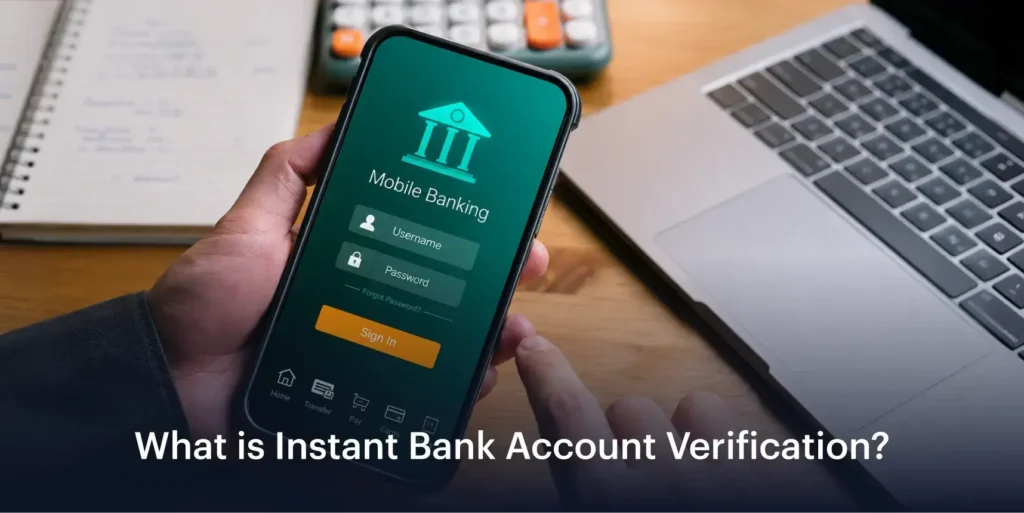

Instant bank account verification, also called instant account verification (IAV), confirms in real time that a bank account is open and that the name held on it matches the customer in front of you, using an API call to bank-held data instead of a test deposit that usually takes days to settle. What is legally required of you varies by market, from Nacha’s account validation rule in the US to payee name matching under Regulation (EU) 2024/886 in the EU.
What does instant account verification actually check?
Instant bank verification answers two separate questions, and it is worth keeping them apart because regulators treat them differently.
- Does the account exist and accept payments?: A status check confirming the account is open, live, and reachable for credits or debits.
- Does the account belong to this customer?: A name check comparing the account holder of record against the name you verified during identity verification.
Nacha’s rule covers only the first question. Its own guidance states that the WEB debit rule does not require an originator to validate ownership of the account, only that the account is a legitimate, open account to which ACH entries may be posted. Ownership verification sits above the minimum standard, as a risk-based decision you make yourself.
An open account can still be a mule account
An account that is open and reachable can still be a mule account. Confirming the account exists tells you the payment will land. It does not tell you the person collecting the money is the person you onboarded, which is the whole point of money mule detection and payout controls.
What an instant account verification returns
| Return type | What you get | Best used for |
| Full name return | The name registered on the account | Matching against the name on file |
| Masked name return | A partially obscured name | Initial-level matching where disclosure is restricted |
| Match status (pass/fail) | A verdict, with no name exposed | Markets with strict data disclosure limits |
| IBAN validation | Country-specific structure confirmed | Blocking malformed IBANs pre-payment |
| IBAN checksum | Check digits validated | Catching transposition errors and typos |
| Account existence | Account is active and reachable | Lightweight pre-payment status check |
The first three answer the ownership question. The last three answer the existence question.
How instant bank account verification works
There are three delivery models, and they differ in who holds the customer’s credentials.
1. Open banking and API-based access
The customer authenticates with their bank and consents to share account data. In the EU this runs on the account information service framework in Directive (EU) 2015/2366, which gives the customer a right to use an account information service provider and requires explicit consent for each access.
2. Credential-based access through a data aggregator
The customer types their online banking username and password into a third-party aggregator, which signs in as them and retrieves account and identity data. This is not open banking, and treating the two as one model is the most common error in vendor documentation. Aggregator access returns richer data than a database lookup, including account holder name, balances, and transaction history, which is why it is often used to answer the ownership question in markets without mandated API access.
The distinction is written into US law. Under 12 CFR 1033.311(e), a data provider must not let a third party reach its developer interface using the credentials a consumer uses for the consumer interface. Part 1033 remains codified, though the CFPB opened a reconsideration of the rule in August 2025, so confirm current status before you rely on its compliance dates.
3. Database and payment-network lookups
The account number or IBAN is checked against bank-held or scheme-held records without customer login. This is the same class of check as any other database check and is what makes docless verification possible in markets where the data is available.
| Model | Customer does | Credentials shared with a third party | Answers ownership |
| Open banking API | Authenticates at their own bank | No | Bank-authenticated access and, where available, account-holder verification |
| Credential-based aggregation | Enters bank login into the aggregator | Yes | Account access, but not always rightful ownership |
| Database or network lookup | Nothing | No | Name/account match where returned by the network or database |
Instant bank verification vs micro-deposits and prenotes
Nacha is explicitly method-neutral and recognises prenotification entries, micro-entries, commercial validation services, and API-enabled validation as valid approaches.
| Method | Time to result | Operational catch |
| Instant API or database check | Seconds | Coverage gaps in some markets, backfill with another method |
| ACH prenotification | Days | Non-response inside the return window can be treated as validation |
| Micro-deposits (penny drop) | Two to three days | The customer must confirm the amounts back to you; silence is not validation and live entries are prohibited until they do |
The micro-deposit catch is the one which teams underestimate. Nacha prohibits originating live entries where the receiver never completes the confirmation step, even if the micro-entries were not returned. A drop-off in that flow is not a soft failure, it is a blocked payment.
Bank Account Verification rules by Jurisdiction
| Jurisdiction | Requirement | Trigger point |
| EU | Verification of Payee, Article 5c of Regulation (EU) 2024/886 | Before the payer authorises a euro credit transfer |
| UK | Confirmation of Payee, PSR Specific Direction 17 | Before a Faster Payments or CHAPS payment is sent |
| US | Account validation for first-use consumer WEB debits, Nacha | First use of an account number, and any change of account number |
| Global | FATF Recommendation 10 customer due diligence | Establishing a business relationship |
Confirmation of Payee and Verification of Payee are payment-time payee-matching duties owed by payment service providers, not onboarding mandates. They do not tell you to verify account ownership when a customer links an account. That control is yours to design, and the FATF Recommendation 10 obligation to verify identity using reliable, independent source data is the standard it should meet.
How Shufti’s Bank Account Verification Works
Shufti Bank Account Verification is delivered through a single API. Depending on the country’s banking infrastructure, regulatory requirements, and bank data-sharing policies, the bank account verification API returns the richest response permitted by that market. This enables customers to integrate once while automatically receiving the most appropriate response type for each jurisdiction.
Learn more about Shufti’s Bank Account Verification service and how it confirms account ownership before payouts, withdrawals, and beneficiary changes are approved.
Frequently Asked Questions
How long does instant bank account verification take?
Seconds, in markets where bank-held data or open banking access is available. Where coverage is missing, Nacha permits supplementing an instant service with prenotification or micro-entries for the remaining accounts.
Is instant bank verification safe?
Open banking checks run on the customer's explicit consent under Directive (EU) 2015/2366, which bars the provider from requesting sensitive payment data or storing it for any purpose beyond the requested service. Database lookups need no customer credentials at all.
Instant verification vs micro-deposits, what is the difference?
Micro-deposits send small test amounts the customer must confirm back, taking two to three days. Instant verification queries bank-held or scheme-held data directly and returns a result in seconds. Nacha accepts both.
Does instant verification prove account ownership?
Only if the check returns a name or a name-match verdict. An account existence check confirms the account is open and reachable, nothing more, which is why Nacha treats ownership verification as a separate risk-based step.