AMLR Solutions
 AMLR Consultation
 Onboarding
 Ongoing Monitoring
 FRAML
FRAML KYC
KYC KYB
KYB KYI
KYI Age Assurance
 Workforce IAM
 Candidate Verification
 Account Takeover
 Bonus/ Promotion Abuse
 Chargeback Fraud
 Deepfake
 Document Fraud
 Fraud Networks
 Impersonation Fraud
 Money Mule Activity
 Multi-Accounting
 Party Fraud
 Regulatory & Compliance Risks
 Synthetic Identity Fraud
 Adult Content
 Banking
 Crypto
 Fintech
 Forex
Forex Compliance
 Fraud prevention
 Trust & safety
 Global expansion
 Compliance Officers
 Developers
 Fraud Analysts
 Product Managers
 Advanced Journey Builder (AJB)
 Global Trust Platform
 Customer Profiles
 Vendor Comparison
 IDV Case Management
 AML Case Management
 Regulatory Reporting
 Travel Rule Protocols
 Agentic Rule Builder
 AI Compliance Co-Pilot
 Fraud Analytics
 Fraud Hub
 OCR
OCR Shufti AI
 Bank Account Verification
 Biometric Duplication
 Database Checks
 Document Intelligence
 Government ID
 Mobile Driver's License
 NFC
NFC Selfie Liveness
 Brand Personalisation
 Deployment Options
 Identity Methods
 IDV Modes
 Multi-tenancy
 On-Premise IDV
 Secure Capture











Sanction lists are expanding regularly and sanctions imposed by different authorities do not always align. Coupled with this, the definition of a sanction list has broadened and is open for interpretation, making it challenging for companies to identify and manage risks effectively. Before diving deeper into global sanction lists and how to stay compliant, let’s first comprehend what the AML sanction list is.
Understanding the AML Sanction List
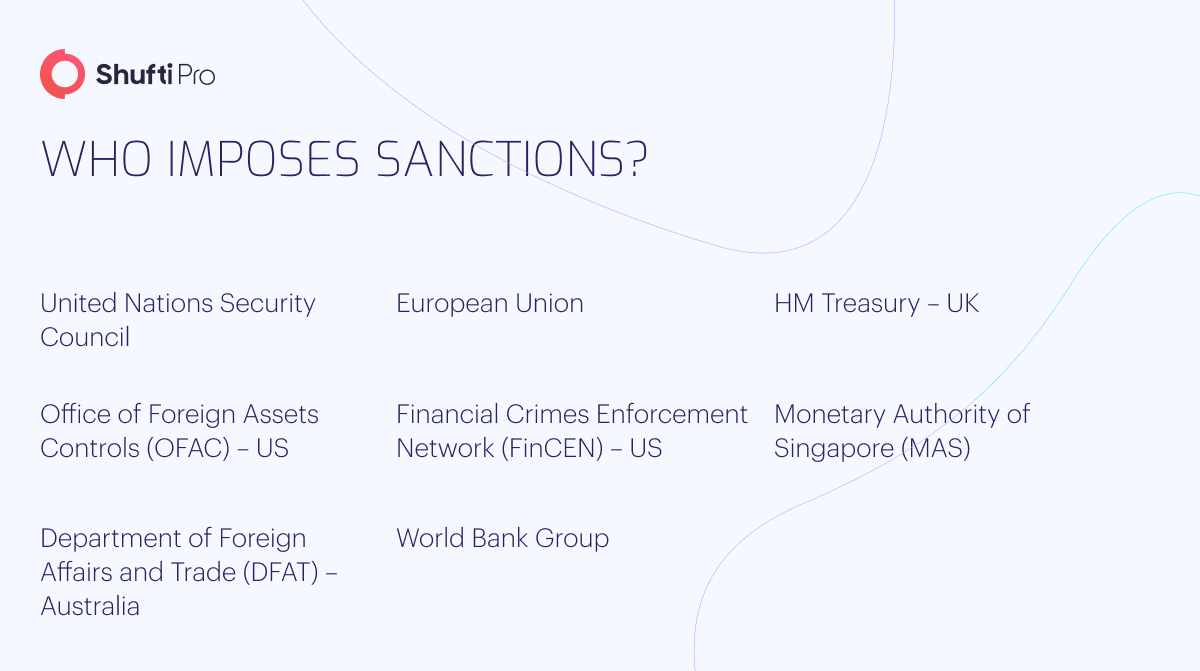
AML sanctions apply to any individual, country, and organisation identified by national and international bodies for involvement in financial crimes, such as money laundering and terrorist financing. Financial firms and other businesses use these lists to identify and prevent transactions with entities and individuals subject to sanctions. The sanction lists are compiled and maintained by national and international authorities such as the European Union, the United Nations Security Council, and the Office of Foreign Assets Control (OFAC) in the US.
The Key Sanction Lists in Different Countries
Sanctions regimes vary from country to country. Some countries implement sanctions imposed by international bodies such as the EU or the UN, whilst others develop autonomous sanction programs having their sanction lists.
Here are the primary sanction regimes worldwide:
-
United Nations
The UN’s sanction list, also known as the UNSC Consolidated List, comprises two sub-lists: one targeting individuals and the other comprising groups and entities. United Nations Security Council (UNSC) imposes UN sanctions when it determines that the country is violating international regulations, threatens peace by committing
crime.
-
United States of America
Arguably one of the most influential sanction regimes globally, the US imposes multiple sanction lists. The OFAC maintains two key sanction lists:
- The Specially Designated Nationals (SDN) List comprises individuals and businesses targeted by US sanctions.
- The Consolidated Sanction List includes details not mentioned in the SDN list.
The US Bureau of Industry and Security also manages the BIS Entity List, designating all global entities that mandate US citizens to have a licence before being involved in a trading relationship.
-
European Union
The EU’s Common Foreign and Security Policy (CFSP) requires the member states to execute EU sanctions. This implies screening individuals against the Global Human Rights Sanctions Regime (GHRSR) and European Union’s Consolidated Sanction List.
-
United Kingdom
Following its removal from the European Union, the UK implemented an autonomous sanction list executed by the Office of Financial Sanctions Implementation (OFSI) and Her Majesty’s Treasury (HMT). Thus, businesses operating in the UK must screen against the UK sanction list.
-
Australia
The Department of Foreign Affairs and Trade (DFAT) and the Australian Sanctions Office (ASO) enforce Australia’s independent sanction list, and firms are also required to screen individuals against the Consolidated Sanction List.
-
Canada
The government of Canada enforces a sanction regime under the Justice for Victims of Corrupt Foreign Officials Act (JVCFO) and the Special Economic Measures Act (SEMA). Organisations working in Canada are mandated to screen their clients against the Consolidated Canadian Autonomous Sanction List.
-
Japan
Japan’s sanction list is issued by the Foreign Exchange and Foreign Trade Act (FEFTA) and maintained by the Ministry of Finance (MoF) and the Ministry of Economy, Trade, and Industry (METI). Japan follows the United Nations in the sanction that it imposes but also works with global partners such as the EU and the US or imposes sanctions unilaterally.
-
China
The Chinese Ministry of Foreign Affairs can issue its autonomous sanction list. The country’s Ministry of Commerce (MOFCOM) has been introducing new sanctions laws since 2020 in response to Western sanctions. Therefore, firms in China are required to check their clients against the Unreliable Entity List (UEL) and follow the Anti-Foreign Sanctions Law (AFSL) and the Blocking Rules.
Sanction Lists: How they Help Satisfy AML Compliance
AML sanction lists must abide by AML regulations as they help financial firms recognise and prevent transactions with sanctioned individuals and organisations, mitigating the risk of money laundering, terrorist financing, and other financial crimes.
It is crucial to understand that sanctions change frequently, with fresh individuals or organisations being removed or added to the list based on the circumstances. Therefore, businesses must update their compliance systems regularly to stay informed of changes made to the AML sanction list and avoid any non-compliance penalties.
Best Practices for AML Compliance
- Ensure the data collection method is comprehensive and up-to-date to minimise false positives.
- Use a reliable AML screening solution capable of handling piles of data, is user-friendly, supports many languages and collects data 24/7.
- Keep up with the ever-changing sanction lists.
- Screen customers against the global sanction list before onboarding.
How Can Shufti Help?
Navigating the AML sanction lists is not an easy task to do. Screening your customer manually whilst factoring in the different lists available is not only inefficient but is prone to errors. This is where Shufti steps in. The globally trusted AML verification solution provider performs extensive checks against 1700+ global sanctions, watchlists, and Politically Exposed Persons (PEPs) lists to minimise false positives, enhance efficiencies, and protect firms from costly penalties.
Here’s what Shufti’s AML solution brings to the table:
- Comply with national and international AML regulations
- Identify client risk factors with a regularly updated database
- Conduct background checks of ultimate beneficial owners in real-time
- Perform an ongoing AML screening to identify existing high-risk customers
Want to know more about which AML solution is best for your company?