






 AMLR Solutions
 AMLR Consultation
 EUDI Wallet
 Onboarding
 Ongoing Monitoring
 FRAML
FRAML KYC
KYC KYB
KYB KYI
KYI Age Assurance
 Workforce IAM
 Candidate Verification
 Bank Account Verification
 Account Takeover
 Bonus/ Promotion Abuse
 Chargeback Fraud
 Deepfake
 Document Fraud
 Fraud Networks
 Impersonation Fraud
 Money Mule Activity
 Multi-Accounting
 Party Fraud
 Regulatory & Compliance Risks
 Synthetic Identity Fraud
 Adult Content
 Banking
 Crypto
 Fintech
 Forex
Forex Compliance
 Fraud prevention
 Trust & safety
 Global expansion
 Compliance Officers
 Developers
 Fraud Analysts
 Product Managers
 Advanced Journey Builder (AJB)
 Global Trust Platform
 Customer Profiles
 Vendor Comparison
 IDV Case Management
 AML Case Management
 Regulatory Reporting
 Agentic Rule Builder
 AI Compliance Co-Pilot
 Fraud Analytics
 Fraud Hub
 OCR
OCR Shufti AI
 Biometric Duplication
 Database Checks
 Document Intelligence
 Government ID
 Mobile Driver's License
 NFC
NFC Selfie Liveness
 Brand Personalisation
 Deployment Options
 Identity Methods
 IDV Modes
 Multi-tenancy
 On-Premise IDV
 Secure Capture


- Australia
- Austria
- Bangladesh
- Brazil
- Bulgaria
- Canada
- China
- Cyprus
- Egypt
- Estonia
- Eswatini
- Ethiopia
- France
- Germany
- Greece
- Haiti
- Hong Kong
- India
- Iraq
- Ireland
- Indonesia
- Italy
- Japan
- Jordan
- Kazakhstan
- Kenya
- Kosovo
- Kuwait
- Latvia
- Luxembourg
- Malaysia
- Malta
- Mauritius
- Mexico
- Micronesia
- Moldova
- Montenegro
- Morocco
- Mozambique
- Myanmar
- Namibia
- Nauru
- Nepal
- Nigeria
- Nicaragua
- Niue
- Norway
- Netherlands
- New Zealand
- Oman
- Pakistan
- Palau
- Palestine
- Panama
- Papua New Guinea
- Paraguay
- Peru
- Puerto Rico
- Philippines
- Portugal
- Portugal
- Qatar
- Republic of Congo
- Romania
- Russia
- Rwanda
- Samoa
- San Marino
- Senegal
- Serbia
- Seychelles
- Sierra Leone
- Singapore
- Slovakia
- Slovenia
- Somalia
- South Africa
- South Korea
- South Sudan
- Sri Lanka
- St Kitts and Nevis
- St Maarten
- St Lucia
- Sweden
- Switzerland `
- Syria
- Taiwan
- Tajikistan
- Tanzania
- Thailand
- Timor Leste
- Togo
- Tonga
- Trinidad and Tobago
- Turkey
- Turks and Caicos
- Turkmenistan
- Tunisia
- Tuvalu
- Uganda
- Ukraine
- UK
- Uruguay
- USA
- Uzbekistan
- Vatican City
- Vietnam
- Venezuela
- Vanuatu
Philippines
Identity Verification & KYC For Philippines
Shufti brings KYC, KYB, and AML screening into one workflow for the Philippines, aligned to BSP, AMLC, SEC, NPC, PSA-administered PhilSys, BIR, and PAGCOR requirements.
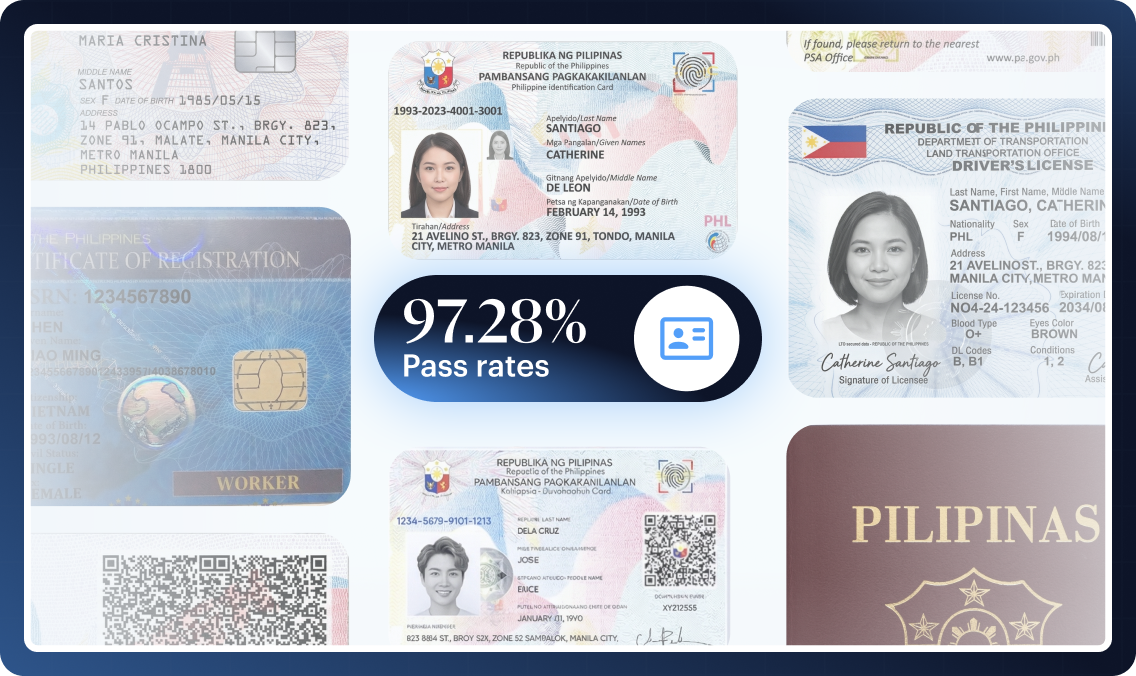
Operational performance for Philippines KYC
Our Numbers Speak Volumes
97.28%
Pass rates
< 5 sec
Verification
Time
98.77%
EIDV
Verification
Evidence-Ready Checks Across People & Businesses
Individual Documents We Verify
Shufti supports 26 Philippine document types used for regulated onboarding, including National ID formats, chip passports, and common government-issued fallback IDs.
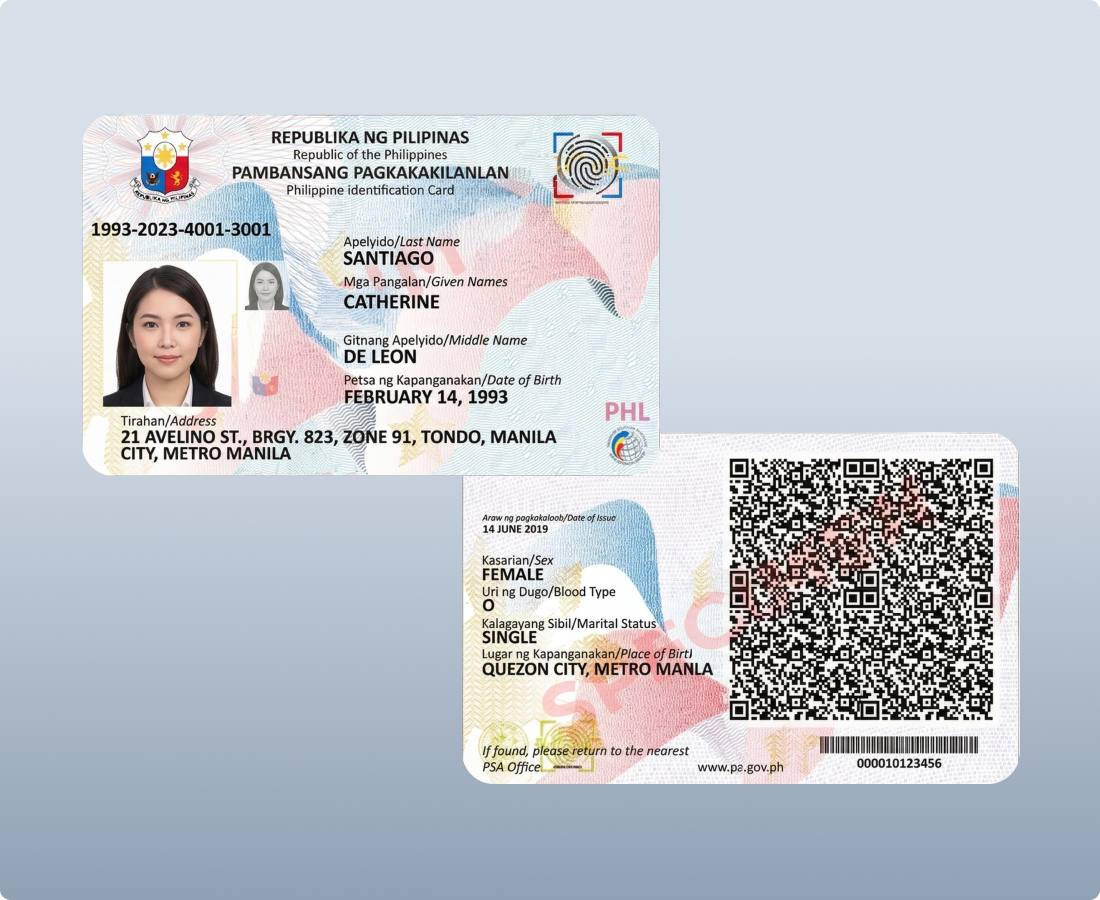
View All Supported DocumentsNational ID Card
Primary government ID for citizens and resident aliens. Used for identity proofing, account opening, and remote KYC across Philippine regulated onboarding flows.
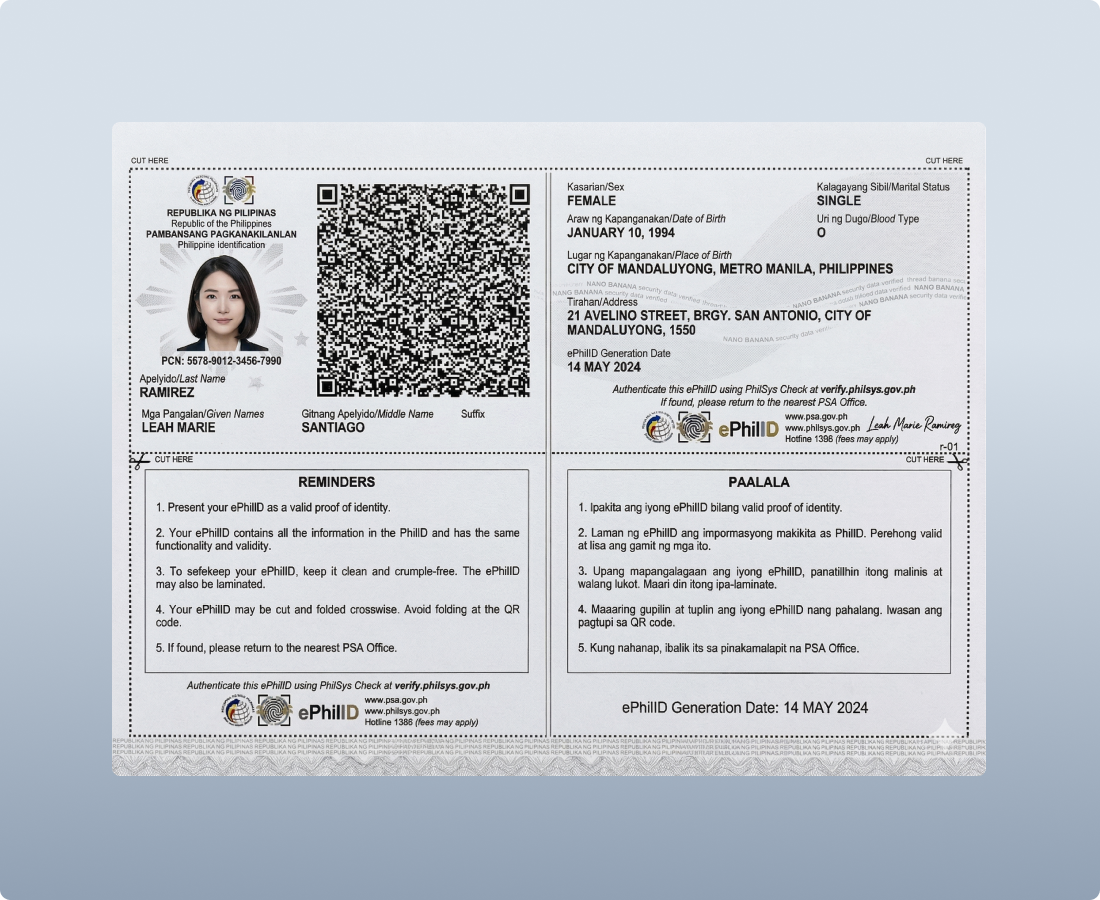
National ID In Paper Format (ePhilID)
Interim PhilSys credential issued while card delivery is pending. Common in onboarding, often needing tighter capture controls, QR-based checks, and exception handling.
Digital National ID
Digital PhilSys credential used for identity and age proof. Capture must stay controlled, and unofficial plastic or PVC reproduction is prohibited in onboarding use.

Philippine ePassport
Strong fallback ID for domestic and overseas customers. MRZ-based capture supports automated extraction, cross-border consistency, and more stable remote onboarding.

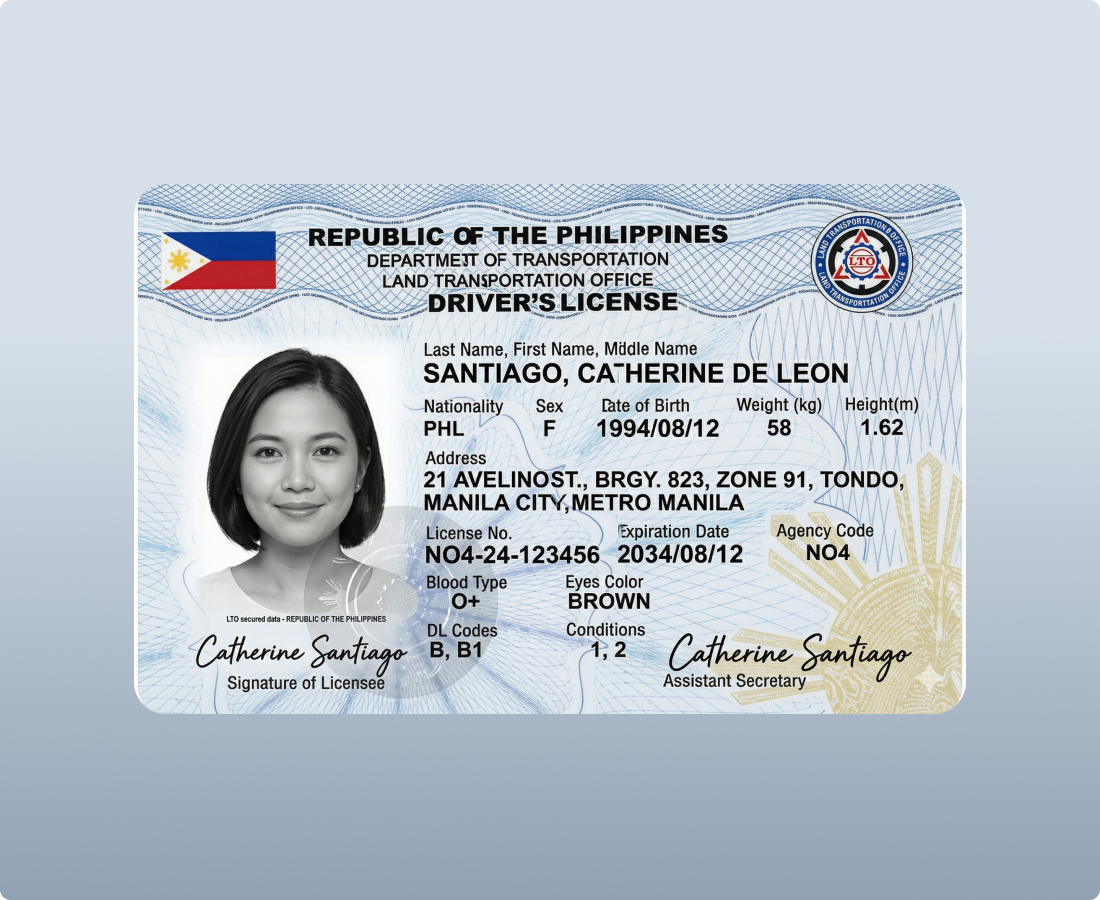
LTO Driver’s Licence
Common government photo ID used to reduce drop-off where PhilSys formats are unavailable at first attempt. Version variability needs flexible review, including digital presentation routes.
Alien Certificate Of Registration Identity Card (ACR I-Card)
Resident-foreigner ID used with passport and visa context to support KYC, immigration-linked identity review, and ongoing account maintenance for non-citizen customers.

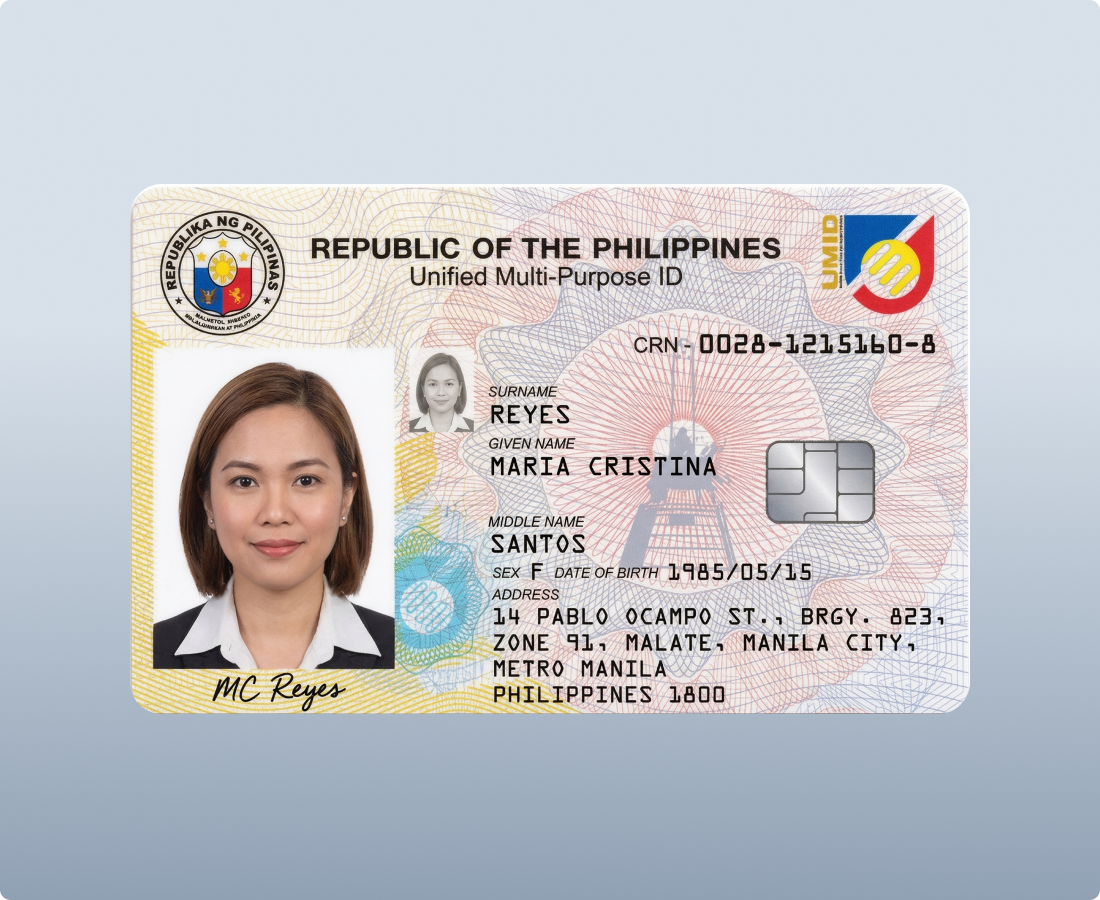
UMID And UMID ATM Pay Card
Legacy government-linked ID still seen in circulation and used as supplementary proof of identity, though its relevance is declining as PhilSys formats become more widely adopted.
Business Entity Identity
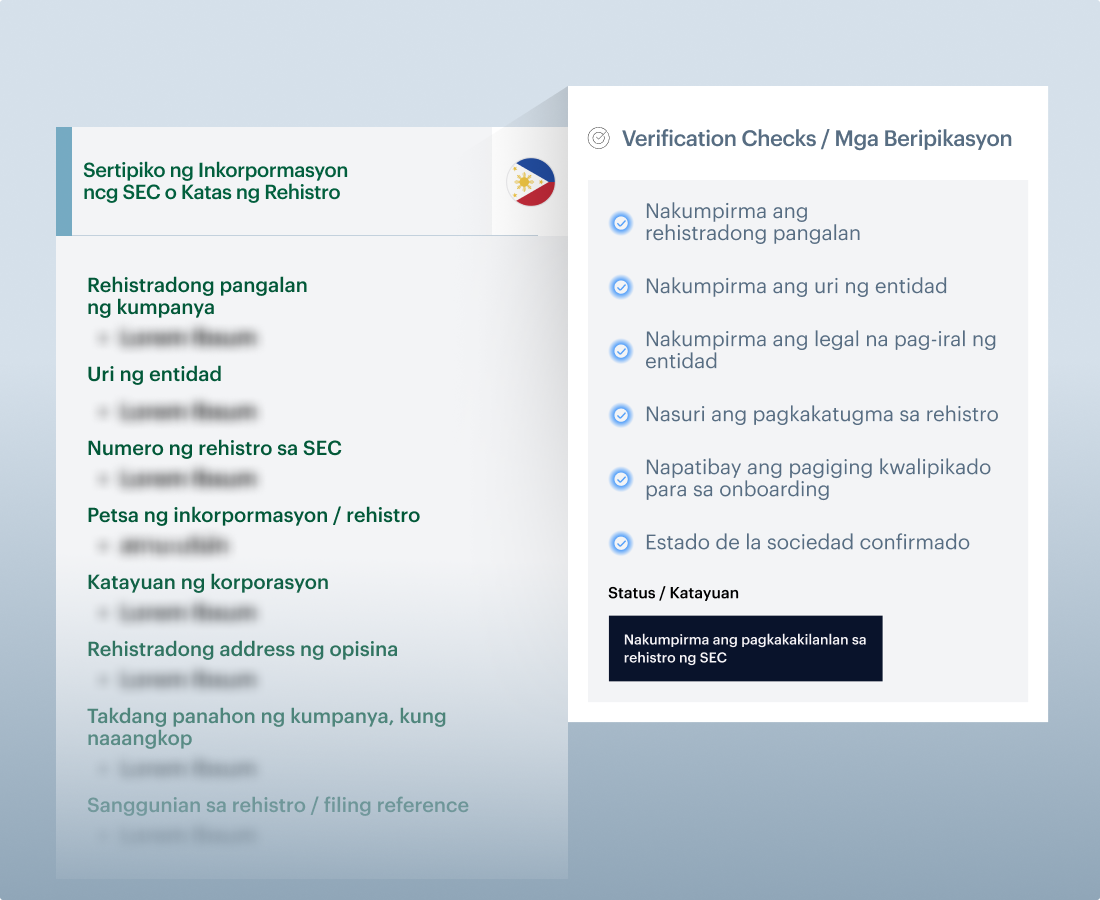
SEC Certificate Of Incorporation Or Registration Extract
Confirms registered name, entity type, and legal existence. Used as baseline KYB evidence when validating corporate status, registry consistency, and onboarding eligibility.
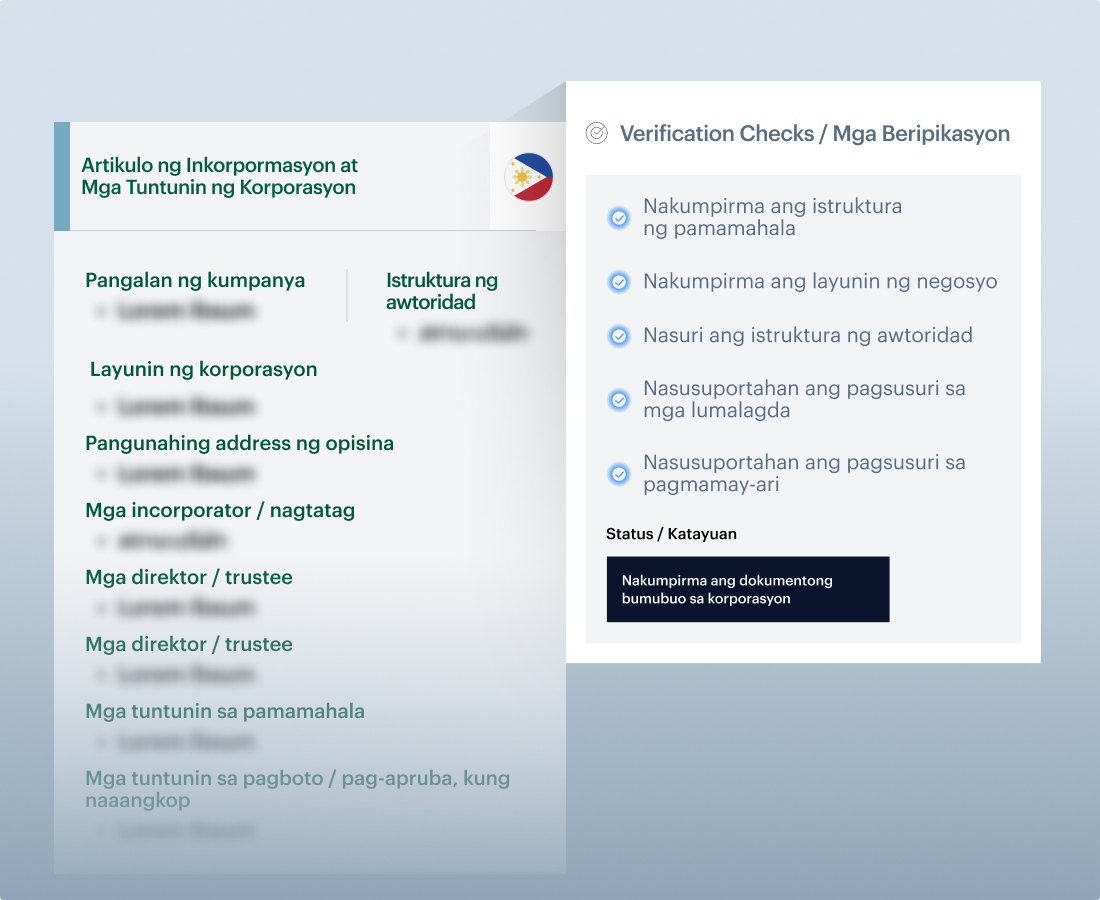
Articles Of Incorporation And By-Laws
Confirms governance, business purpose, and authority structure. Used for signatory checks, ownership interpretation, and risk review where operating powers affect onboarding scope.
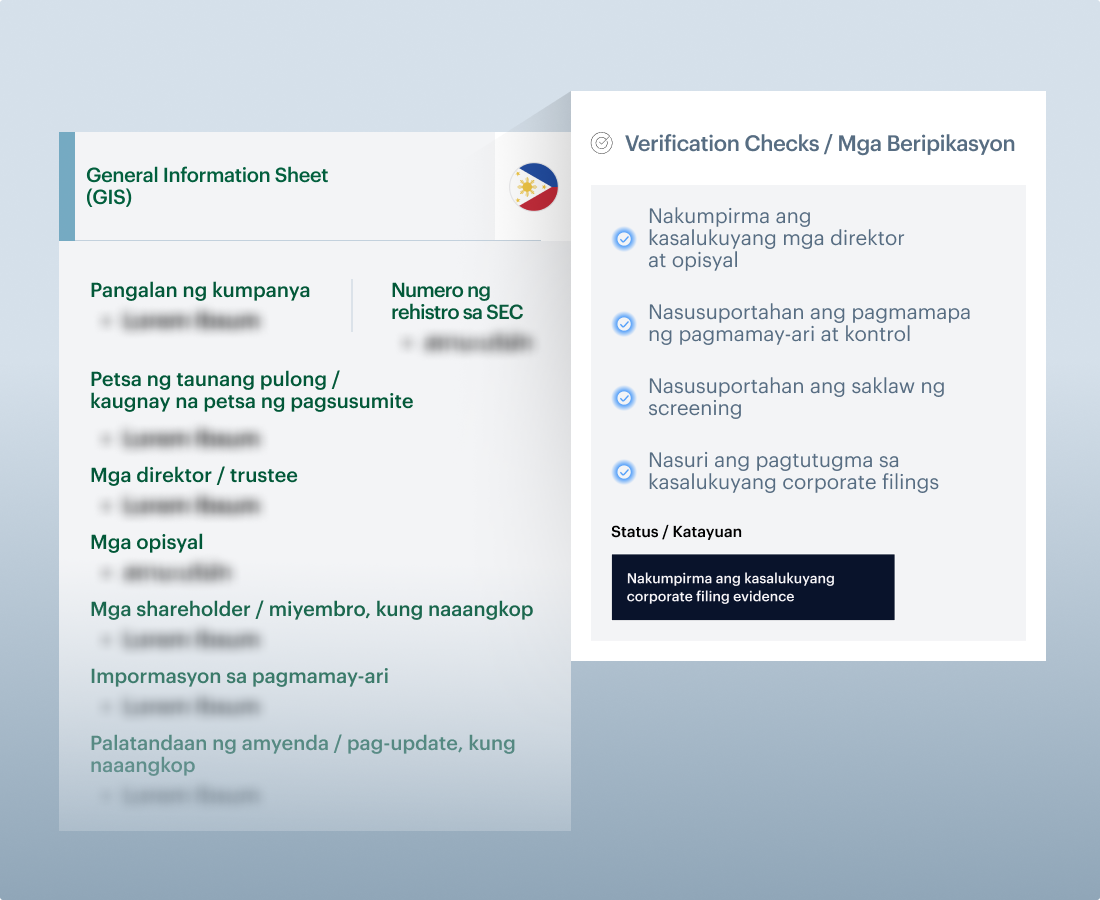
General Information Sheet (GIS)
Confirms current directors and officers and supports ownership and control mapping. Useful for KYB review, screening scope, and alignment with current corporate filings.
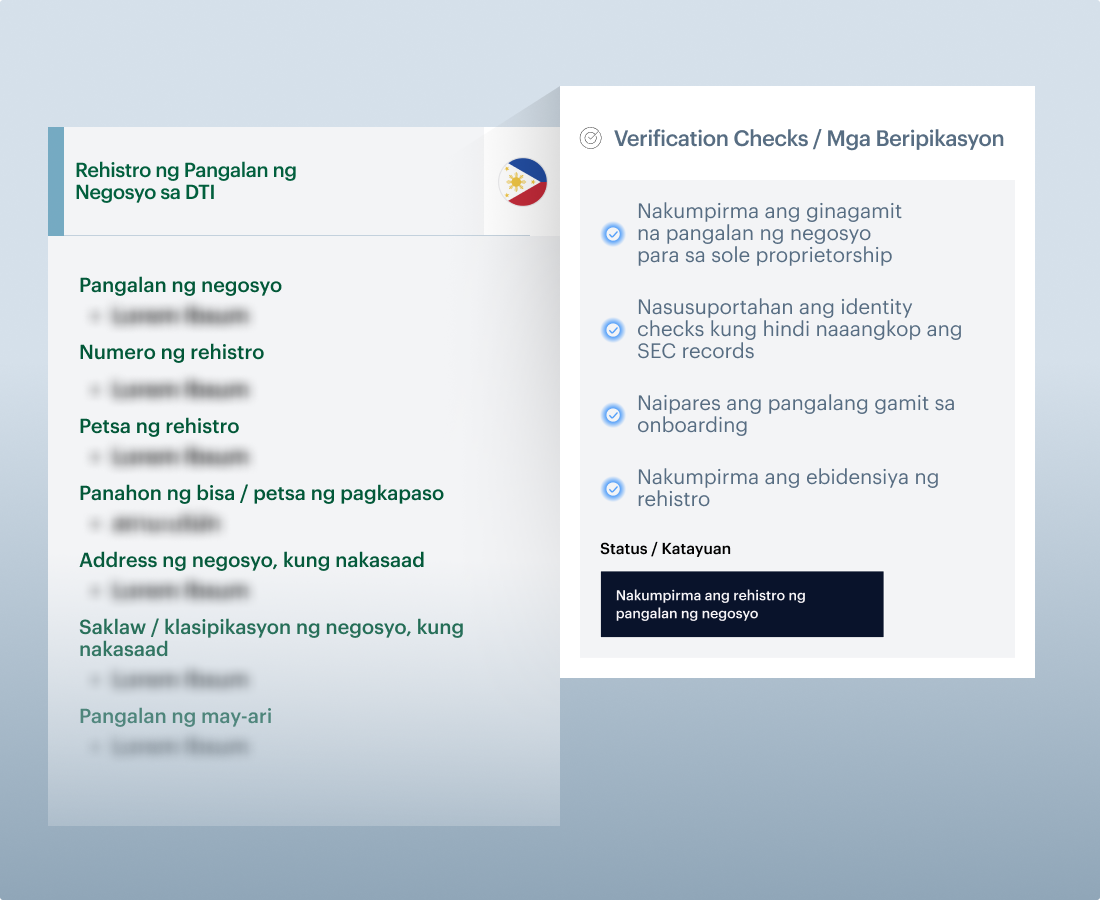
DTI Business Name Registration
Relevant for sole proprietorships. Supports entity identity checks where SEC incorporation records do not apply and helps confirm the operating name used in business onboarding.
Business Tax Identity
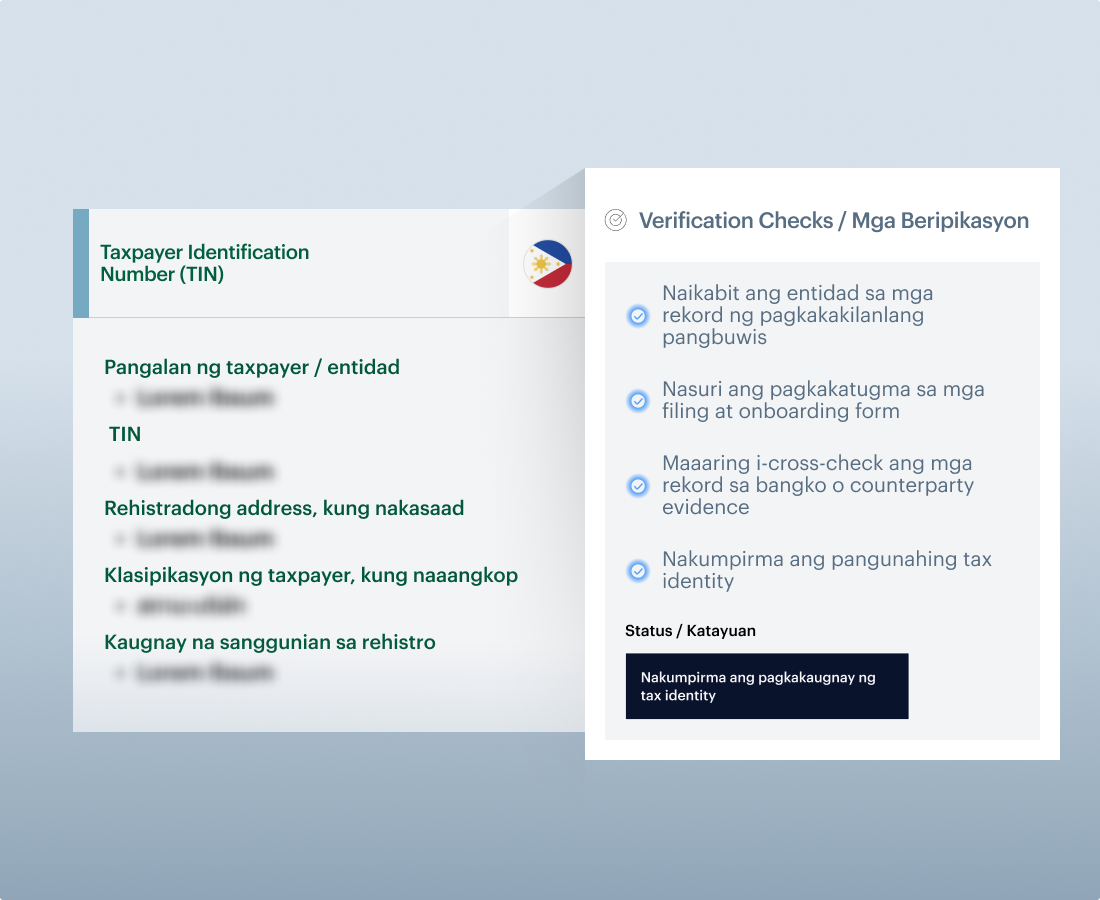
Taxpayer Identification Number (TIN)
Links the entity to tax identity records and supports consistency checks across filings, banking records, onboarding forms, and counterparty evidence packs.
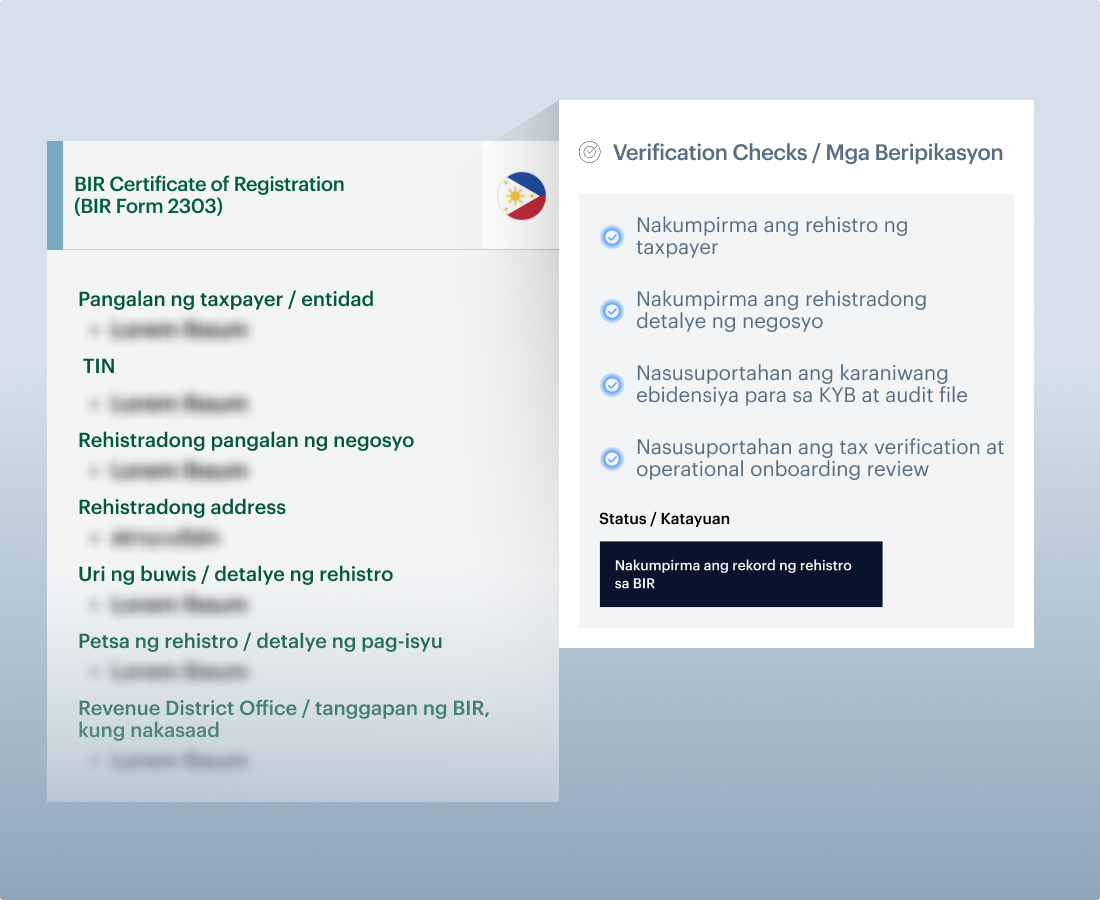
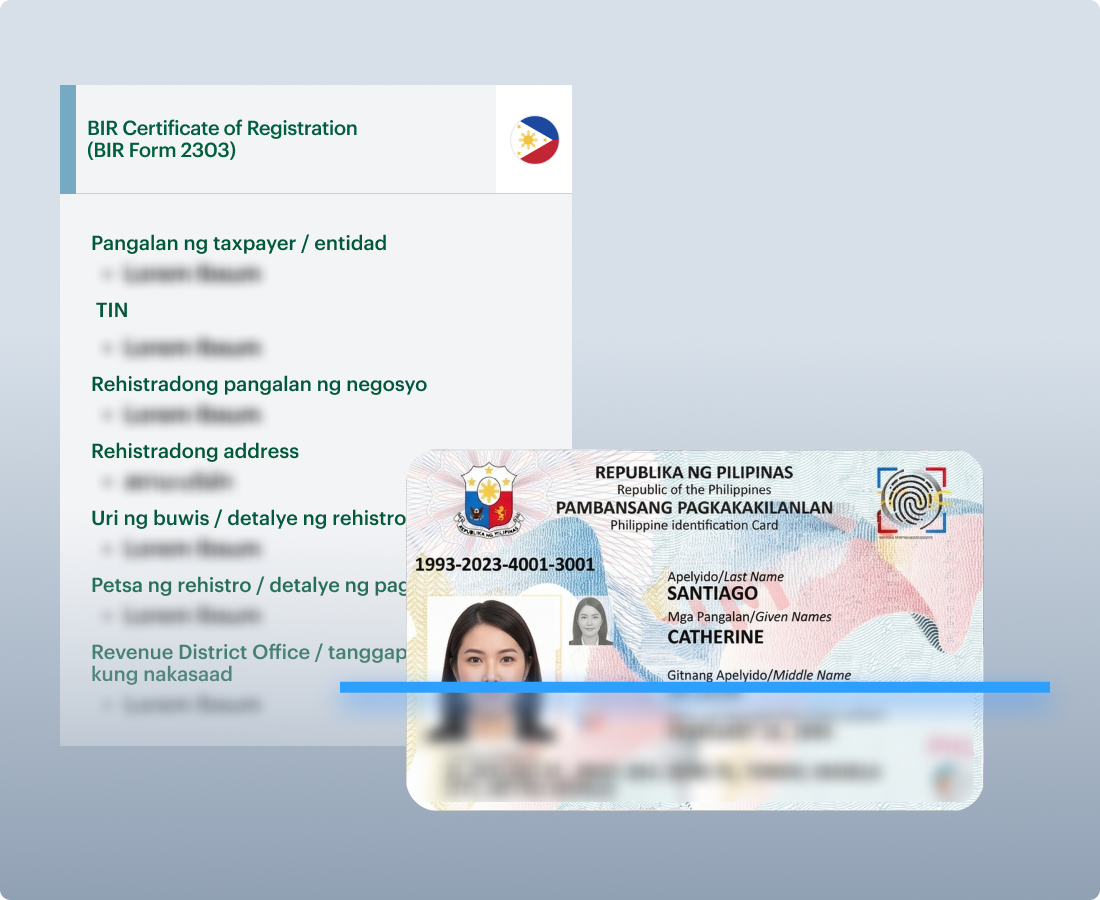
BIR Certificate Of Registration (BIR Form 2303)
Confirms taxpayer registration and registered business details. Commonly used in KYB packs, audit files, tax verification checks, and operational onboarding reviews.
Ownership & Control (UBO)
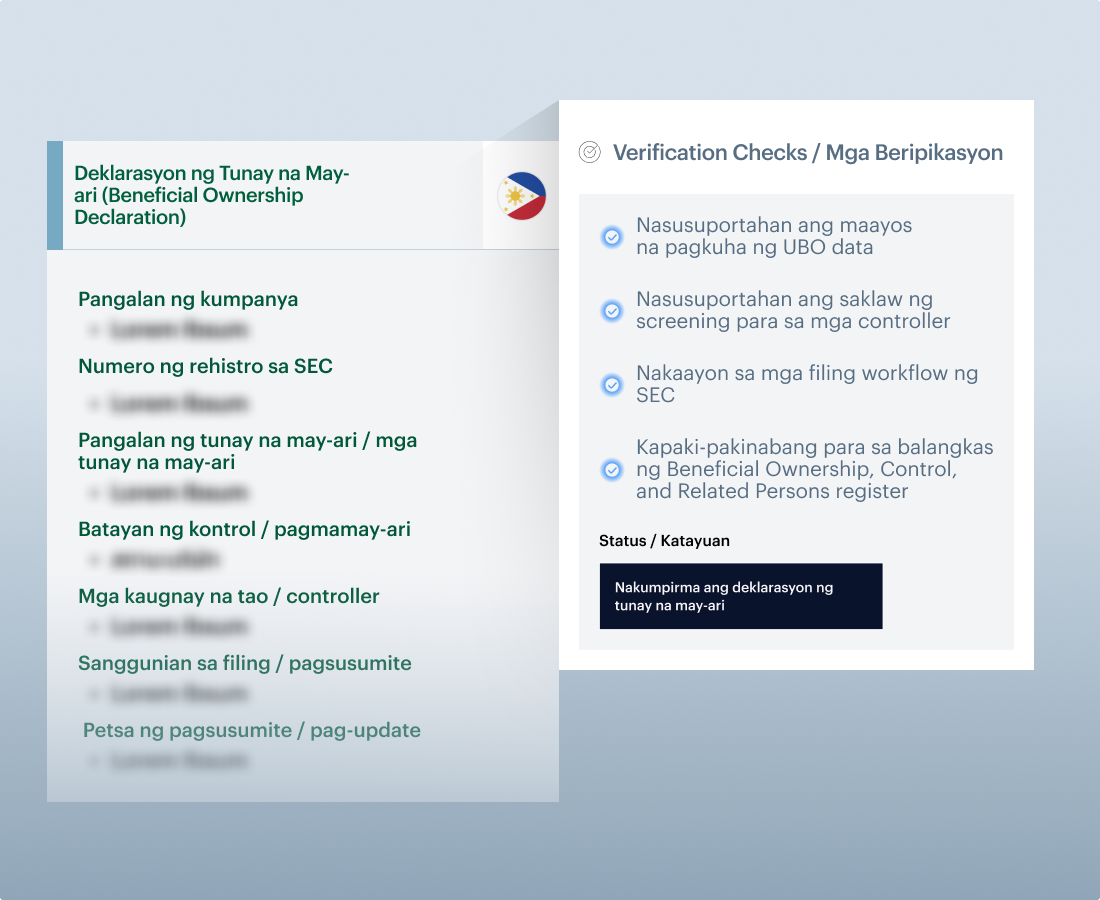
Beneficial Ownership Declaration
Supports structured UBO capture and controller screening scope, aligned to SEC filing workflows and the Beneficial Ownership, Control, and Related Persons Register framework.
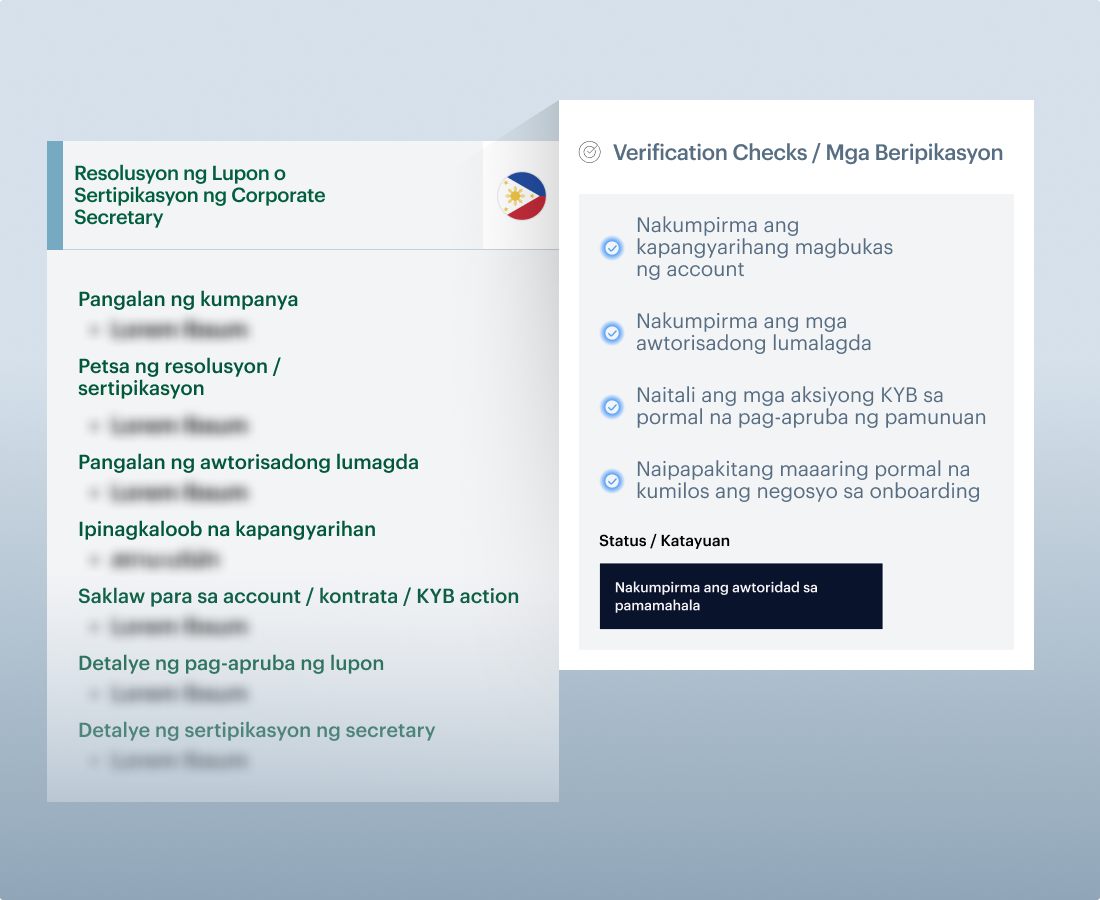
Board Resolution Or Secretary’s Certificate
Confirms authority to open accounts, appoint authorised signatories, and bind KYB actions to formal governance approvals recorded by the business.
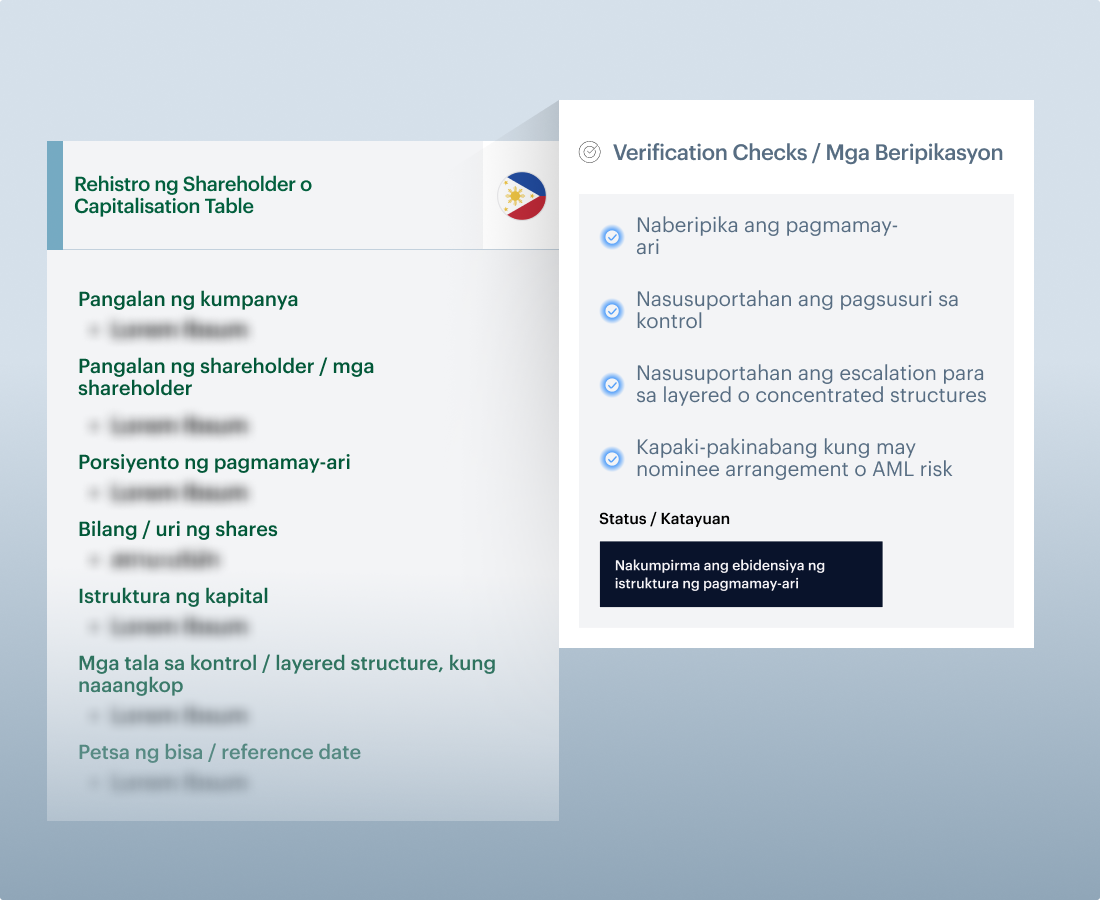
Shareholder Register Or Capitalisation Table
Supports ownership verification, control analysis, and escalation where layered structures, nominee arrangements, or concentrated holdings increase KYB and AML risk.
Languages We Cover
Document Text Handling
Shufti supports Filipino and English Latin-script capture across Philippine IDs and passports, keeping extraction consistent across PhilSys formats, mixed layouts, and legacy versions.
Name Matching Controls
Shufti helps control Philippine name variance, including middle-name-as-mother’s-maiden-surname logic, abbreviations, surname spacing, and married-name formats in review workflows.
Evidence Consistency
Shufti links document, face, and screening steps into one evidence trail, with decision reasons and review history that support internal QA and regulator-facing audit requests.
GOVERNANCE & CONTROLS
Audit-Ready Decisions, Lower Operational Drag
Fewer Avoidable Re-submissions
Mobile capture variability drives retries. Shufti uses structured reject reasons and capture guidance to reduce repeat uploads, manual review loops, and unnecessary customer friction.
Cleaner Audit
Trails
Aligned to BSP supervision and AMLC reporting follow-ups. Shufti maintains consistent decision outputs, time stamps, evidence links, and review history usable in audits and investigations.
Better Name Matching Outcomes
Philippine name-part rules, abbreviations, and married-name formats create mismatch risk. Shufti supports controlled matching logic and review evidence for repeatable outcomes.
One workflow, one
back office
KYC, KYB, and AML screening evidence sits in one operational view, supporting faster escalations and cleaner handoffs between onboarding, risk, compliance, and review teams.

PhilSys-First Flow Design
Prioritise the National ID card, National ID in paper format, and Digital National ID flows, while handling prohibited plastic printing and other controlled digital capture constraints. Reject reasons can flag QR issues, document tilt, or glare over key fields.
Philippines IDV/KYC Challenges

Multiple PhilSys ID Formats In One Onboarding Stack
National ID card, National ID in paper format, and Digital National ID formats collide in real onboarding. Rules like no plastic printing create avoidable rework and manual handling.

Mule-Account And Scam Risk Raise Evidence Standards
Money mule typologies and enforcement under the Anti-Financial Account Scam Act increase the need for clean onboarding decisions, fast escalation, and exportable evidence trails.

Mobile Capture Quality Still Drives Retry Rates
Mobile-first onboarding, uneven connectivity, and lower-spec device cameras can drive blur, glare, and incomplete uploads, inflating retries and slowing AML-aligned onboarding SLAs.

SIM-Linked Fraud Raises The Need For Stronger Identity Binding
SIM registration rules and spoofing risks reflect a high-scam environment. Phone-based step-ups need tighter linkage to verified identity from the first session.
Shufti’s IDV/KYC Solutions for Philippines
KYC Solutions
Fast track customer onboarding and authentication with real-time identity verification solutions.

Face Verification
Designed for Philippines scam and mule-account pressure. Verifies the applicant matches the ID holder at onboarding, supporting BSP-aligned e-KYC evidence and stronger provenance checks.
.
Age Verification
Selfie-based age estimation supports fast age gating. When higher assurance is required, add a document verification step using the National ID or passport to keep outcomes defensible.
.
Address Verification
Shufti can verify any address-bearing document. In the Philippines this often includes Meralco bills, Manila Water or Maynilad statements, bank statements from BDO, BPI, or Metrobank, permits, or lease records.
.
Document Verification
Supports Philippine IDs and passports, including National ID formats, Digital National ID handling rules, and LTO versions. Optimised for mobile capture with clear reject reasons.
.KYB Solutions

Business Verification
Verify entity existence using SEC incorporation artefacts, GIS, or DTI business-name records, then validate tax identity using TIN and BIR Form 2303, with director and UBO capture.
.
Enhanced Due Diligence (EDD)
Triggers on Philippines risk signals such as scam exposure, mule typologies, complex ownership, and gaming-sector risk. Produces structured evidence packs for audit and FIU follow-up.
.AML Screening
Utilise artificial intelligence models and 1700+ sanction and watchlists to identify and prevent money laundering attempts.

Business AML Screening
Screen entities and controllers against UN sanctions, the AMLC Consolidated Target List, domestic targeted financial sanctions, and PEP data, with retained match rationales.
.
Transaction Screening
Supports monitoring patterns aligned to Philippines scam and mule environments, helping teams escalate AFASA-linked signals early and reduce STR backlogs with clear alert evidence.
.Built to Fit Philippines's Compliance Landscape

Bangko Sentral ng Pilipinas (BSP)
Regulates BSP-supervised financial institutions and sets e-KYC standards equivalent to face-to-face CDD. Shufti captures ID, face match, screening results, and timed decisions for audit.

Anti-Money Laundering Council (AMLC)
The Philippines’ FIU for STR and CTR reporting under the AMLA and GoTRACS, the Government Transaction Reporting and Analysis System. Shufti keeps evidence exportable and traceable.

Securities And Exchange Commission (SEC)
Corporate registry and governance authority for incorporation, GIS filings, and beneficial ownership submissions. Shufti structures entity, director, and UBO evidence for KYB screening.

National Privacy Commission (NPC)
Enforces Data Privacy Act safeguards and accountability across personal data processing. Shufti supports retention controls, access governance, and encrypted handling for IDV data.

Philippine Statistics Authority (PSA), Which Administers PhilSys
Owns PhilSys formats and acceptance rules for the National ID card, National ID in paper format, and Digital National ID. Shufti supports PhilSys-first onboarding with controlled exceptions.

National Telecommunications Commission (NTC)
Enforces SIM registration rules and telecom controls relevant to spoofing, SIM misuse, and fraud-linked identity abuse. This matters in scam and mule-account controls alongside NBI and PNP-ACG enforcement.

Bureau Of Internal Revenue (BIR)
Tax authority relevant to KYB evidence and taxpayer registration checks. Shufti supports capture of BIR Form 2303 and TIN evidence for legitimacy and address consistency checks.

Philippine Amusement And Gaming Corporation (PAGCOR)
Gaming regulator for sector-specific onboarding and AML obligations. Shufti supports patron KYC and monitoring evidence that aligns to casino AML controls and audit expectations.
Deployment Choice
No in-country AWS, Azure, or Google Cloud public regions are listed in primary catalogues. AWS Local Zones Manila can support lower-latency workloads, but they are not full cloud regions, so private cloud and on-premise options remain important.
Regulatory Alignment
Aligned to AMLA-driven evidence needs for STR and CTR support, and to Data Privacy Act accountability and safeguard expectations for sensitive identity and financial data handling. The Philippines has moved beyond FATF grey-listing, with ongoing focus on implementation quality, beneficial ownership transparency, and transaction monitoring.
Retention controls
Configurable retention and purge settings aligned to AML recordkeeping, audit reproduction needs, data minimisation, and lifecycle governance under Philippines privacy rules. Data subject access, rectification, and erasure workflows should be supportable with audit trails.
Encryption posture
Encryption applied in transit and at rest, supporting privacy safeguard expectations and secure evidence handling for IDV and AML workflows, including exportable audit artefacts.
Data Controls & Privacy for Philippines
Philippines AML Sources That Strengthen Decision

Anti-Money Laundering Council (AMLC)

House of Representatives of the Philippines

Bureau of Customs

Land Bank of the Philippines

Civil Aviation Authority of the Philippines

National Economic and Development Authority (NEDA)

Cebu City Government

Asian Development Bank (ADB)
Anti-Money Laundering Council (AMLC)
House of Representatives of the Philippines
Bureau of Customs
Land Bank of the Philippines
Civil Aviation Authority of the Philippines
National Economic and Development Authority (NEDA)
Cebu City Government
Asian Development Bank (ADB)
Anti-Money Laundering Council (AMLC)
House of Representatives of the Philippines
Bureau of Customs
Land Bank of the Philippines
Civil Aviation Authority of the Philippines
National Economic and Development Authority (NEDA)
Cebu City Government
Asian Development Bank (ADB)
Frequently Asked Questions
What Is The Primary ID To Prioritise For Philippines Onboarding?
PhilSys credentials are the natural first choice: National ID card, National ID in paper format, and Digital National ID. Design your flow to accept multiple PhilSys formats with clear rules.
Can We Use The Digital National ID In Remote KYC?
It is intended for identity and age proof, but official rules prohibit printing it on PVC or plastic cards for presentation. Build for in-app or on-screen capture and controlled validation.
What Is A Practical Fallback If A Customer Cannot Provide PhilSys Yet?
Passports and LTO driver’s licences are common fallbacks in practice. For non-residents or foreign nationals, pair passport onboarding with the ACR I-Card where applicable.
What KYB Evidence Set Is Most Common For Philippine Corporates And Sole Proprietors?
For corporates, expect SEC incorporation documents, GIS, TIN, and BIR Form 2303. For sole proprietors, DTI business-name evidence often sits alongside tax and address records.
Should We Collect Shareholder And Local Permit Evidence In Philippine KYB?
Often yes. Shareholder registers or cap tables support ownership review, while LGU permits and lease or address records help corroborate operating status and business location.
What Domestic Reporting Workflow Should We Plan For With The FIU?
Covered persons follow AMLC reporting guidelines for transaction reporting and compliance submissions through GoTRACS. KYC evidence should be exportable for STR and CTR narratives.
What Do We Screen Against For AML In The Philippines?
Programmes typically screen against UN sanctions, the AMLC Consolidated Target List, domestic targeted financial sanctions, and PEP data, including controllers and beneficial owners.
How Do We Handle Philippine Middle Names Correctly In Matching?
Philippine government forms define middle name as the mother’s maiden surname. Matching should also account for abbreviations, surname spacing, and married-name transitions.
How Do We Align With Philippines Data Privacy Expectations For IDV Data?
Follow the Data Privacy Act accountability and safeguard principles, including security measures and vendor governance. Retention and access controls should be configurable and documented.
How Do We Reduce Drop-Off From Retries In Mobile Onboarding?
Use clear reject reasons and re-capture prompts, and prioritise document types most common in the Philippines. Build a controlled fallback path to passport or driver’s licence.
Build a Philippines-ready KYC, KYB & AML programme with Shufti
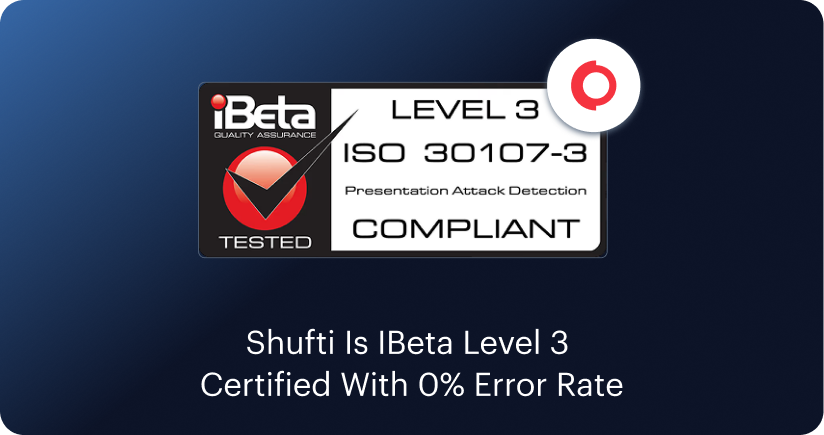
INDEPENDENTLY AUDITED. GLOBALLY CERTIFIED.
Certified to Global Standards





PROVEN WORKFLOWS
Use Cases for Regulated Growth in Philippines
Accelerate Growth, Eliminate Friction
Onboard users in seconds, not days. Deploy tiered address verification flows that maximise completion rates for genuine users while filtering out synthetic fraud.


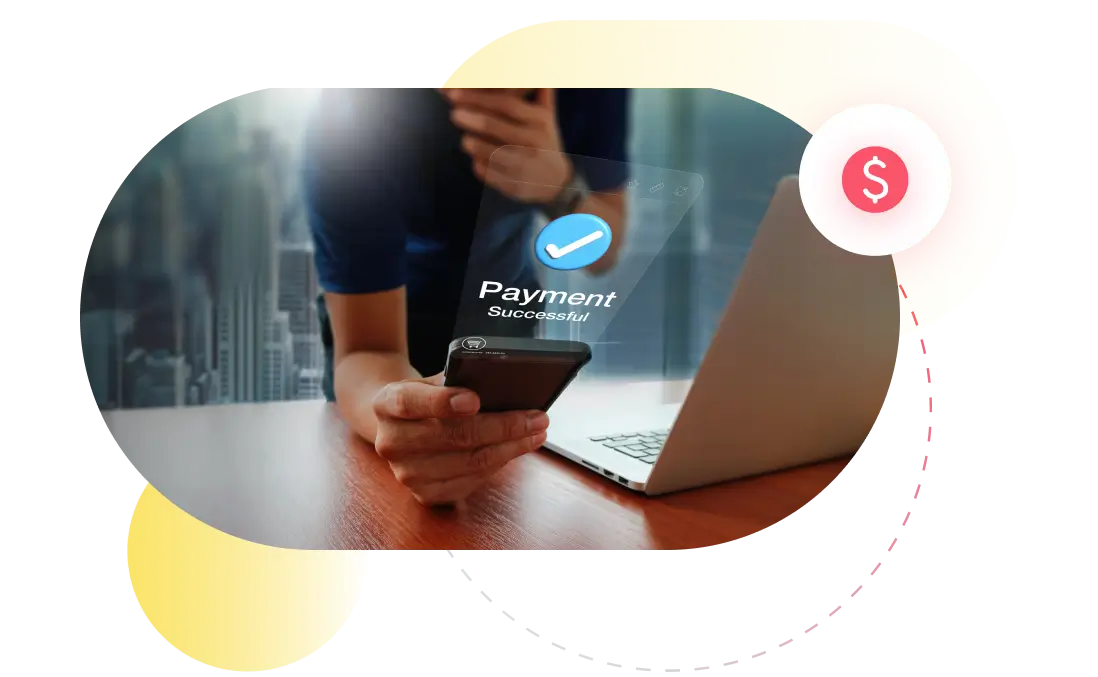
Onboard Global Traders in Real-Time
Verify investors across 240+ countries & territories. Ensure compliance with international financial regulations while preventing identity theft and high-risk chargebacks.



Secure Trust at Every Transaction
Automate KYC and AML workflows to reduce manual onboarding costs. Strengthen residency checks while delivering the frictionless digital experience modern customers expect.


Power a Fair & Secure Player Experience
Reduce bonus abuse and multi-accounting rings at the door. Enforce location rules and trigger step-up checks without disrupting the player journey.



Build a Trusted, Verified Workforce
Screen freelancers and drivers at scale. Verify residency and reduce onboarding friction while maintaining trust between users.



Scale Your Exchange with Confidence
Balance anonymity with compliance. Instantly verify user jurisdiction to meet Travel Rule obligations and help stop abuse without slowing down legitimate trading volume.



Reduce fraud without blocking growth
Shufti supports marketplace integrity by verifying seller and buyer identities, enabling age-gated journeys where needed, and preserving evidence to support investigations, disputes and risk-led enforcement actions.




Accelerate Growth, Eliminate Friction
Onboard users in seconds, not days. Deploy tiered address verification flows that maximise completion rates for genuine users while filtering out synthetic fraud.
Onboard Global Traders in Real-Time
Verify investors across 240+ countries & territories. Ensure compliance with international financial regulations while preventing identity theft and high-risk chargebacks.
Secure Trust at Every Transaction
Automate KYC and AML workflows to reduce manual onboarding costs. Strengthen residency checks while delivering the frictionless digital experience modern customers expect.
Power a Fair & Secure Player Experience
Reduce bonus abuse and multi-accounting rings at the door. Enforce location rules and trigger step-up checks without disrupting the player journey.
Build a Trusted, Verified Workforce
Screen freelancers and drivers at scale. Verify residency and reduce onboarding friction while maintaining trust between users.
Scale Your Exchange with Confidence
Balance anonymity with compliance. Instantly verify user jurisdiction to meet Travel Rule obligations and help stop abuse without slowing down legitimate trading volume.
Reduce fraud without blocking growth
Shufti supports marketplace integrity by verifying seller and buyer identities, enabling age-gated journeys where needed, and preserving evidence to support investigations, disputes and risk-led enforcement actions.
Accelerate Growth, Eliminate Friction
Onboard users in seconds, not days. Deploy tiered address verification flows that maximise completion rates for genuine users while filtering out synthetic fraud.
Onboard Global Traders in Real-Time
Verify investors across 240+ countries & territories. Ensure compliance with international financial regulations while preventing identity theft and high-risk chargebacks.
Secure Trust at Every Transaction
Automate KYC and AML workflows to reduce manual onboarding costs. Strengthen residency checks while delivering the frictionless digital experience modern customers expect.
Power a Fair & Secure Player Experience
Reduce bonus abuse and multi-accounting rings at the door. Enforce location rules and trigger step-up checks without disrupting the player journey.
Build a Trusted, Verified Workforce
Screen freelancers and drivers at scale. Verify residency and reduce onboarding friction while maintaining trust between users.
Scale Your Exchange with Confidence
Balance anonymity with compliance. Instantly verify user jurisdiction to meet Travel Rule obligations and help stop abuse without slowing down legitimate trading volume.
Reduce fraud without blocking growth
Shufti supports marketplace integrity by verifying seller and buyer identities, enabling age-gated journeys where needed, and preserving evidence to support investigations, disputes and risk-led enforcement actions.
Let’s Tailor your journey
Just a few quick questions to guide your Shufti experience.

Shufti
Market Positioning and Commercial Assessment

Industry stands at 1.7rating

Best ID Verification Innovator

TOP 10 KYC Solution Provider
Best Client Onboarding Solution

Samer Al Tamimi@CEO of Safwa Bank
We take our client's privacy very seriously and always look for new innovative solutions to ensure a safe banking experience. Working with Shufti feels like a breath of fresh air, as their 100% in-house tech keeps our customer's data free from vulnerabilities and fully safe and protected.



PROVEN PLAYBOOKS
Explore Practical KYC & AML Resources
16 August, 2025
5 minutes read
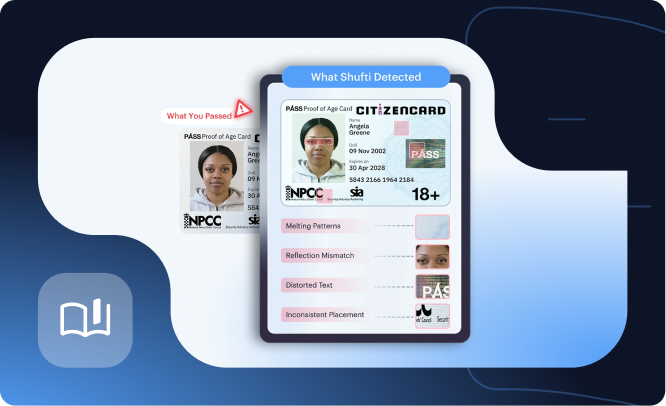
How Much of What You’ve Verified Is Actually Real?
Shufti’s Deepfake Blindspot Audit now runs fully inside your AWS environment, auditing historic KYC for manipulation signals without moving sensitive data off-prem.
whitepapers