






 AMLR Solutions
  AMLR Consultation
 EUDI Wallet
 Onboarding
 Ongoing Monitoring
 FRAML
FRAML KYC
KYC KYB
KYB KYI
KYI Age Assurance
 Workforce IAM
 Candidate Verification
 Account Takeover
 Bonus/ Promotion Abuse
 Chargeback Fraud
 Deepfake
 Document Fraud
 Fraud Networks
 Impersonation Fraud
 Money Mule Activity
 Multi-Accounting
 Party Fraud
 Regulatory & Compliance Risks
 Synthetic Identity Fraud
 Adult Content
 Banking
 Crypto
 Fintech
 Forex
Forex Compliance
 Fraud prevention
 Trust & safety
 Global expansion
 Compliance Officers
 Developers
 Fraud Analysts
 Product Managers
 Advanced Journey Builder
  Global Trust Platform
 Customer Profiles
 Vendor Comparison
 IDV Case Management
 AML Case Management
 Regulatory Reporting
 Agentic Rule Builder
  AI Compliance Co-Pilot
  Fraud Analytics
 Fraud Hub
  OCR
OCR Shufti AI
 Bank Account Verification
  Biometric Duplication
 Database Checks
 Document Intelligence
 Government ID
 Mobile Driver's License
 NFC
NFC Selfie Liveness
 Brand Personalisation
 Deployment Options
 Identity Methods
 IDV Modes
 Multi-tenancy
 On-Premise IDV
 Secure Capture
 Shufti MCP


- Australia
- Austria
- Bangladesh
- Brazil
- Bulgaria
- Canada
- China
- Cyprus
- Egypt
- Estonia
- Eswatini
- Ethiopia
- France
- Germany
- Greece
- Haiti
- Hong Kong
- India
- Iraq
- Ireland
- Indonesia
- Italy
- Japan
- Jordan
- Kazakhstan
- Kenya
- Kosovo
- Kuwait
- Latvia
- Luxembourg
- Malaysia
- Malta
- Mauritius
- Mexico
- Micronesia
- Moldova
- Montenegro
- Morocco
- Mozambique
- Myanmar
- Namibia
- Nauru
- Nepal
- Nigeria
- Nicaragua
- Niue
- Norway
- Netherlands
- New Zealand
- Oman
- Pakistan
- Palau
- Palestine
- Panama
- Papua New Guinea
- Paraguay
- Peru
- Puerto Rico
- Philippines
- Portugal
- Portugal
- Qatar
- Republic of Congo
- Romania
- Russia
- Rwanda
- Samoa
- San Marino
- Senegal
- Serbia
- Seychelles
- Sierra Leone
- Singapore
- Slovakia
- Slovenia
- Somalia
- South Africa
- South Korea
- South Sudan
- Sri Lanka
- St Kitts and Nevis
- St Maarten
- St Lucia
- Sweden
- Switzerland `
- Syria
- Taiwan
- Tajikistan
- Tanzania
- Thailand
- Timor Leste
- Togo
- Tonga
- Trinidad and Tobago
- Turkey
- Turks and Caicos
- Turkmenistan
- Tunisia
- Tuvalu
- Uganda
- Ukraine
- UK
- Uruguay
- USA
- Uzbekistan
- Vatican City
- Vietnam
- Venezuela
- Vanuatu
Estonia
Identity Verification & KYC For Estonia
Shufti supports KYC, KYB, and AML screening aligned to Estonia’s FIU, Finantsinspektsioon, e-Business Register, and Tax and Customs Board workflows. That gives compliance teams a clearer, more consistent way to manage onboarding, business verification, and ongoing AML decisions.
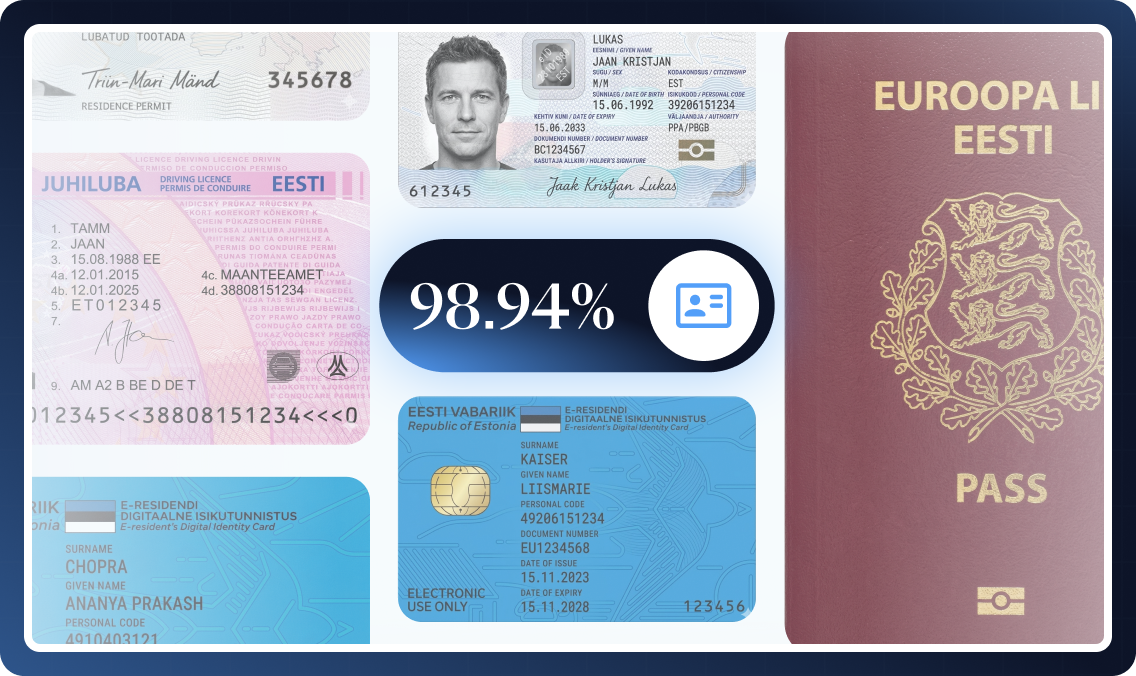
Operational performance for Estonia KYC
Our Numbers Speak Volumes
98.94%
Pass rates
< 5 sec
Verification
Time
300 Million
Companies
Evidence-Ready Checks Across People & Businesses
Individual Documents We Verify
Shufti supports 15 Estonian identity and resident document types, alongside passports and other identity documents commonly used in Estonia-based onboarding.
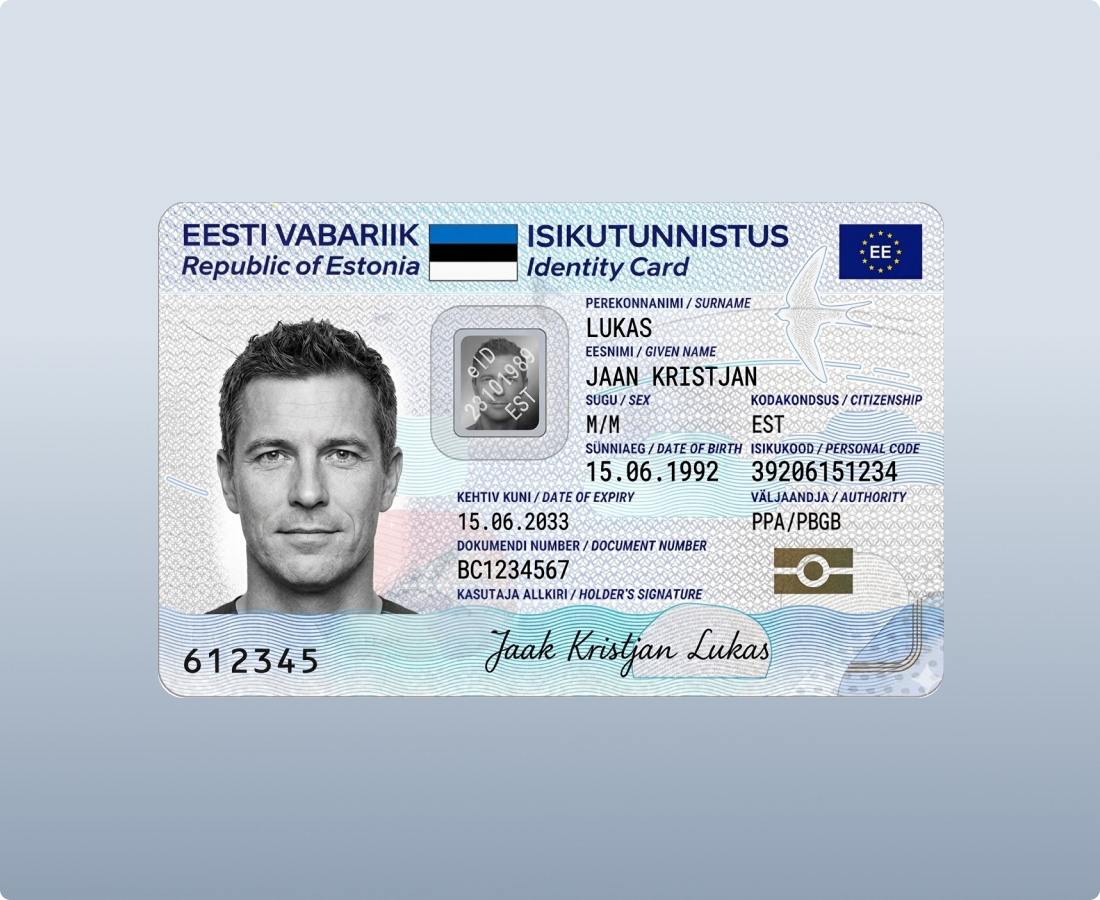
View All Supported DocumentsEstonian ID Card
Primary photo ID for Estonian citizens and EU citizens permanently resident in Estonia. Used to prove identity, capture isikukood, and confirm expiry in local onboarding
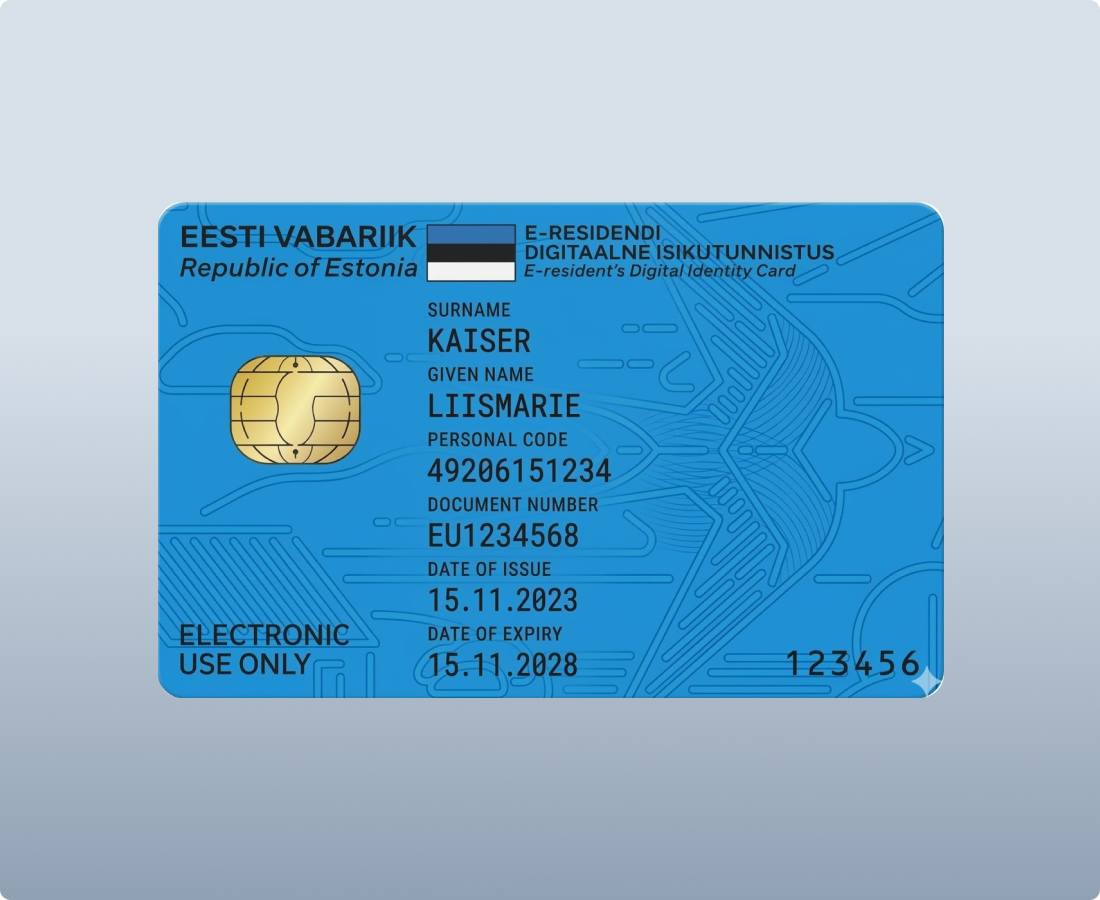
Digital ID
Electronic-only credential with no photo, used for e-services and signing. Legacy cards remain valid until expiry, but issuance ended on 01.05.2025 for new cards.
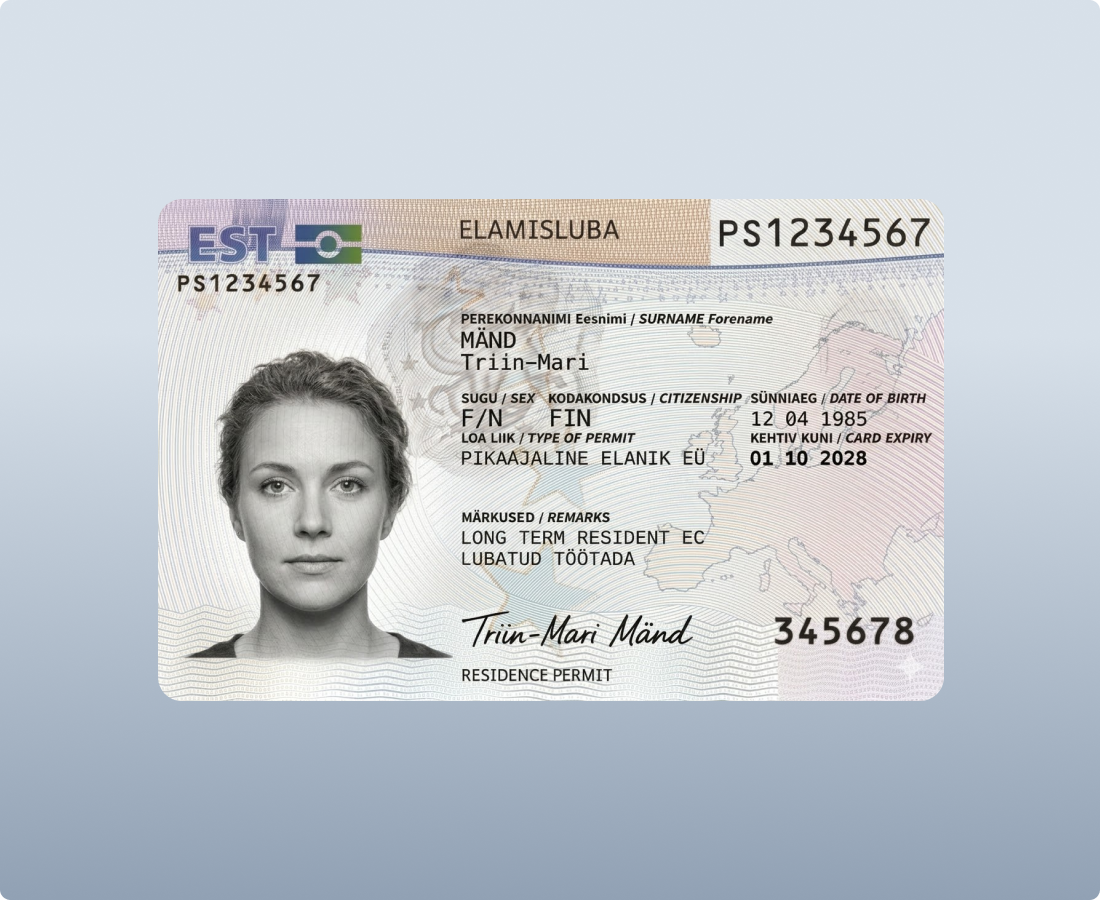
Residence Permit Card
Primary photo ID for third-country nationals holding an Estonian residence permit or right to reside. It includes permit data plus photo and fingerprint images used in resident KYC checks.
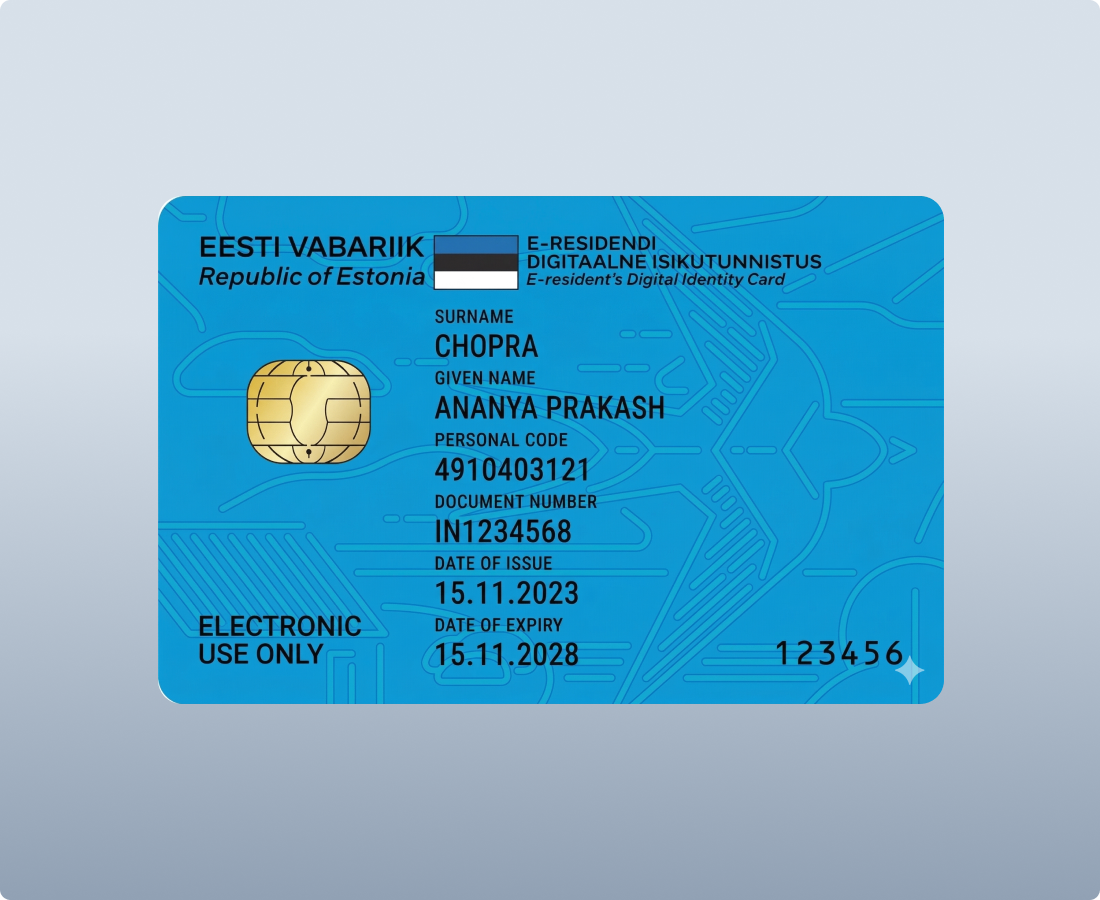
E-Resident Digital ID
Digital credential for foreign citizens outside Estonia using local e-services and company tools. As it is not a normal photo ID, KYC often needs passport fallback.
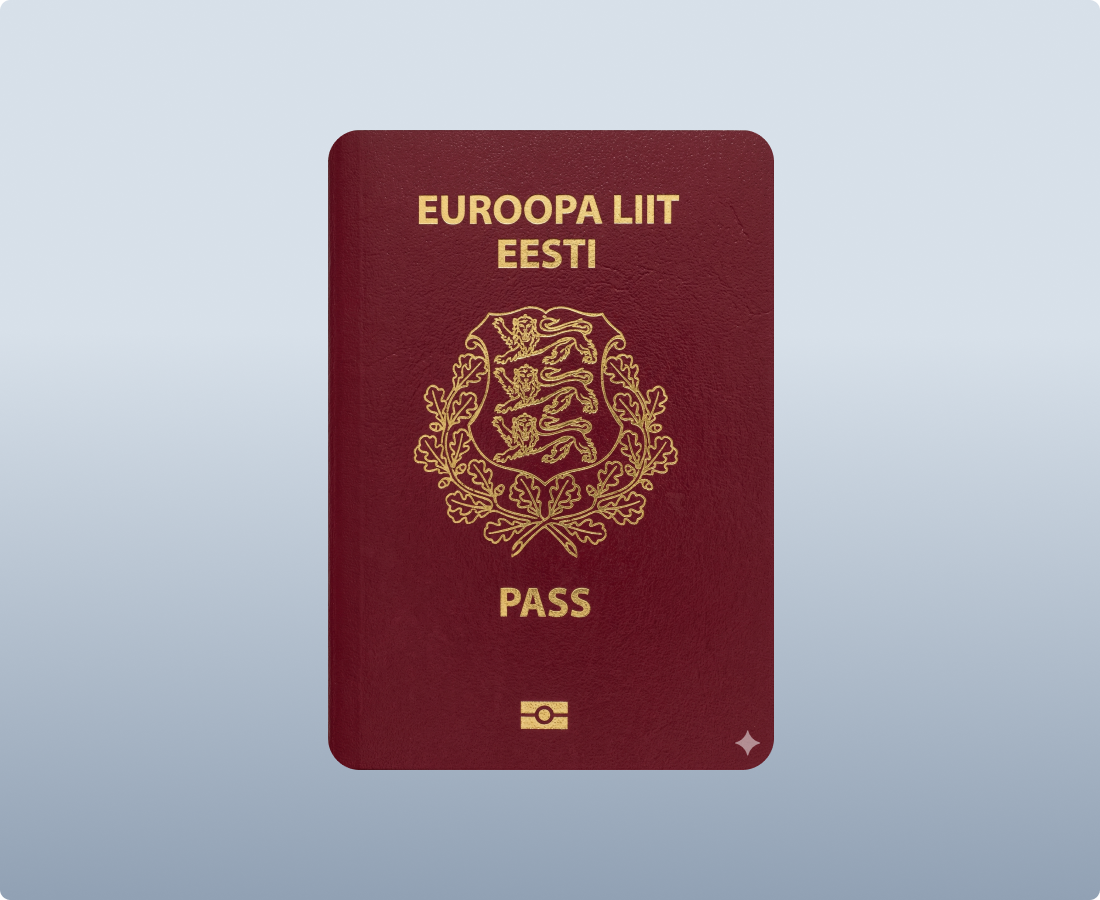
Estonian Passport
Primary travel document used in cross-border and non-resident onboarding. It is a practical fallback in remote KYC and stores fingerprints on the passport chip.
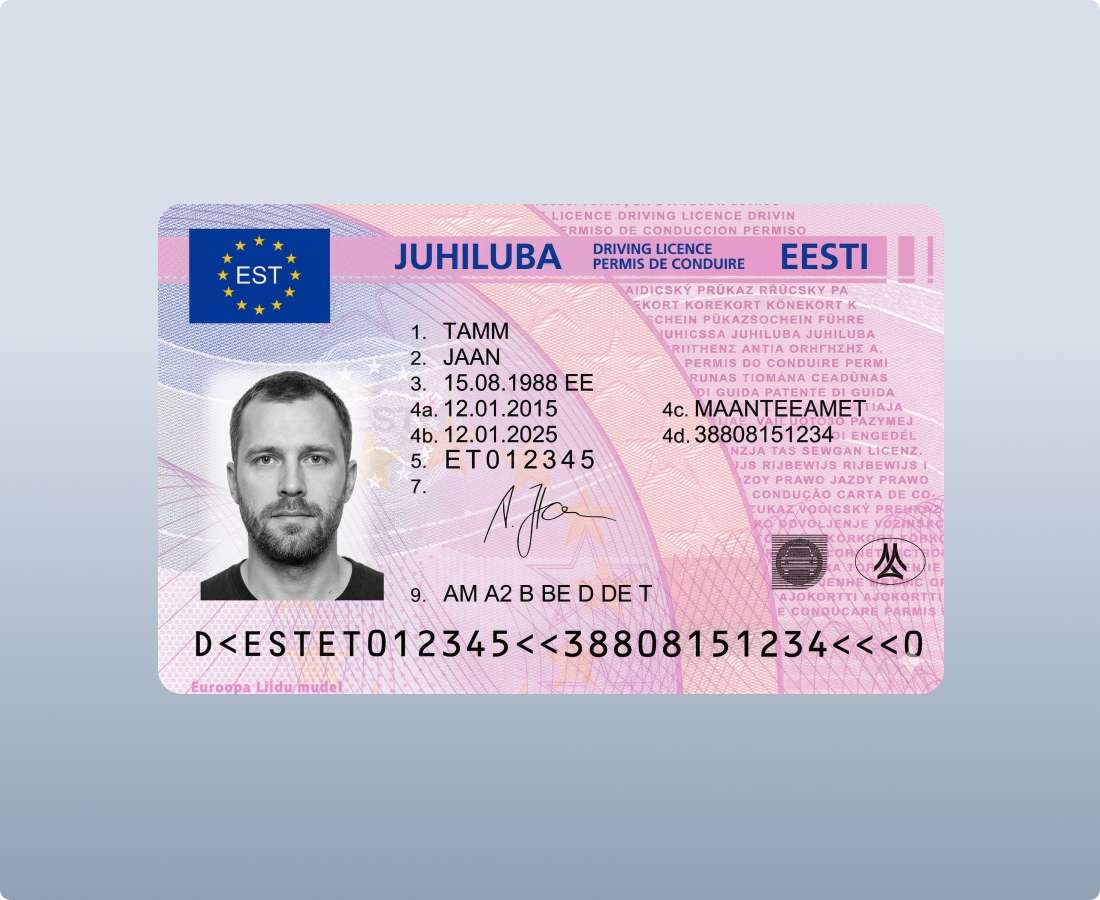
Estonian Driving Licence
Secondary photo ID in some onboarding flows. It follows the EU model, is issued by the Transport Administration, and foreign licences may need translation.
Business Entity Identity
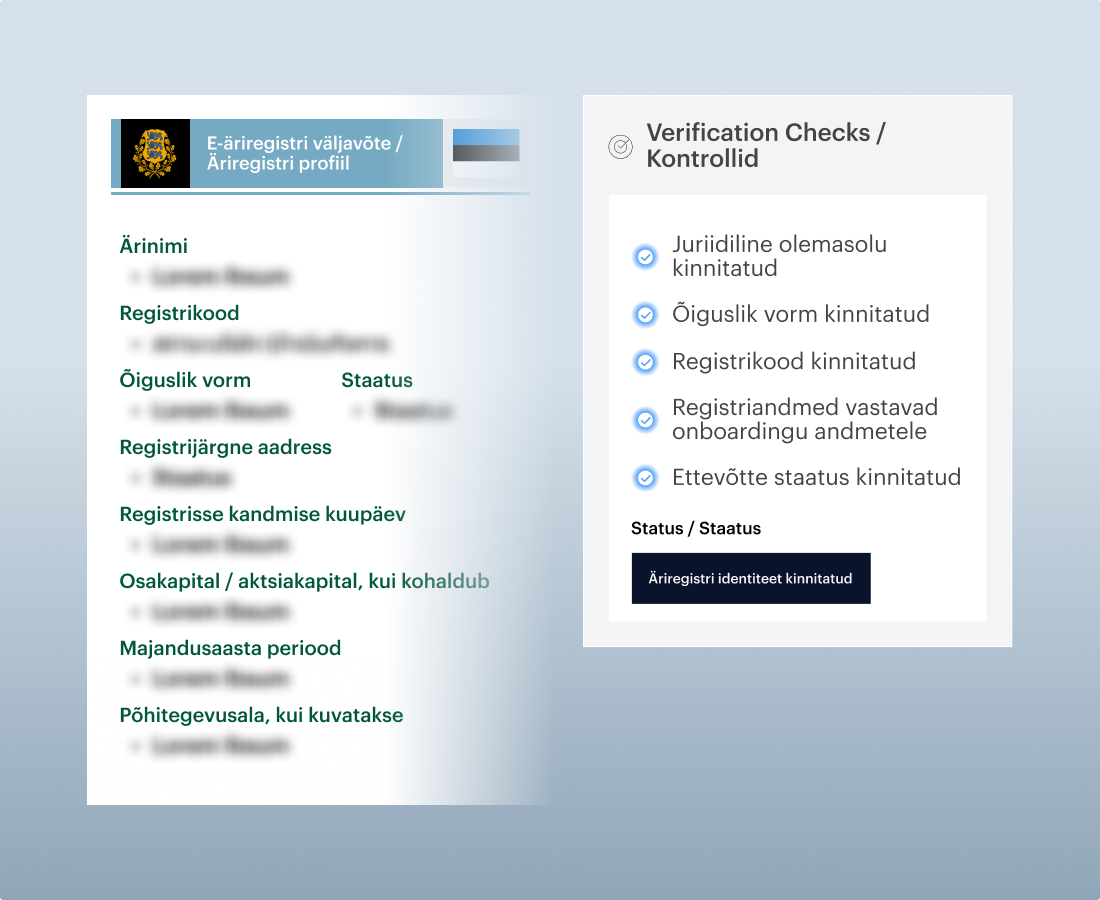
E-Business Register Extract
Proves legal existence, legal form, status, registry code, and registered details from Estonia’s official state portal, making it the usual starting point for KYB baselining.
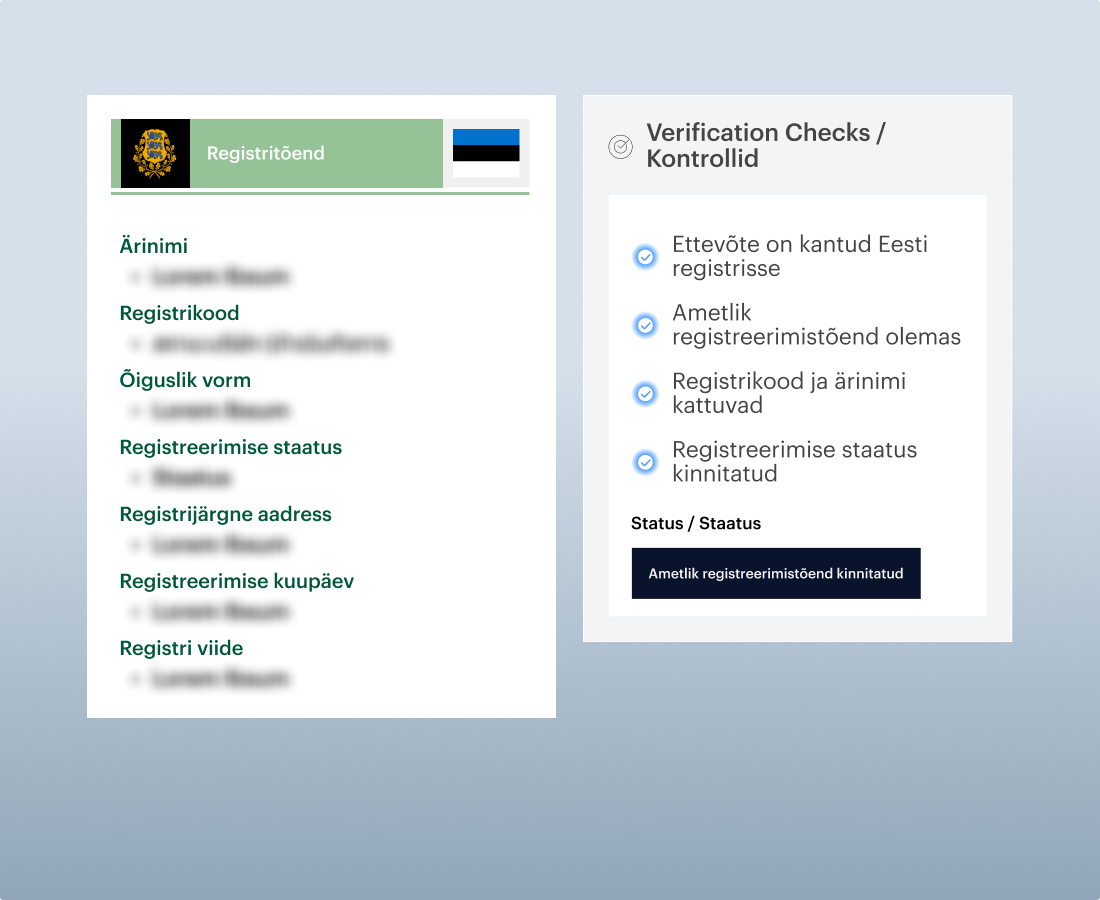
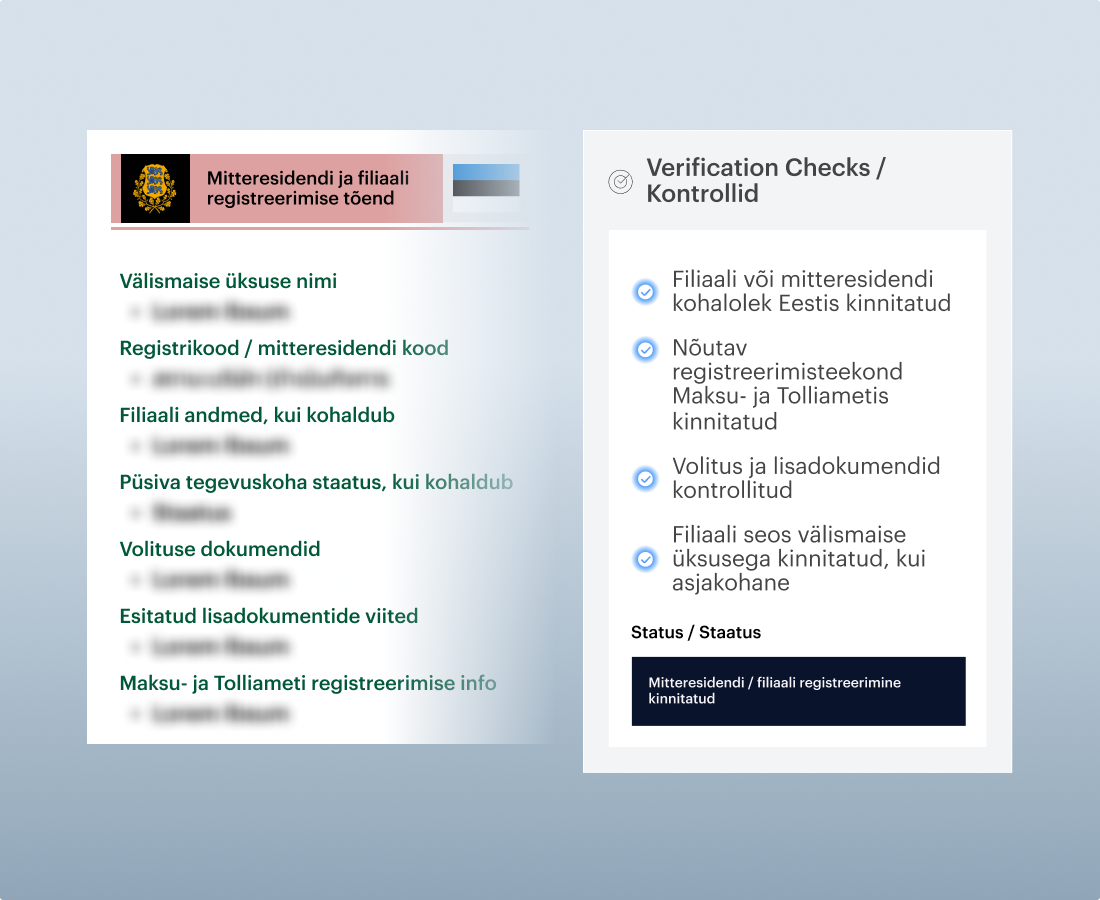
Registration Certificate
Certificate-style registry output confirming the entity is entered in the Estonian register. Often used where counterparties want formal registration evidence in the KYB file.
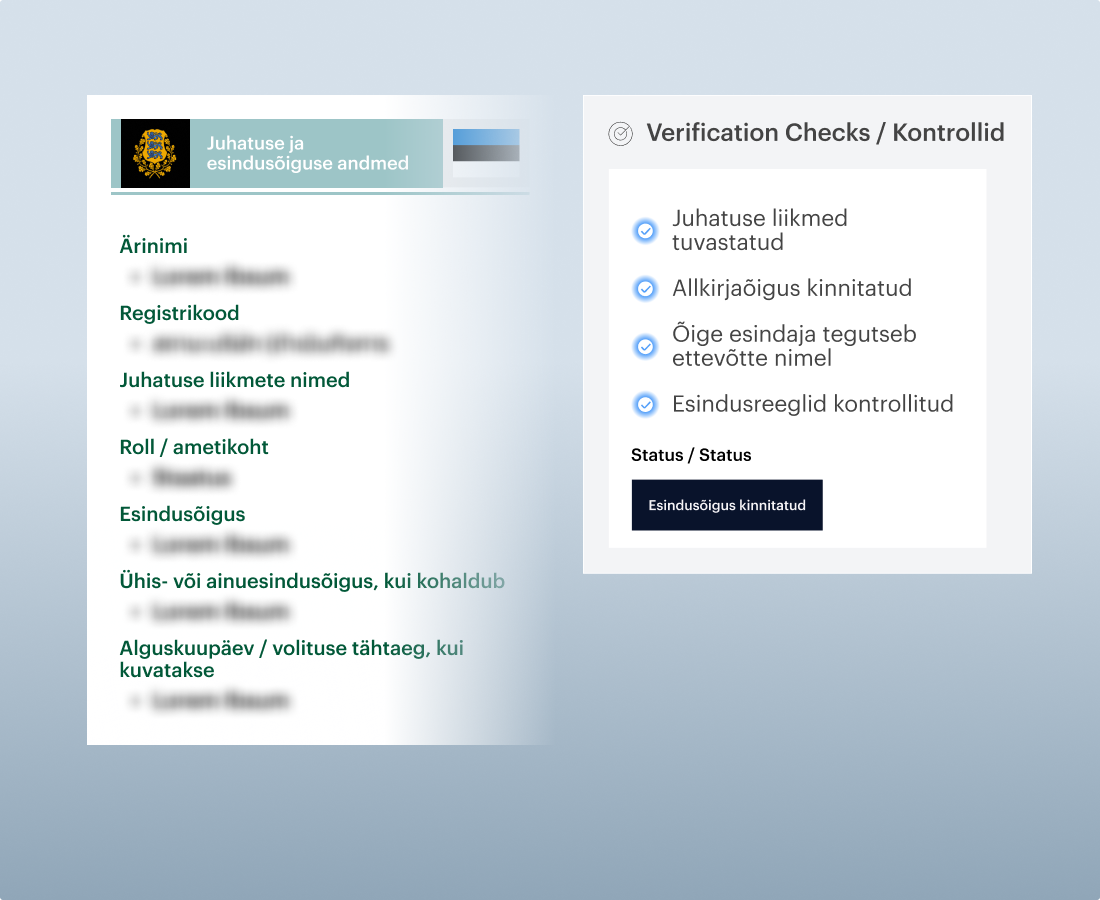
Management Board And Representation Details
Shows who can bind the company in practice and is used to validate signatory authority, reducing avoidable KYB exceptions where the wrong representative applies.
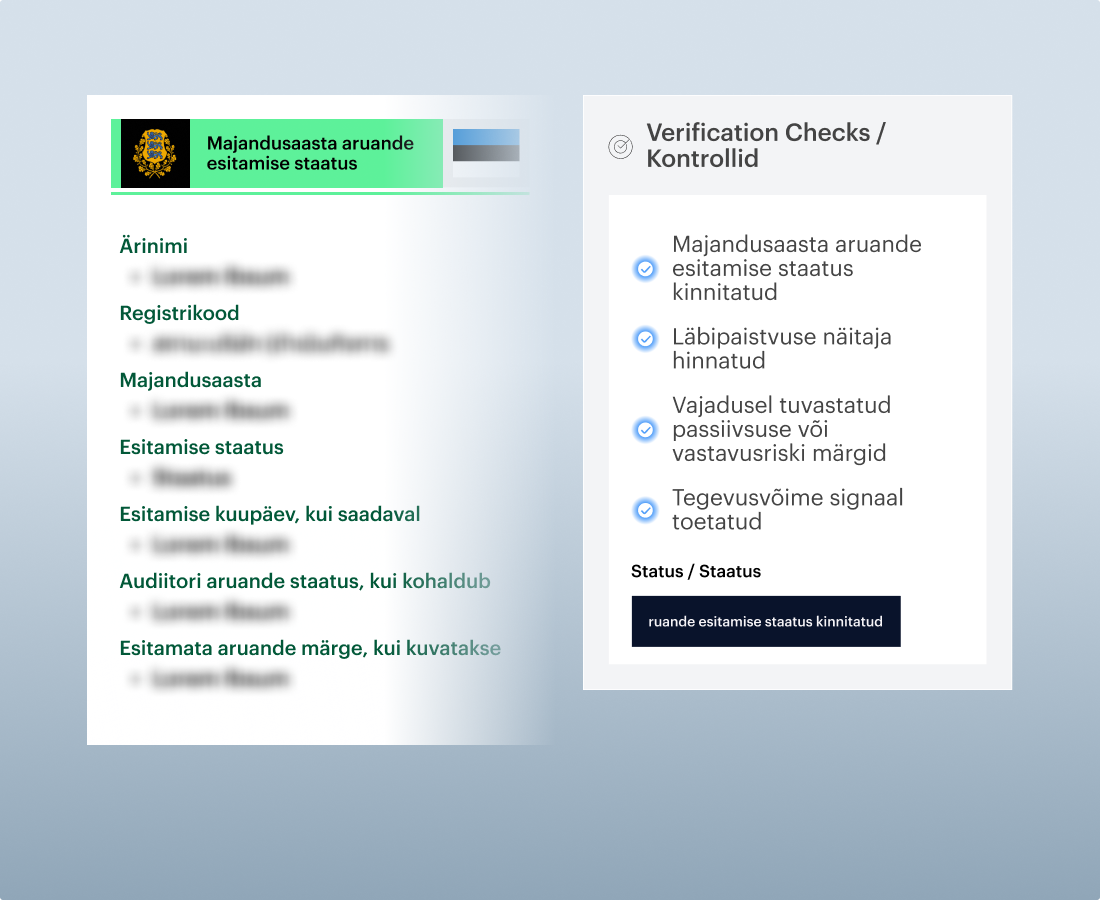
Annual Report Filing Status
Used as a transparency and operational health signal during KYB, especially for higher-risk sectors, dormant entities, or structures with non-resident control.
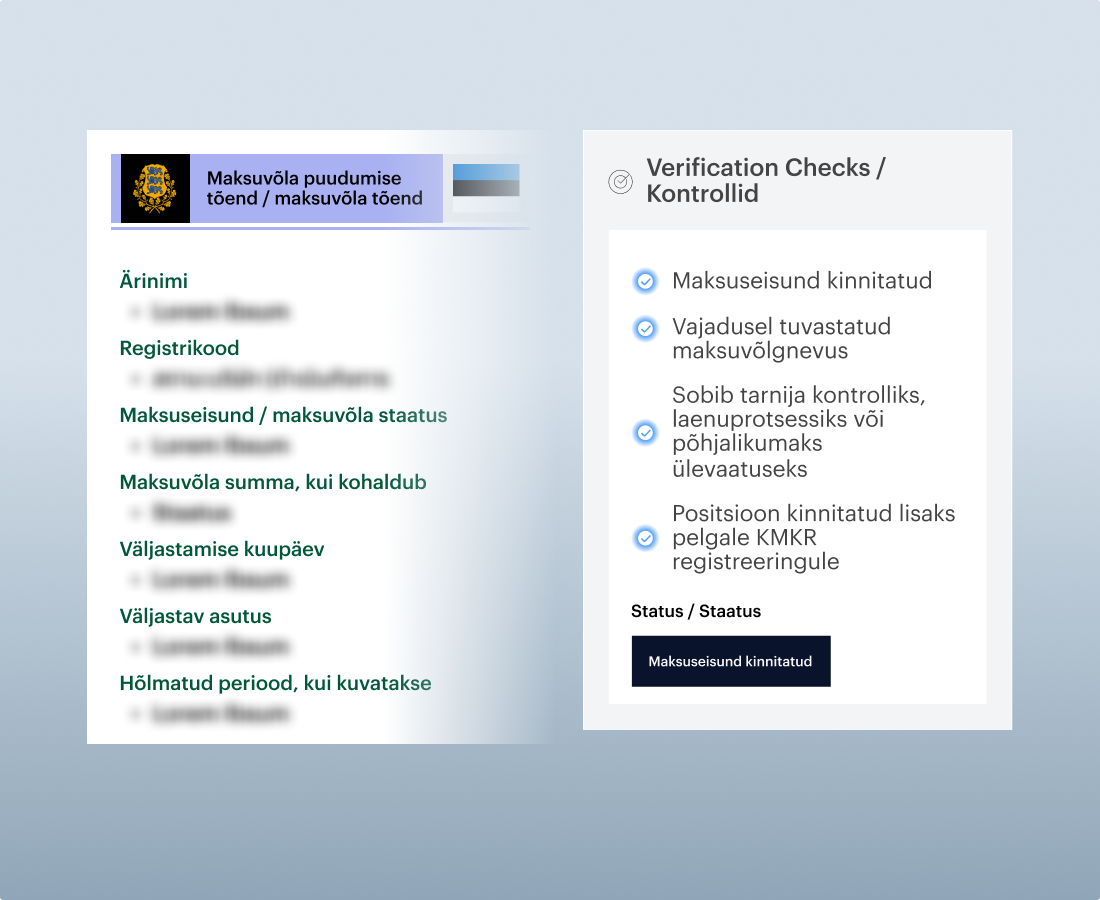
Business Tax Identity
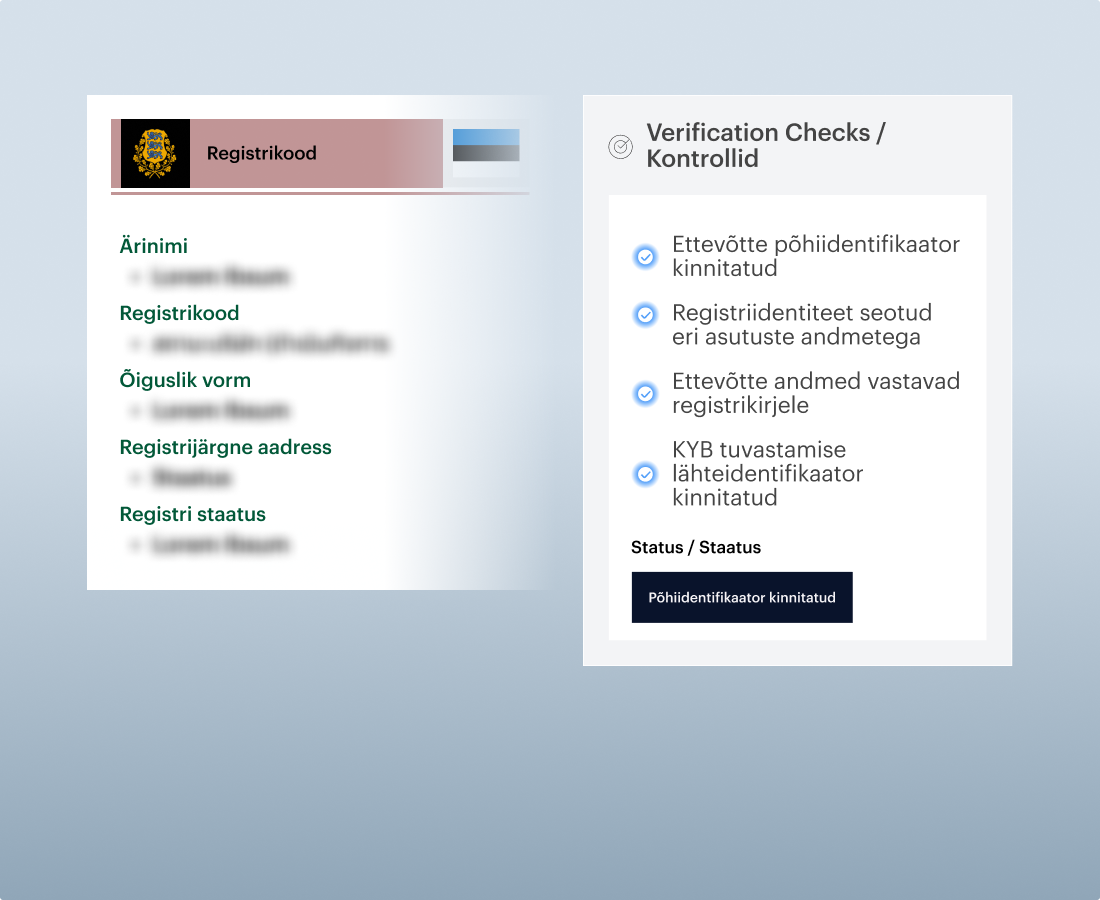
Company Registration Code
Core company identifier used across Estonian institutions. As everyday practice does not rely on a separate company tax ID, KYB capture usually starts here.
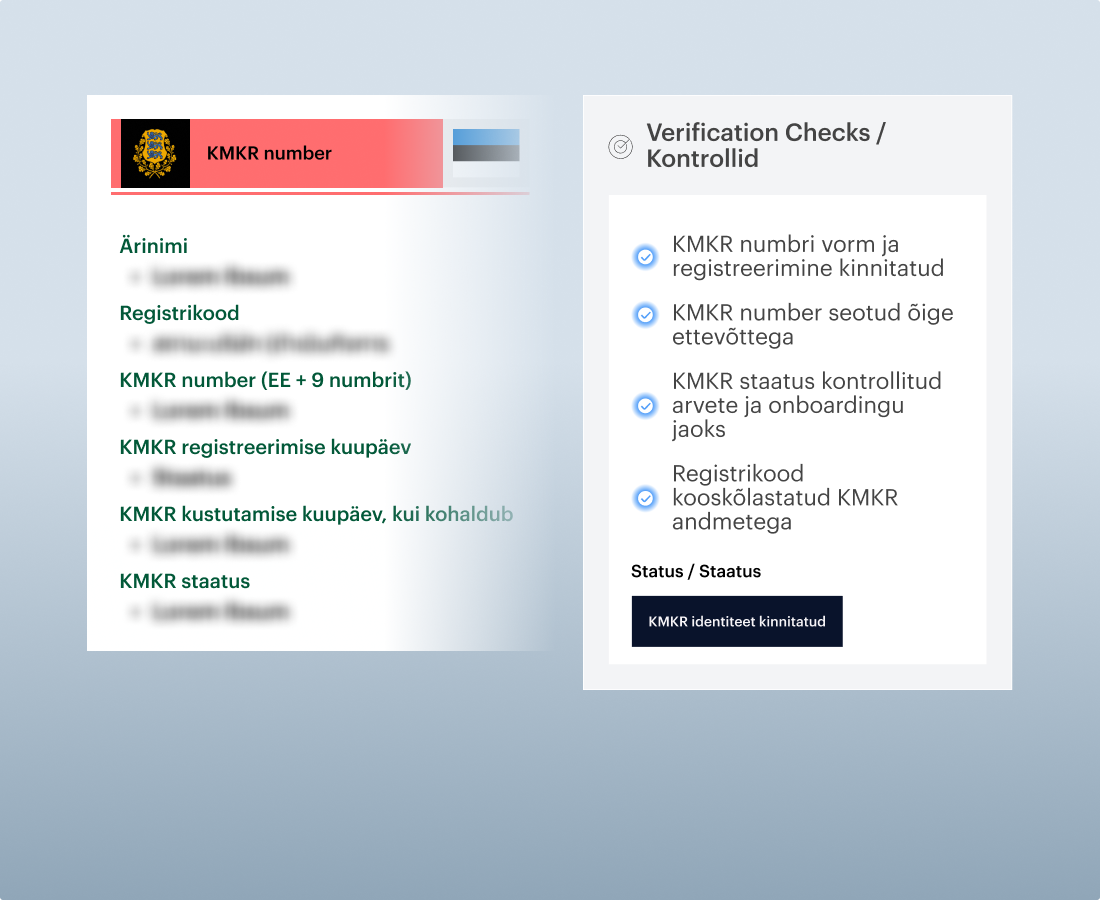
VAT Number
VAT number starts with EE plus nine digits. Once granted, it is published in the Business Register and used in invoicing, tax checks, and onboarding review.
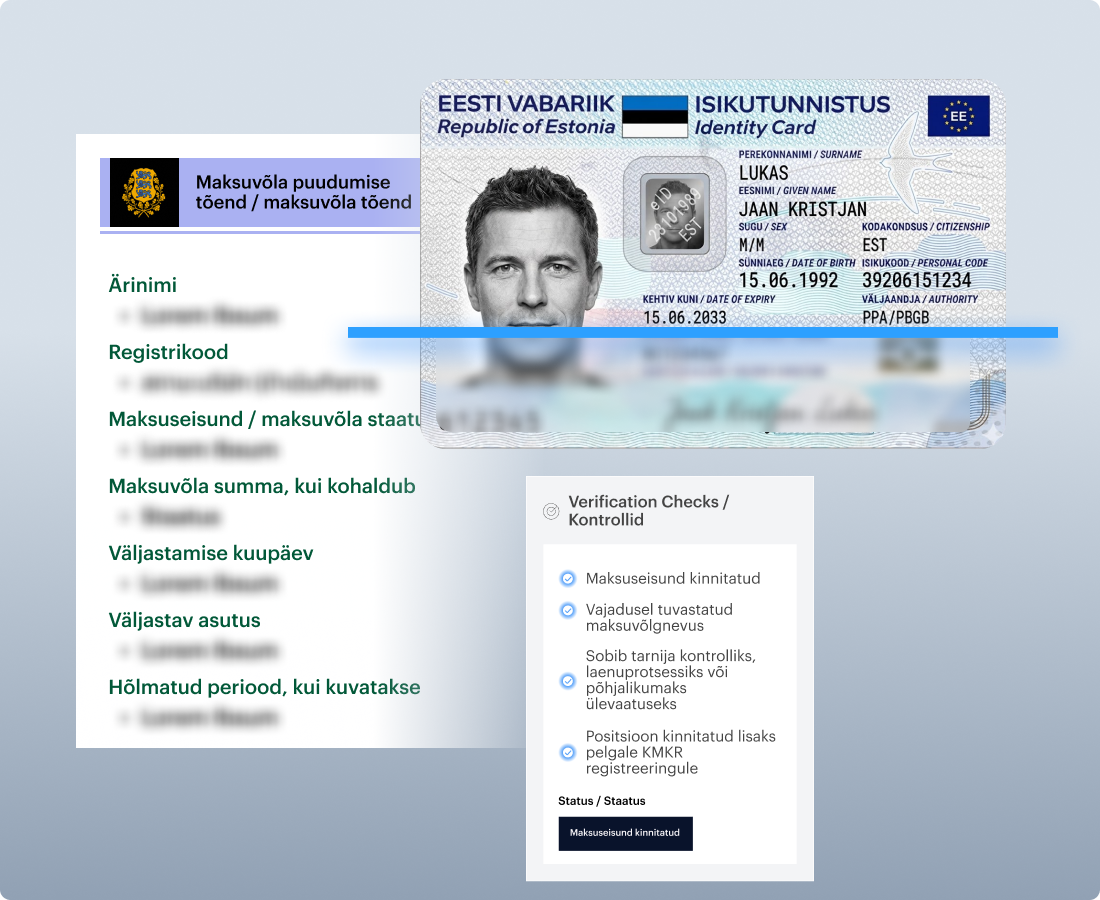
Tax Standing Or Tax Debt Certificate
Useful in supplier due diligence, lending, or enhanced review where teams need evidence of tax standing or arrears status beyond basic VAT registration alone.
Ownership & Control (UBO)
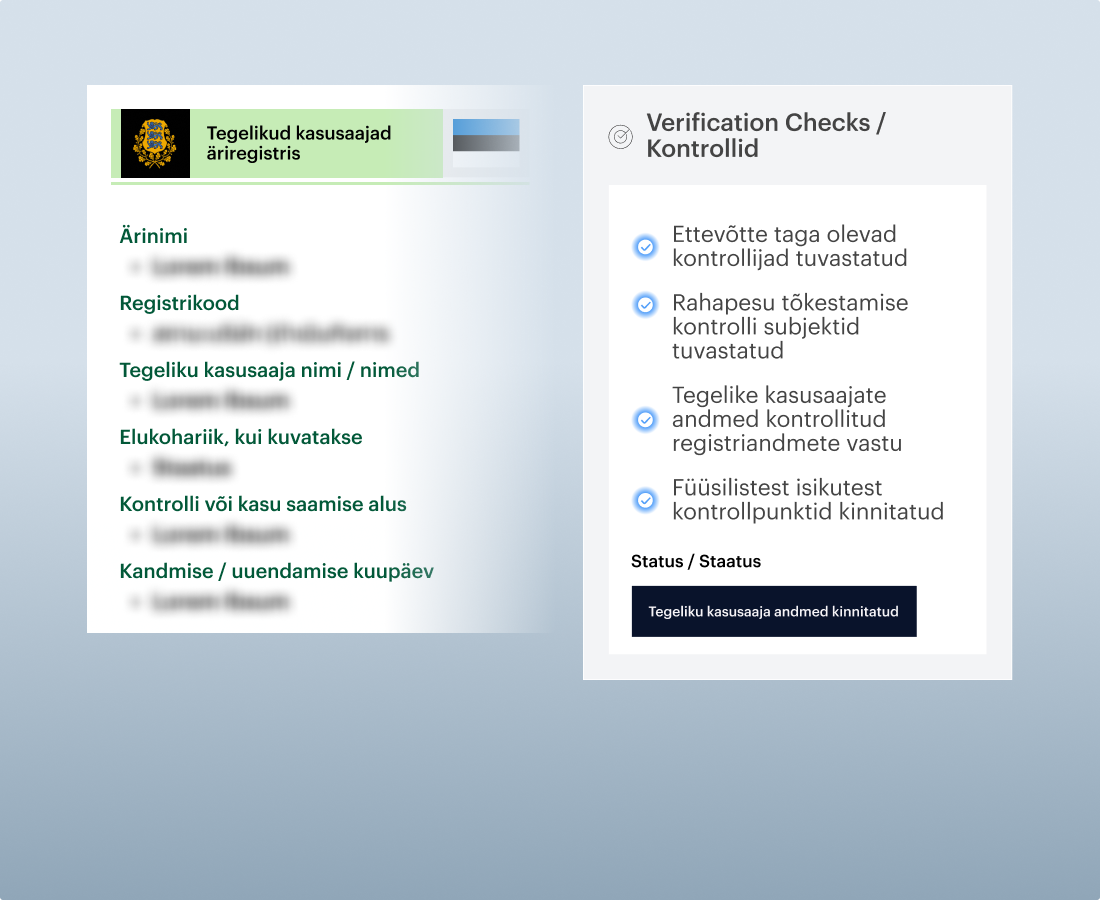
Beneficial Owner Data (UBO) In The Business Register
Used to identify controllers and support AML screening on the natural persons behind the entity. It is available through Estonia’s official Business Register tools.
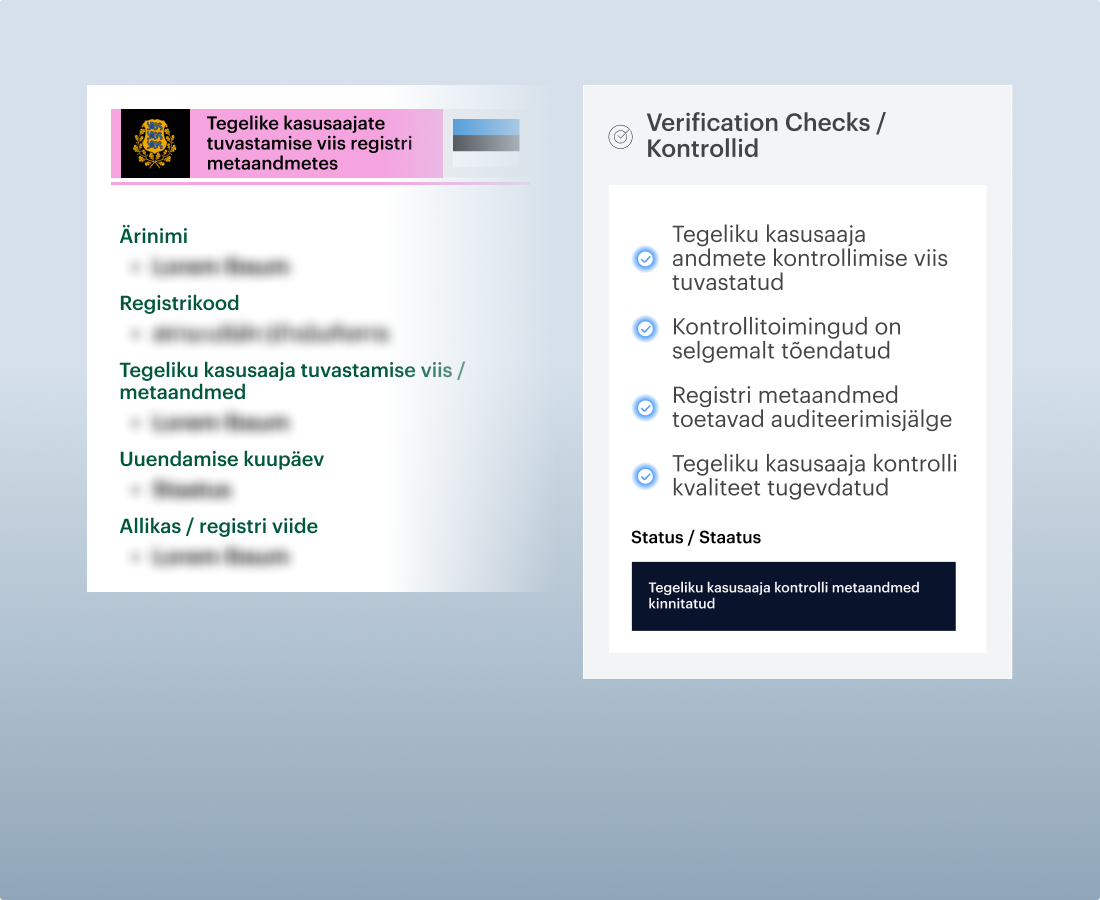
UBO Verification Approach (Register Metadata)
Open register datasets include fields describing how beneficial owner identity verification was carried out, helping teams evidence control checks more clearly.
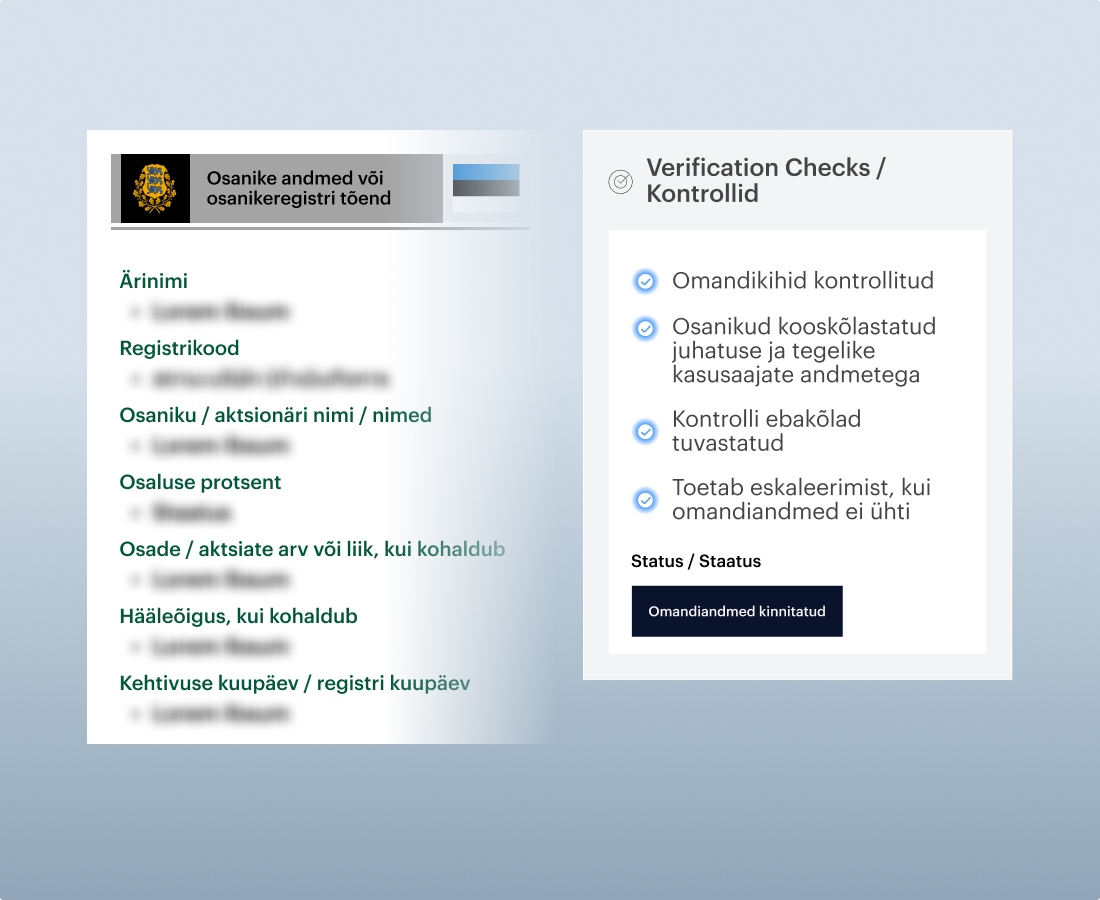
Shareholder Data Or Share Register Evidence
Used to test ownership layers, reconcile control, and support escalation where shareholder, board, and beneficial-owner evidence does not align cleanly.
Non-Resident And Branch Registration Evidence
For branches and permanent establishments, tax registration can require documented authorisation and supporting filings with the Tax and Customs Board.
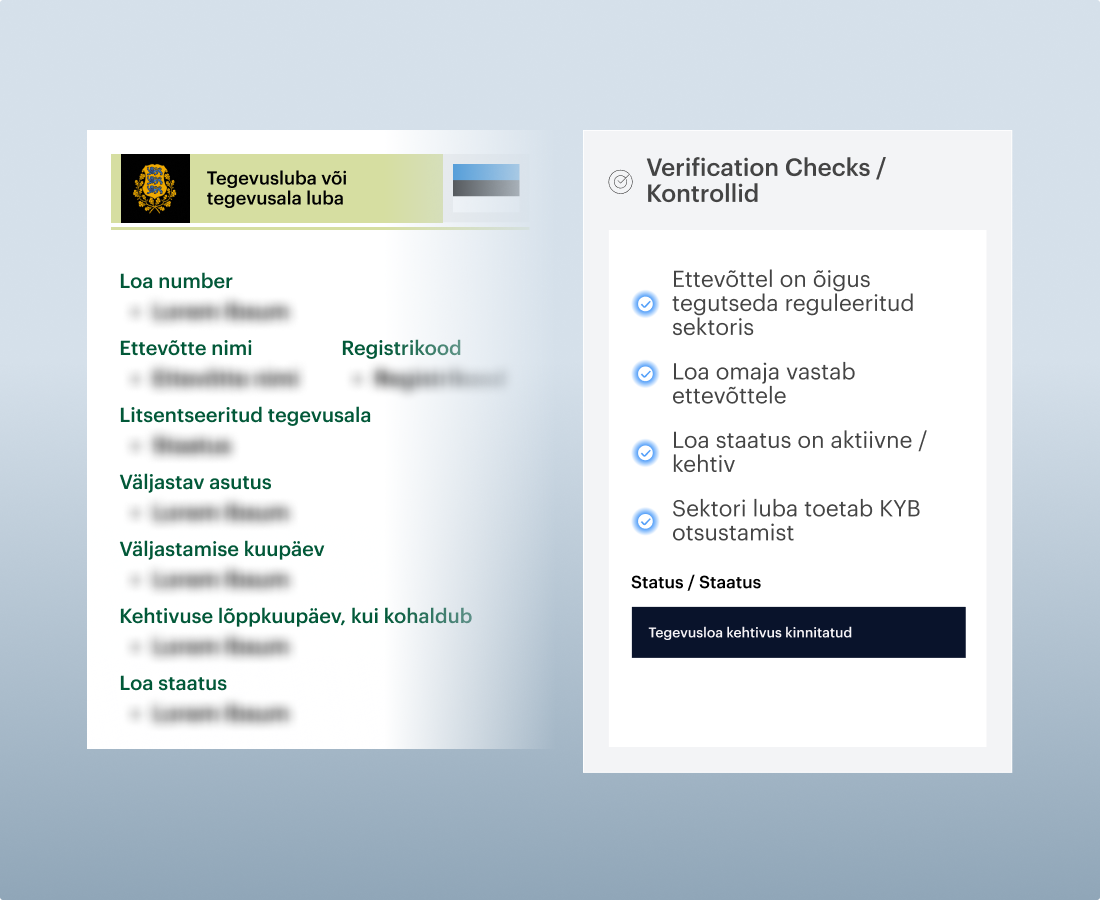
Sector Licence Or Activity Licence
For regulated sectors, licence evidence helps show that the business is permitted to operate and strengthens KYB decisions where sector approval matters.
Languages We Cover
Document Text Handling
Estonian is the official language and Estonian IDs use Latin script. Shufti also supports mixed-document intake where customers present foreign passports and records.
Name Matching Controls
Estonian uses Õ, Ä, Ö, Ü, Š, and Ž. Shufti supports controlled variant matching so forms like Mägi and Magi can be reviewed, logged, and resolved consistently.
Evidence Consistency Across Steps
Shufti keeps document, selfie, and screening evidence aligned by anchoring to stable identifiers such as isikukood rules, even where foreign records add transliteration variance.
GOVERNANCE & CONTROLS
Audit-Ready Decisions, Lower Operational Drag
Fewer Avoidable Re-submissions
Reduce repeat uploads with controls tuned to Estonian ID variants, document capture issues, and remote submission patterns that often slow approval.
Cleaner Audit Trails
Evidence retention aligns to Estonia’s five-year recordkeeping baseline, with data structured for prompt FIU responses and retention of digital-identification recordings where required.
Better Name Matching Outcomes
Reduce false positives with explainable matching for Õ, Ä, Ö, Ü and cross-script names, while keeping analyst decisions easier to review and defend.
One Workflow, One Back Office
Bring KYC, KYB, and AML screening into one operational workflow so teams can review users, businesses, and controllers without fragmented evidence handling.

National ID-First Flow Design
Start with Estonia’s primary resident IDs, capture isikukood consistently, and switch cleanly to passport fallback for non-resident and e-resident cases.
Estonia IDV/KYC Challenges

E-Resident ID Creates More KYC Exceptions
Foreign e-resident onboarding creates more passport fallback and proof-of-address exceptions because the digital credential is not a standard photo document for remote KYC.

Non-Resident Ownership Chains Slow UBO Review
Estonia’s company-services risk profile increases escalation work where controller evidence is weak, especially when ownership chains involve non-resident structures or intermediaries.

Sanctions Screening Creates More Manual Review
EU sanctions duties and Estonia’s reporting setup increase screening hits, analyst review time, and the need for documented decisions that stand up in FIU-facing enquiries.

Name Variants Drive Repeat Review Work
Dropped diacritics and foreign-script names create false matches across KYC and AML checks, leading to repeat reviews where Estonian and imported records do not align.
Shufti’s IDV/KYC Solutions for Estonia
KYC Solutions

Face Verification
Reduce impersonation risk in Estonia’s remote onboarding flows with face checks designed for resident, non-resident, and passport-led journeys where stronger evidence is needed upfront.
.
Age Verification
Use selfie-based age estimation to flag likely minors early, then add document verification when Estonia-facing age-gated access or higher-control onboarding requires it.
.
Address Verification
Verify address-bearing documents commonly used in Estonia, including utility bills and bank statements, to reduce manual proof-of-address review and keep onboarding moving.
.
Document Verification
Verify Estonian ID cards, residence permit cards, e-resident digital IDs, and passports with flows built to handle local formats, fallback routes, and retry reduction.
.KYB Solutions

Business Verification
Build KYB around Estonia’s e-Business Register, then connect registry code, status, directors, VAT publication, and beneficial owners into one clearer business risk view.
.
Enhanced Due Diligence (EDD)
Trigger EDD where Estonia’s risk profile is sharper, including non-resident ownership chains, higher-risk sectors, and CSP-linked structures that demand stronger evidence.
.AML Screening

Business AML Screening
Screen Estonian entities and controllers against EU and UN sanctions, PEPs, and watchlists, then keep the evidence needed for escalation, review, and reporting.
.
Transaction Screening
Monitor transactions for Estonia-relevant typologies, including cross-border activity and crypto-linked narratives, with logs that support faster review and FIU response.
.Built to Fit Estonia's Compliance Landscape

Financial Intelligence Unit (FIU)
Exercises AML/CFT supervision across many obliged entities and receives suspicious, unusual, cash, terrorist financing, and sanctions reports. Shufti helps teams keep the records, rationale, and escalation trail needed for audit and reporting.

Finantsinspektsioon
Supervises banks, insurers, investment firms, and other licensed financial entities. Shufti supports risk-based CDD, consistent screening records, and decisions that are ready for internal review and supervisory scrutiny.

Ministry Of Finance
Owns Estonia’s AML policy framework and publishes national money laundering risk assessments. Shufti helps firms turn that risk-based model into structured KYB, UBO, and evidence-led onboarding controls.

Ministry Of Foreign Affairs
Coordinates Estonia’s implementation of international sanctions. Shufti helps firms show how sanctions checks, controller screening, and escalation handling were carried out in practice.

Estonian Data Protection Inspectorate
Supervises personal data processing under GDPR and Estonia’s Personal Data Protection Act. Shufti supports tighter retention control, data minimisation, and safer handling of onboarding evidence.

Police And Border Guard Board
Issues Estonia’s core identity documents, including ID cards, residence permit cards, and e-resident digital IDs. Shufti supports document checks built around local fields, formats, and document change cycles.

Centre Of Registers And Information Systems (RIK)
Operates the e-Business Register portal, while the legal register force sits with Tartu County Court’s Registration Department. Shufti helps bring registry facts, ownership data, and representation details into one KYB workflow.

Estonian Tax And Customs Board
Manages tax registration, VAT status, and non-resident registration relevant to company onboarding. Shufti helps teams capture and retain the tax-linked evidence used in higher-confidence KYB reviews.
Deployment Choice
No in-country AWS, Azure, Google Cloud, or Oracle public regions are listed for Estonia, so teams usually deploy in nearby EU regions or via enterprise on-premises.
Regulatory Alignment
Aligned to Estonia’s AML recordkeeping duties and the need to provide FIU-requested information without delay, alongside GDPR and Estonia’s Personal Data Protection Act oversight framework.
Retention controls
Configurable retention and purge settings can align to Estonia’s five-year minimum for KYC and transaction records, including digital-identification audio and video recordings.
Encryption posture
Encryption protects personal and financial data in transit and at rest, supporting Estonian data protection expectations around unlawful access, loss, and destruction.
Data Controls & Privacy for Estonia
Estonia AML Sources That Strengthen Decision

Estonian Centre Party

Harju County Government

Estonia Police – Wanted Persons /Police And Border Guard Board

Ministry of Foreign Affairs

Post Timees
Delfi

ERR News
Estonian Centre Party
Harju County Government
Estonia Police – Wanted Persons /Police And Border Guard Board
Ministry of Foreign Affairs
Post Timees
Delfi
ERR News
Estonian Centre Party
Harju County Government
Estonia Police – Wanted Persons /Police And Border Guard Board
Ministry of Foreign Affairs
Post Timees
Delfi
ERR News
Estonian Centre Party
Harju County Government
Estonia Police – Wanted Persons /Police And Border Guard Board
Frequently Asked Questions
What Is The Primary ID For Estonian Resident Onboarding?
Estonia’s ID-card is the primary proof for citizens and EU residents living in Estonia. For non-EU residents, the residence permit card is a common primary ID.
Is An Estonian Digital ID Enough For KYC?
Digi-ID is electronic-only and has no photo. It supports e-services and signing, but it does not replace photo ID in standard onboarding control design. Issuance ends 01.05.2025.
What Is The Practical Passport Fallback In Estonia?
In remote journeys and for non-residents, passports are a practical fallback due to structured data pages and consistent capture. Estonia requires fingerprints for travel documents and stores them on the chip.
How Do We Report Suspicious Activity To The FIU In Estonia?
FIU notifications are submitted electronically via the FIU reporting portal. Suspicious ML or TF reports must be made immediately, and no later than within two working days after suspicion is identified.
What KYB Evidence Set Works For Estonian Companies?
Start with the e-Business Register profile and registry code, capture directors and beneficial owners, then add VAT status where relevant. Registration certificate and shareholder evidence can strengthen higher-risk files.
How Should We Handle UBO And Corporate Service Provider Risk?
Estonia’s risk work flags higher vulnerability in company service providers. Apply tighter tests on UBO credibility, escalation triggers, and evidence quality in non-resident control structures.
What Sanctions Lists And Controls Matter Operationally In Estonia?
Screening should cover EU restrictive measures and UN lists as a baseline. Estonia’s International Sanctions Act and the Ministry of Foreign Affairs’ coordinating role also matter operationally.
How Does Shufti Reduce False Matches From Estonian Name Variants?
Shufti supports diacritics and controlled normalisation across scripts, then logs match rationale so analysts can explain why a hit was cleared or escalated.
How Do We Reduce Drop Off In Estonia’s Remote Journeys?
Use ID-card and residence permit card first for residents, keep passport fallback simple for non-residents, allow guided retries, and scope address checks to address-bearing documents.
Build a Estonia-ready KYC, KYB & AML programme with Shufti
INDEPENDENTLY AUDITED. GLOBALLY CERTIFIED.
Certified to Global Standards





PROVEN WORKFLOWS
Use Cases for Regulated Growth in Estonia
Accelerate Growth, Eliminate Friction
Onboard users in seconds, not days. Deploy tiered address verification flows that maximise completion rates for genuine users while filtering out synthetic fraud.



Onboard Global Traders in Real-Time
Verify investors across 240+ countries & territories. Ensure compliance with international financial regulations while preventing identity theft and high-risk chargebacks.



Secure Trust at Every Transaction
Automate KYC and AML workflows to reduce manual onboarding costs. Strengthen residency checks while delivering the frictionless digital experience modern customers expect.



Power a Fair & Secure Player Experience
Reduce bonus abuse and multi-accounting rings at the door. Enforce location rules and trigger step-up checks without disrupting the player journey.



Build a Trusted, Verified Workforce
Screen freelancers and drivers at scale. Verify residency and reduce onboarding friction while maintaining trust between users.



Scale Your Exchange with Confidence
Balance anonymity with compliance. Instantly verify user jurisdiction to meet Travel Rule obligations and help stop abuse without slowing down legitimate trading volume.



Reduce fraud without blocking growth
Shufti supports marketplace integrity by verifying seller and buyer identities, enabling age-gated journeys where needed, and preserving evidence to support investigations, disputes and risk-led enforcement actions.




Accelerate Growth, Eliminate Friction
Onboard users in seconds, not days. Deploy tiered address verification flows that maximise completion rates for genuine users while filtering out synthetic fraud.
Onboard Global Traders in Real-Time
Verify investors across 240+ countries & territories. Ensure compliance with international financial regulations while preventing identity theft and high-risk chargebacks.
Secure Trust at Every Transaction
Automate KYC and AML workflows to reduce manual onboarding costs. Strengthen residency checks while delivering the frictionless digital experience modern customers expect.
Power a Fair & Secure Player Experience
Reduce bonus abuse and multi-accounting rings at the door. Enforce location rules and trigger step-up checks without disrupting the player journey.
Build a Trusted, Verified Workforce
Screen freelancers and drivers at scale. Verify residency and reduce onboarding friction while maintaining trust between users.
Scale Your Exchange with Confidence
Balance anonymity with compliance. Instantly verify user jurisdiction to meet Travel Rule obligations and help stop abuse without slowing down legitimate trading volume.
Reduce fraud without blocking growth
Shufti supports marketplace integrity by verifying seller and buyer identities, enabling age-gated journeys where needed, and preserving evidence to support investigations, disputes and risk-led enforcement actions.
Accelerate Growth, Eliminate Friction
Onboard users in seconds, not days. Deploy tiered address verification flows that maximise completion rates for genuine users while filtering out synthetic fraud.
Onboard Global Traders in Real-Time
Verify investors across 240+ countries & territories. Ensure compliance with international financial regulations while preventing identity theft and high-risk chargebacks.
Secure Trust at Every Transaction
Automate KYC and AML workflows to reduce manual onboarding costs. Strengthen residency checks while delivering the frictionless digital experience modern customers expect.
Power a Fair & Secure Player Experience
Reduce bonus abuse and multi-accounting rings at the door. Enforce location rules and trigger step-up checks without disrupting the player journey.
Build a Trusted, Verified Workforce
Screen freelancers and drivers at scale. Verify residency and reduce onboarding friction while maintaining trust between users.
Scale Your Exchange with Confidence
Balance anonymity with compliance. Instantly verify user jurisdiction to meet Travel Rule obligations and help stop abuse without slowing down legitimate trading volume.
Reduce fraud without blocking growth
Shufti supports marketplace integrity by verifying seller and buyer identities, enabling age-gated journeys where needed, and preserving evidence to support investigations, disputes and risk-led enforcement actions.
Let’s Tailor your journey
Just a few quick questions to guide your Shufti experience.

Shufti
Market Positioning and Commercial Assessment

Industry stands at 1.7rating

Best ID Verification Innovator

TOP 10 KYC Solution Provider
Best Client Onboarding Solution

Samer Al Tamimi@CEO of Safwa Bank
We take our client's privacy very seriously and always look for new innovative solutions to ensure a safe banking experience. Working with Shufti feels like a breath of fresh air, as their 100% in-house tech keeps our customer's data free from vulnerabilities and fully safe and protected.


PROVEN PLAYBOOKS
Explore Practical KYC & AML Resources
16 August, 2025
5 minutes read
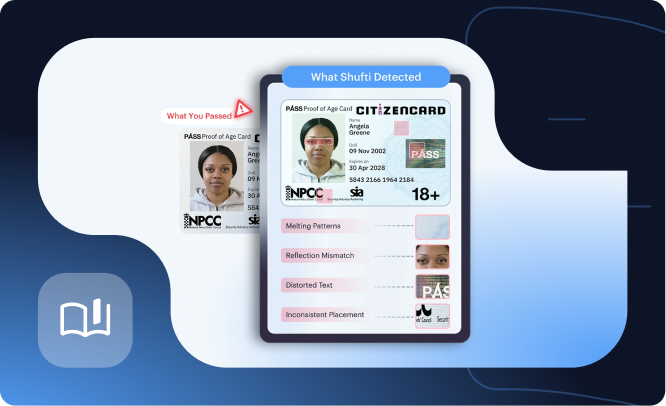
How Much of What You’ve Verified Is Actually Real?
Shufti’s Deepfake Blindspot Audit now runs fully inside your AWS environment, auditing historic KYC for manipulation signals without moving sensitive data off-prem.
whitepapers