AMLR Solutions
  AMLR Consultation
 EUDI Wallet
 Onboarding
 Ongoing Monitoring
 FRAML
FRAML KYC
KYC KYB
KYB KYI
KYI Age Assurance
 Workforce IAM
 Candidate Verification
 Account Takeover
 Bonus/ Promotion Abuse
 Chargeback Fraud
 Deepfake
 Document Fraud
 Fraud Networks
 Impersonation Fraud
 Money Mule Activity
 Multi-Accounting
 Party Fraud
 Regulatory & Compliance Risks
 Synthetic Identity Fraud
 Adult Content
 Banking
 Crypto
 Fintech
 Forex
Forex Compliance
 Fraud prevention
 Trust & safety
 Global expansion
 Compliance Officers
 Developers
 Fraud Analysts
 Product Managers
 Journey Builder
  Global Trust Platform
 Customer Profiles
 Vendor Comparison
 IDV Case Management
 AML Case Management
 Regulatory Reporting
 Agentic Rule Builder
  AI Compliance Co-Pilot
  Fraud Analytics
 Fraud Hub
  OCR
OCR Shufti AI
 Bank Account Verification
  Biometric Duplication
 Database Checks
 Document Intelligence
 Government ID
 Mobile Driver's License
 NFC
NFC Selfie Liveness
 Brand Personalisation
 Deployment Options
 Identity Methods
 IDV Modes
 Multi-tenancy
 On-Premise IDV
 Secure Capture
 Shufti MCP











KYC, KYB and AML 2026 Playbook for Mexico
A guide to KYC, KYB and AML in Mexico, from onboarding and beneficial ownership to sanctions and enforcement after the LFPIORPI reform.
In 2025 Mexico ran its deepest anti-money-laundering overhaul in a decade. The beneficial-owner threshold dropped to 25%, automated monitoring became mandatory, and regulators started fining missing evidence, not just missing policy. This playbook shows what changed and how to onboard, verify and screen against it.
Schedule a Mexico demoWhat the 2025 LFPIORPI reform actually changed
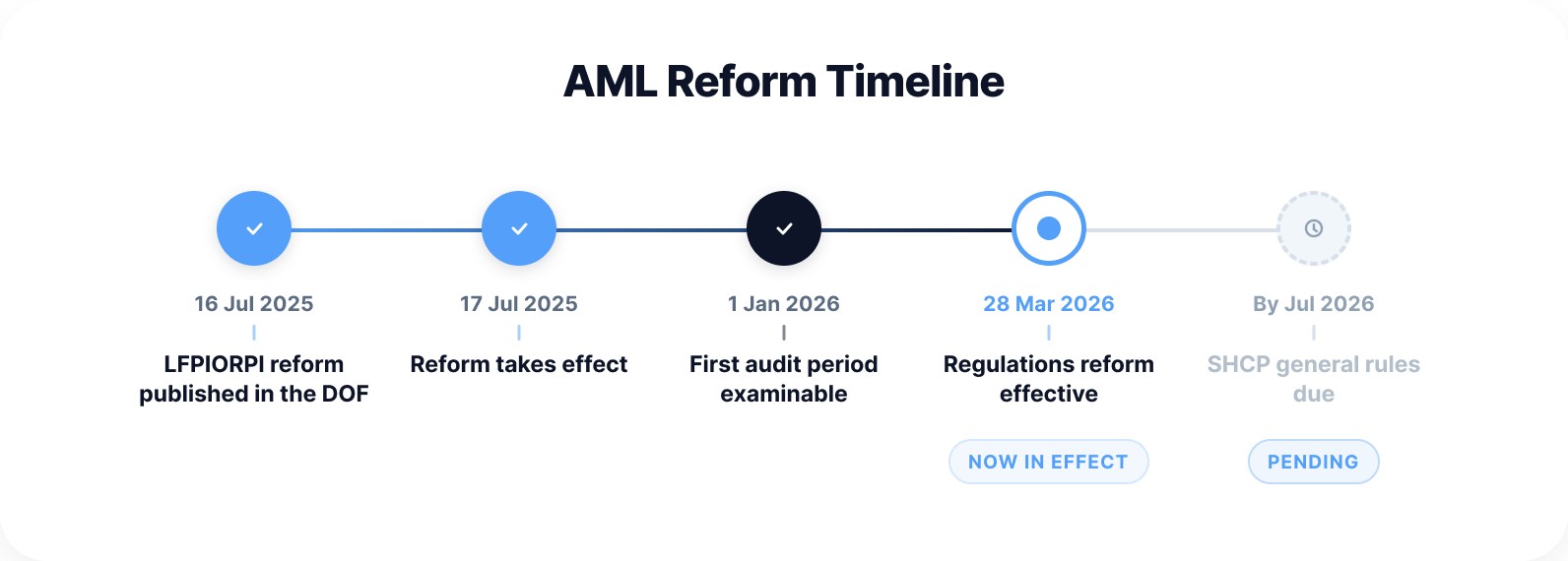
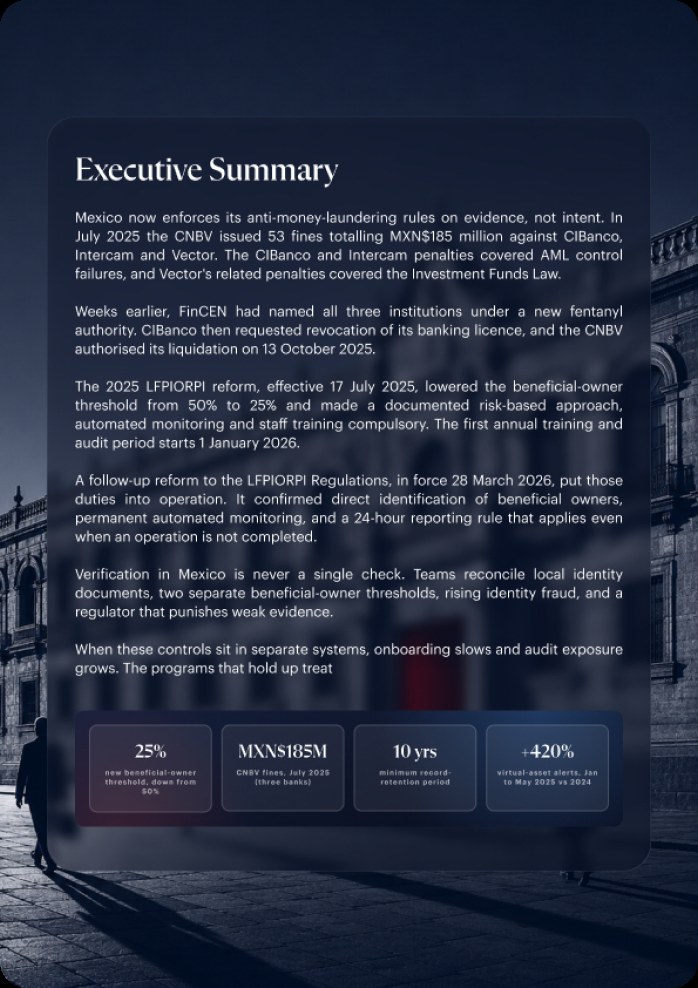
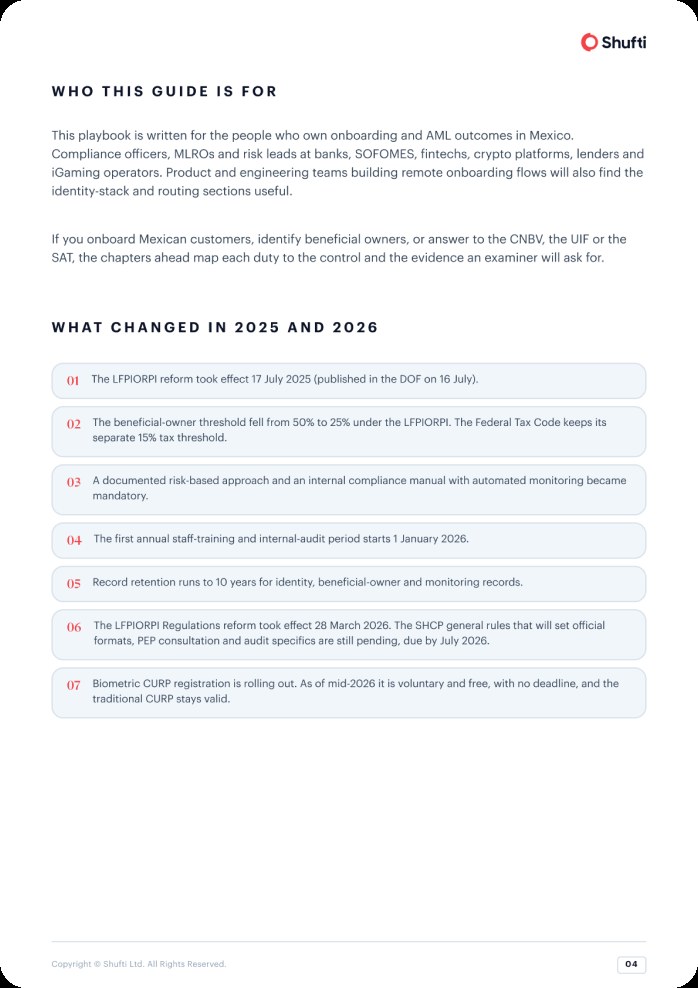
Mexico's July 2025 LFPIORPI reform is the country's deepest AML overhaul in a decade. From 17 July 2025 it cut the beneficial-owner threshold from 50% to 25%, made a documented risk-based approach and automated monitoring mandatory, and set record retention at ten years.
A second reform to the LFPIORPI Regulations took effect on 28 March 2026 and turned those duties into daily practice. Firms now identify beneficial owners directly, monitor transactions continuously, and file a report within 24 hours of a suspicious operation, even one that never completes.
Threshold cut to 25%
- Beneficial owner now captured at 25% control, down from 50%.
- Five 20% shareholders all count as owners, where the old rule captured none.
Documented,
automated, audited
- Risk-based approach and automated monitoring now mandatory
- Annual training and internal audit from 1 January 2026
- 24-hour reporting, including attempted operations
Two things that held
- The Federal Tax Code keeps its separate 15% beneficial-owner threshold
- The traditional CURP stays valid as the biometric CURP rolls out
Who regulates KYC and AML in Mexico?
Mexico spreads AML authority across several agencies, and a single onboarding decision can answer more than one. The LFPIORPI is the core statute. The Federal Tax Code adds its own beneficial-owner regime, and the 2018 Fintech Law governs virtual assets.
Two bodies shape day-to-day work. The CNBV sets how identity and AML controls are examined, and the UIF decides which names are blocked and which reports are filed. You can satisfy the CNBV on paperwork and still fail by missing one name on the UIF list.
| Body | Role |
|---|---|
| SHCP | Sets AML and CFT policy |
| UIF | Receives STRs, maintains the LPB blocked-persons list |
| CNBV | Supervises banks and fintechs, issues KYC provisions |
| Banxico | Restricts crypto for regulated institutions |
| SAT | Receives vulnerable-activity reports, 15% tax UBO |
| CNSF | Supervises insurance |
| CONSAR | Oversees pensions |
Mexico remains in enhanced follow-up from its 2018 FATF evaluation.
Why a valid Mexican ID does not prove a real person
A valid Mexican ID proves registry enrollment, not that the person holding it is real. A CURP confirms someone exists in RENAPO's records. It says nothing about who is on the other side of the screen.
That is the personhood gap, and it is where fraud rings work, pairing genuine registry data with forged or synthetic documents. Closing it takes face verification with liveness detection and biometric matching, so the file binds to a living person instead of a document anyone can copy.
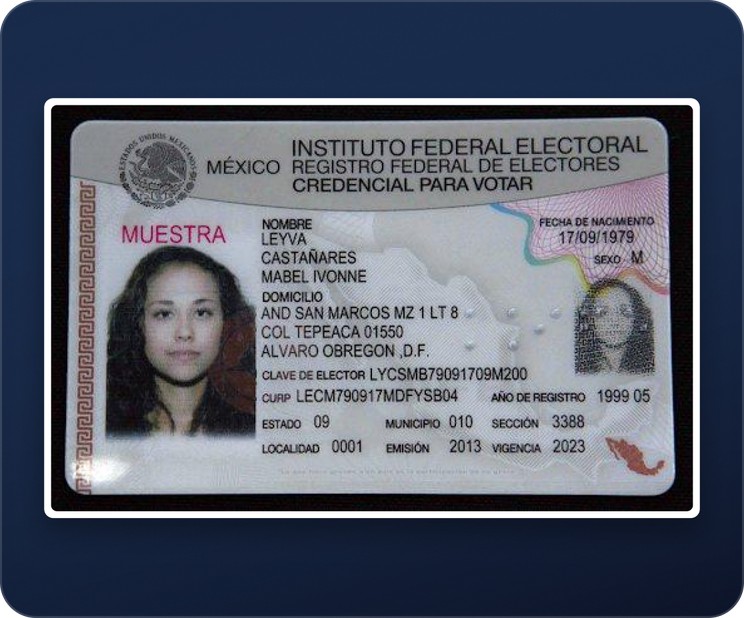
INE credential, what a verification engine reads:
- Photo, bound to a live selfie with face match and liveness
- CURP, the 18-character RENAPO registry code
- MRZ and OCR zone, machine-read and cross-checked
- Holographic overlay, sits directly over the data fields
- Paternal and maternal surnames, multi-name parsing
| Identifier | What it proves | The gap | How to cover it |
|---|---|---|---|
| CURP | Registry enrolment | No liveness or biometric match | Liveness detection and facial matching |
| INE | Electoral registry and photo | Photo can be forged or swapped | Face verification with 3D liveness |
| Passport (foreign) | Travel authority, biometric where supported | Depends on issuer controls | NFC chip and MRZ checks |
| Comprobante de domicilio | Address association | Does not identify the person | Pair with INE or passport |
| Biometric CURP | Registry plus face, fingerprint, iris | Assurance depends on RENAPO security | iBeta Level 3 Conformance liveness and spoof detection |

Mexican IDs are issued by federal, state and municipal bodies, many with holographic overlays printed straight over the data fields, and names often stack multiple given names with paternal and maternal surnames. Reliable document reading and verification across this variety is the first real test of any verification partner.
How to onboard and verify a customer
Mexico's CNBV scales identity checks to account risk through four tiers, Nivel 1 to Nivel 4. Lower tiers allow lighter checks and small balances. Higher tiers require full identification and biometrics and support business accounts.
Remote onboarding is well established at the higher tiers. Since 2020, banks and fintechs can open Nivel 3 and Nivel 4 accounts for Mexican nationals over video, using an INE photo, a selfie and a live call of at least 30 seconds, matched against the INE and confirmed with RENAPO.
| Tier | Identification depth | Deposit cap | Opening method |
|---|---|---|---|
| Nivel 1 | No identification file | approx MXN 6,600 / mo | In person or remote |
| Nivel 2 | Name, DOB, address from an official ID | approx MXN 26,400 / mo | In person or remote |
| Nivel 3 | INE or passport plus proof of address | approx MXN 88,000 / mo | In person or by video (INE holders) |
| Nivel 4 | Full file plus biometric checks, corporate docs for entities | No limit | In person or by video (30-second live call) |
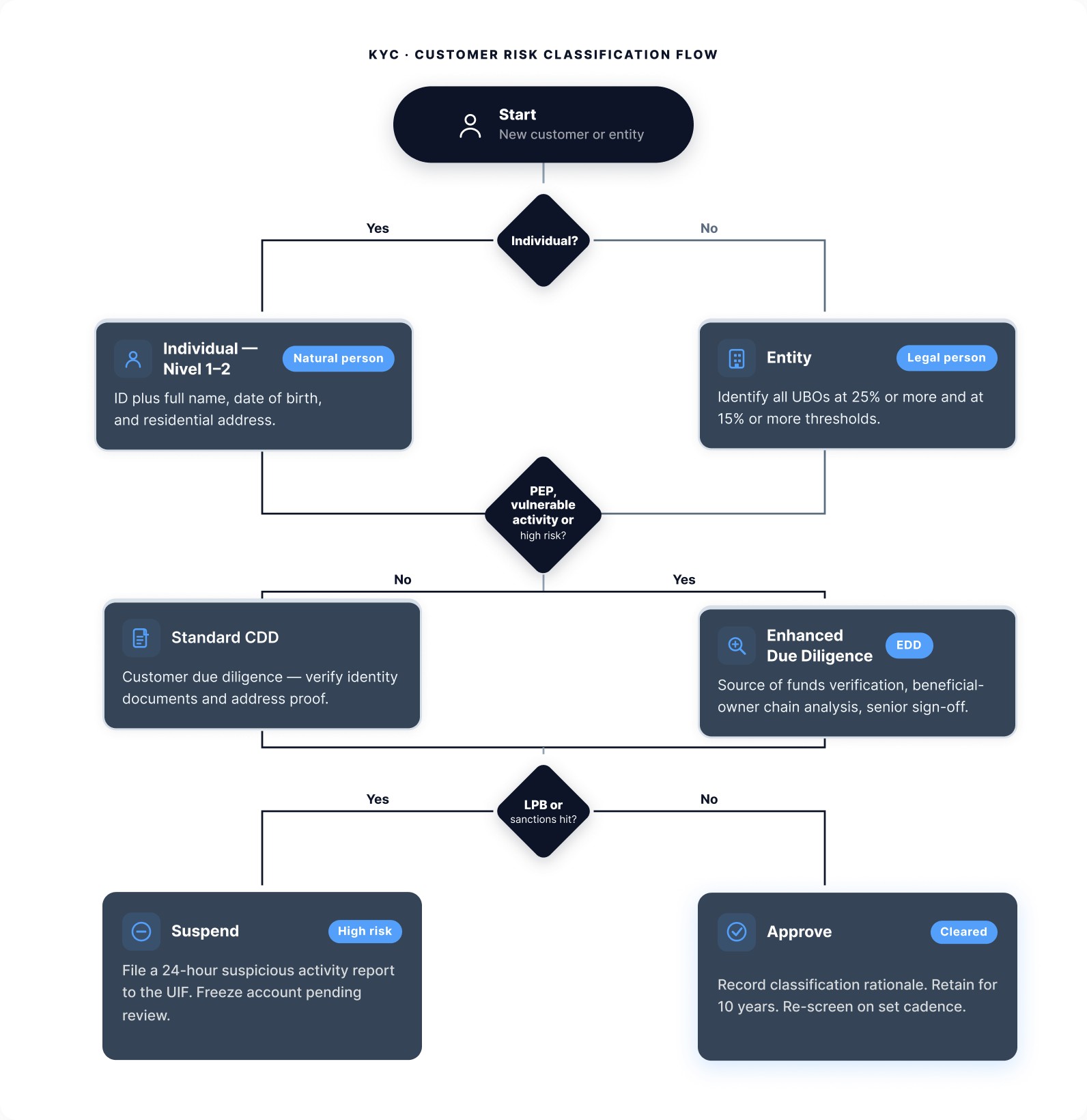
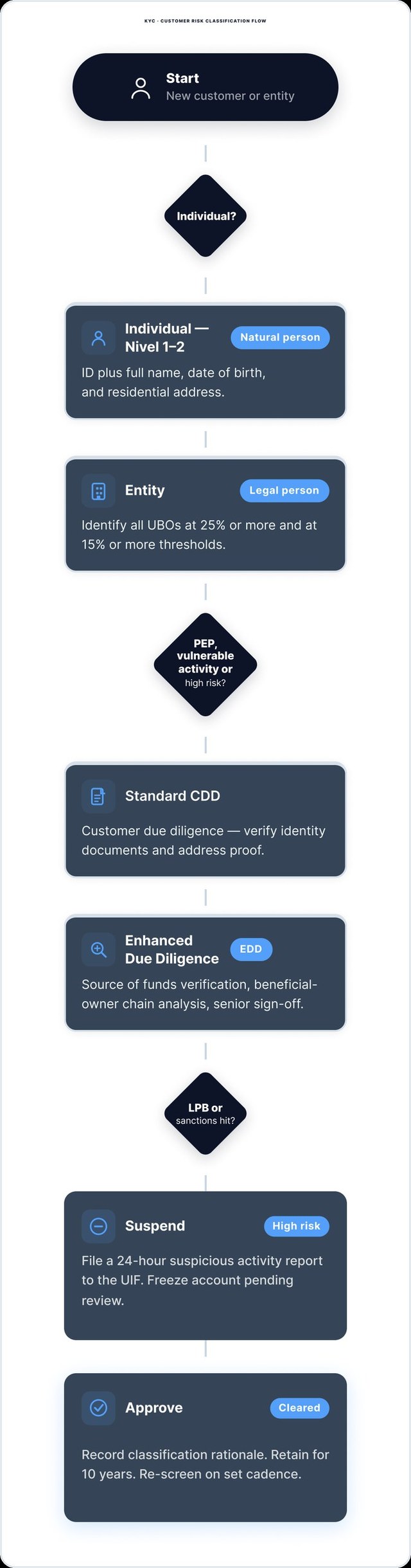
Want to Know what Mexico-ready verification looks like?
Map these controls to live Mexican onboarding, from INE and CURP reading with liveness to the dual 25% and 15% ownership checks.
Explore Shufti for MexicoBeneficial ownership after the 25% rule
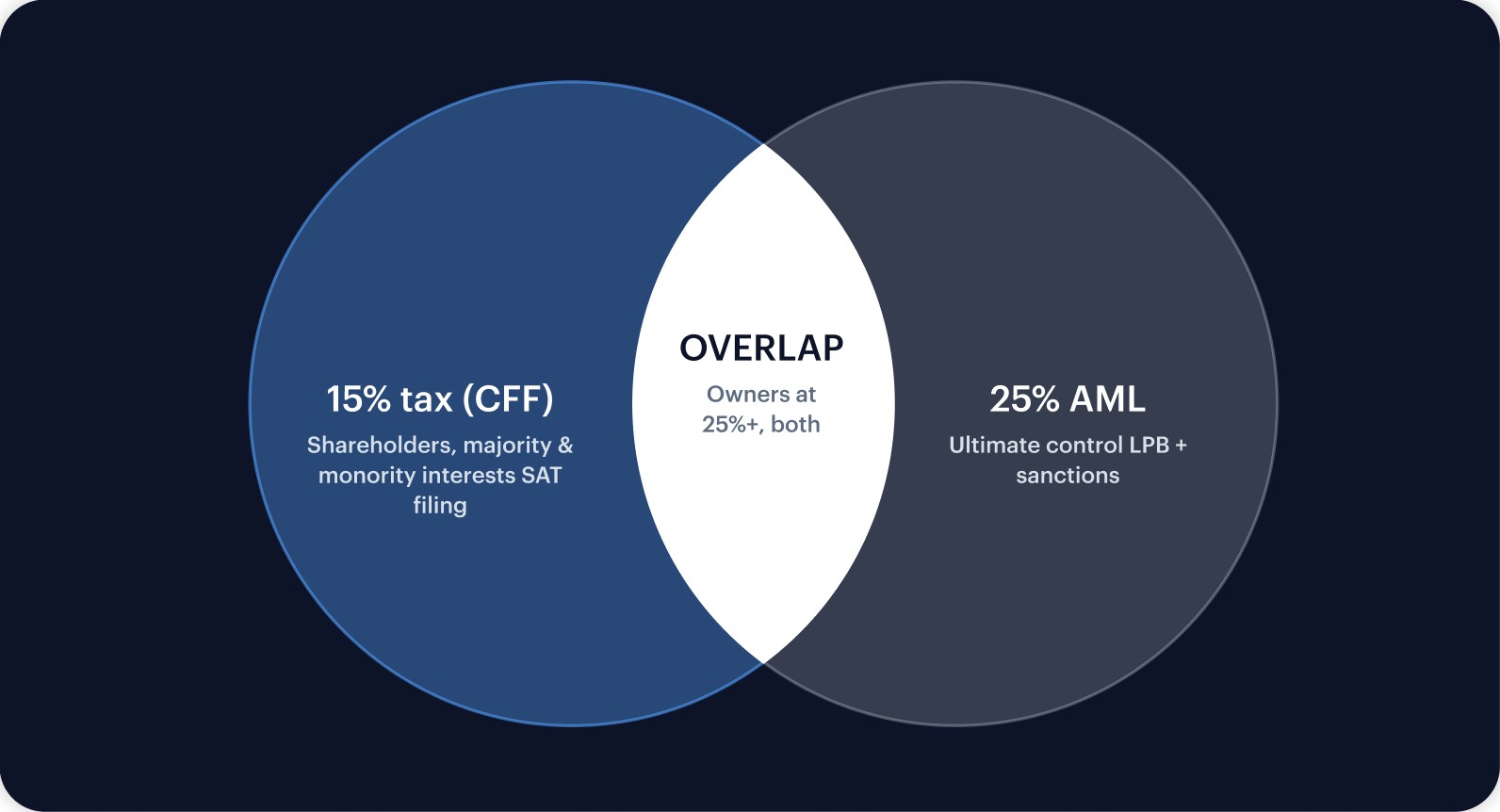
Since 17 July 2025, a beneficial owner in Mexico is anyone who ultimately owns or controls 25% or more of an entity, down from 50%. The Federal Tax Code keeps its own 15% threshold under Article 32-B Quarter, so companies now document beneficial owners under two regimes at once, 25% for AML and 15% for tax.
The two thresholds do not line up, and that gap is where the work lives. Every AML owner at 25% or more is screened against the LPB and international lists through AML screening, while KYB business verification maps the ownership chain behind them. The tax regime wants the SAT notified within 15 days of any ownership change.
| Shareholder | Stake | AML owner (≥25%)? | Tax owner (≥15%)? |
|---|---|---|---|
| Shareholder A | 30% | Yes | Yes |
| Shareholder B | 25% | Yes | Yes |
| Shareholder C | 20% | No | Yes |
| Shareholder D | 15% | No | Yes |
| Shareholder E | 10% | No | No |
Under the old 50% rule, Company X had zero beneficial owners. The 25% AML rule captures two. The separate 15% tax rule captures four, including two holders the AML rule misses. One cap table, two owner lists, and that gap is where the complexity lives.
PEPs, sanctions and the US-Mexico enforcement axis
Mexico runs two sanctions tracks at once. A domestic one through the UIF's Lista de Personas Bloqueadas (LPB), and an international one across OFAC, the UN, the EU and FinCEN. A match triggers suspension and a 24-hour unusual-operation report. A politically exposed person moves straight to enhanced due diligence.
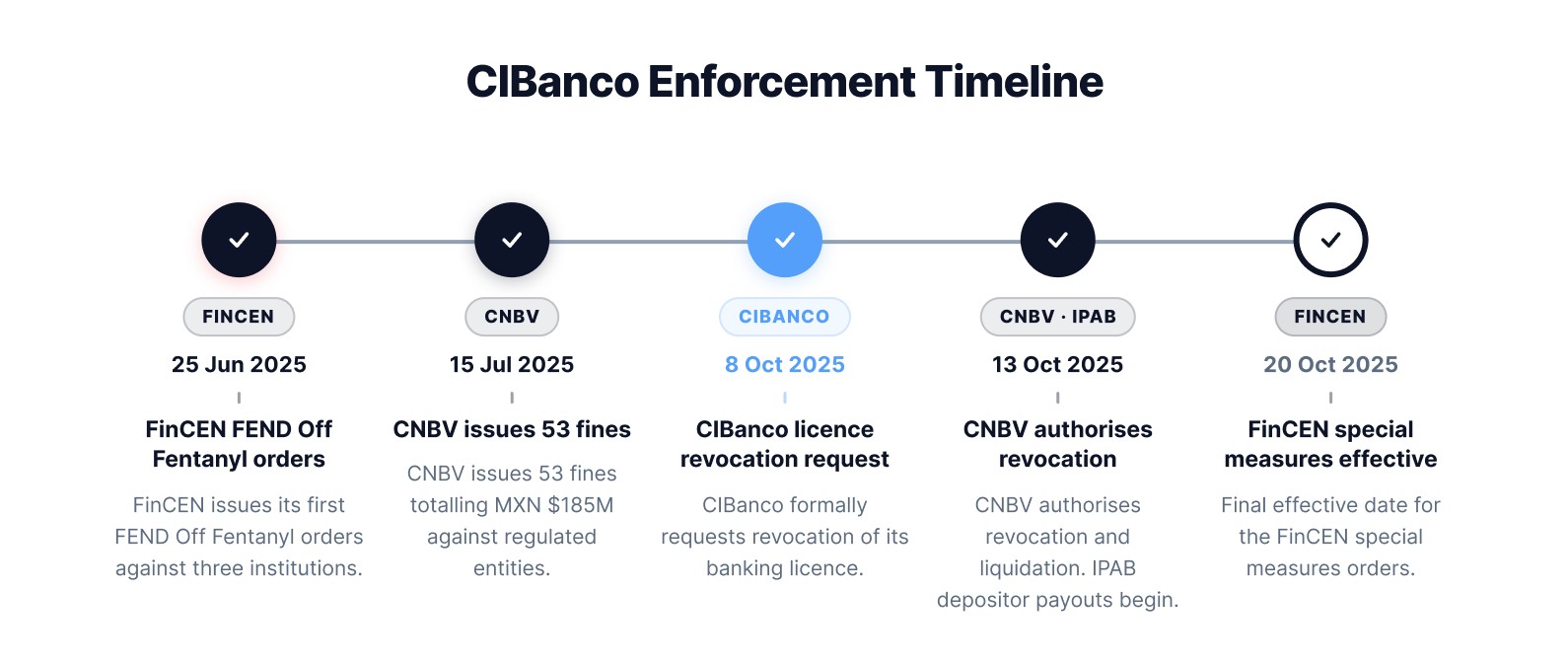
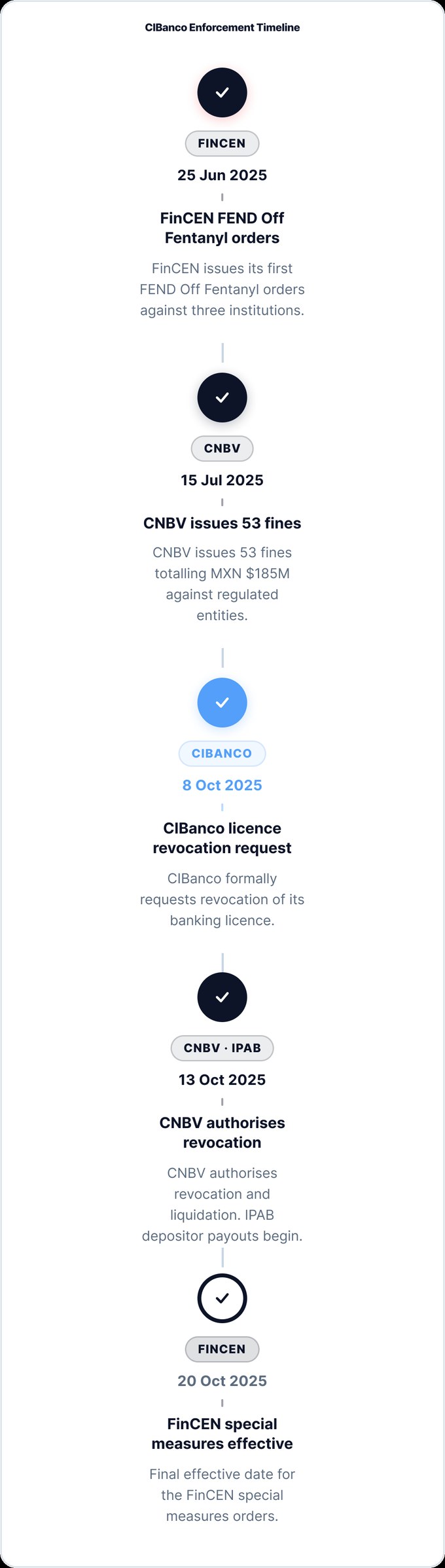
The 2025 CIBanco, Intercam and Vector case shows why continuous screening is now the floor. A bank with decades of history was liquidated after control failures it could not document, and correspondent banks worldwide cut their Mexico exposure in response.

2025 maximum IEEPA civil penalty per violation, or twice the transaction value, whichever is greater.
“A decades-long banking history is no shield when controls cannot be proven. Mexico now punishes missing evidence, not only missing policy.”
Sources: FinCEN's first FEND Off Fentanyl orders; 53 fines totalling MXN$185M.
Sector rules for fintech, crypto, iGaming and lending
Mexico regulates every sector through one shared AML core, the LFPIORPI, then adds licence-specific duties on top. A fintech, a crypto provider, an iGaming operator and a lender all run the same tiered KYC, documented risk-based approach and ten-year retention, but each reports to a different supervisor and carries different sector risks.
Crypto shows where the risk is heading. UIF virtual-asset alerts jumped almost fivefold in a year, the fastest-rising vulnerable activity in the country.
| Sector | Governing framework | KYC / AML emphasis |
|---|---|---|
| Fintech (IFPE / IFC) | 2018 Fintech Law and LFPIORPI | Bank-grade AML, full LFPIORPI, tiered KYC, documented risk-based approach, ten-year retention. Around 40 authorised IFPE on the CNBV register in mid-2026, verify the live count. |
| Crypto / VASPs | Banxico Circular 4/2019 and LFPIORPI | Regulated institutions are barred from virtual-asset exchange or custody, while non-financial VASPs fall under the LFPIORPI. Track the proposed peso-stablecoin Senate initiative from May 2026. |
| iGaming | Ley Federal de Juegos y Sorteos (1947) and LFPIORPI | Age verification, INE-linked identity, UBO identification and betting-pattern monitoring. The IEPS betting tax rose from 30% to 50% on 1 January 2026, including online betting. |
| Lending | CNBV supervision and LFPIORPI | Enhanced KYC, corporate UBO identification and fraud monitoring at origination. Identity fraud is the acute risk. |
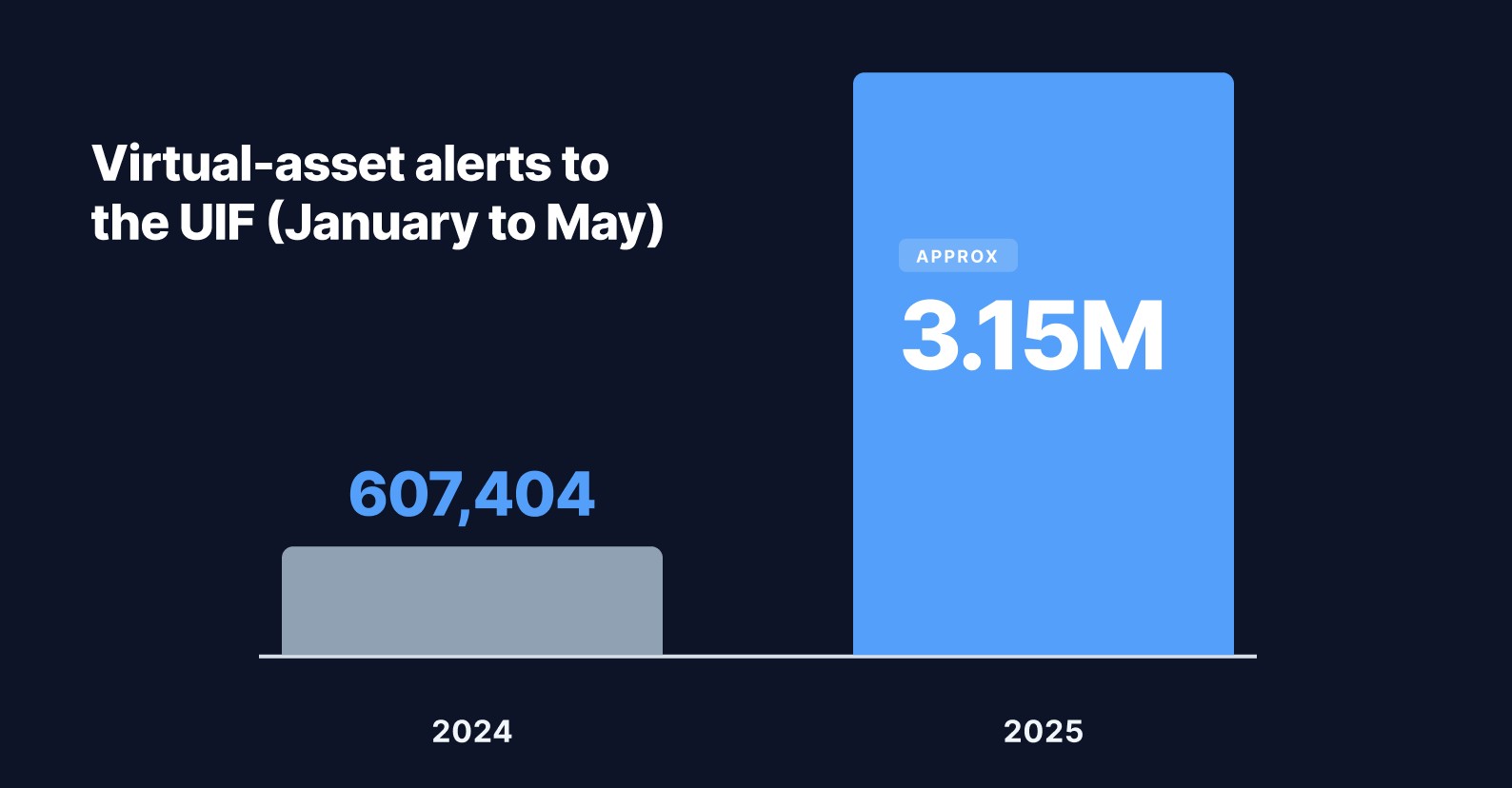
Roughly a fivefold jump, about +420%, close to half of all vulnerable-activity reports the UIF received in that window.
How to choose an identity verification partner for Mexico
Choosing a verification partner for Mexico comes down to five local tests. Document coverage, liveness quality, screening breadth, data residency and configurability for the risk-based tiers. A vendor that shines in a global demo can still fail on Mexican documents.
Document coverage is the test that decides it. Holographic overlays sit directly over the fields an engine reads, and multi-surname names break naive parsers. Ask every vendor to run real Mexican documents through the platform, not a curated sample.
| Criterion | What to check | Why it matters in Mexico | Score |
|---|---|---|---|
| Document coverage | INE plus state and municipal IDs, holographic fields, multi-surname parsing | Documents differ across federal, state and municipal issuers | ☐ |
| Liveness | Presentation-attack-tested liveness with iBeta Level 3 Conformance | Binds a live person to the CURP or INE | ☐ |
| Screening | UIF LPB, OFAC, UN, PEP and cartel FTO lists in one pass | Cross-border USD exposure demands OFAC coverage | ☐ |
| Data residency | On-premise or in-region option | Regulated banks need control over identity data | ☐ |
| Configurability | Tiered flows and risk-based routing | Matches the LFPIORPI risk-based approach | ☐ |
Your Mexico AML compliance checklist
This checklist maps each duty to the control it needs and the evidence an examiner will ask to see. One thread runs through every 2024 and 2025 CNBV finding. Regulators punish missing documentation harder than missing policy.
A programme with written procedures, training sign-offs, internal audits and monitoring trails can defend itself. One with policies but no proof of execution cannot.
| Obligation | Audit evidence an examiner asks for |
|---|---|
| Customer due diligence | Signed CDD file, ID copy, verification timestamp, liveness result, risk-rating memo |
| Enhanced due diligence | Source-of-funds docs, ownership chart, periodic monitoring memos |
| Record-keeping (10 years) | Central repository, encryption and audit log, retention schedule |
| Ongoing monitoring | Screening reports, alert logs, escalation decisions |
| LPB hit protocol | Suspension record, 24-hour UIF report timestamp, notification letter |
| Internal compliance structure | Officer appointment, manual, training sign-off, audit report |
Common CNBV findings, 2024 and 2025

No documented proof that KYC happened, with unsigned CDD files or missing timestamps
Beneficial-owner thresholds misapplied, stopping at 50% instead of 25%
LPB screening run only at account opening rather than continuously
Monitoring alerts left unreviewed with no escalation decision on file
Training not completed by the 1 January 2026 deadline
How Mexican customers actually verify
Verification performance is the proof that ties this playbook together. How often genuine Mexican customers pass on the first try, and how reliably documents authenticate across the country's many issuers. A high first-time pass rate keeps real customers from dropping out and cuts the manual-review load that slows every downstream AML check.
One connected system for identity proofing, beneficial-owner verification and transaction monitoring means fewer manual reviews, faster onboarding and a higher first-attempt pass rate. That is the difference between a clean exam and a queue of exceptions.
How Shufti maps to Mexico's LFPIORPI duties
Shufti is a Glocal Platform that manages the full compliance lifecycle, from sign-up and onboarding through authentication and monitoring to remediation. Built for every industry, every region and every use case, it works across 240+ countries and territories, with SaaS, private-cloud and on-premise deployment and ISO 27001, SOC 2 Type II and GDPR alignment.
| Capability | How it maps to the guide |
|---|---|
| Document verification | Reads 10,000+ actively processed document types, including the INE, passport, comprobante and biometric CURP, with OCR across 150+ languages, so onboarding handles local documents without manual triage. |
| Face verification | Binds a document to a live person with 3D liveness detection, biometric matching and iBeta Level 3 Conformance to ISO/IEC 30107-3. This is how a team closes the personhood gap and catches deepfakes and synthetic identities. |
| AML screening | Screens customers and beneficial owners in parallel against global sanctions, PEP and adverse-media watchlists, covering the dual 25% and 15% threshold checks with continuous LPB and OFAC coverage. |
| KYB & beneficial ownership | Verifies corporate entities and maps ownership chains, with manual and automated UBO analysis for the dual LFPIORPI and CFF regimes across 240+ countries and territories. |
Disclaimer: This guide is educational and does not constitute legal advice. Verify current obligations against the LFPIORPI, its Regulations, and CNBV and UIF provisions before acting.
Certifications
Independently audited and certified for enterprise-grade security and data protection.




Frequently asked questions (FAQs)
The July 2025 LFPIORPI reform, effective 17 July 2025, cut the beneficial-owner threshold from 50% to 25%, made a documented risk-based approach and automated monitoring mandatory, and set record retention at ten years. A follow-up reform to the Regulations, in force 28 March 2026, added a 24-hour reporting rule and confirmed direct identification of beneficial owners.
For AML purposes under the LFPIORPI, a beneficial owner is anyone who ultimately owns or controls 25% or more of an entity, down from the old 50%. The Federal Tax Code keeps a separate 15% threshold, so companies now track two beneficial-owner tests at once, 25% for AML and 15% for tax.
No. A CURP proves only that a person is enrolled in RENAPO’s population registry. It does not prove the living person presenting it is genuine. Closing that personhood gap takes face verification with liveness detection and biometric matching, paired with document verification that authenticates the INE or passport.
Yes. Since 2020 the CNBV has allowed Nivel 3 and Nivel 4 accounts to be opened for Mexican nationals through a non-face-to-face video procedure, an INE photo, a selfie and a live video call of at least 30 seconds, matched against the INE and confirmed with RENAPO. As biometric CURP adoption grows, video verification with liveness is becoming the norm.
The biometric CURP binds face, fingerprint and iris data to RENAPO’s registry record, created by a reform published in the DOF on 16 July 2025. As of mid-2026 it is described as a gradual, free rollout, and the traditional CURP stays valid. The once-anticipated February 2026 mandatory date did not take effect, though some institutions already request the biometric version.
They are severe and increasingly evidence-driven. In July 2025 the CNBV issued 53 fines totalling MXN$185 million against CIBanco, Intercam and Vector, and CIBanco was ultimately liquidated. Institutions with US-dollar exposure also face OFAC penalties, and the 2025 maximum IEEPA civil penalty is USD$377,700 per violation, or twice the transaction value.
Five Mexico-specific tests. Document coverage across the INE plus state and municipal IDs, holographic fields and multi-surname parsing. Presentation-attack-tested liveness. Screening breadth across the UIF LPB and OFAC. A data-residency option for regulated banks. And configurability for the risk-based Nivel tiers. Always run real Mexican documents through any trial, not the vendor’s curated sample.
Talk to our Mexico compliance team
Tell us where you are onboarding and we will show you how Shufti maps to Mexico’s tiered KYC, dual-threshold beneficial ownership and UIF sanctions screening.