AMLR Solutions
 AMLR Consultation
 Onboarding
 Ongoing Monitoring
 FRAML
FRAML KYC
KYC KYB
KYB KYI
KYI Age Assurance
 Workforce IAM
 Candidate Verification
 Account Takeover
 Bonus/ Promotion Abuse
 Chargeback Fraud
 Deepfake
 Document Fraud
 Fraud Networks
 Impersonation Fraud
 Money Mule Activity
 Multi-Accounting
 Party Fraud
 Regulatory & Compliance Risks
 Synthetic Identity Fraud
 Adult Content
 Banking
 Crypto
 Fintech
 Forex
Forex Compliance
 Fraud prevention
 Trust & safety
 Global expansion
 Compliance Officers
 Developers
 Fraud Analysts
 Product Managers
 Advanced Journey Builder (AJB)
 Global Trust Platform
 Customer Profiles
 Vendor Comparison
 IDV Case Management
 AML Case Management
 Regulatory Reporting
 Travel Rule Protocols
 Agentic Rule Builder
 AI Compliance Co-Pilot
 Fraud Analytics
 Fraud Hub
 OCR
OCR Shufti AI
 Bank Account Verification
 Biometric Duplication
 Database Checks
 Document Intelligence
 Government ID
 Mobile Driver's License
 NFC
NFC Selfie Liveness
 Brand Personalisation
 Deployment Options
 Identity Methods
 IDV Modes
 Multi-tenancy
 On-Premise IDV
 Secure Capture












TL;DR
- Driver onboarding verifies a driver’s identity, license, and record before activation.
- Verified rideshare and delivery accounts are now rented and sold online to unvetted people.
- A complete process includes identity, license verification, background checks, and ongoing monitoring.
- US rideshare rules vary by state, from name-based checks to FBI fingerprint screening.
- An API-based, single-vendor solution speeds onboarding without weakening fraud controls.
In May 2026, CBS News reported that active Uber, DoorDash, and Lyft accounts were being rented and sold online for a few hundred dollars, letting people with no license and no screening pick up riders and deliveries under someone else’s verified identity. This particular failure mode is what every platform fears, and it all falls back to one moment, which is when the driver is onboarded.
If done wrong, then it leaves a possibility for safety incidents, regulatory exposure, and fraud losses, which, as per the Federal Trade Commission, reported consumer fraud losses exceeding $12.5 billion in 2024, a 25% increase over the prior year.
This guide breaks down what a modern driver onboarding process involves, why fraud has made it harder, what regulators expect, and how to choose a driver onboarding solution that verifies fast without opening the door to impersonation.
What is Driver Onboarding?
Driver onboarding is the end-to-end process a ride-hailing, delivery, or logistics platform uses to verify a driver’s identity, confirm their right to drive, and screen their background before activating their account. A complete driver onboarding process does more than collect a photo of a license. It ties a real person to a valid credential, checks that credential against its source, and confirms the applicant carries no disqualifying history.
Done well, onboarding can be the single most important control a platform owns. Every safety promise made to a passenger or a customer rests on the assumption that the person behind the wheel is who the app says they are. That assumption is exactly what attackers target.
Why has driver onboarding become a fraud problem?
This is because a verified account is treated as a tradable asset. The more dominant attack is that of impersonation. A fraudster onboards with a stolen or synthetic identity, or an already-approved driver rents their verified account to someone who could never pass a check.
The structural weakness is twofold. First, name-based background checks alone can miss records when an applicant supplies a borrowed or altered identity, so the screen passes the wrong person. Second, most platforms verify once at signup and never again, which means a clean onboarding tells you nothing about who is logged in three months later. Closing both gaps is what separates a checkbox process from a real defense.
What does a complete driver onboarding process include?
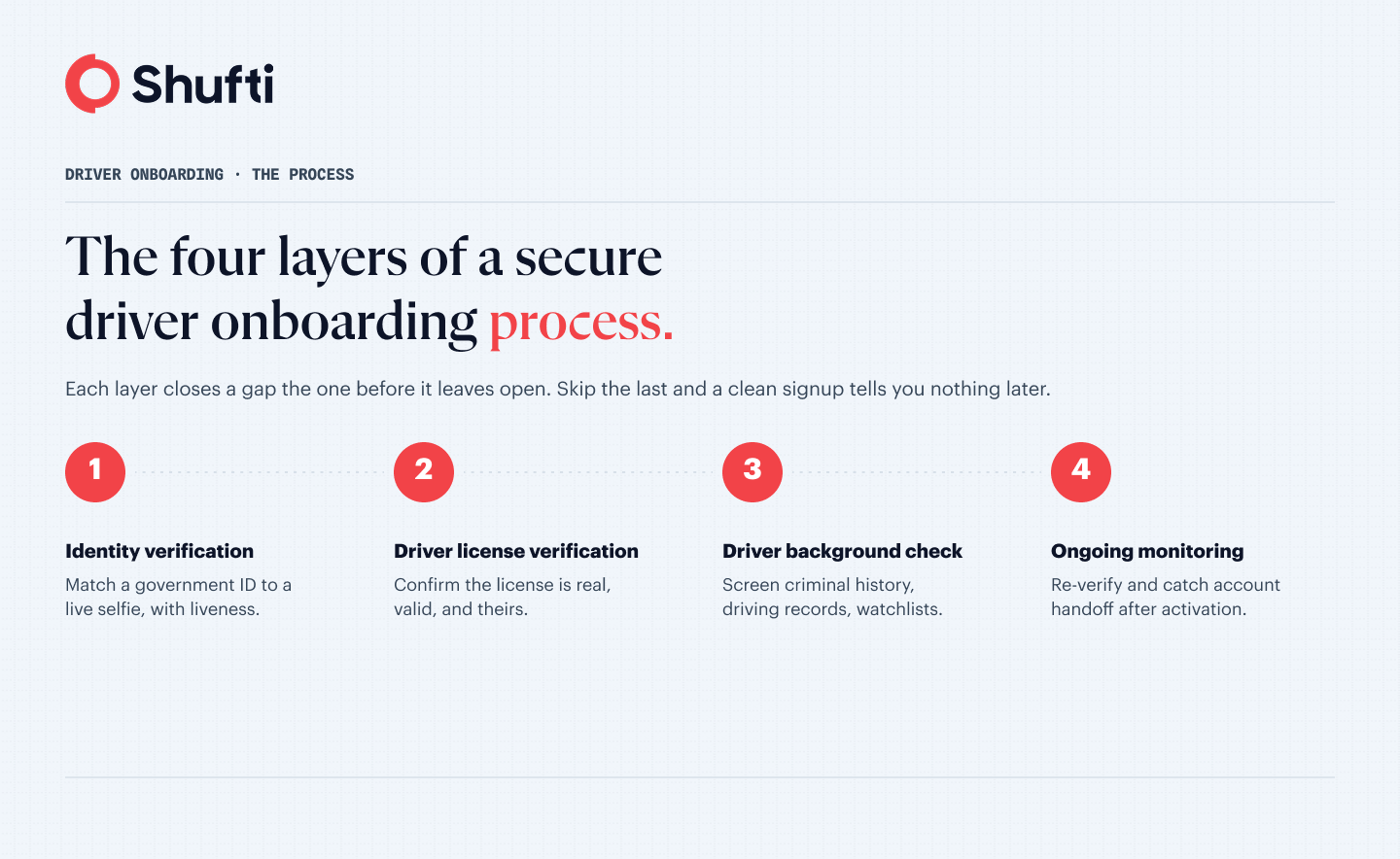
A resilient driver onboarding process layers four checks, each closing a gap before moving on to the next step.
Identity verification
Driver identity verification anchors everything else. The platform captures a government-issued ID and matches it to a live selfie, using liveness detection to confirm a real person is present rather than a photo, a video replay, or a deepfake. Without a reliable biometric match, every downstream check can be attached to the wrong human.
Driver’s license verification
Driver license verification confirms the license is genuine, unexpired, and actually belongs to the applicant. Forensic document checks read the security features, parse the machine-readable zone or barcode, and flag tampering that a simple photo match would miss. This is where a borrowed or edited credential gets caught.
Driver background check
A driver background check screens criminal history, driving records, and relevant watchlists. Because the check is only as trustworthy as the identity it runs against, it has to sit on top of verified identity data, not raw self-reported details. A background screen run on a stolen name returns a clean result for the wrong person.
Delivery driver verification and ongoing checks
Delivery driver verification follows the same identity and license logic and then adds right-to-work and address confirmation for last-mile roles. Because risk does not end at activation, strong programs re-verify periodically and monitor for the account-handoff pattern, prompting a fresh biometric check when a session looks off.
What do regulators require for license verification and background checks?
Requirements vary by jurisdiction, and in the US they vary sharply by state. The Government Accountability Office found that many states and localities mandate criminal background checks for drivers, with some requiring fingerprint-based FBI checks and others accepting name-based checks run by private screening companies. The table below summarizes the common layers.
| Check type | What it confirms | Where it typically applies |
| Name-based criminal check | Criminal history via commercial screening databases | Baseline in most US states |
| Fingerprint / FBI check | Criminal history against FBI records | Required in some states, including Colorado, Connecticut, Georgia, and New Jersey |
| Driving record review | License validity and moving violations | Standard across rideshare programs |
| Sex offender registry search | Match against national registry | Common statutory requirement |
The GAO also flagged a data gap: incomplete assault reporting leaves regulators and platforms without a clear picture of risk, which is why scrutiny of screening quality keeps rising. Outside the US, frameworks such as the UK’s Disclosure and Barring Service checks impose their own standards, so any platform operating across borders needs verification that adapts to local rules rather than a single fixed workflow.
How do you choose a driver onboarding solution?
Evaluate a driver onboarding solution against five criteria, weighted to the markets your drivers actually work in:
- API driver identity verification: A clean, well-documented API lets you embed identity, license, and biometric checks directly into your signup flow so verification happens in the app rather than through a manual side process.
- Document and language coverage: Confirm the solution reads the IDs and licenses your hardest markets use, not just the headline country count.
- Independently validated liveness: Look for iBeta Level 3 conformance under ISO/IEC 30107-3, the benchmark for detecting deepfakes and presentation attacks at the biometric step.
- Ongoing monitoring, not one-time checks: The solution should support re-verification and account-handoff detection after activation, where most impersonation actually surfaces.
- Deployment and data residency: Cloud, local-cloud, or on-premises options decide whether you can meet the privacy rules of each region you operate in.
How Shufti helps platforms onboard drivers
If your drivers span multiple countries, you have probably watched onboarding stall on the documents and faces that off-the-shelf checks were never trained for. A driver abandons signup after the third retry on a non-Latin license, or an impersonated account slips through because the liveness step was weak.
Shufti runs driver identity verification, document verification, and biometric liveness through a single identity verification API, backed by ongoing AML and watchlist screening. Because Shufti built and owns the full stack, with liveness holding iBeta Level 3 conformance under ISO/IEC 30107-3, decisions stay fast and defensible even in the markets where others struggle. One platform. Fully owned technology. Global coverage with real local depth.
Frequently Asked Questions
How long does driver onboarding take?
With automated identity, license, and biometric checks running through an API, a driver can be verified in under a minute in most cases. Background screening can add time depending on the jurisdiction and whether fingerprint-based checks are required.
What is the difference between driver's license verification and a background check?
Driver's license verification confirms the license is authentic, valid, and belongs to the applicant. A driver background check screens criminal history, driving records, and watchlists. The first proves the credential is real; the second proves the person is eligible to drive.
Can driver onboarding be automated through an API?
Yes. API driver identity verification lets a platform embed document capture, biometric liveness, and screening directly into its own signup flow, so the full driver onboarding process runs in-app without manual review for most applicants.