AMLR Solutions
  AMLR Consultation
 EUDI Wallet
 Onboarding
 Ongoing Monitoring
 FRAML
FRAML KYC
KYC KYB
KYB KYI
KYI Age Assurance
 Workforce IAM
 Candidate Verification
 Account Takeover
 Bonus/ Promotion Abuse
 Chargeback Fraud
 Deepfake
 Document Fraud
 Fraud Networks
 Impersonation Fraud
 Money Mule Activity
 Multi-Accounting
 Party Fraud
 Regulatory & Compliance Risks
 Synthetic Identity Fraud
 Adult Content
 Banking
 Crypto
 Fintech
 Forex
Forex Compliance
 Fraud prevention
 Trust & safety
 Global expansion
 Compliance Officers
 Developers
 Fraud Analysts
 Product Managers
 Journey Builder
  Global Trust Platform
 Customer Profiles
 Vendor Comparison
 IDV Case Management
 AML Case Management
 Regulatory Reporting
 Agentic Rule Builder
  AI Compliance Co-Pilot
  Fraud Analytics
 Fraud Hub
  OCR
OCR Shufti AI
 Bank Account Verification
  Biometric Duplication
 Database Checks
 Document Intelligence
 Government ID
 Mobile Driver's License
 NFC
NFC Selfie Liveness
 Brand Personalisation
 Deployment Options
 Identity Methods
 IDV Modes
 Multi-tenancy
 On-Premise IDV
 Secure Capture
 Shufti MCP















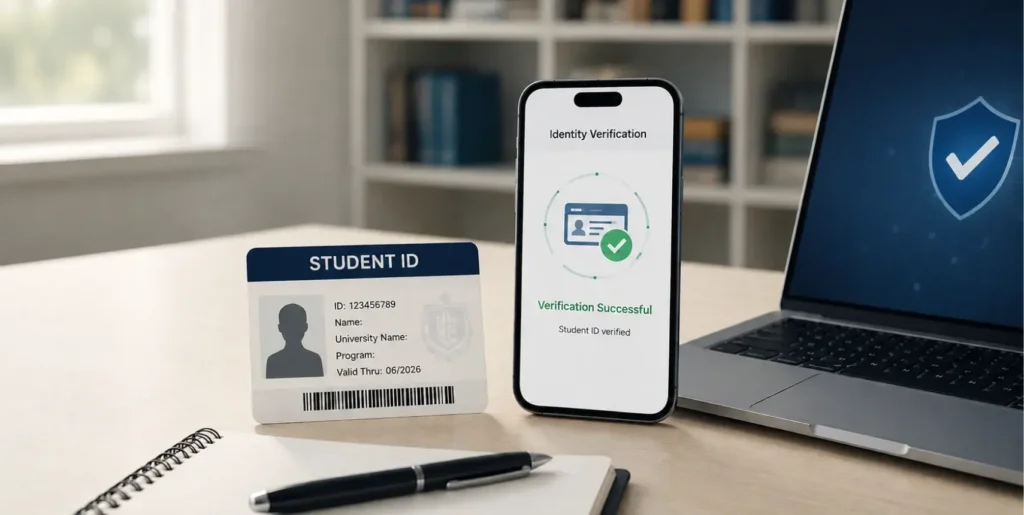

Blog Summary:
- Student identity verification confirms both a person’s identity and their current enrolment status, helping businesses prevent fraud and misuse.
- A secure online verification process combines government-issued ID verification, biometric face matching, liveness detection, and enrolment validation.
- Student ID cards alone are not sufficient because they are non-standard and can be easily forged or shared.
- Automated student verification enables edtech platforms, exam providers, universities, and student discount programmes to verify students in seconds with a complete audit trail.
- Shufti streamlines student verification through document verification, face verification, liveness detection, and age verification across 240+ countries.
What Does it Mean to Verify a Student ID Online?
Verifying a student ID online is the process of confirming, over the internet and without physical inspection, that a person is a genuine, enrolled student and that they are who they claim to be. It combines two separate checks that are often confused:
- Student Status Verification: Proving the person is currently enrolled at a recognised institution. This is what discount platforms, software vendors, and campus services care about.
- Student Identity Verification: Proving the person is the real, living owner of the identity presented, and not using a stolen, borrowed, or synthetic identity. This is what fraud, compliance, and security teams care about.
A robust student check does both. Confirming enrollment without confirming identity lets one verified student share a discount or an exam login with dozens of others. Confirming identity without confirming enrollment tells you who someone is but not whether they qualify.
How to verify a student ID online, step by step
For a business verifying a student remotely, the flow follows five stages:
- Capture the Identity Document. The student photographs a government-issued ID like passport, national ID card, or driving onboarding. Relying on the plastic student card alone is weak, because campus cards are non-standard and easy to forge.
- Authenticate the Document. The system checks security features, fonts, layout, and machine-readable zones to confirm the document is real and unaltered.
- Match the Person to the Document. The student takes a live selfie. Facial biometrics compare the selfie to the document photo to confirm they are the same person.
- Confirm Liveness. A liveness check confirms a real, present human is completing the verification, not a photo, video, mask, or deepfake.
- Validate Enrollment. The extracted details are cross-checked against an enrolment record, an institution confirmation, or a supporting document such as an enrolment letter or valid student email domain.
Done manually, this takes days and leaks fraud. Done through an automated platform, it takes seconds and produces a full audit trail.
How do Students Verify Their Own Status?
If you are a student trying to unlock a discount or a service, the process is usually simpler and sits on the vendor’s side. You typically submit your student email address, upload a proof of enrolment, or complete an identity check through the vendor’s verification provider. The vendor, not you, decides which evidence counts. This article is written for the businesses running those checks, so the rest focuses on the operator’s view.
Which Documents Are Used to Verify a Student?
Student verification usually layers two document types:
- Identity Evidence: passport, national identity card, or driving licence. This proves who the person is and, through the date of birth, their age.
- Enrolment Evidence: a student ID card, enrolment or admission letter, tuition receipt, or a verified institutional email address. This proves current student status.
Leading with government ID matters for global coverage. Student cards vary widely by country and institution, whereas government documents follow recognised standards that an automated system can authenticate consistently across 240+ countries.
How Do Businesses Verify Student Status at Scale?
Manual review does not scale and does not stop determined fraud. Automated student identity verification replaces it with a configurable, repeatable flow:
- Document verification authenticates the submitted ID in real time.
- Biometric face verification matches the live selfie to the document photo.
- Liveness detection blocks spoofing with photos, replays, masks, and deepfakes.
- Age verification derives the date of birth from the verified document, useful where student offers overlap with age-restricted access.
- Data extraction and validation pull the details and check them against enrolment records or supporting evidence.
The result is a decision in seconds, a consistent standard across markets, and an audit log for compliance.
Where Student Identity Verification Matters
- Edtech and online learning platforms: confirming that enrolled learners are genuine, especially for accredited or certificate-bearing courses.
- Remote exam proctoring: confirming the person sitting the exam is the registered student, protecting academic integrity.
- Student discount and offer platforms: preventing non-students and repeat abusers from draining margins.
- Campus and university services: securing access to portals, libraries, financial aid, and records.
- Age-gated services: where student status and a minimum age requirement overlap.
Why Student Verification Gets Exploited, And How To Stop It
Student offers and student logins are high-value and lightly guarded, which makes them a common fraud target. The usual attacks are forged or edited student cards, borrowed or stolen identities, one verified account shared across many users, and increasingly deepfake selfies designed to defeat weak face checks.
The defence is layered rather than single-point. Document authentication stops forged evidence, biometric matching stops borrowed identities, and liveness detection stops deepfakes and replays. No single check is enough on its own, which is why serious student verification combines all three.
Shufti authenticates identity documents, matches faces, and detects liveness across 240+ countries, so you can confirm genuine, enrolled students and shut out fraud. Talk to our team
Frequently Asked Questions
What is student identity verification?
Student identity verification is the process of confirming that a person is a genuine, enrolled student and the real owner of the identity they present, usually by authenticating a government ID, matching it to a live selfie, checking liveness, and validating enrollment.
How do you verify a student ID online?
Capture a government-issued ID, authenticate it, match the student to it with a live selfie and biometric check, confirm liveness, then validate enrollment against a record or supporting document. Automated platforms complete this in seconds.
Is a student ID card enough to verify a student?
No. Student cards are non-standard and easy to forge, so they are treated as supporting enrolment evidence, not primary identity evidence. A government-issued ID plus a biometric check gives a far stronger result.
What is the difference between student status and student identity verification?
Student status verification confirms current enrollment, so the person qualifies for a student offer or service. Student identity verification confirms the person is the real owner of the identity. A complete check does both.
Can student verification detect fake or deepfake attempts?
Yes, when it combines document authentication, biometric face matching, and liveness detection. Liveness detection is specifically designed to catch photos, replays, masks, and deepfakes.
How does Shufti verify students?
Shufti combines document verification, biometric face verification, liveness detection, and age verification into a single automated flow, confirming genuine enrolled students across 240+ countries with a full audit trail.