AMLR Solutions
  AMLR Consultation
 EUDI Wallet
 Onboarding
 Ongoing Monitoring
 FRAML
FRAML KYC
KYC KYB
KYB KYI
KYI Age Assurance
 Workforce IAM
 Candidate Verification
 Account Takeover
 Bonus/ Promotion Abuse
 Chargeback Fraud
 Deepfake
 Document Fraud
 Fraud Networks
 Impersonation Fraud
 Money Mule Activity
 Multi-Accounting
 Party Fraud
 Regulatory & Compliance Risks
 Synthetic Identity Fraud
 Adult Content
 Banking
 Crypto
 Fintech
 Forex
Forex Compliance
 Fraud prevention
 Trust & safety
 Global expansion
 Compliance Officers
 Developers
 Fraud Analysts
 Product Managers
 Journey Builder
  Global Trust Platform
 Customer Profiles
 Vendor Comparison
 IDV Case Management
 AML Case Management
 Regulatory Reporting
 Agentic Rule Builder
  AI Compliance Co-Pilot
  Fraud Analytics
 Fraud Hub
  OCR
OCR Shufti AI
 Bank Account Verification
  Biometric Duplication
 Database Checks
 Document Intelligence
 Government ID
 Mobile Driver's License
 NFC
NFC Selfie Liveness
 Brand Personalisation
 Deployment Options
 Identity Methods
 IDV Modes
 Multi-tenancy
 On-Premise IDV
 Secure Capture
 Shufti MCP















TL;DR
- KYB (Know Your Business) is how banks verify corporate clients, their legal structure, who controls them, and whether they carry financial crime risk
- Unlike KYC, which verifies individuals, KYB maps the full ownership chain down to the ultimate beneficial owners (UBOs) behind a company
- Banks are legally required to perform KYB under FATF Recommendation 24, the EU AMLA framework, and FinCEN’s Beneficial Ownership Rule
- A complete KYB process covers six stages: business registration check, UBO identification, document verification, AML and sanctions screening, risk scoring, and ongoing monitoring
- KYB is not a one-time check ownership structures change, and sanctions lists update, so continuous monitoring is a regulatory requirement, not optional
- Slow or manual KYB workflows cost banks revenue as well as compliance standing; 70% of banks lose clients due to slow onboarding
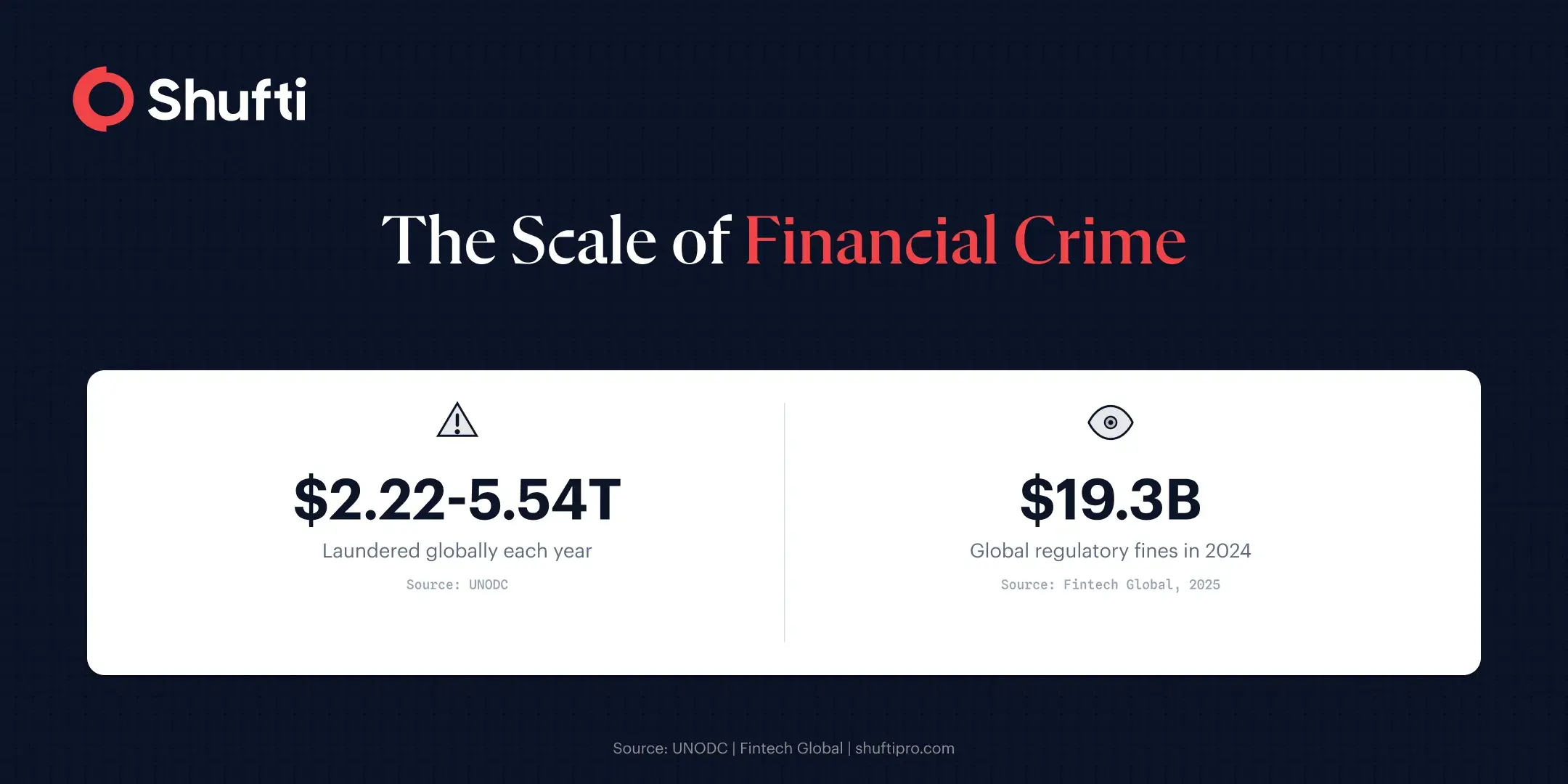
- Global regulatory fines for AML failures reached $19.3 billion in 2024, much of it tied to inadequate corporate client verification
Global regulatory fines reached $19.3 billion in 2024. A substantial portion was traced to the same persistent failure. Banks were onboarding corporate clients without adequately establishing who controlled them. Know Your Business banking is the compliance discipline built to close that gap, yet many institutions still process it through manual workflows designed for a fraction of their current volume, producing verification backlogs that cost both revenue and regulatory standing.
KYB (Know Your Business) is the process through which financial institutions verify the identity, legal structure, ownership, and regulatory standing of their corporate clients, both at onboarding and throughout the relationship. The KYB financial institutions conduct on corporate clients goes further than a company registry lookup. It means confirming who actually controls the entity, whether those individuals appear on sanctions lists or PEP databases, and whether the business itself presents regulatory or financial risk.
What Is KYB in Banking?
Business verification in banking exists because corporate entities present a verification problem that personal identity checks cannot solve. An individual presents a passport. A company presents articles of incorporation, a document that confirms legal existence but says almost nothing about who directs it. Complex ownership structures, holding companies, and nominee directorships can sit between a bank and the individuals actually driving the relationship.
Know Your Business banking addresses this gap by requiring financial institutions to map the ownership chain down to the ultimate beneficial owners (UBOs), meaning the individuals who hold 25% or more of the entity or who exercise effective control regardless of their stated ownership percentage.
The regulatory mandate is explicit. FATF Recommendation 24 requires that competent authorities have access to adequate, accurate, and up-to-date beneficial ownership information. The EU’s Anti-Money Laundering Authority (AMLA), operational as of July 2025, places UBO verification at the core of its supervisory mandate for high-risk entities. Banks that cannot demonstrate a clear audit trail of their corporate client verification face direct examination under these frameworks.
Why KYB Compliance Is Non-Negotiable for Banks
The scale of the problem makes the obligation concrete. Between 2 and 5 percent of global GDP is laundered annually, an estimated $800 billion to $2 trillion, much of it passing through corporate banking structures where layered ownership obscures the origin of funds. The record AML enforcement figures for 2024 reflect what happens when that obscurity goes unchallenged. $19.3 billion in global regulatory fines were recorded in 2024 alone, the highest figure on record.
KYB compliance in banking carries a second, less-discussed cost beyond enforcement. Fintech Global reports that 70% of banks lose clients due to slow onboarding processes, which reframes manual business verification in banking as a revenue problem, not just a compliance one. Speed and thoroughness are not competing demands. In an automated KYB workflow, they run together.
KYB AML compliance extends the obligation beyond onboarding. Regulators do not treat a one-time verification as adequate. Banks must screen corporate clients against sanctions lists, PEP databases, and adverse media at onboarding, then continue monitoring those clients throughout the relationship. Ownership structures change. Sanctions designations are updated. Adverse media coverage emerges. A static verification record fails to capture any of it. How KYC, KYB, and KYT interconnect shows how transaction-level monitoring sits alongside these entity-level obligations in a complete compliance posture.
KYB vs KYC Banking: Understanding the Difference
The KYB vs. KYC banking distinction sits in the verification subject and what verifying it actually requires.
KYC verifies individuals. At onboarding, a KYC check confirms that a person is who they say they are through document verification and biometric matching. Corporate KYC banking, sometimes treated as equivalent to KYB, extends this to entity-level checks covering company name, registration number, registered address, and directorship. KYB banking sets a higher standard. It requires identifying and individually verifying the UBOs behind the entity, assessing the business risk profile, establishing the source of funds, and running AML screening at both the entity and individual owner levels simultaneously.
The gap between corporate KYC banking and full KYB becomes most visible during regulatory examination. Banks that cite entity registration records as their due diligence trail find that regulators assess UBO verification, risk scoring, and ongoing monitoring as separate, distinct requirements, none of which a registry check alone satisfies. KYB due diligence banking is not a single check. It is a complete verification workflow with a continuous monitoring obligation attached from the outset.
How the KYB Process Works in Banking
The KYB process in banks runs through six core stages. Specific sequencing and depth vary by the institution’s risk appetite and the client’s risk tier, but the core stages are consistent across the major regulatory frameworks, from FATF to the EU’s 6AMLD to the FinCEN Beneficial Ownership Rule.
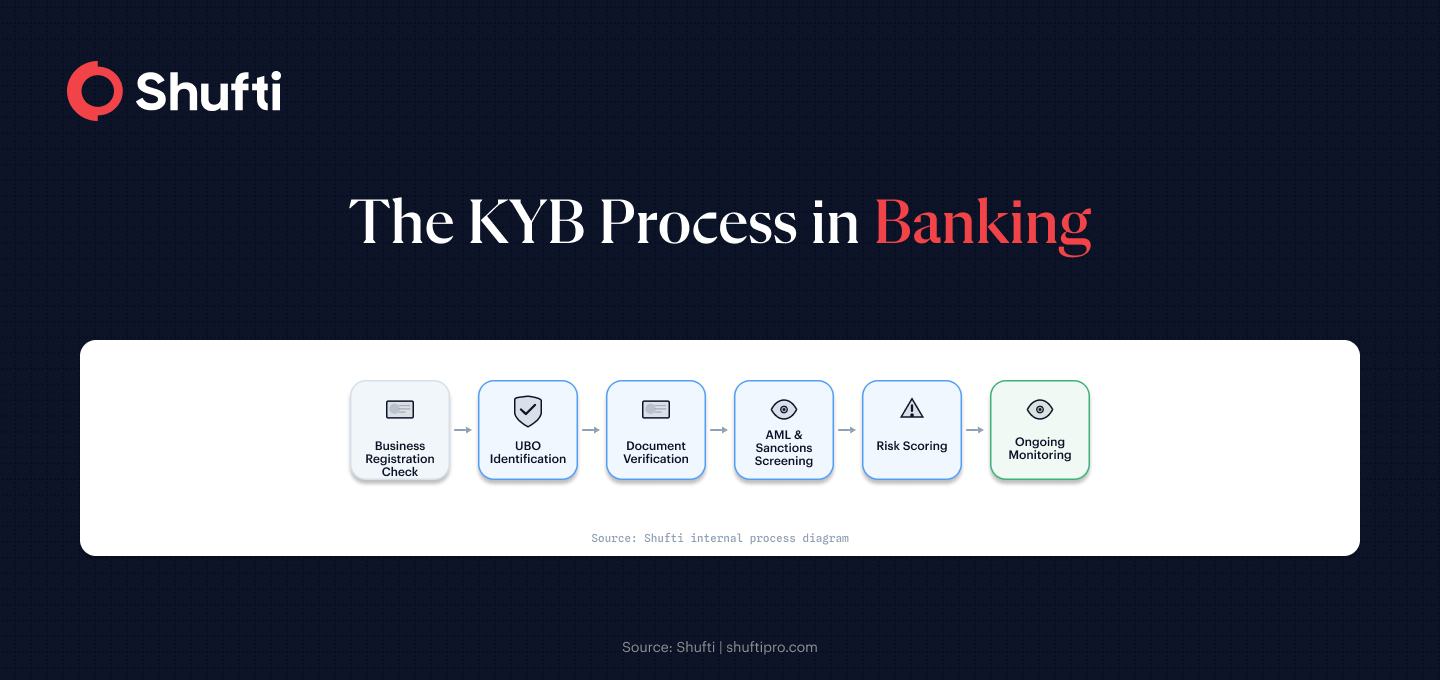
Business registration check
The process opens with a company registry lookup. This confirms the entity’s legal existence, current standing, incorporation jurisdiction, and whether any legal proceedings affect its status. The data source is the official registry of the relevant jurisdiction, not a third-party aggregator substituting for it.
UBO identification and document verification
The ownership structure is then mapped to identify the individuals who own or control the entity. Each UBO is verified through identity document checks and, where the risk profile warrants it, biometric verification. Company formation documents, directorship records, and authorised signatory lists are also verified at this stage.
AML and sanctions screening
With ownership confirmed, the entity and its UBOs are screened simultaneously against global sanctions lists, PEP databases, and adverse media sources. KYB AML compliance requires broad coverage, not a single-list check, but screening across the full range of watchlists and jurisdictional databases relevant to the client.
Risk scoring and ongoing monitoring
An automated risk score is produced from the combined verification and screening outputs. Higher-risk entities attract enhanced due diligence and more frequent review cycles. Managed KYB services describe how ongoing monitoring can operate without requiring a dedicated in-house compliance function for every ownership change or watchlist update.
KYB Due Diligence Banking: What Banks Actually Verify
KYB due diligence banking covers more ground than most compliance programs initially anticipate. The verification starts with the corporate entity, covering registration status, legal structure, and jurisdiction of incorporation. It then moves through the beneficial ownership layer, confirming the identities of UBOs and checking each one against PEP lists and sanctions databases. The business’s financial profile adds a third dimension, establishing the account’s declared purpose and expected transaction patterns against what the company’s industry and operational scale would predict.
Directorship records and authorised signatory information establish who exercises operational control. Where the entity or its UBOs maintain connections to high-risk jurisdictions, enhanced due diligence requirements apply, and the full picture of those connections rarely emerges from a single-country registry check.
Banks operating across multiple markets face a compounding challenge here. Registry data quality, UBO disclosure thresholds, and watchlist coverage vary by country and by jurisdiction type. KYB verification banking at the jurisdictional depth modern corporate books require cannot default to whichever registry is nearest. It needs coverage across 240+ countries and territories, with the capacity to map ownership across borders in a single verification run.
How Shufti helps banks run KYB verification
The banks most exposed to KYB risk are not the ones with inadequate compliance intent. They are the ones running adequate intent on workflows built for lower volumes and simpler ownership structures. A compliance team processing KYB manually across separate systems cannot keep pace with the scale and jurisdictional spread of a modern corporate book.
Shufti’s approach to business verification maps ownership structures and runs AML screening inside the same workflow, covering 240+ countries and territories. When a corporate client has ownership spread across multiple jurisdictions, the verification covers each ownership layer rather than stopping at the nearest registry. AML data refreshes every 15 minutes across 100,000+ sources, so the risk posture your team approves at onboarding reflects current watchlist exposure, not a static snapshot from the previous week.
See how Shufti handles KYB verification at the volume and jurisdictional depth your corporate book requires. Explore the KYB solution. Book a demo now.
Frequently Asked Questions
What is KYB in banking?
KYB (Know Your Business) in banking is the process by which financial institutions verify the identity, legal structure, beneficial ownership, and regulatory standing of corporate clients. It goes beyond entity registration to confirm who controls the business and whether they carry financial crime risk.
What does KYB stand for in finance?
KYB stands for Know Your Business. In finance, it describes the due diligence process financial institutions use to verify corporate clients, covering entity registration, UBO identification and verification, and AML screening against watchlists and sanctions lists.
How is KYB different from KYC?
KYC verifies individual identity through document and biometric checks. KYB verifies corporate entities, maps ownership structures, identifies ultimate beneficial owners, and runs entity-level AML screening. KYB applies where the client is a business and requires deeper ownership analysis than personal KYC.
Why is KYB important for banks?
Banks are primary entry points for commercial funds. Without KYB, they cannot confirm whether a corporate client is who it claims or whether its owners carry sanctions or financial crime exposure. FATF, the EU AMLA, and FinCEN treat KYB as a core AML obligation backed by significant enforcement authority.
Is KYB mandatory for financial institutions?
Yes, in most major jurisdictions. FATF Recommendation 24 requires beneficial ownership verification. The EU's 6AMLD and AMLA framework impose direct KYB obligations on credit institutions. FinCEN's Beneficial Ownership Rule requires US-regulated banks to identify and verify the UBOs of corporate accounts.