SPA/MF-Ready ID Verification for .bet.br Operators
Brazil's betting market has moved from licensing into active enforcement. This playbook shows how .bet.br operators connect CPF, document, liveness, AML, SIGAP and audit-trail controls into one regulator-ready KYC framework.
Why Brazil’s betting market moved from licensing into active enforcement
Brazil’s licensed betting market has moved from licensing-phase oversight into active operational compliance enforcement. For .bet.br operators, the question is no longer whether to implement KYC controls, but whether what was built for initial licensing still holds up under inspection.
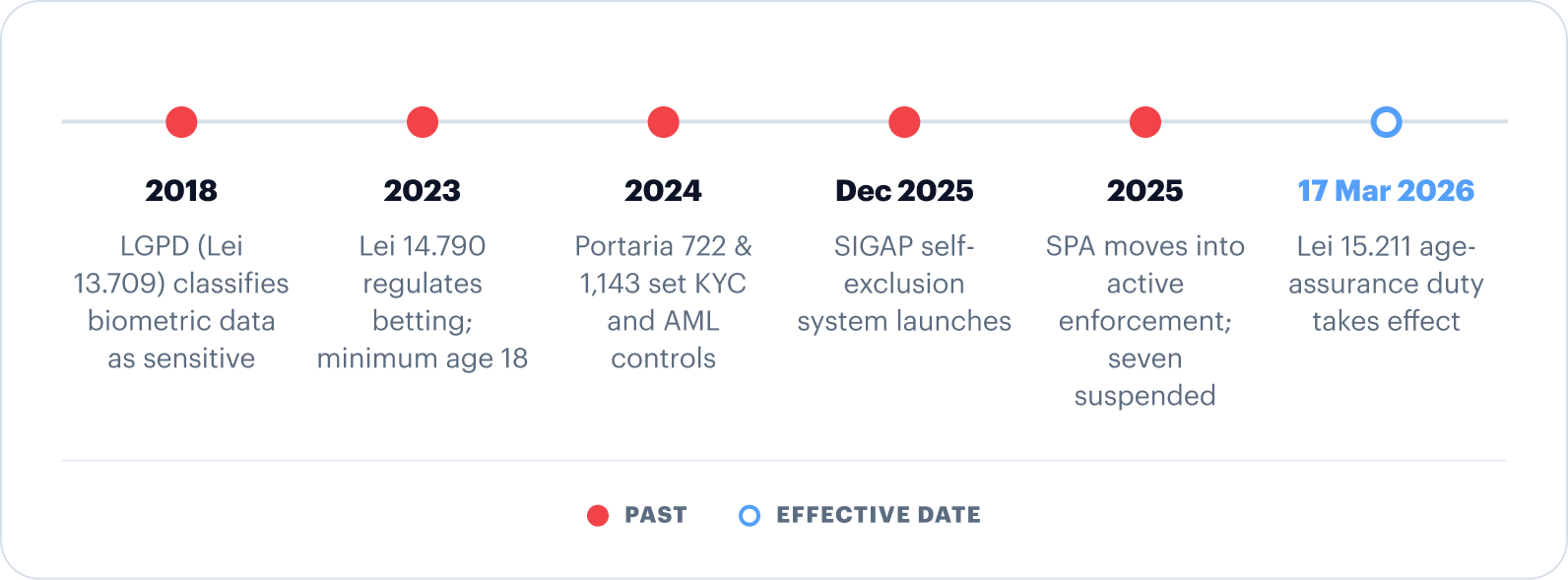
In May 2025, the Secretaria de Prêmios e Apostas (SPA) suspended seven operators for cybersecurity non-compliance, with daily fines of R$40,000 per violation. Identity verification, AML reporting, self-exclusion workflows, biometric certification and audit-trail availability are next in line as inspection priorities.
Enforcement tests whether policies run in production logs, not whether they sit in a compliance manual. The gap between what was built for licensing approval and what SPA now inspects is where operator exposure sits.
R$40,000/ day · per violation
SPA suspended seven operators for non-compliance in May 2025
BRL 36.96bnGross gaming revenue, Brazil 2025
25.20MActive bettors
173+Licensed operators
5thLargest betting market globally; LATAM’s largest
Identity verification, AML reporting, self-exclusion workflows, biometric certification and audit-trail availability are next in line as inspection priorities. Enforcement tests whether policies run in production logs, not whether they sit in a compliance manual. The gap between what was built for licensing approval and what SPA now inspects is where operator exposure sits. These pressures built over several years, as Brazil’s betting rulebook tightened in stages.
The Nine-Control Map
The nine controls SPA/MF audits separately
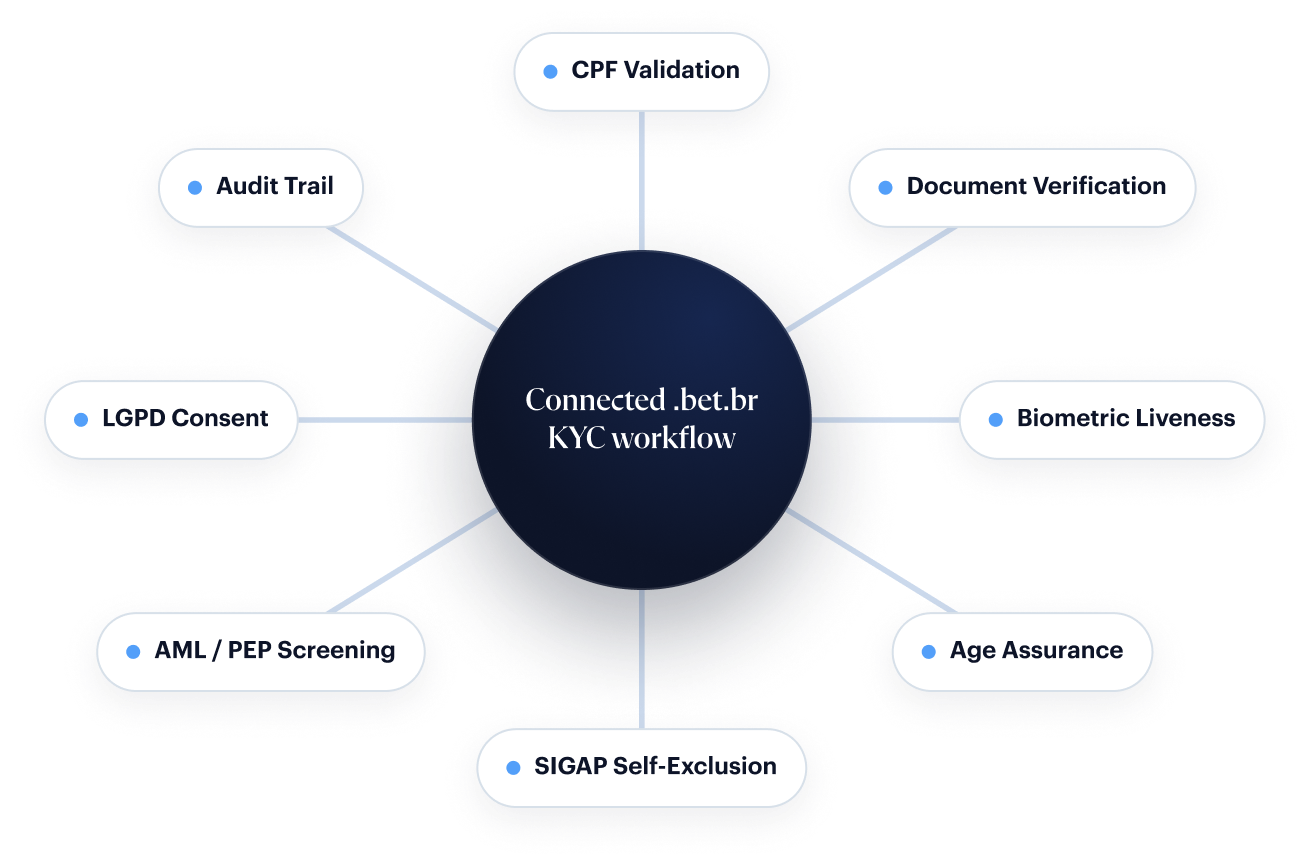
SPA/MF compliance requires a connected identity workflow spanning nine separately audited controls. Each control has its own regulatory source, and each can generate an independent compliance finding.
Failing one layer creates operator liability even where the remaining eight are fully compliant. That is the structural shift: Brazil treats KYC as one connected system, not a menu of isolated checks.
Separately audited means an examiner can ask for proof of any single control in isolation, on demand, with timestamps and outcomes. Seven controls must complete before account activation; re-authentication and the audit trail run for the life of the account.
1
CPF ValidationPortaria 722 / 1,143
IdentityBefore activation
2
Document VerificationPortaria 722 / 1,231
IdentityBefore activation
3
Biometric LivenessPortaria 722
IdentityBefore activation
4
Age AssuranceLei 14.790 / Lei 15.211
IdentityBefore activation
5
AML / PEP ScreeningPortaria 1,143
AMLContinuous
6
Self-Exclusion / SIGAPReg. Instruction No. 31
PlatformReg · login · 15-day
7
Biometric Consent (LGPD)Lei 13.709/2018
PrivacyBefore activation
8
Re-AuthenticationPortaria 722
Platform7 days / 30-min idle
9
Audit TrailPortaria 722 Art. 25
All Controls36-month retention
Controls 1–7: required before account activationControls 8–9: ongoing obligation
Note: The CPF is an eligibility gate, not an identity control. It confirms a bettor exists in the Receita Federal database and is not deceased or suspended. Identity assurance begins only when CPF, document verification, face match, liveness and AML are connected in one verified workflow.
The CPF Gap
Why CPF validation alone leaves operators exposed
CPF validation confirms a taxpayer record exists and is active. It does not prove the person registering owns that identity which is why CPF alone cannot stop mule accounts or synthetic identity fraud.
Large-scale Brazilian data breaches have exposed CPF numbers at population scale. A real, active CPF bought from an underground marketplace clears format, status and name-match checks, so the account activates with no document and no face behind it.
1
Fraudster buys a valid CPF
A real, active CPF from an underground data marketplace. Tax record is live, name is real.
2
CPF validation passes
Account registered with fabricated contact details. Format valid, Receita Federal status active, name match clears. No further checks.
3
Account activates, fraud begins
Mule account used for layering, bonus abuse or payment receipt. No document. No face. No liveness.
→ without document or liveness checks →
The fix — a connected chain
CPF Validationconfirms the person exists
Document Verificationconfirms the document belongs to them
Biometric Livenessconfirms they are physically present
All three together close the gap CPF alone leaves open.
Brazil's Identity Layer
Document verification across 27 RG state formats
Brazil's primary national identity document, the Registro Geral (RG), is issued by state governments with no federal standard. Each of the 27 states maintains its own RG format, numbering scheme and security features.
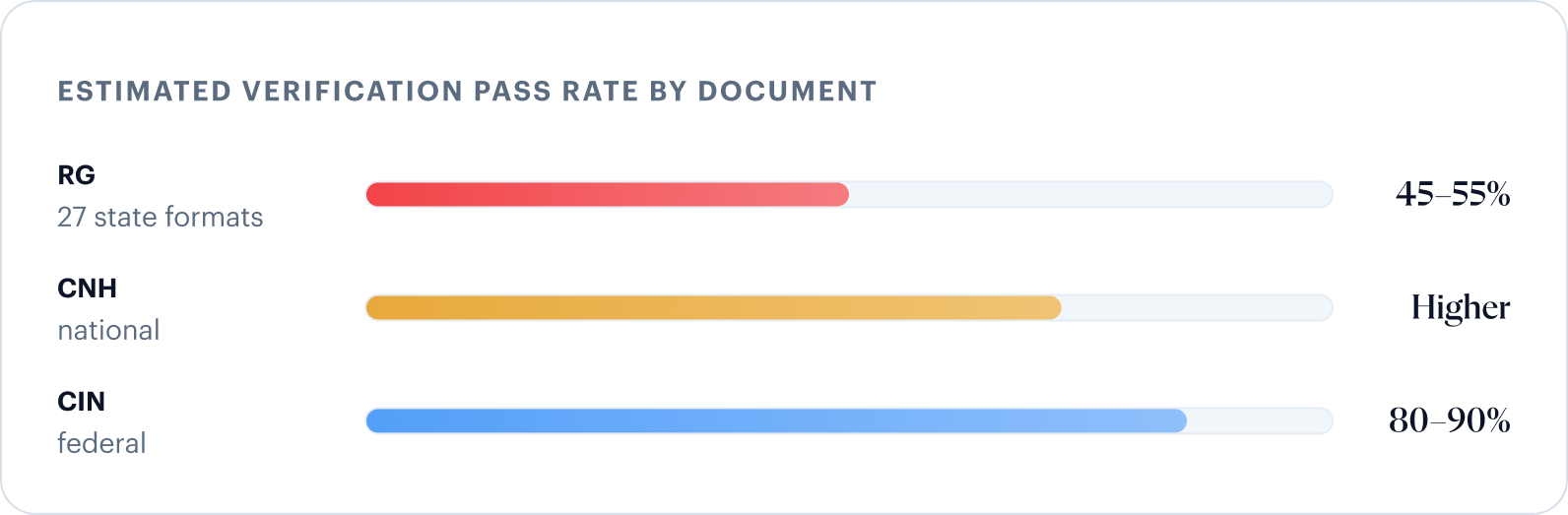
RG documents produce an estimated 45–55% verification pass rate, the lowest among accepted Brazilian IDs driven by format variation, photograph ageing and security-feature degradation. A vendor trained on a narrow document set raises false rejection, abandonment and manual-review backlogs. Operators cannot design for the CIN alone: Brazil stays a mixed-document environment for years, so flows must support legacy RG across all 27 states, CNH, passport and the accelerating CIN rollout at the same time.
Gate only
CPF
Receita Federal · federal
Eligibility gate, not an identity control.
45–55% pass
RG
27 state governments
No federal standard; 10-year validity since 2022.
Higher pass
CNH
DETRAN · state traffic
Standardised national security features.
80–90% pass
CIN
Federal standard
20M issued by early 2025; 130M targeted by end-2026.
Pass rates diverge sharply by document type, which is what drives the friction. CIN pass-rate projection reflects early-rollout data; individual operator rates vary by vendor capability and user population.
Brazil KYC Walkthrough
See a connected Brazil KYC flow, configured for .bet.br
Compliance teams working through CPF, document, liveness, AML and SIGAP requirements can walk through the configuration with the Shufti team before committing to a vendor decision.
The licensed onboarding flow runs nine connected steps, each mapped to an SPA/MF ordinance and each carrying its own audit-evidence requirement. Steps one to seven complete before account activation; re-authentication and the audit trail are ongoing obligations.
The architecture question is whether the system holds the data each control needs at the moment its trigger fires, and whether every decision can be reconstructed for an examiner on request.
1CPF ValidationReceita Federal status + name match.
2Document VerificationRG / CNH / CIN / passport.
3Liveness + Face MatchCertified, blocks screen capture.
4Age AssuranceDOB + CPF cross-reference.
5SIGAP CheckSelf-exclusion query.
6AML / PEPSanctions + PEP screening.
7LGPD ConsentStandalone biometric consent.
8Account ActivatedAll checks complete.
9Re-Verify + Audit7-day cycle, full trail.
Step
Regulatory Source
Audit Evidence to Produce
CPF validation
Portaria 722 / 1,143
Result, status, name-match outcome, timestamp, actor ID
✓Liveness + face matchPAD Level 2 cert v3.1 · pass · device + session logged
◂Certification field names body, level & algorithm version
✓Age assuranceDocument DOB + CPF cross-reference · 18+ confirmed
✓SIGAP self-exclusionQueried 14:02:30 · result: not matched
◂Result and timestamp prove the self-exclusion check ran
✓AML / PEPCleared · list version 2026-03-14 · risk tier low
✓LGPD consentStandalone · form v4 · IP + timestamp captured
If an operator cannot produce this single timeline on request, a finding can follow even when the underlying checks were performed.
Where Operators Fail
Six Failure Patterns SPA Enforcement Is Built to Catch
Compliance audits reveal six recurring failure patterns across licensed operators, and each is a gap between licensing approval and operational enforcement. Each one is independently detectable in production logs.
The common thread is the same as the Stanleybet-style architecture problem elsewhere: checks that exist on paper but cannot be evidenced, automated or reconstructed when an examiner asks.
Ghost accounts: no biometric liveness
Problem
Accounts activate on valid CPFs without certified liveness; synthetic identities pass registration.
Regulator risk
Direct Portaria 722 violation; a primary target of SPA's active monitoring.
Fix
Mandate certified liveness before activation, with no exceptions.
RG false rejection driving abandonment
Problem
Vendors trained on a subset of RG formats push false rejection past 60% for legitimate users.
Regulator risk
Lost first-deposit conversion plus manual-review backlogs that become compliance gaps.
Fix
Use a multi-format vendor covering all 27 RG variants; accept CNH and CIN as fallbacks.
SIGAP blocking not automated in 72 hours
Problem
Self-exclusion notices route through a manual queue; the bettor keeps betting for days.
Regulator risk
The 72-hour deadline runs from notification receipt, not from the manual review decision.
Fix
Automate blocking as a system action; set an internal 24-hour target as a buffer.
7-day re-verification not enforced
Problem
Re-verification is documented but fires only on withdrawal; users bet 30+ days without re-auth.
Regulator risk
Portaria 722 non-compliance; the audit shows the gap between policy and production.
Fix
Enforce the 7-day cycle through automated system logic and log every attempt.
AML screening at registration only
Problem
Operators screen at onboarding and treat it as permanent clearance, but PEP status changes.
Regulator risk
Portaria 1,143 requires continuous screening; registration-only is non-compliant.
Fix
Run continuous PEP and sanctions screening with a daily or faster list refresh.
Weak audit evidence: checks done, proof missing
Problem
Screenshots and fragmented logs cannot reconstruct the decision trail on request.
Regulator risk
A finding can follow even when the underlying checks were performed correctly.
Fix
Build one audit record per KYC event; test XML, XLS and CSV exports before an audit lands.
A valid CPF clears the gate. And yet without certified liveness, no one has confirmed a real person is behind the account.
Close the Gap Between a Licence and SPA Enforcement
See how CPF validation, multi-format document verification, liveness detection, SIGAP support and continuous AML screening fit together for Brazilian operators, mapped to Portaria 722 and LGPD..
Reducing onboarding friction without weakening controls
Brazilian .bet.br operators face a conversion problem alongside the compliance one. An onboarding flow that is technically compliant but operationally punishing produces high registration abandonment, low first-deposit conversion and large manual-review queues.
The aim is not fewer controls. It is to run every required control with less friction for legitimate users, using passive liveness, document fallbacks, cached self-exclusion queries and risk-tiered review.
Risk
Control
Conversion Risk
Best-Practice Fix
Shufti Capability
Leaked CPF / mule account
CPF + certified liveness
Extra step raises abandonment
Passive liveness; no visible action for legitimate users
Active + passive liveness, PAD-certified
RG format variation
Multi-format document verification
False rejection causes retry loops
Accept RG, CNH, CIN; one retry with another type
All 27 RG formats + CNH, CIN, passport
Self-excluded user
SIGAP query at registration + login
Query latency delays clean logins
Cache compliant queries; automate blocking
SIGAP integration support; automated blocking
Underage user
Age assurance: DOB + face match
Youth false positives block 18+ users
Combine CPF age, document DOB and face match
CPF + document + face match in one flow
PEP or sanctions match
Continuous AML / PEP screening
Manual review delays activation
Risk-tier queue; auto-approve low risk
1,700+ sources, 20M+ records, frequent refresh
Commercial considerations
PaymentsPIX payment-layer riskConnect identity, device and payment signals before withdrawal approval, not just at registration.
CaptureMobile-first captureMost bettors onboard on mobile, under low light and on older cameras, which lab testing does not capture.
InfrastructurePeak-volume loadVolumes surge during major football events; test KYC infrastructure under projected peak load.
FraudCPF leakage & multi-accountingLiveness is the strongest single control against contas laranja and bonus-abuse account farming.
The Vendor Test
How to evaluate a Brazil Bets KYC vendor
Selecting a KYC vendor for a .bet.br operator is a high-stakes compliance decision, because a vendor failure cascades across every downstream obligation. Seven capabilities are non-negotiable, and a vendor that is Partial or Not Met on any of them should not be selected.
Score each capability against evidence, not sales claims. Confirm certification currency, RG coverage by tested state, and SIGAP integration with sandbox results before signing.
Required Capability
What to Verify
Evidence
Status
Certified Biometric LivenessRequired
PAD certification (ISO/IEC 30107-3 or iBeta L1/2) from an SPA-recognised body, current for the live algorithm version
Certificate + algorithm version
Met
Multi-Format Document VerificationRequired
All 27 RG state formats with no manual configuration, plus CNH, CIN and passport
Coverage list + tested-state list
Met
Real-Time CPF ValidationRequired
Receita Federal query, exact name match, active/suspended/cancelled status detection
API integration documentation
Met
SIGAP IntegrationRequired
Native API or documented pathway, automated blocking, balance-return workflow, query scheduling
Award one point per control that is fully implemented and tested in production. Partial controls score zero.
0-4
High exposure. Multiple gaps need urgent remediation before the next SPA cycle.
5-7
Partial readiness. Prioritise SIGAP automation, liveness certification and audit-trail completeness.
8-9
Strong readiness. Confirm audit-trail completeness before an inspection request arrives.
Red flag a vendor that confirms AML screening but cannot show continuous-refresh logs, SIGAP blocking timestamps and structured audit exports may not have sufficient evidence for Brazil. Confirm with evidence, not with sales claims. The full nine-point self-assessment and the complete RFP question bank are in the guide.
Self-Serve
Build and price a Brazil-ready stack without a sales call
Configure CPF validation, document verification, certified liveness, AML screening and SIGAP support for your accepted markets, and see pricing for every tier in the self-serve portal.
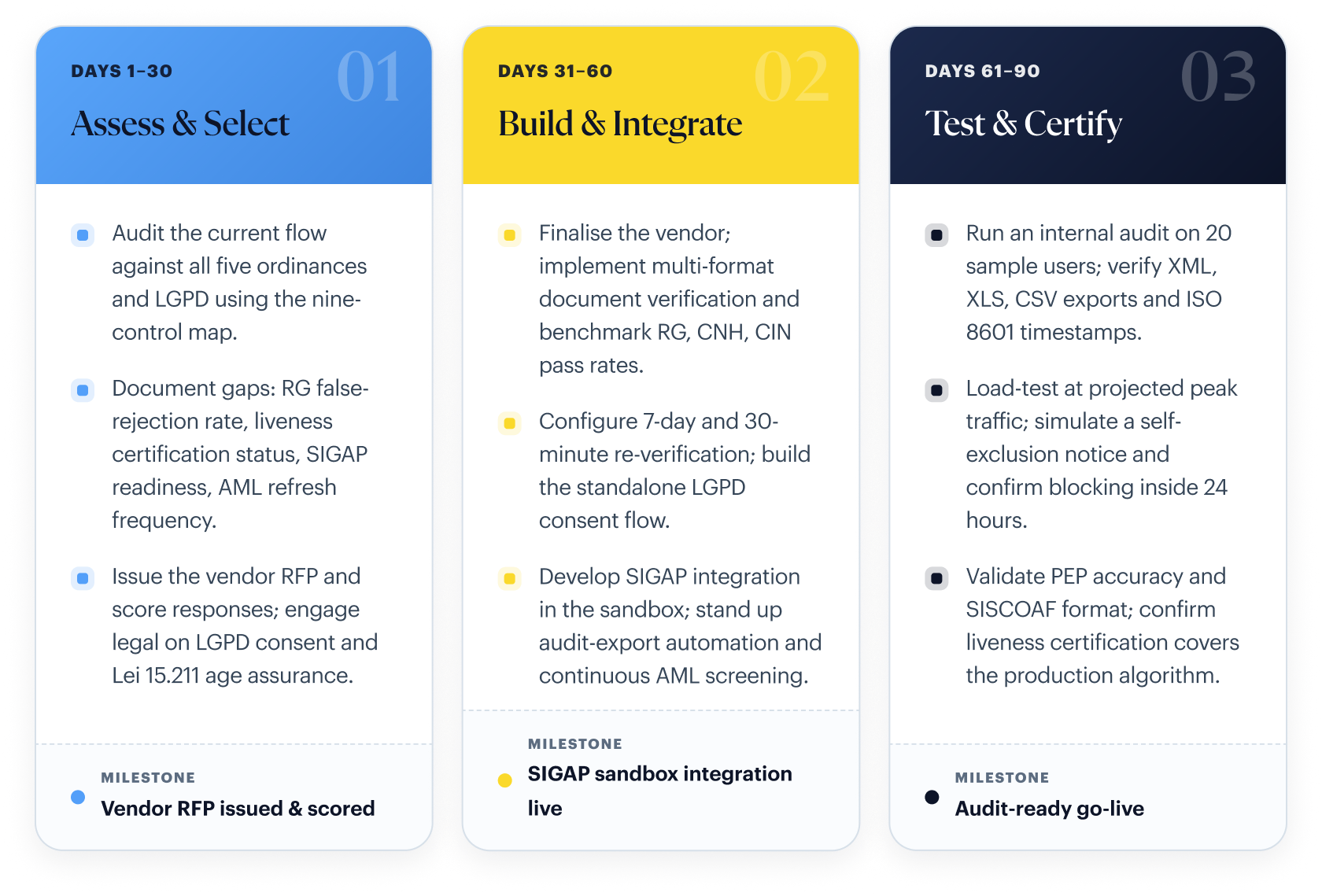
A typical licensed .bet.br operator needs about 90 days to reach full Portaria 722/1,143 compliance from project start. The sequence closes the highest-risk gaps first, then builds toward a complete, audit-ready control environment.
Sequencing matters because remediation is a programme, not a single purchase. Liveness certification, SIGAP automation and audit-export completeness carry the heaviest enforcement weight, so they move ahead of lower-risk refinements.
How Shufti Maps to Brazil Controls
How Shufti supports Brazilian betting operators
Shufti is a global identity verification and AML platform serving 2,000+ enterprise customers across 240+ actively processed countries and territories. It combines CPF validation, document verification, face verification with certified liveness, AML screening, behavioural biometrics and risk assessment in one system and produces the timestamps, logs and audit trails an SPA inspection asks for.
Brazilian operators do not need more isolated checks. They need a connected workflow that proves who the bettor is, whether they are eligible, whether they create AML or fraud risk, and whether every decision can be reconstructed for audit.
Each control in that workflow maps to a specific Shufti capability and the evidence it produces.
Brazil Requirement
Operator Challenge
Shufti Capability
CPF Validation (Portaria 722 / 1,143)
CPF alone misses mule and synthetic fraud
CPF + document + face match in one workflow; real-time Receita Federal integration with exact name-matching
Biometric Liveness (Portaria 722)
Non-certified liveness is a direct violation
iBeta PAD Level 1 and 2 certified active + passive liveness; deepfake, mask and face-swap detection
Document Verification (Portaria 722 / 1,231)
27 RG formats raise false rejection
Multi-format verification across 10,000+ document types from 240+ countries; all 27 RG formats with no manual configuration
AML / PEP Screening (Portaria 1,143)
Registration-only screening is non-compliant
Continuous screening; domestic + international PEP coverage; SISCOAF-compatible output
SIGAP / Self-Exclusion (Reg. Instruction No. 31)
Manual blocking risks the 72-hour breach
SIGAP integration support with automated blocking and timestamped logs for notice, block and balance return
LGPD Biometric Consent (Lei 13.709/2018)
Bundled ToS consent is non-compliant
Standalone consent capture; timestamp and IP logging; audit-ready records in the verification flow
Audit Trail (Portaria 722 Art. 25)
Screenshots are not structured evidence
Structured exports in XML, XLS, CSV; granular ISO 8601 event logging; 36-month retention supported
01 - 04
Certifications
Independently audited and certified for enterprise-grade security and data protection.
Frequently Asked Questions
Licensed .bet.br operators must run a connected identity workflow under SPA/MF rules: CPF validation, document verification, certified biometric liveness, age assurance, AML and PEP screening, SIGAP self-exclusion checks, standalone LGPD biometric consent, automated re-verification, and structured audit-trail exports. Each control has its own regulatory source and is audited separately.
Was This Content Helpful ?
CPF validation only confirms that a taxpayer record exists and is active. It does not prove the person registering owns that identity, and population-scale CPF leakage means a valid CPF can be bought and used for a mule account. Operators still need document verification, face match, liveness and continuous AML screening to close the gap.
Was This Content Helpful ?
Brazil's RG identity document is issued across 27 state-level formats with no federal standard, varying layouts and security features. RG pass rates sit around 45 to 55 percent, the lowest of the accepted IDs, so vendors trained on a narrow set generate high false rejection and onboarding friction. Flows must support RG, CNH, CIN and passport at the same time.
Was This Content Helpful ?
Yes. Portaria 722 prohibits static selfies and expects liveness detection certified against recognised presentation-attack-detection standards, such as ISO/IEC 30107-3 or iBeta PAD Level 1/2, validated by an SPA-recognised testing body. The certification must cover the algorithm version running in production.
Was This Content Helpful ?
SIGAP is Brazil's centralised government betting management system, launched in December 2025. Under Regulatory Instruction No. 31, operators must query it at registration, at first daily login, and every 15 days for active users. If a user is self-excluded, the operator must block access and return the balance within 72 hours of the notification; an internal 24-hour target gives a compliance buffer.
Was This Content Helpful ?
Portaria 722 Article 25 sets a minimum 36-month retention for audit trails covering account statements and transaction logs. Exports must be available in XML, XLS and CSV, with daily and monthly submissions to SPA via SIGAP. Operators with AML obligations should confirm with counsel whether longer retention applies under COAF guidance.
Was This Content Helpful ?
Lei 14.790/2023 sets a hard minimum age of 18. Lei 15.211/2025, a digital child-safety law effective 17 March 2026, raises the standard beyond self-declaration or checkbox-only gates, requiring reliable and auditable age-assurance mechanisms. Compliance teams should confirm with legal counsel how it applies to their operator structure.
Was This Content Helpful ?
Confirm seven non-negotiable capabilities with evidence: certified biometric liveness from an SPA-recognised body, all 27 RG formats plus CNH and CIN, real-time CPF validation, SIGAP integration with automated blocking, standalone LGPD consent, continuous PEP and sanctions screening, and structured XML/XLS/CSV audit exports. A vendor that is Partial or Not Met on any of these should not be selected.
Was This Content Helpful ?
Form submitted successfully!
Thank you for your interest — your report is
loading now.
Verify .bet.br Players With a Connected KYC Stack
CPF validation, multi-format document verification, iBeta PAD-certified liveness, SIGAP integration, continuous AML screening, LGPD consent and structured audit exports, configured for licensed .bet.br operator workflows.
Form submitted successfully!
Thank you for your interest — your report is loading now.
Take the next steps to better security.
Contact us
Get in touch with our experts. We'll help you find the perfect solution for your compliance and security needs.


 AMLR Solutions
  AMLR Consultation
 EUDI Wallet
 Onboarding
 Ongoing Monitoring
 FRAML
FRAML KYC
KYC KYB
KYB KYI
KYI Age Assurance
 Workforce IAM
 Candidate Verification
 Account Takeover
 Bonus/ Promotion Abuse
 Chargeback Fraud
 Deepfake
 Document Fraud
 Fraud Networks
 Impersonation Fraud
 Money Mule Activity
 Multi-Accounting
 Party Fraud
 Regulatory & Compliance Risks
 Synthetic Identity Fraud
 Adult Content
 Banking
 Crypto
 Fintech
 Forex
Forex Compliance
 Fraud prevention
 Trust & safety
 Global expansion
 Compliance Officers
 Developers
 Fraud Analysts
 Product Managers
 Journey Builder
  Global Trust Platform
 Customer Profiles
 Vendor Comparison
 IDV Case Management
 AML Case Management
 Regulatory Reporting
 Agentic Rule Builder
  AI Compliance Co-Pilot
  Fraud Analytics
 Fraud Hub
  OCR
OCR Shufti AI
 Bank Account Verification
  Biometric Duplication
 Database Checks
 Document Intelligence
 Government ID
 Mobile Driver's License
 NFC
NFC Selfie Liveness
 Brand Personalisation
 Deployment Options
 Identity Methods
 IDV Modes
 Multi-tenancy
 On-Premise IDV
 Secure Capture
 Shufti MCP











 Back
Back