


 AMLR Solutions
  AMLR Consultation
 EUDI Wallet
 Onboarding
 Ongoing Monitoring
 FRAML
FRAML KYC
KYC KYB
KYB KYI
KYI Age Assurance
 Workforce IAM
 Candidate Verification
 Account Takeover
 Bonus/ Promotion Abuse
 Chargeback Fraud
 Deepfake
 Document Fraud
 Fraud Networks
 Impersonation Fraud
 Money Mule Activity
 Multi-Accounting
 Party Fraud
 Regulatory & Compliance Risks
 Synthetic Identity Fraud
 Adult Content
 Banking
 Crypto
 Fintech
 Forex
Forex Compliance
 Fraud prevention
 Trust & safety
 Global expansion
 Compliance Officers
 Developers
 Fraud Analysts
 Product Managers
 Journey Builder
  Global Trust Platform
 Customer Profiles
 Vendor Comparison
 IDV Case Management
 AML Case Management
 Regulatory Reporting
 Agentic Rule Builder
  AI Compliance Co-Pilot
  Fraud Analytics
 Fraud Hub
  OCR
OCR Shufti AI
 Bank Account Verification
  Biometric Duplication
 Database Checks
 Document Intelligence
 Government ID
 Mobile Driver's License
 NFC
NFC Selfie Liveness
 Brand Personalisation
 Deployment Options
 Identity Methods
 IDV Modes
 Multi-tenancy
 On-Premise IDV
 Secure Capture
 Shufti MCP














 Back
Back
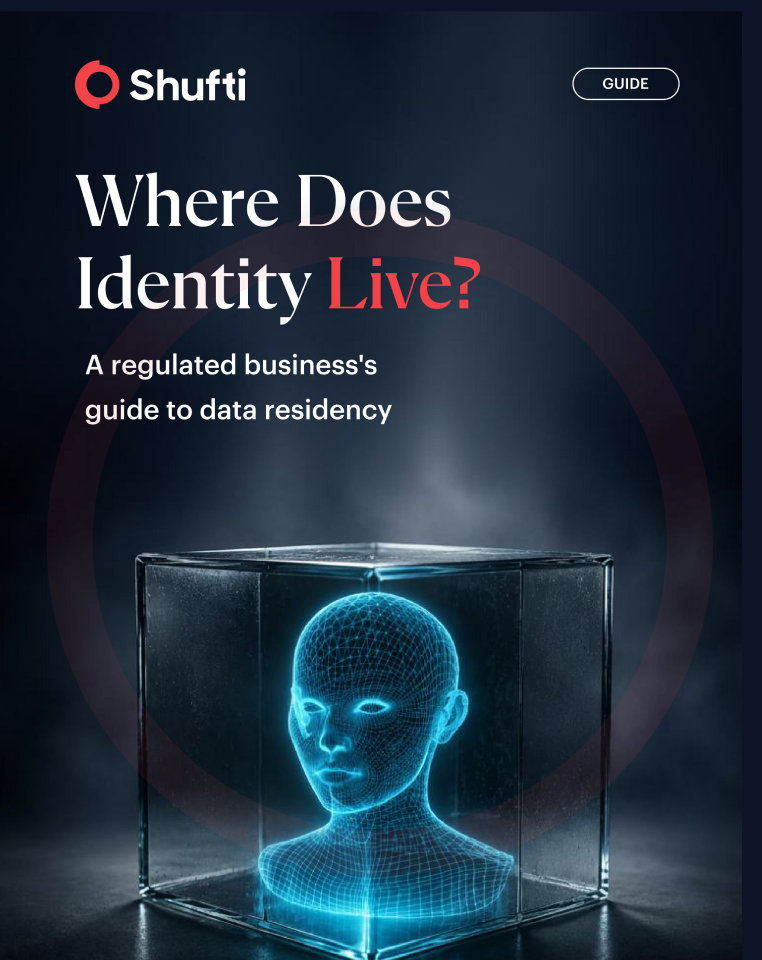
Data residency requirements for identity verification
A practitioner guide to data residency, data localization and data sovereignty requirements for customer identity data, and how to choose an identity verification solution whose deployment model meets every market’s rules.
Request a demoInside the guide

Plain definitions of data residency, data localization and data
sovereignty.
Data residency requirements by country across the Gulf,
Asia, Europe and the Americas.
The two layers that bind every provider, the privacy law and the sector regulator.
A KYC vendor due diligence checklist to test how a solution meets data
privacy and localization needs.
The One Question a Regulator Always Asks
Who owns data residency compliance when you outsource KYC?
When a business outsources identity verification, its regulator still holds it to the data residency requirements of every market it serves. Is customer identity data stored, processed and reachable in line with local law? Two layers decide the answer, privacy law and sector regulation, and they don’t always agree.
Data localization requirements don’t always come from privacy law
A data localization requirement can come from a financial regulator’s rules on the material outsourcing of sensitive data. So an identity verification solution that meets a jurisdiction’s data privacy law can still miss the sector-specific localization rule in the same market.
The Three Terms, In Plain Words
Data residency vs data localization vs data sovereignty
Data residency, data localization and data sovereignty are easy to confuse, and vendors often use them interchangeably. Each answers a different question.
What is data residency?
Where a business’s customer identity data physically sits. Residency is often a setting chosen through the solution’s deployment model.
What is data localization?
A legal command to keep, and sometimes process, the data inside a country’s borders. It often comes from a financial sector regulator such as SAMA, the RBI or OJK, not only the privacy law.
What is data sovereignty?
Whose law governs the data and who can lawfully demand access to it. A solution can give in-country residency and still fall under a foreign government’s reach.
The data residency vs data sovereignty distinction matters most at vendor selection. In-country storage doesn’t put data beyond the reach of a foreign government if the provider itself falls under that government’s law.
Why Privacy-Law Compliance May Not Be Sufficient
Why GDPR compliance doesn’t cover every data residency requirement
One layer comes from the privacy law. The other comes from a sector regulator’s material outsourcing requirements. The second often calls for in-country deployment, and many solutions can’t meet both.
 From the privacy law
Privacy law: lawful cross-border data transfers across the whole chain
A privacy law such as the GDPR places a real, ongoing set of obligations on a business, well beyond paperwork. A business must show on request that identity data is stored, processed and accessed lawfully, and that every cross-border data transfer is authorized. It must also audit that handling across the solution and every party in the chain. The longer the chain of subprocessors, the harder this is to prove.
 From the sector regulator
Sector regulators: data localization through outsourcing rules
A sector regulator may go further. Its material outsourcing requirements can oblige the data to stay inside the country on a local cloud region or on-premises. This is a question about the solution’s deployment model, not its paperwork. A solution that meets the privacy law may still miss the localization requirement, so both belong in due diligence from the first conversation.
Which Markets Keep Identity Data In-Country
Data residency requirements by country (2026)
Few countries have data localization laws that cover all personal data, but several financial regulators set their own. An identity verification solution needs in-country deployment in two situations. The first is when the law of the market obliges the data to stay inside the country. The second is when the approval friction around offshore outsourcing makes the in-country route the simpler one. Most major economies allow offshore cloud, so the real need isn’t in-country deployment everywhere. The real need is a solution that can move between flexible cloud, offshore cloud, in-country cloud and on-premises as each market demands. The pressure for in-country deployment concentrates in the financial sector across the Gulf and parts of Asia.
Data residency requirements for identity data in 15 markets, as of 2026.
SAMA’s Cloud Computing Regulatory Framework keeps customer data in-Kingdom. Offshore cloud needs SAMA approval.
CBUAE Outsourcing Regulation, Article 6: the master record of confidential data stays inside the UAE.
The RBI’s 2018 directive stores payment-system data, including customer PII, only in India.
OJK obliges banks to keep data centers and disaster-recovery sites inside Indonesia.
Offshore outsourcing needs QCB consent. The QCB E-KYC Regulation gates onboarding of non-residents.
CBB Rulebook OM-2: outsourcing customer data, and any offshore arrangement, needs prior CBB approval.
Under BNM’s RMiT, critical public cloud needs a first-time consultation. Offshore is fine for non-critical systems.
No localization. MAS Guidelines on Outsourcing require MAS and auditor access and a clear chain.
No GDPR mandate. EBA outsourcing guidelines and DORA (January 2025) push material work toward the EEA.
No localization. PRA SS2/21 judges data location by risk.
No mandate under the PDPA (2022). Must guarantee Bank of Thailand and auditor access.
No localization under the PDPO. The HKMA expects audit, inspection and supervisory access.
No localization. OSFI Guideline B-10 asks banks to weigh data location and foreign legal exposure.
No localization under the LGPD. The Central Bank expects audit and supervisory access.
No federal mandate. Biometric data falls under state laws such as Illinois BIPA.
How Shufti meets data residency requirements in every market
The full whitepaper sets out data residency laws market by market. It then shows how one integration with four deployment options (flexible cloud, offshore cloud, in-country cloud and on-premises) meets each market’s data privacy and data residency requirements. Need data to stay inside your own infrastructure? See on-premises identity verification.
Vendor Assessment Checklist
KYC vendor due diligence checklist: 13 data residency questions
Use this checklist to compare KYC vendors with data residency options. Put the same 13 questions to every provider, Shufti included. The answers show whether a vendor’s architecture fits the markets you serve.
Data storage and processing location
3 questions- 01In which countries can a solution store your data, and can it pin storage to one?
- 02Where does a solution process the data, as distinct from where it stores it?
- 03Can a solution deploy in-country, on local cloud, or on your own servers?
Cross-border data transfers and sovereignty
3 questions- 01What cross-border data transfer mechanism does a provider use for each region?
- 02Who are a provider’s subprocessors, where are they, and whose laws apply?
- 03Could a foreign government compel the data wherever a solution stores it?
Biometric data and BIPA compliance
3 questions- 01How does a solution handle biometric data, from consent to storage to retention?
- 02Can a solution delete biometric data right after a verification decision?
- 03How does a solution meet strict biometric rules such as Illinois BIPA?
Data retention, deletion and assurance
4 questions- 01What default retention periods does a solution set, and can you adjust them per market?
- 02How do a provider’s deletions reach backups and subprocessors?
- 03Which security credentials does a provider hold, and does it own its core technology?
- 04How does a provider reconcile deletion rights with AML retention minimums?


Certifications
Independently audited and certified for enterprise-grade security and data protection.




Frequently asked questions
No. The GDPR doesn’t require personal data to stay in the EU. It controls cross-border data transfers instead, through adequacy decisions, Standard Contractual Clauses or binding corporate rules. Financial firms still face pressure toward the EEA from EBA outsourcing guidelines and DORA, so GDPR compliance alone doesn’t settle where KYC data can sit.
Data residency is where data is physically stored. Data sovereignty is whose law governs it and who can lawfully demand access. The two can split: data stored in Frankfurt by a US-owned provider sits in the EU but can still be reached under the US CLOUD Act.
No single law defines them. In practice, they come from three places: the privacy law where the data is collected, sector rules such as SAMA’s or the CBUAE’s outsourcing regulations, and the laws that apply to the provider itself. A business meets them by controlling where data sits, who processes it, and which governments can compel it.
For identity data in financial services, Saudi Arabia, the UAE, India (payment data) and Indonesia (banks) require in-country storage. Qatar and Bahrain put offshore outsourcing behind regulator approval. The EU, UK, Singapore, Thailand, Hong Kong, Canada, Brazil and the US have no mandate. Beyond this guide, China, Russia and Vietnam run broader localization laws.
Yes. The CLOUD Act (2018) lets US authorities compel providers under US jurisdiction to disclose data they control, wherever it’s stored. That’s why European buyers now check a KYC provider’s ownership, subprocessor chain and deployment model, not only where its data center is.
Look for a vendor that can deploy in more than one model. SaaS-only vendors can’t meet an in-country rule, and EU hosting on a global cloud doesn’t help in Saudi Arabia or Indonesia. Shufti deploys as flexible cloud, offshore cloud, in-country cloud or on-premises from one integration.
A subprocessor is a third party your vendor uses to handle your data, such as a liveness or document-check supplier. Each one adds a jurisdiction and an audit duty, and DORA now requires EU financial firms to map the whole chain. A vendor that owns its verification stack keeps that chain short.
In most markets, yes. The EU and UK treat it as special-category data, and Saudi Arabia, the UAE, Indonesia, Brazil, Canada and Thailand class it as sensitive, which brings explicit consent and stricter transfer rules. India, Singapore and Hong Kong have no separate tier, and the US leaves it to state laws such as Illinois BIPA.

Form submitted successfully!
Thank you for your interest — your report is loading now.
Expand into new markets with KYC built for local data residency laws
Tell us which markets you’re entering. We’ll show you how Shufti meets each one’s data residency, localization and sovereignty rules from a single integration.