




 Face Verification
 Address Verification
 Document Verification
 Age Verification
 VideoIdent
 Fast ID
 Docless Verification
 Consent Verification
 NFC Verification
 Business Verification
 Due Diligence
 Investor Verification
 E-Signature

 QES
QES
 AML Screening
 Transaction Monitoring
 Adverse Media
 Business AML Screening
 PEP & RCA
 Sanctions
 Watchlist
 Behavioural Biometrics
 Device Fingerprinting
 Biometric Face Authentication
 MFA
MFA
 Fraud Hub
 Onboarding
 Ongoing Monitoring
 KYC
KYC
 KYB
KYB
 KYI
KYI
 Age Assurance
 Identity Verification
 Workforce IAM
 Candidate Verification
 Compliance
 Fraud prevention
 Trust & safety
 Global expansion
 Product Managers
 Compliance Officers
 Fraud Analysts
 Developers
 Deepfake Detection
 Bonus Abuse / Promotion Abuse
 Account Takeover
 Synthetic Identity Fraud
 Document Fraud
 Impersonation Fraud
 Multi-Accounting
 Fraud Networks
 Chargeback Fraud
 Money Mule Activity
 Party Fraud
 Regulatory & Compliance Risks
 Fintech
 Crypto
 iGaming
 Forex
Forex
 Social Network
 Marketplace
 Banking
 Gig Economy
 Payments
 Ride Hailing
 Adult Content
 Blind Spot Audit
 Deepfake Detector
 Liveness Spoofs
 Document Originality
 Document Deepfake
 Global Trust Platform
 Journey Builder
 Case Management
 Shufti AI
 Fraud Analytics
 Vendor Comparison
 Brand Personalisation
 AI Compliance Co-Pilot
 OCR
OCR
 Secure Capture
 Deployment Options
 Identity Methods
 API Documentation
 Mobile SDKs
 Service Status
 Help Center
 Contact Us
 Technical Support
 Supported Documents
 Supported Countries
 Content library
 Blogs
Blogs
 News
News
 Reports
 Insights
 Knowledgebase
 ROI calculator
 About
About
 Career
 Press Release
 Certifications
 Partnership
 Awards
 Events & Webinar
 Interactive Demo
 Podcast Studio
 Spotlight Studio
- Australia
- Austria
- Bangladesh
- Brazil
- Bulgaria
- Canada
- China
- Cyprus
- Egypt
- Estonia
- Eswatini
- Ethiopia
- France
- Germany
- Greece
- Haiti
- Hong Kong
- India
- Iraq
- Ireland
- Indonesia
- Italy
- Japan
- Jordan
- Kazakhstan
- Kenya
- Kosovo
- Kuwait
- Latvia
- Luxembourg
- Malaysia
- Malta
- Mauritius
- Mexico
- Micronesia
- Moldova
- Montenegro
- Morocco
- Mozambique
- Myanmar
- Namibia
- Nauru
- Nepal
- Nigeria
- Nicaragua
- Niue
- Norway
- Netherlands
- New Zealand
- Oman
- Pakistan
- Palau
- Palestine
- Panama
- Papua New Guinea
- Paraguay
- Peru
- Puerto Rico
- Philippines
- Portugal
- Portugal
- Qatar
- Republic of Congo
- Romania
- Russia
- Rwanda
- Samoa
- San Marino
- Senegal
- Serbia
- Seychelles
- Sierra Leone
- Singapore
- Slovakia
- Slovenia
- Somalia
- South Africa
- South Korea
- South Sudan
- Sri Lanka
- St Kitts and Nevis
- St Maarten
- St Lucia
- Sweden
- Switzerland `
- Syria
- Taiwan
- Tajikistan
- Tanzania
- Thailand
- Timor Leste
- Togo
- Tonga
- Trinidad and Tobago
- Turkey
- Turks and Caicos
- Turkmenistan
- Tunisia
- Tuvalu
- Uganda
- Ukraine
- UK
- Uruguay
- USA
- Uzbekistan
- Vatican City
- Vietnam
- Venezuela
- Vanuatu
Qatar
Identity Verification & KYC For Qatar
Shufti delivers identity verification and online KYC services for Qatar under Law No. 20 of 2019. Enable KYC, KYB, and AML compliance for financial institutions and businesses.
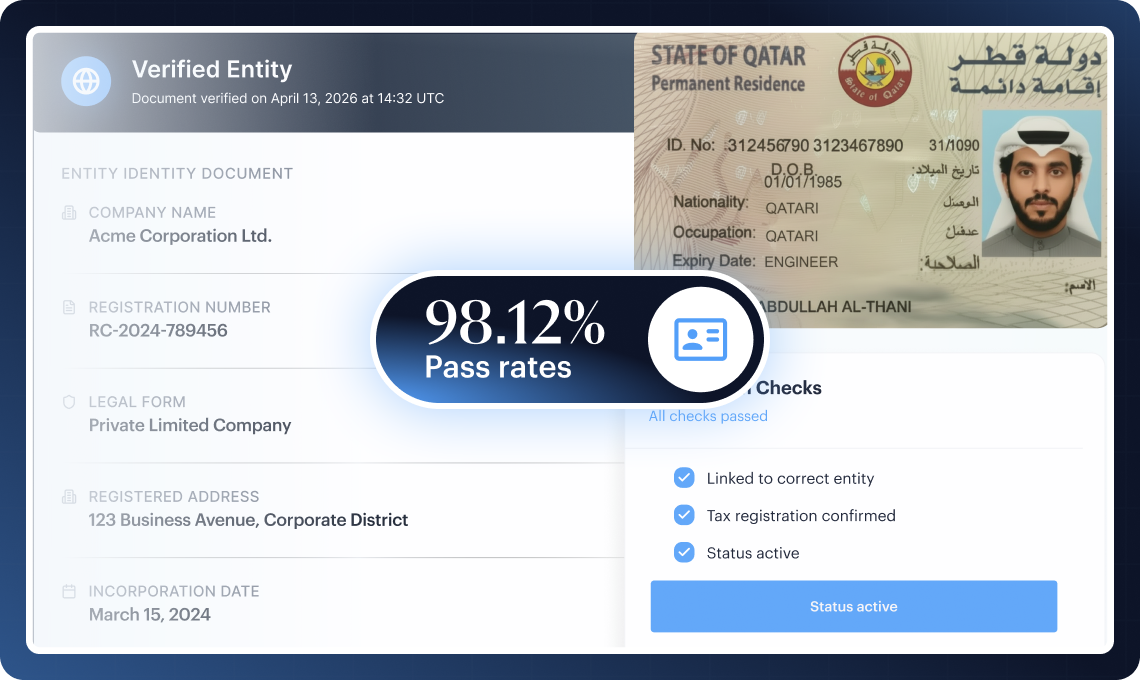
Operational performance for Qatar KYC
Our Numbers Speak Volumes
98.12%
Pass Rates
< 5 sec
Verification
Time
150+
Languages
Covered
Evidence-Ready Checks Across People & Businesses in Qatar
Individual Documents We Verify
Shufti supports 9 Qatari document types.
View All Supported DocumentsQatar National ID Card
Primary identity and residency document for citizens and expatriates, issued by the Ministry of Interior. Contains photograph, full name, date of birth, nationality, and 11-digit Qatar ID number. Valid 1-5 years and mandatory for KYC transactions.
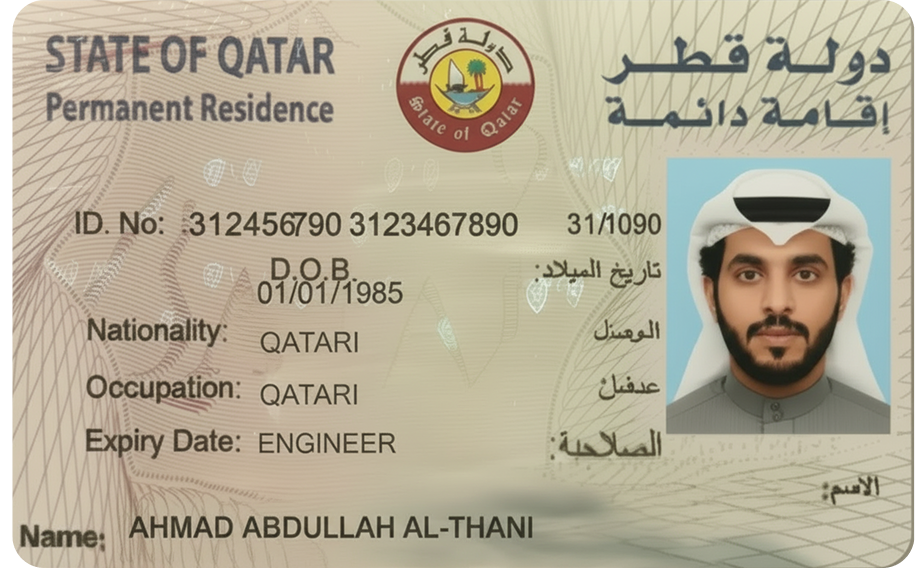
Residence Permit (Iqama)
Work permit or family visa linked to Qatar ID, issued by the General Directorate of Borders, Passages and Expatriate Affairs. Authorizes employment and legal residency; incorporates QID number, employer details, and occupational information for expatriate identity verification.
Passport
A national passport issued by the Ministry of Interior to Qatari citizens for international travel. Accepted as a primary KYC document when the Qatar ID is unavailable; it contains a photograph, date of birth, nationality, and unique identifier for verification.
Driver's License
Government-issued photo ID is accepted for KYC purposes in Qatar. Contains photograph, full name, date of birth, and license number. Applicants must hold a valid Qatar ID or passport; used as a secondary identity verification document.
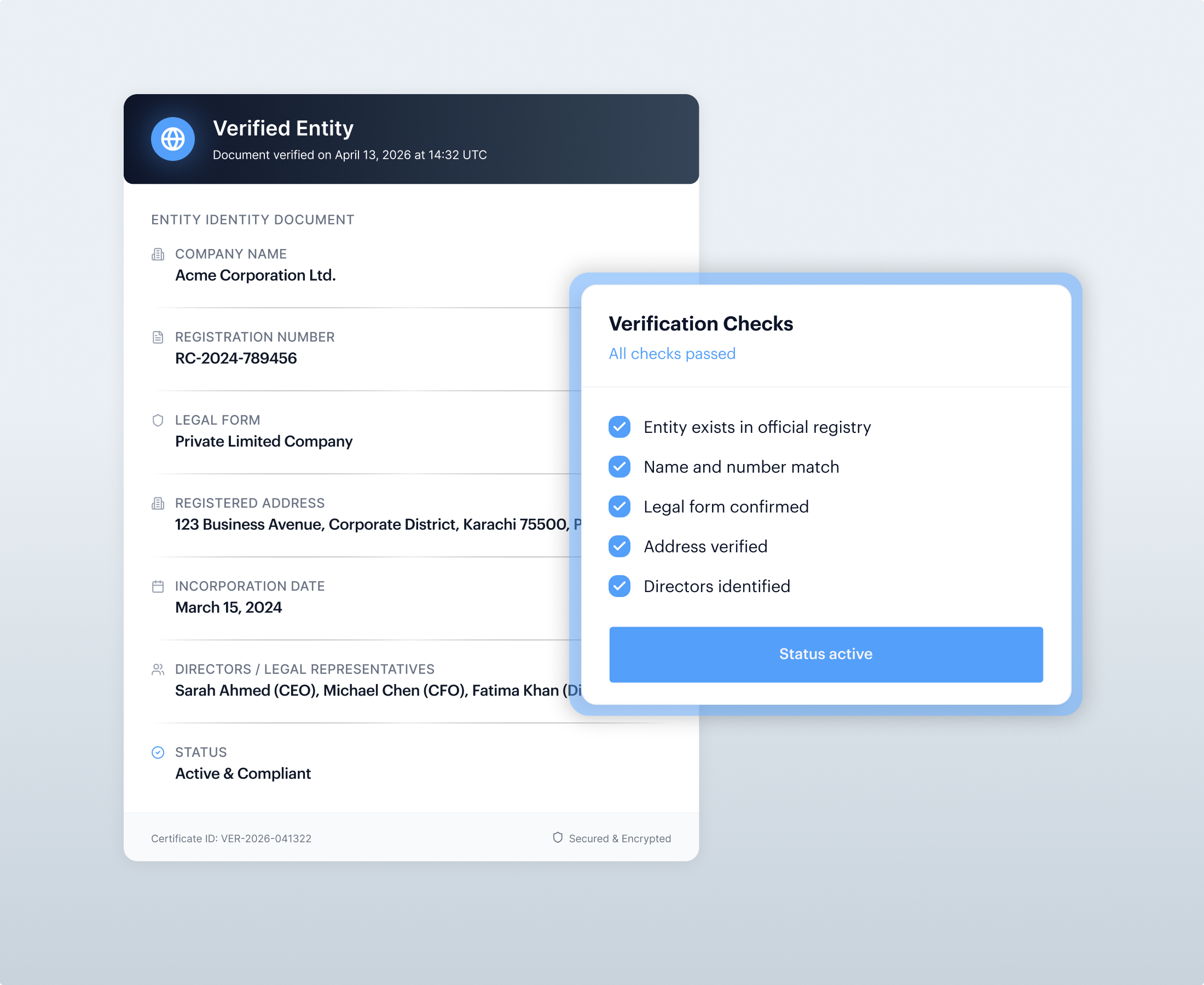
Business Entity Identity
Commercial Registration Certificate
Issued by the Ministry of Commerce and Industry confirming legal business entity registration. Valid one year with annual renewal; contains the company name, registration number, registration date, and nature of business activities.
Memorandum and Articles of Association
Foundational constitutional document defining company governance, ownership distribution, and operational procedures. Required for UBO identification and beneficial ownership verification in KYB compliance processes.
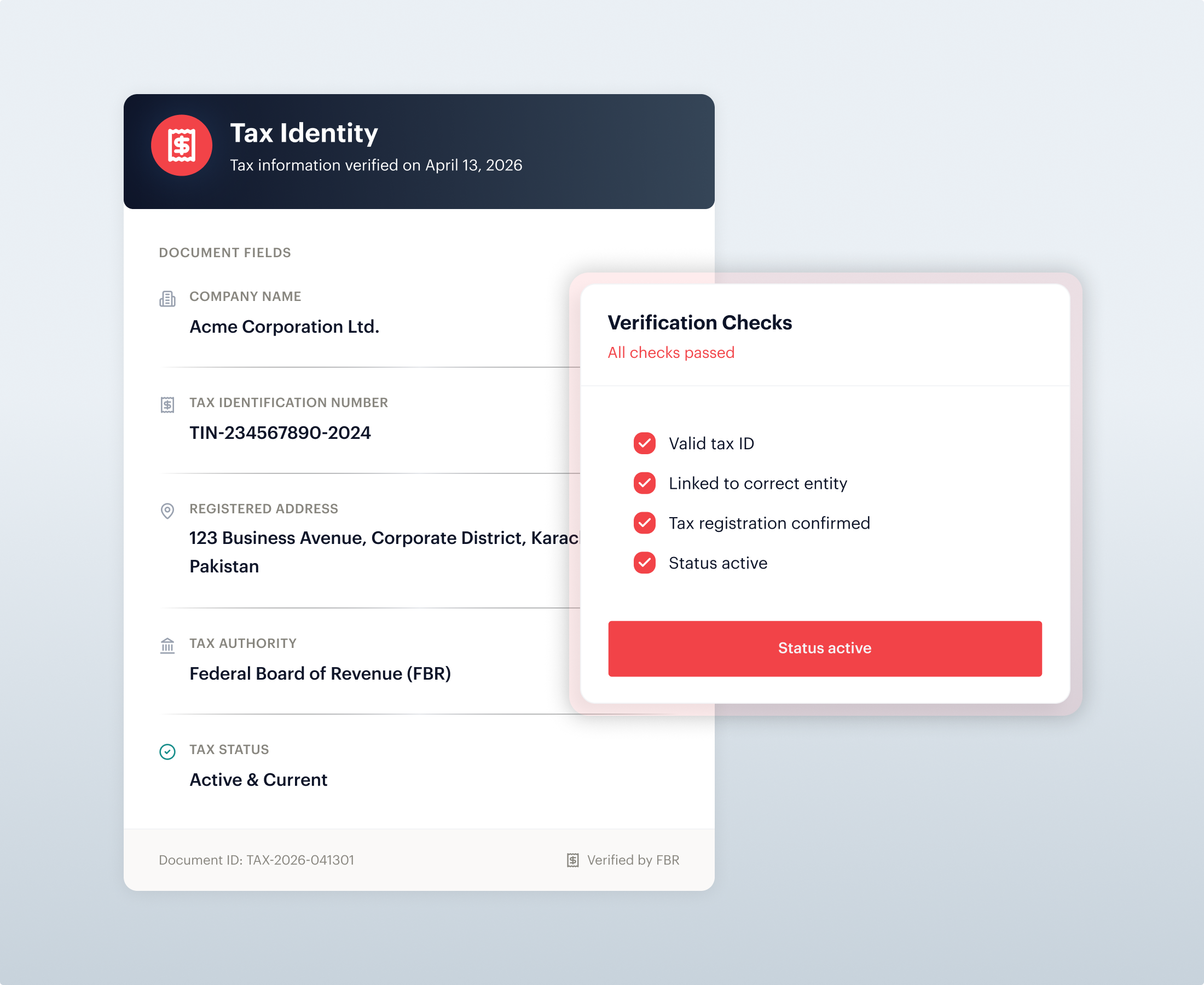
Business Tax Identity
Tax Registration Certificate
Issued by the General Tax Authority to individuals and companies registered for tax purposes in Qatar. Requestable via the Dhareeba portal; contains tax identification number and registration status for KYB tax compliance verification.
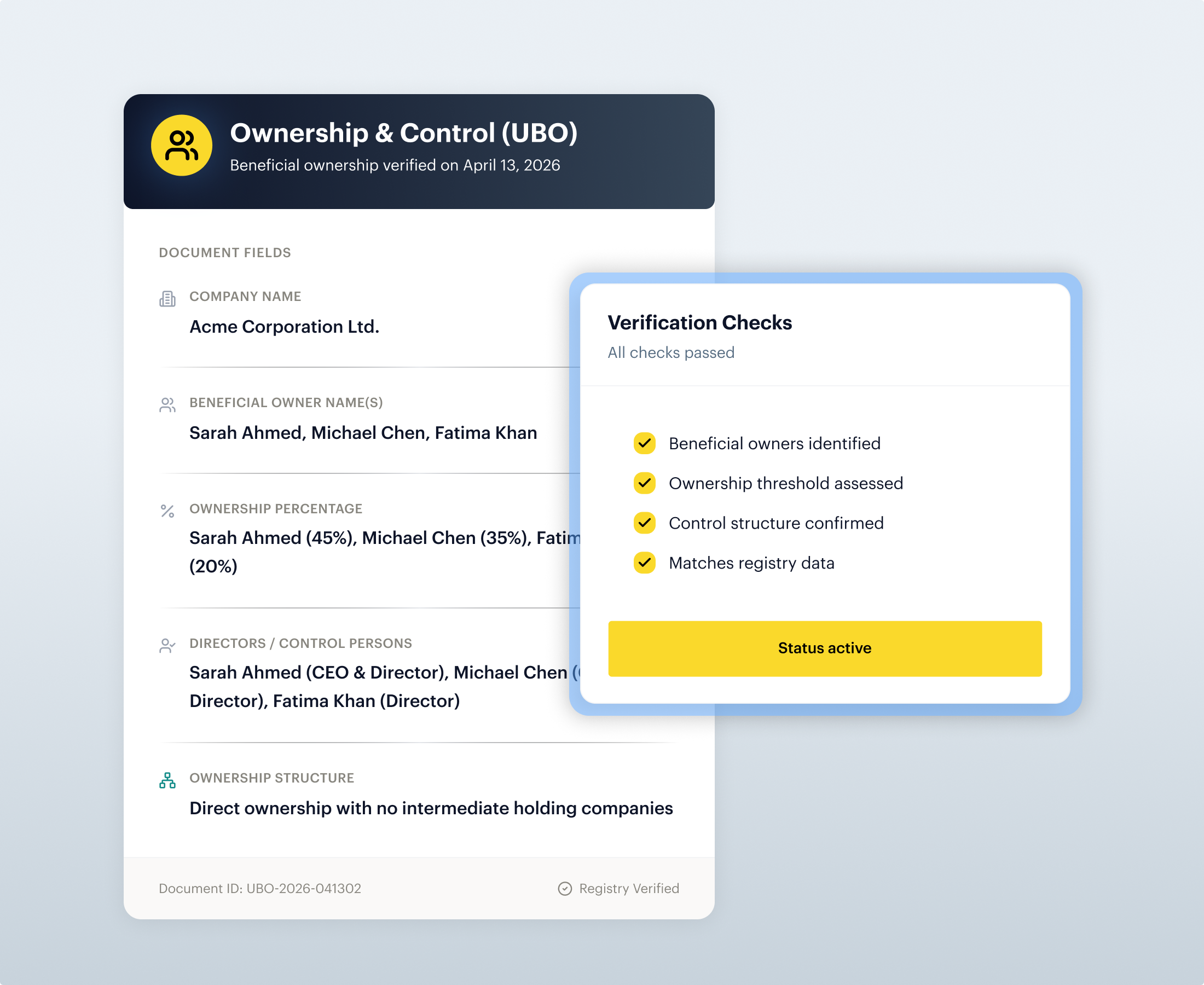
Ownership & Control (UBO)
UBO Declaration Form
Required by QFCRA and Law No. 1 of 2020 (Unified Economic Register). Discloses natural persons exercising control or owning 20% or more of the entity or voting rights. Mandatory at registration or renewal; must be updated within 10 days of ownership changes.
Shareholder Register
Maintained internally by the company documenting ownership structure and share distribution. Required for UBO identification and beneficial ownership verification for regulatory KYC and corporate compliance reporting.
Languages We Cover
Arabic-First Document Processing
Shufti handles right-to-left script with connected letterforms and diacritical marks. OCR accommodates shape variations by character position and Arabic-specific requirements for accurate identity data extraction and regulatory compliance.
Arabic Transliteration And Name Matching
Names transliterated from Arabic script vary by system (Muhammad/Mohammed/Mohamed). Platform applies phonetic fuzzy-matching and Arabic-optimized screening to identify equivalent names across Qatari, GCC, and international records for beneficial owner and sanctions matching.
Dual-Language Evidence Consistency
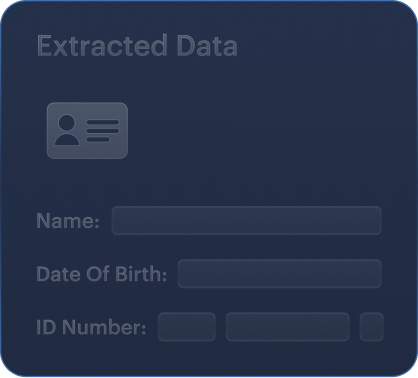
Government documents in Qatar display Arabic and English versions. System validates name, date of birth, and document number consistency across both scripts for multi-language KYC workflows supporting international customers and cross-border financial flows.
GOVERNANCE & CONTROLS
Audit-Ready Decisions, Lower Operational Drag
Fewer Avoidable Re-Submissions
High expatriate population with 50+ nationalities requires diverse document types. Multi-format verification reduces rejection and resubmission cycles for faster onboarding.
Cleaner Audit Trails
Every verification decision, document image, and biometric match recorded with timestamps and evidence chains. Full audit trail meets QCB and QFIU recordkeeping expectations for regulatory inspection.
Better Name Matching Outcomes
Arabic-to-Latin transliteration creates name mismatches across passport, Qatar ID, and bank records. Arabic-native name matching resolves variants, reducing false positives and improving beneficial owner accuracy.
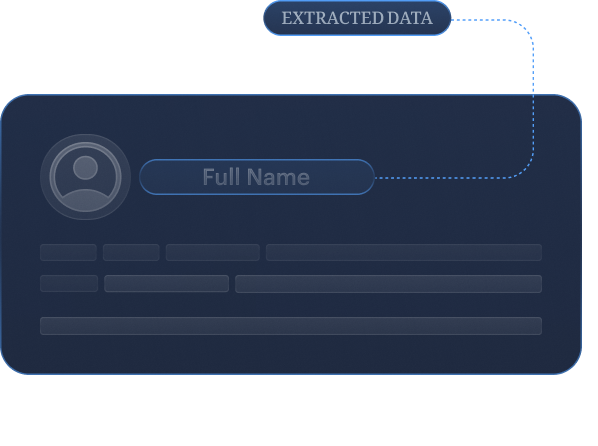
One Workflow, One Back Office
KYC, KYB, and AML screening operate on a single platform and dashboard. Reduce process fragmentation, eliminate duplicate customer checks, and maintain unified evidence sets.

Qatar ID-First Flow Design
Qatar National ID is the primary identity document. Onboarding flow prioritises Qatar ID as first-choice verification method, reducing friction whilst maintaining fallback chains for expatriates.
Qatar IDV/KYC Challenges

High Expatriate Diversity
Qatar's 50+ nationalities bring diverse document types requiring multi-layer verification. Shufti combines passport, biometric, and embassy validation to verify identities across 250+ countries, solving the complexity of high-population diversity.

Arabic Name Variants
Same individual recorded as Abdullah/Abdallah/Abdalla or Ahmad/Ahmed across systems. Phonetic fuzzy-matching and Arabic-optimised screening catch equivalents, preventing sanctions evasion and reducing legitimate customer rejection.

Expanded QFCRA, QCB Rules
QFCRA and QCB compliance obligations expanded post-2022. Enhanced CDD and beneficial owner verification now mandatory. Platform tracks regulatory updates and supports evidence collection aligned to new expectations.

UBO Disclosure Gaps
Law No. 1 of 2020 requires 20% ownership threshold disclosure. Complex GCC-registered entities create opacity. Shufti's structured UBO collection and cross-border ownership verification close disclosure gaps and reduce compliance risk.
Shufti's IDV/KYC Solutions for Qatar
KYC Solutions

Face Verification
Verifies faces using selfie biometrics against passport and Qatar ID photographs. Detects spoofing and deepfake fraud; supports liveness checks for high-value financial services sector onboarding and multi-factor identity confirmation.
.
Age Verification
Selfie-based age estimation combined with date of birth verification from government documents. Supports age-gated services for gaming, trading, and financial products; document verification provides fallback confirmation.
.
Address Verification
Verifies any address-bearing document. Integrates with Kahramaa, Ooredoo, Vodafone Qatar, QNB, and Doha Bank address records to confirm residency. Supports utility bills, bank statements, and government letters for data residency and KYC compliance.
.
Document Verification
Verifies Qatar National ID, Residence Permit, passport, and driver's licence with NFC chip validation, security feature detection, and tampering analysis. Handles Arabic and English dual-language documents with automated data population.
.KYB Solutions

Business Verification
Verifies Commercial Registration Certificate from MOCI, tax identifiers from General Tax Authority, and director/shareholder records. Supports beneficial owner identification and UBO declaration validation with corporate registry integration.
.
Enhanced Due Diligence (EDD)
Structured EDD evidence collection aligned to Qatar risk triggers and QFCRA requirements. Customisable questionnaires, document checklists, and ownership diagrams support complex cross-border entities and regulatory examinations.
.AML Screening

Business AML Screening
Screens entities against QFIU lists, UN Security Council Consolidated List, FATF/MENAFATF designations, and country-specific sanctions. Daily list updates maintain ongoing monitoring compliance with transaction-level escalation support.
.
Transaction Screening
Real-time screening of payment flows against sanctions and watchlists. Monitors cross-border remittance corridors and foreign investment patterns; maintains 10-year transaction records for QFIU reporting and investigative support.
.Built to Fit Qatar's Compliance Landscape

Qatar Central Bank (QCB)
Primary monetary authority regulating banking sector, financial institutions, and monetary policy. Oversees AML/CFT compliance, data protection, and cybersecurity standards. Shufti's e-KYC solutions align with QCB e-KYC Regulation (October 2023) requirements for non-Qatari resident verification and encryption mandates. Official Website: https://www.qcb.gov.qa/

Qatar Financial Centre Regulatory Authority (QFCRA)
Independent regulator of the Qatar Financial Centre authorising and regulating financial services firms. Enforces AML/CFT rules, beneficial ownership requirements, and sanctions compliance. Shufti's KYB platform supports QFCRA beneficial ownership guidance and beneficial owner identification workflows. Official Website: https://www.qfcra.com/

Qatar Financial Information Unit (QFIU)
National Financial Intelligence Unit receiving and analysing suspicious transaction reports (STRs) from financial institutions and designated non-financial businesses. Disseminates intelligence to competent authorities. Shufti maintains full STR audit trails and transaction screening evidence for QFIU reporting support. Official Website: https://www.qfiu.gov.qa/

Qatar Financial Markets Authority (QFMA)
Independent regulatory authority established under Law No. 33 of 2005 supervising capital markets, securities activities, and listed companies. Exercises regulatory oversight and enforcement over Qatar's financial markets. Shufti supports QFMA-regulated entities with tiered customer risk assessment and ongoing monitoring. Official Website: https://www.qfma.org.qa/english/pages/index.html

Ministry of Commerce and Industry (MOCI)
Issues and maintains Commercial Registration Certificates for business entities; regulates trade and industrial activities; manages e-government services. Oversees AML/CFT requirements for non-financial businesses and DNFBPs. Shufti's KYB solutions verify MOCI registrations and support DNFBP compliance evidence collection. Official Website: https://www.moci.gov.qa/en/

General Directorate of Borders, Passages and Expatriate Affairs
Manages residency permits, visa issuance/renewal, passport administration, and expatriate compliance under Ministry of Interior. Issues Qatar ID cards for residents and processes immigration documentation. Shufti verifies Qatar ID authenticity and residency permit validity for expatriate onboarding. Official Website: https://portal.moi.gov.qa/wps/portal/MOIInternet/departmentcommittees/ganationalborderexpatriateaffairs

National Counter Terrorism Committee (NCTC)
Interagency committee under Ministry of Interior formulating counter-terrorism policy and managing Qatar's national terrorist designation list. Maintains Unified Record of Persons and Entities on Sanctions List. Shufti screens all customers and transactions against NCTC sanctions designations daily. Official Website: https://portal.moi.gov.qa/wps/portal/NCTC/Home/

Ministry of Transport and Communications (Data Protection Enforcing Authority)
Enforcing authority for Law No. 13 of 2016 on Personal Data Protection. Oversees compliance with data privacy obligations and recordkeeping requirements in partnership with National Cyber Security Agency (NCSA). Shufti's data residency and encryption align with data protection law requirements. Official Website: https://assurance.ncsa.gov.qa/en/privacy/law
Deployment Choice
Microsoft Azure (Qatar Central, Doha, launched August 2022) and Google Cloud (Doha, launched May 2023) regions available for data residency compliance. On-premise options available for regulated entities requiring in-country processing under Law No. 13 of 2016 and QCB expectations.
Regulatory Alignment
Aligned to Qatar's Personal Data Protection Law (Law No. 13 of 2016) recordkeeping obligations and QCB/QFCRA data governance requirements. Encryption, retention controls, and audit trails support compliance examinations and regulatory confidence in third-party e-KYC.
Retention Controls
Configurable retention and purge settings aligned to the 10-year retention obligation under Law No. 20 of 2019. Automated deletion workflows support data minimisation principles with full audit records tracking data access, modification, and purging.
Encryption Posture
Strong encryption applied to personal and financial data in transit (TLS 1.2+) and at rest (AES-256). Encryption keys generated and managed on-premises in Qatar under institutional control, aligned to QCB Payment Service Provider Regulation (2022).
Data and Privacy Controls in Qatar
Qatar AML Sources That Strengthen Decision

House of Representatives of Qatar

Ministry of Interior National Counter Terrorism Committee Qatar - Sanction List

Qatar Financial Centre Regulatory Authority (QFCRA)

The Peninsula

Gulf Times

Qatar Tribune
Frequently Asked Questions
What are the KYC requirements in Qatar?
Law No. 20 of 2019 mandates customer identity verification, beneficial owner identification, customer risk assessment, and ongoing monitoring. Institutions must assess business relationship purpose, retain records for 10 years, and report suspicious transactions to QFIU.
What documents are accepted for identity verification in Qatar?
Qatar ID card, national passport, residence permit (Iqama), and driver's licence are accepted for identity verification in Qatar. Certified copies of government-issued documents with security features are required for KYC compliance.
Who regulates KYC compliance in Qatar?
Qatar Central Bank (QCB) regulates banking KYC compliance; Qatar Financial Centre Regulatory Authority (QFCRA) oversees QFC firms; Qatar Financial Markets Authority (QFMA) supervises securities firms; Ministry of Interior issues identity documents; Qatar Financial Information Unit (QFIU) receives suspicious transaction reports under Law No. 20 of 2019.
What is customer due diligence and why is it important in Qatar?
Customer due diligence is the mandatory process of identifying and verifying customer identity using reliable independent sources and documenting beneficial owners exercising 10% or more control. Critical in Qatar to prevent money laundering, terrorism financing, and sanctions violations under Law No. 20 of 2019.
How long must Qatar financial institutions retain KYC records?
Law No. 20 of 2019 mandates 10-year retention of customer due diligence records, account files, and transaction documents after the end of the business relationship. This increased standard applies across banking, trading, gaming, and designated non-financial businesses.
What is e-KYC and how does it work in Qatar?
Electronic KYC uses digital identity verification, facial biometrics, and automated document analysis to verify customers remotely. Qatar Central Bank's e-KYC Regulation (October 2023) permits e-KYC for non-Qatari residents with prior QCB authorisation. Institutions may outsource to third-party providers compliant with data residency mandates.
What is beneficial owner identification and why does it matter for Qatar compliance?
Beneficial owner identification requires disclosure of natural persons exercising control or owning 20% or more of an entity's voting rights or economic interest under Law No. 1 of 2020. QFCRA requires annual updates and proof of identity for beneficial owners. Note: Broader beneficial owner awareness under customer due diligence may apply 10% thresholds under QCB guidance.
How do KYC service provider platforms help with Qatar AML compliance?
Online KYC service provider platforms automate identity verification, beneficial owner screening, sanctions list matching, and evidence storage, reducing manual errors and streamlining AML/CFT workflows. Maintain full audit trails and support QCB, QFCRA, and QFIU reporting with documented compliance decision chains.
Build a Qatar-ready KYC, KYB & AML programme with Shufti
INDEPENDENTLY AUDITED. GLOBALLY CERTIFIED.
Certified to Global Standards





PROVEN WORKFLOWS
Use Cases for Regulated Growth in Qatar
Reduce Fraud Without Blocking Growth
Shufti supports marketplace integrity by verifying seller and buyer identities, enabling age-gated journeys where needed, and preserving evidence to support investigations, disputes, and risk-led enforcement actions.




Secure Trust at Every Transaction
Automate KYC and AML workflows to reduce manual onboarding costs. Strengthen residency checks while delivering the frictionless digital experience modern customers expect.


Scale Your Exchange with Confidence
Balance anonymity with compliance. Instantly verify user jurisdiction to meet Travel Rule obligations and help stop abuse without slowing down legitimate trading volume.



Accelerate Growth, Eliminate Friction
Onboard users in seconds, not days. Deploy tiered address verification flows that maximise completion rates for genuine users while filtering out synthetic fraud.


Onboard Global Traders in Real-Time
Verify investors across 250+ countries & territories. Ensure compliance with international financial regulations while preventing identity theft and high-risk chargebacks.



Power a Fair & Secure Player Experience
Reduce bonus abuse and multi-accounting rings at the door. Enforce location rules and trigger step-up checks without disrupting the player journey.



Build a Trusted, Verified Workforce
Screen freelancers and drivers at scale. Verify residency and reduce onboarding friction while maintaining trust between users.



Let’s Tailor your journey
Just a few quick questions to guide your Shufti experience.

Shufti
Market Positioning and Commercial Assessment

Industry stands at 1.7rating

Best ID Verification Innovator

TOP 10 KYC Solution Provider
Best Client Onboarding Solution

Samer Al Tamimi@CEO of Safwa Bank
We take our client's privacy very seriously and always look for new innovative solutions to ensure a safe banking experience. Working with Shufti feels like a breath of fresh air, as their 100% in-house tech keeps our customer's data free from vulnerabilities and fully safe and protected.




PROVEN PLAYBOOKS
Explore Practical KYC & AML Resources
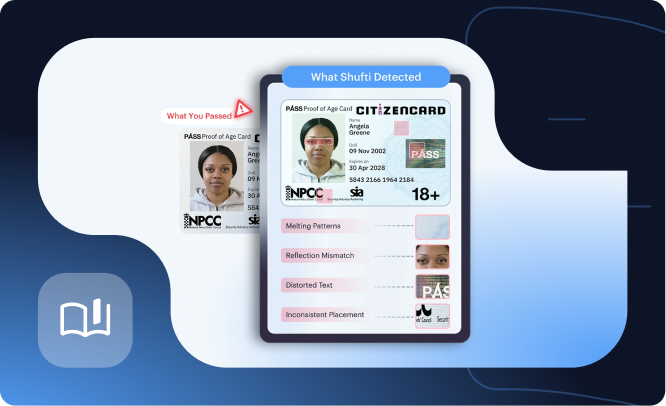
16 August, 2025
5 minutes read
How Much of What You’ve Verified Is Actually Real?
Shufti’s Deepfake Blindspot Audit now runs fully inside your AWS environment, auditing historic KYC for manipulation signals without moving sensitive data off-prem.
whitepapers