


 Face Verification
 Address Verification
 Document Verification
 Age Verification
 VideoIdent
 Fast ID
 Docless Verification
 Consent Verification
 NFC Verification
 Business Verification
 Due Diligence
 Investor Verification
 E-Signature

 QES
QES
 AML Screening
 Transaction Monitoring
 Adverse Media
 Business AML Screening
 PEP & RCA
 Sanctions
 Watchlist
 Behavioural Biometrics
 Device Fingerprinting
 Biometric Face Authentication
 MFA
MFA
 Fraud Hub
 Onboarding
 Ongoing Monitoring
 KYC
KYC
 KYB
KYB
 KYI
KYI
 Age Assurance
 Identity Verification
 Workforce IAM
 Candidate Verification
 Compliance
 Fraud prevention
 Trust & safety
 Global expansion
 Product Managers
 Compliance Officers
 Fraud Analysts
 Developers
 Deepfake Detection
 Bonus Abuse / Promotion Abuse
 Account Takeover
 Synthetic Identity Fraud
 Document Fraud
 Impersonation Fraud
 Multi-Accounting
 Fraud Networks
 Chargeback Fraud
 Money Mule Activity
 Party Fraud
 Regulatory & Compliance Risks
 Fintech
 Crypto
 iGaming
 Forex
Forex
 Social Network
 Marketplace
 Banking
 Gig Economy
 Payments
 Ride Hailing
 Adult Content
 Blind Spot Audit
 Deepfake Detector
 Liveness Spoofs
 Document Originality
 Document Deepfake
 Global Trust Platform
 Journey Builder
 Case Management
 Shufti AI
 Fraud Analytics
 Vendor Comparison
 Brand Personalisation
 AI Compliance Co-Pilot
 OCR
OCR
 Secure Capture
 Deployment Options
 Identity Methods
 API Documentation
 Mobile SDKs
 Service Status
 Help Center
 Contact Us
 Technical Support
 Supported Documents
 Supported Countries
 Content library
 Blogs
Blogs
 News
News
 Reports
 Insights
 Knowledgebase
 ROI calculator
 About
About
 Career
 Press Release
 Certifications
 Partnership
 Awards
 Events & Webinar
 Interactive Demo
 Podcast Studio
 Spotlight Studio
- Australia
- Austria
- Bangladesh
- Brazil
- Bulgaria
- Canada
- China
- Cyprus
- Egypt
- Estonia
- Ethiopia
- France
- Germany
- Greece
- Haiti
- Hong Kong
- India
- Iraq
- Ireland
- Indonesia
- Italy
- Japan
- Jordan
- Kazakhstan
- Kenya
- Kosovo
- Kuwait
- Latvia
- Luxembourg
- Malaysia
- Malta
- Mauritius
- Mexico
- Micronesia
- Moldova
- Montenegro
- Morocco
- Mozambique
- Myanmar
- Namibia
- Nauru
- Nepal
- Nigeria
- Nicaragua
- Niue
- Norway
- Netherlands
- New Zealand
- Oman
- Pakistan
- Palau
- Palestine
- Panama
- Papua New Guinea
- Paraguay
- Peru
- Puerto Rico
- Philippines
- Portugal
- Portugal
- Qatar
- Republic of Congo
- Romania
- Russia
- Rwanda
- Samoa
- San Marino
- Senegal
- Serbia
- Seychelles
- Sierra Leone
- Singapore
- Slovakia
- Slovenia
- Somalia
- South Africa
- South Korea
- South Sudan
- Sri Lanka
- St Kitts and Nevis
- St Lucia
- Sweden
- Switzerland
- Taiwan
- Tanzania
- Thailand
- Turkey
- UK
- USA
- Vietnam
Senegal
Identity Verification & KYC For Senegal
Shufti delivers KYC, KYB, and AML compliance for Senegal, aligned to BCEAO regulations, CENTIF reporting obligations, and Law No. 2018-03 customer due diligence requirements.
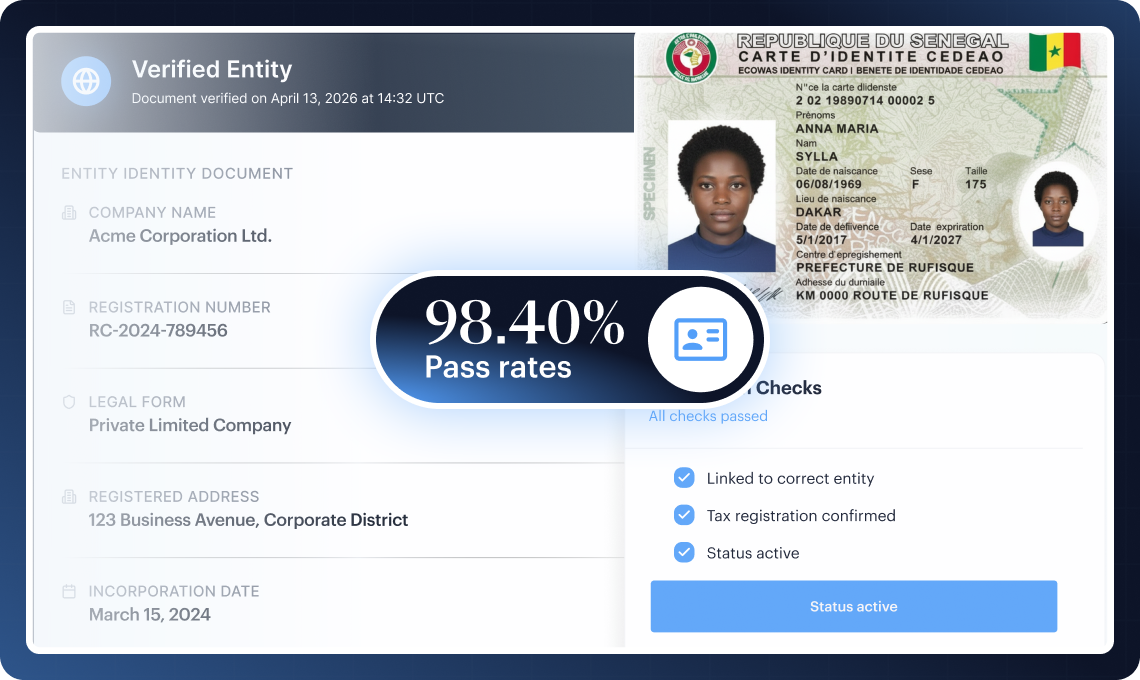
Operational performance for Senegal KYC
Our Numbers Speak Volumes
98.40%
Pass Rates
<5 sec
Verification
Time
300 Million
Companies Data
Evidence-Ready Checks Across People & Businesses in Senegal
Individual Documents We Verify
Shufti supports 7 Senegalese document types.
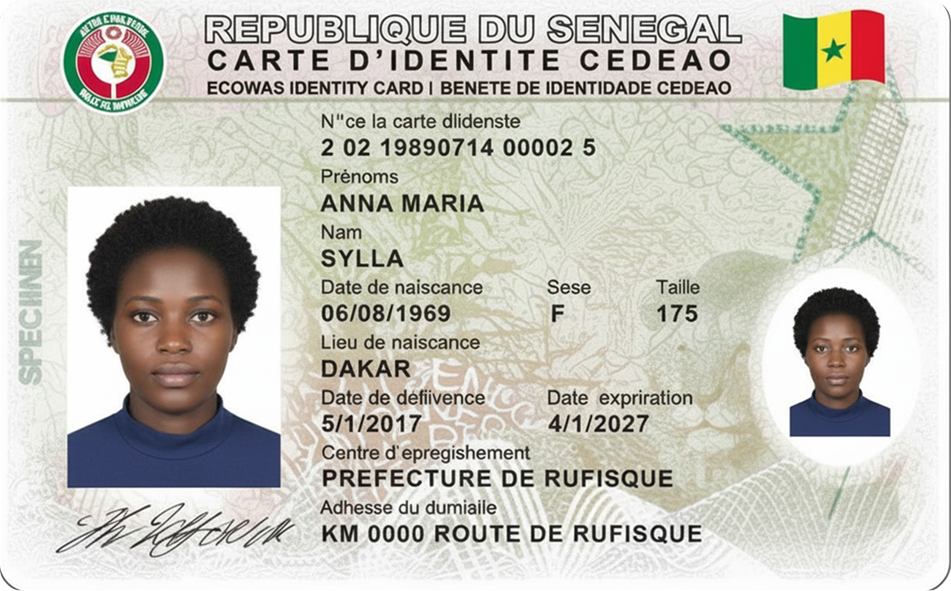
View All Supported DocumentsCarte nationale d'Identité (National ID Card)
A biometric ECOWAS-compliant eID is required for all Senegalese citizens aged 15 and above. Valid for 10 years; primary identity verification document in Senegal.
Passeport Ordinaire Sénégalais (Ordinary Senegalese Passport)
ICAO-compliant passport issued by DPETV. Accepted for cross-border travel and international KYC verification; contains integrated biometric data features.
Permis de Conduire (Driver's Licence)
Government-issued driving licence featuring QR codes, issued by ANASER. Commonly used for secondary identity verification and address confirmation in Senegal.
Cartes d'Électeur (Voter ID Card)
Secondary identity document issued by electoral authorities. Used when primary documents are unavailable or during voter registration verification processes.
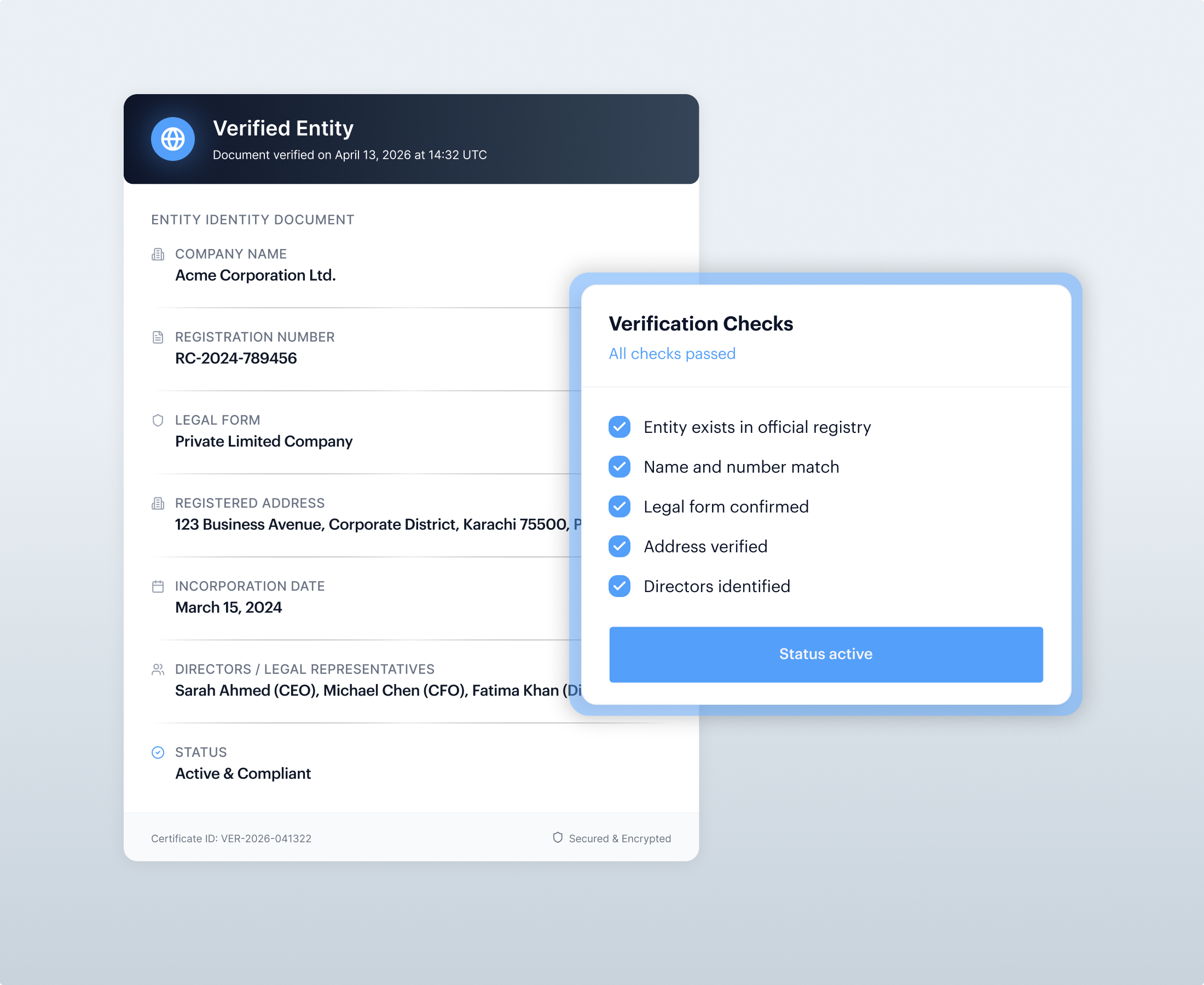
Business Entity Identity
NINEA (Numéro d'Identification National des Entreprises et des Associations)
National business registration identifier issued by DGID; mandatory for all enterprises and non-profit organisations.
RCCM (Registre du Commerce et du Crédit Mobilier)
Commercial register entry proving legal entity status and commercial registration with national authorities.
Statuts (Articles of Association)
Corporate governance document filing articles of association and ownership structure at the commercial registry.
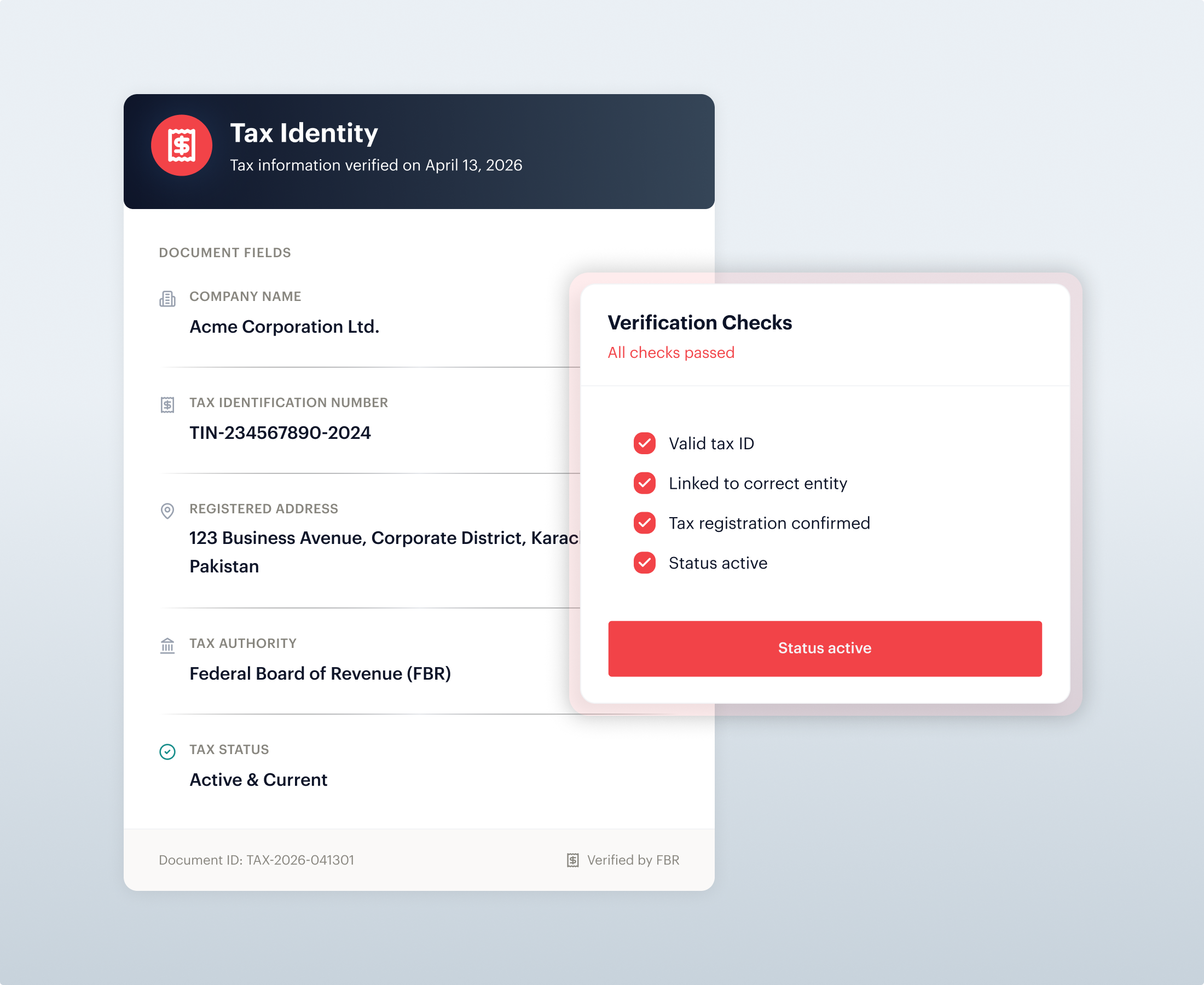
Business Tax Identity
NINEA / Tax Identification
Tax identification number issued by DGID; used to verify ongoing tax compliance and business status.
Quitus Fiscal (Tax Clearance Certificate)
Tax authority certificate confirming business tax obligations have been met; required for business licence renewal and government contracts.
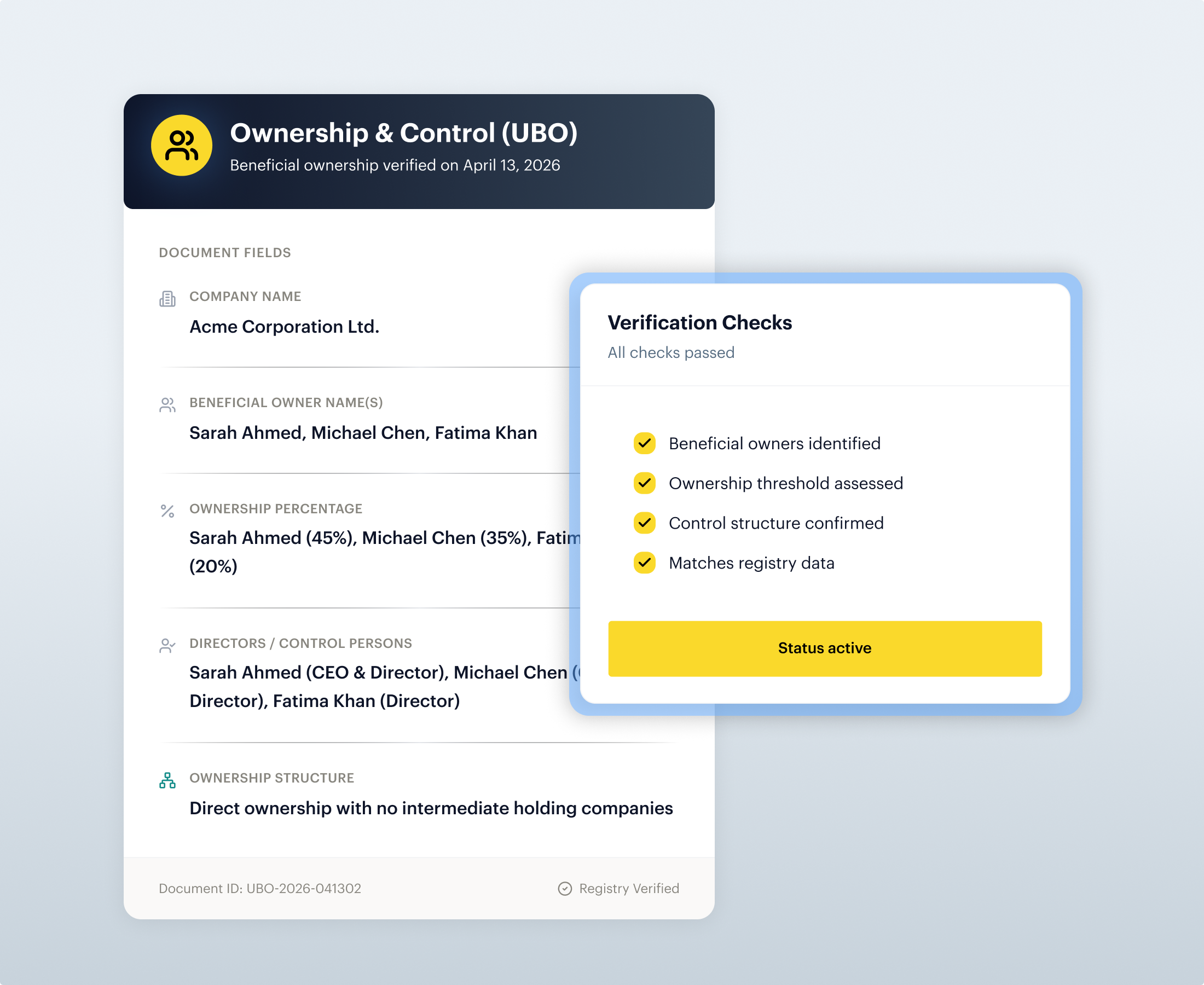
Ownership & Control (UBO)
Beneficial Ownership Declaration (RCCM Filing)
Disclosure of ultimate beneficial owners meeting the 25% beneficial ownership threshold; filed at the commercial registry.
Shareholder Register / Registre des Actionnaires
Internal record of shareholdings and ownership percentages; required for business verification and KYB processes.
Languages We Cover
French-Only Document Handling
All Senegalese government documents are issued in French. Shufti processes French text extraction, name matching, and verification without transliteration.
Name Matching Across French Naming Conventions
Senegalese naming conventions include compound first and family names. Shufti handles matching logic, accounting for name variations and hyphenated surnames.
Evidence Consistency Across KYC/KYB Steps
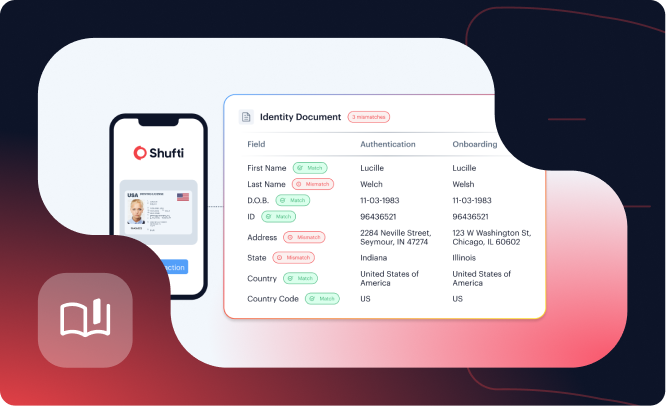
Automated consistency checks ensure matching names, dates of birth, and company information throughout onboarding and verification journeys across documents.
GOVERNANCE & CONTROLS
Audit-Ready Decisions, Lower Operational Drag
Fewer Avoidable Re-Submissions
Senegalese document capture improves when workflows anticipate biometric ID light reflection and QR-code readability challenges in verification processes.
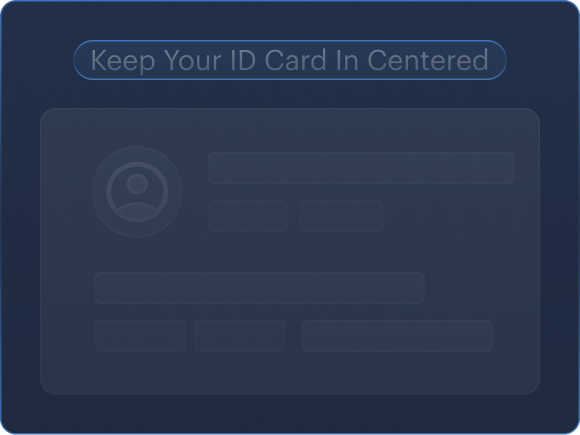
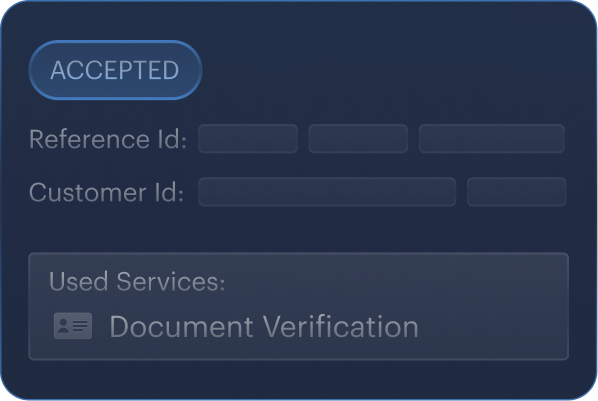
Cleaner Audit Trails
Decision logs comply with CENTIF reporting expectations and BCEAO audit requirements, providing timestamped evidence of due diligence application.
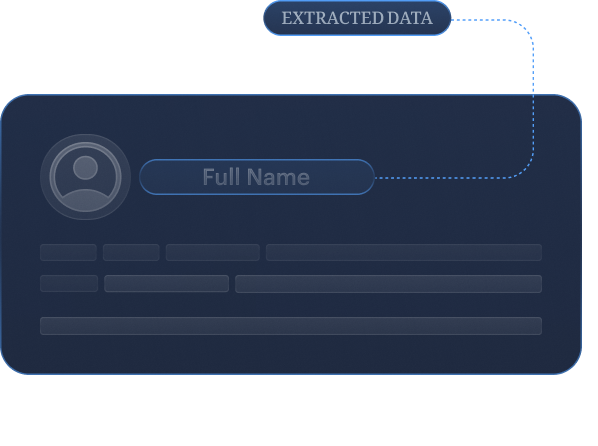
Better Name Matching Outcomes
Shufti handles French naming conventions and compound surnames, reducing false rejections from legitimate customers with hyphenated or multi-part names.
One Workflow, One Back Office
Consolidate KYC, KYB, and AML screening into a single verification view. Eliminate document context switching and streamline evidence collation.

National ID-First Flow Design
National ID is the primary identity document for Senegalese citizens. Shufti prioritises national ID capture to minimise friction and maximise completion rates.
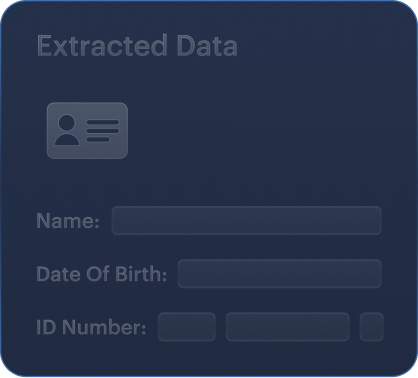
Senegal IDV/KYC Challenges

Informal Economy Cash Tracing
Senegal's informal economy represents 47.5% of GDP and WAEMU cash-intensive trade, making beneficial ownership tracing difficult for compliant businesses.

Digital Identity Gaps
Limited digital identity infrastructure and government database access require manual verification. Shufti applies biometric matching and multi-document checks.

Fraud and Synthetic IDs
Document tampering, forged identities, and account takeover schemes occur across Senegalese digital finance. Shufti flags suspicious biometric features.

Multi-Framework Compliance
Law No. 2018-03, Law No. 02/2024, and BCEAO instructions create overlapping compliance requirements. Shufti integrates workflows to satisfy all obligations.
Shufti's IDV/KYC Solutions for Senegal
KYC Solutions

Face Verification
Liveness detection and facial biometrics deter spoofing and synthetic identity attacks. Verify genuine customer presence during the Senegal onboarding processes.
.
Age Verification
Selfie-based age estimation combined with document verification confirms customer age for regulated activities. Manual review when the biometric confidence is insufficient.
.
Address Verification
Verify Senegalese residency through Senelec utility bills, CBAO, Ecobank, or UBA statements. Shufti can verify any address-bearing document issued locally.
.
Document Verification
Automated verification of French-language Senegalese documents, including National ID cards with biometric features and QR-code validation and ECOWAS markers.
.KYB Solutions

Business Verification
Verify business entities using NINEA registration, RCCM commercial register, and DGID tax ID. Confirm company status and regulatory standing.
.
Enhanced Due Diligence (EDD)
Step-up screening for PEPs, high-risk sectors (extractive, telecommunications), and WAEMU-flagged jurisdictions. Shufti screens against sanction lists.
.AML Screening

Business AML Screening
Screen business entities and principals against UN Security Council lists, OFAC SDN list, EU sanctions list, and Senegal-specific CENTIF regulatory watchlists.
.
Transaction Screening
Monitor customer activity for suspicious patterns, high-value transfers, and cross-border WAEMU flows. Flag CENTIF reporting triggers and comply with deadlines.
.Built to Fit Senegal's Compliance Landscape

Banque Centrale des États de l'Afrique de l'Ouest (BCEAO)
BCEAO sets AML/KYC standards across WAEMU, including Senegal. Shufti embeds BCEAO KYC directives and documentation standards to ensure central bank compliance. Official Website: https://www.bceao.int/en/content/presentation-bceao

Commission Bancaire de l'UMOA (WAEMU Banking Commission)
Banking Commission supervises banks, microfinance institutions, and e-money issuers. Shufti delivers real-time verification meeting prudential standards. Official Website: https://cb-umoa.org/index.php/en/composition

Cellule Nationale de Traitement des Informations Financières (CENTIF)
CENTIF receives Suspicious Transaction Reports within 48 hours and maintains Senegal's AML watchlists. Shufti automates CENTIF-compliant STR reporting. Official Website: https://www.finances.gouv.sn/ministere/cabinet/cellule-nationale-de-traitement-des-informations-financieres-centif/

Commission de protection des données personnelles (CDP)
CDP enforces Law No. 2008-12 on data protection and regulates personal data processing. Shufti implements data minimisation and encryption aligned to CDP. Official Website: https://www.cdp.sn/

Direction de la Police des Étrangers et des Titres de Voyage (DPETV)
DPETV issues passports and travel documents for Senegalese citizens and foreign nationals. Shufti verifies DPETV-issued documents using biometric validation. Official Website: https://www.policenationale.gouv.sn/direction-de-la-police-des-etrangers-et-des-titres-de-voyages-dpetv/

Commission Régionale de Contrôle des Assurances (CRCA)
CRCA regulates insurers and intermediaries across the CIMA zone in Senegal. Shufti supports onboarding and beneficiary verification for insurance entities. Official Website: https://cima-afrique.org/crca-statuts-3/?lang=en
Deployment Choice
Cloud providers lack dedicated regions in Senegal; the nearest AWS and GCP regions are in South Africa. On-premise deployment addresses data residency needs.
Regulatory Alignment
Law No. 2008-12 and BCEAO Instruction No. 121-07-08 establish data protection standards for financial services. CDP enforces personal data processing controls.
Retention Controls
AML and KYC records are retained for five years per Law No. 2018-03 and WAEMU alignment. General commercial records are retained for ten years per the Commercial Code.
Encryption Posture
Personal and financial data are encrypted in transit and at rest using AES-256 encryption and TLS 1.2 or higher, aligned with international security standards.
Data and Privacy Controls in Senegal
Senegal AML Sources That Strengthen Decision

National Assembly of Senegal

Ministry of Economy and Finance, Senegal - Consolidated List

Ndarinfo

Senegal7

Le Quotidien

Seneweb
Frequently Asked Questions
What are the KYC requirements for customer onboarding in Senegal?
Senegal requires businesses to collect, verify, and retain customer identity information, including name, date of birth, nationality, and residential address, per Law No. 2018-03 and BCEAO standards. Enhanced due diligence is required for PEPs, high-risk jurisdictions, and beneficial owners in extractive sectors.
Which identity documents are accepted for KYC verification in Senegal?
The Carte Nationale d'Identité (National ID Card), Passeport Ordinaire Sénégalais (passport), Permis de Conduire (driver's licence), and Cartes d'Électeur (voter card) are accepted for identity verification in Senegal. The National ID is the primary document for Senegalese citizens aged 15 and above.
What is the role of CENTIF in Senegal's AML compliance?
CENTIF (Cellule Nationale de Traitement des Informations Financières) is Senegal's financial intelligence unit responsible for receiving Suspicious Transaction Reports filed within 48 hours. CENTIF maintains consolidated watchlists and coordinates with international FIUs on money laundering and terrorist financing investigations.
What are the BCEAO regulations for KYC and AML in Senegal?
The BCEAO (Banque Centrale des États de l'Afrique de l'Ouest) sets harmonised KYC and AML standards across WAEMU member states, including Senegal. BCEAO directives require customer identification, beneficial ownership disclosure, transaction monitoring, and STR reporting aligned with FATF recommendations.
What is NINEA, and why is it required for business KYC in Senegal?
NINEA (Numéro d'Identification National des Entreprises et des Associations) is the national business registration identifier issued by DGID. NINEA is mandatory for all Senegalese enterprises and non-profit organisations; it serves as the primary business identifier for tax, regulatory, and KYB verification.
What are the beneficial ownership disclosure requirements in Senegal?
Senegalese law requires disclosure of ultimate beneficial owners meeting the 25% beneficial ownership threshold, or 2% for extractive sector entities. Beneficial ownership information is filed at the commercial registry (RCCM); the ECOWAS register deadline is January 2027.
How do fintechs comply with KYC and AML regulations in Senegal?
Law No. 02/2024 (effective 2 February 2024) expanded KYC and AML obligations to include fintechs, payment service providers, and virtual asset service providers. Fintechs must implement customer verification, transaction monitoring, and STR reporting aligned with CENTIF and BCEAO standards.
What is enhanced due diligence (EDD), and when is it required in Senegal?
Enhanced due diligence is a step-up verification process applied to high-risk customers, including PEPs, individuals from high-risk jurisdictions, and beneficial owners in extractive sectors. EDD requires additional screening against sanction lists, adverse media, and ongoing transaction monitoring.
Build a Senegal-ready KYC, KYB & AML programme with Shufti
INDEPENDENTLY AUDITED. GLOBALLY CERTIFIED.
Certified to Global Standards





PROVEN WORKFLOWS
Use Cases for Regulated Growth in Senegal
Reduce Fraud Without Blocking Growth
Shufti supports marketplace integrity by verifying seller and buyer identities, enabling age-gated journeys where needed, and preserving evidence to support investigations, disputes, and risk-led enforcement actions.




Secure Trust at Every Transaction
Automate KYC and AML workflows to reduce manual onboarding costs. Strengthen residency checks while delivering the frictionless digital experience modern customers expect.

Scale Your Exchange with Confidence
Balance anonymity with compliance. Instantly verify user jurisdiction to meet Travel Rule obligations and help stop abuse without slowing down legitimate trading volume.



Accelerate Growth, Eliminate Friction
Onboard users in seconds, not days. Deploy tiered address verification flows that maximise completion rates for genuine users while filtering out synthetic fraud.


Onboard Global Traders in Real-Time
Verify investors across 250+ countries & territories. Ensure compliance with international financial regulations while preventing identity theft and high-risk chargebacks.


Power a Fair & Secure Player Experience
Reduce bonus abuse and multi-accounting rings at the door. Enforce location rules and trigger step-up checks without disrupting the player journey.



Build a Trusted, Verified Workforce
Screen freelancers and drivers at scale. Verify residency and reduce onboarding friction while maintaining trust between users.


Reduce Fraud Without Blocking Growth
Shufti supports marketplace integrity by verifying seller and buyer identities, enabling age-gated journeys where needed, and preserving evidence to support investigations, disputes, and risk-led enforcement actions.
Secure Trust at Every Transaction
Automate KYC and AML workflows to reduce manual onboarding costs. Strengthen residency checks while delivering the frictionless digital experience modern customers expect.
Scale Your Exchange with Confidence
Balance anonymity with compliance. Instantly verify user jurisdiction to meet Travel Rule obligations and help stop abuse without slowing down legitimate trading volume.
Accelerate Growth, Eliminate Friction
Onboard users in seconds, not days. Deploy tiered address verification flows that maximise completion rates for genuine users while filtering out synthetic fraud.
Onboard Global Traders in Real-Time
Verify investors across 250+ countries & territories. Ensure compliance with international financial regulations while preventing identity theft and high-risk chargebacks.
Power a Fair & Secure Player Experience
Reduce bonus abuse and multi-accounting rings at the door. Enforce location rules and trigger step-up checks without disrupting the player journey.
Build a Trusted, Verified Workforce
Screen freelancers and drivers at scale. Verify residency and reduce onboarding friction while maintaining trust between users.
Reduce Fraud Without Blocking Growth
Shufti supports marketplace integrity by verifying seller and buyer identities, enabling age-gated journeys where needed, and preserving evidence to support investigations, disputes, and risk-led enforcement actions.
Secure Trust at Every Transaction
Automate KYC and AML workflows to reduce manual onboarding costs. Strengthen residency checks while delivering the frictionless digital experience modern customers expect.
Scale Your Exchange with Confidence
Balance anonymity with compliance. Instantly verify user jurisdiction to meet Travel Rule obligations and help stop abuse without slowing down legitimate trading volume.
Accelerate Growth, Eliminate Friction
Onboard users in seconds, not days. Deploy tiered address verification flows that maximise completion rates for genuine users while filtering out synthetic fraud.
Onboard Global Traders in Real-Time
Verify investors across 250+ countries & territories. Ensure compliance with international financial regulations while preventing identity theft and high-risk chargebacks.
Power a Fair & Secure Player Experience
Reduce bonus abuse and multi-accounting rings at the door. Enforce location rules and trigger step-up checks without disrupting the player journey.
Build a Trusted, Verified Workforce
Screen freelancers and drivers at scale. Verify residency and reduce onboarding friction while maintaining trust between users.
Let’s Tailor your journey
Just a few quick questions to guide your Shufti experience.

Shufti
Market Positioning and Commercial Assessment

Industry stands at 1.7rating

Best ID Verification Innovator

TOP 10 KYC Solution Provider
Best Client Onboarding Solution

Samer Al Tamimi@CEO of Safwa Bank
We take our client's privacy very seriously and always look for new innovative solutions to ensure a safe banking experience. Working with Shufti feels like a breath of fresh air, as their 100% in-house tech keeps our customer's data free from vulnerabilities and fully safe and protected.

PROVEN PLAYBOOKS
Explore Practical KYC & AML Resources
16 August, 2025
5 minutes read
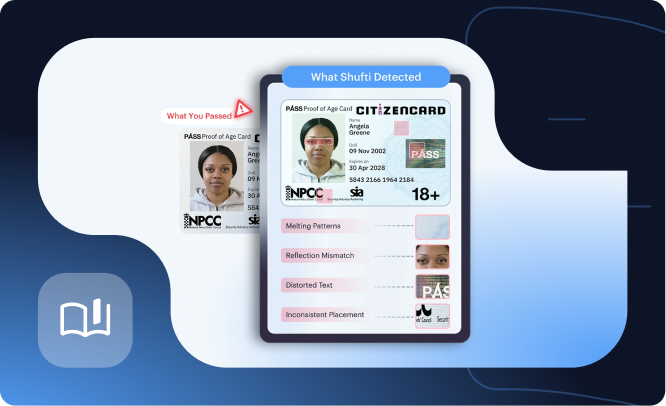
How Much of What You’ve Verified Is Actually Real?
Shufti’s Deepfake Blindspot Audit now runs fully inside your AWS environment, auditing historic KYC for manipulation signals without moving sensitive data off-prem.
whitepapers