








 AMLR Solutions
  AMLR Consultation
 EUDI Wallet
 Onboarding
 Ongoing Monitoring
 FRAML
FRAML KYC
KYC KYB
KYB KYI
KYI Age Assurance
 Workforce IAM
 Candidate Verification
 Account Takeover
 Bonus/ Promotion Abuse
 Chargeback Fraud
 Deepfake
 Document Fraud
 Fraud Networks
 Impersonation Fraud
 Money Mule Activity
 Multi-Accounting
 Party Fraud
 Regulatory & Compliance Risks
 Synthetic Identity Fraud
 Adult Content
 Banking
 Crypto
 Fintech
 Forex
Forex Compliance
 Fraud prevention
 Trust & safety
 Global expansion
 Compliance Officers
 Developers
 Fraud Analysts
 Product Managers
 Journey Builder
  Global Trust Platform
 Customer Profiles
 Vendor Comparison
 IDV Case Management
 AML Case Management
 Regulatory Reporting
 Agentic Rule Builder
  AI Compliance Co-Pilot
  Fraud Analytics
 Fraud Hub
  OCR
OCR Shufti AI
 Bank Account Verification
  Biometric Duplication
 Database Checks
 Document Intelligence
 Government ID
 Mobile Driver's License
 NFC
NFC Selfie Liveness
 Brand Personalisation
 Deployment Options
 Identity Methods
 IDV Modes
 Multi-tenancy
 On-Premise IDV
 Secure Capture
 Shufti MCP


- Algeria
- Angola
- Argentina
- Armenia
- Australia
- Austria
- Azerbaijan
- Bahrain
- Bangladesh
- Belarus
- Belgium
- Bolivia
- Brazil
- Bulgaria
- Cambodia
- Cameroon
- Canada
- Chile
- China
- Colombia
- Costa Rica
- Croatia
- Cyprus
- Czech Republic
- Denmark
- Dominican Republic
- Ecuador
- Egypt
- Estonia
- Eswatini
- Ethiopia
- Finland
- France
- Germany
- Greece
- Haiti
- Hong Kong
- Hungary
- India
- Iraq
- Ireland
- Indonesia
- Italy
- Japan
- Jordan
- Kazakhstan
- Kenya
- Kosovo
- Kuwait
- Latvia
- Lithuania
- Luxembourg
- Malaysia
- Malta
- Mauritius
- Mexico
- Micronesia
- Moldova
- Mongolia
- Montenegro
- Morocco
- Mozambique
- Myanmar
- Namibia
- Nauru
- Nepal
- Nigeria
- Nicaragua
- Niue
- Norway
- Netherlands
- New Zealand
- Oman
- Pakistan
- Palau
- Palestine
- Panama
- Papua New Guinea
- Paraguay
- Peru
- Puerto Rico
- Philippines
- Portugal
- Poland
- Qatar
- Republic of Congo
- Romania
- Russia
- Rwanda
- Samoa
- San Marino
- Saudi Arabia
- Senegal
- Serbia
- Seychelles
- Sierra Leone
- Singapore
- Slovakia
- Slovenia
- Somalia
- South Africa
- South Korea
- South Sudan
- Spain
- Sri Lanka
- St Kitts and Nevis
- St Maarten
- St Lucia
- Sweden
- Switzerland `
- Syria
- Taiwan
- Tajikistan
- Tanzania
- Thailand
- Timor Leste
- Togo
- Tonga
- Trinidad and Tobago
- Turkey
- Turks and Caicos
- Turkmenistan
- Tunisia
- Tuvalu
- UAE
- Uganda
- Ukraine
- UK
- USA
- Vietnam
- Zambia
Tunisia
Identity Verification & KYC For Tunisia
Shufti streamlines CTAF compliance and anti-money laundering requirements with digital KYC and KYB solutions built for Tunisia's regulatory framework and financial institutions.
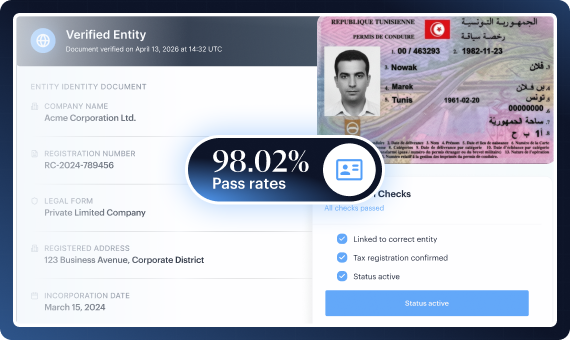
Operational performance for Tunisia KYC
Our Numbers Speak Volumes
98.02%
Pass Rates
<5 sec
Verification Time
100%
Omni-format Document Recognition
Evidence-Ready Checks Across People & Businesses
Individual Documents We Verify
Shufti supports 8 Tunisian document types.
View All Supported DocumentsNational Identity Card (Carte d'Identité nationale — CIN)
Primary identity document for Tunisian citizens aged 18+. Arabic and French bilingual text mandatory for financial identity verification and KYC compliance.
Tunisian Passport
Issued by the Ministry of Foreign Affairs for travel and identity verification. Accepted where stronger assurance is required during cross-border onboarding.
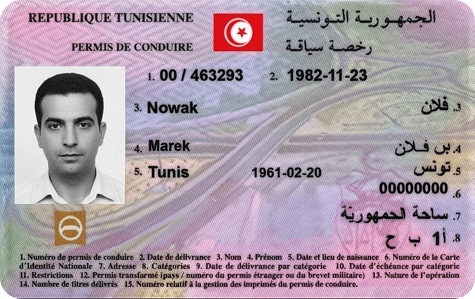
Driver's Licence
Valid secondary document for KYC and address verification. Widely used under Tunisia's transport authority regulations and financial services compliance.
Residence Permit (For Foreign Nationals)
Primary identity document for non-citizens residing in Tunisia. Accepted for KYC verification under financial services and AML compliance regulations.
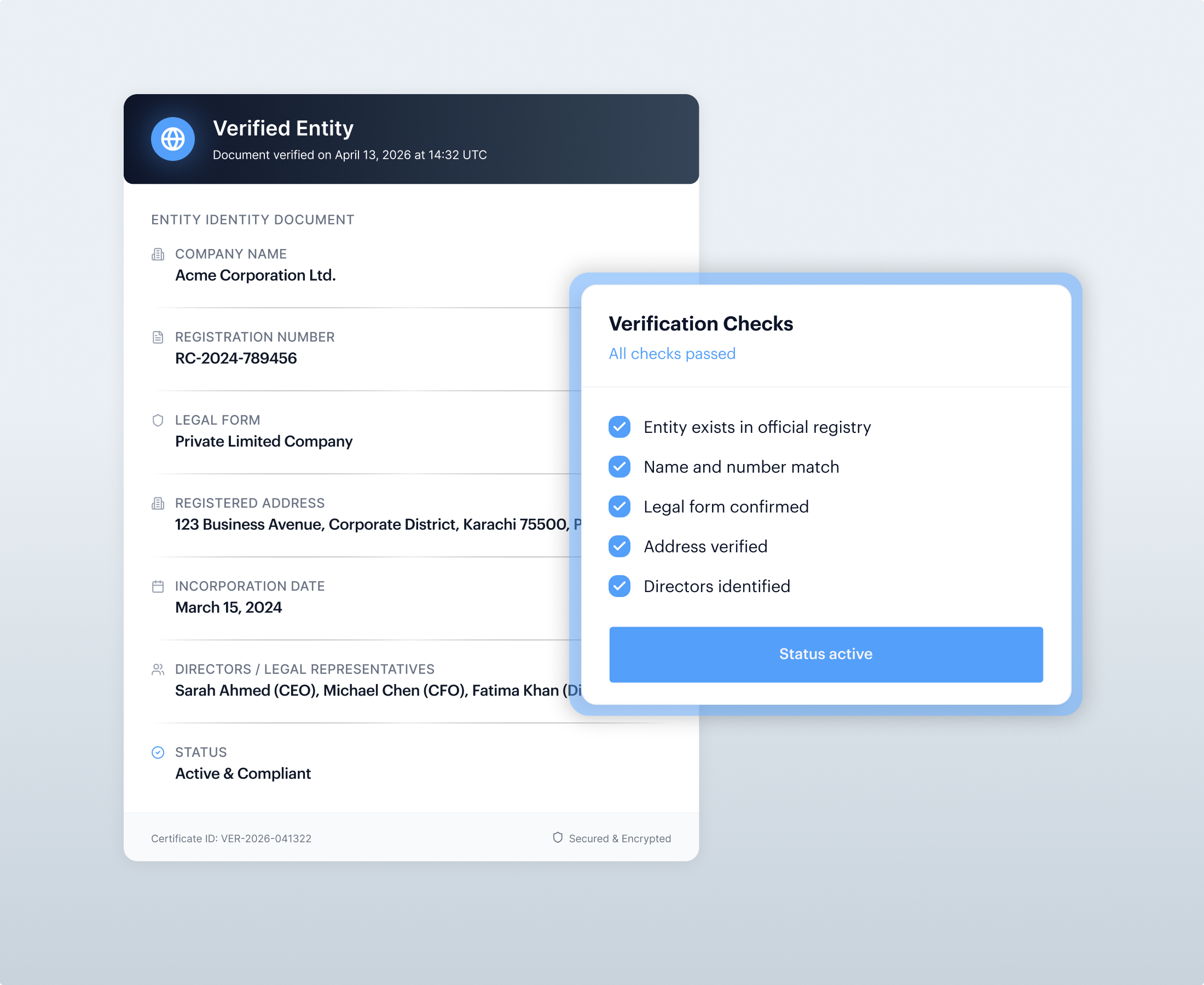
Business Entity Identity
Extrait du Registre de Commerce (Commercial Register Extract)
Confirms legal registration of business entities with the commercial courts. Essential evidence of corporate existence and active trading status under Tunisian business law.
Articles of Association (Statuts de la Société)
Foundational incorporation document outlining corporate structure, shareholder details, and management responsibilities. Notarised and filed with the commercial courts as required by Tunisian law.
Business Tax Identity
Carte d'Identification fiscale (Tax Identification Certificate)
Issued by the Ministry of Finance/Tax Administration. Contains the IF/MF number required for all tax-related transactions and business registration in Tunisia.
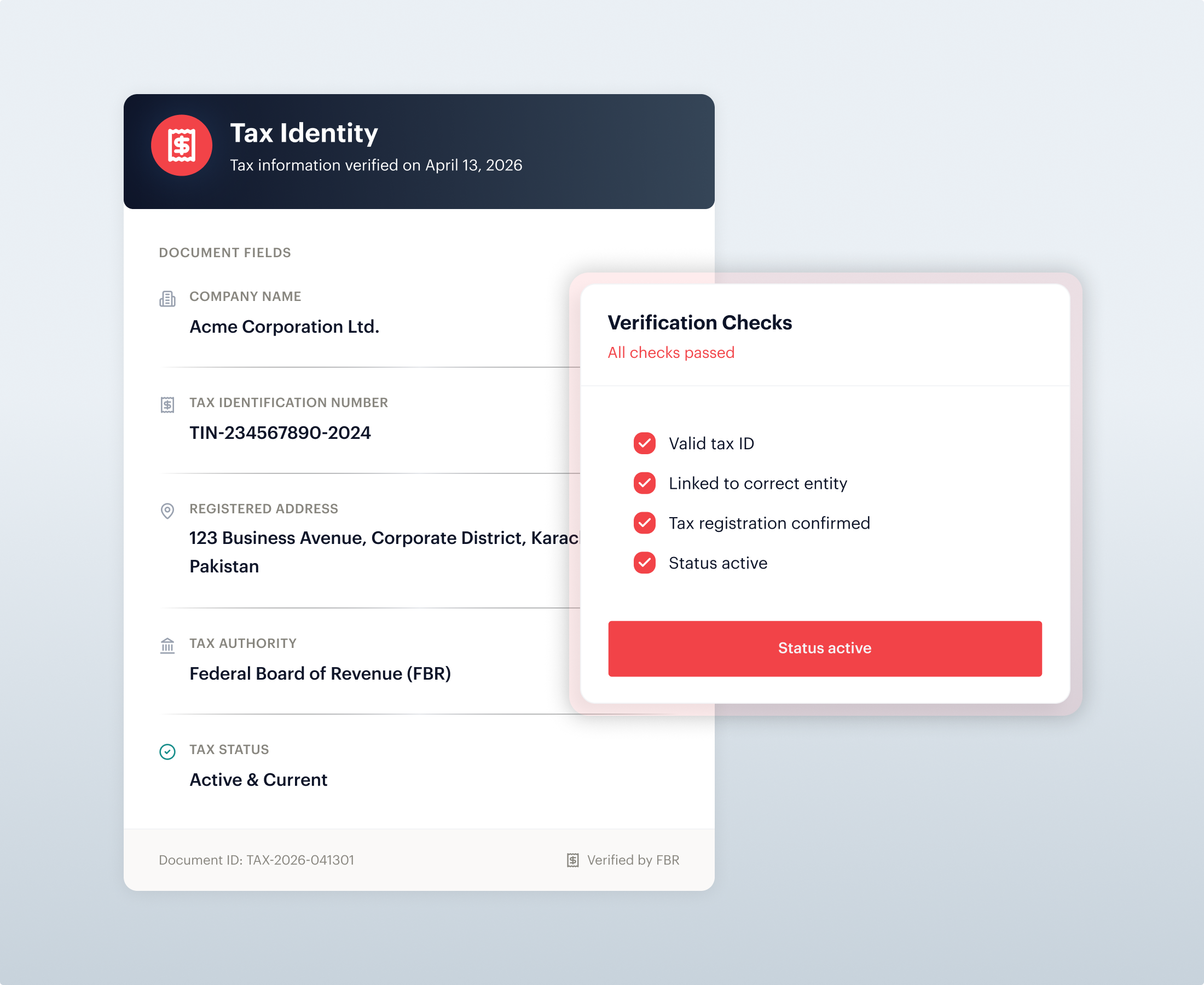
Certificate of Tax Compliance
Confirms active tax compliance status and filing obligations. Required for certain regulated entity onboarding and government-related business interactions.
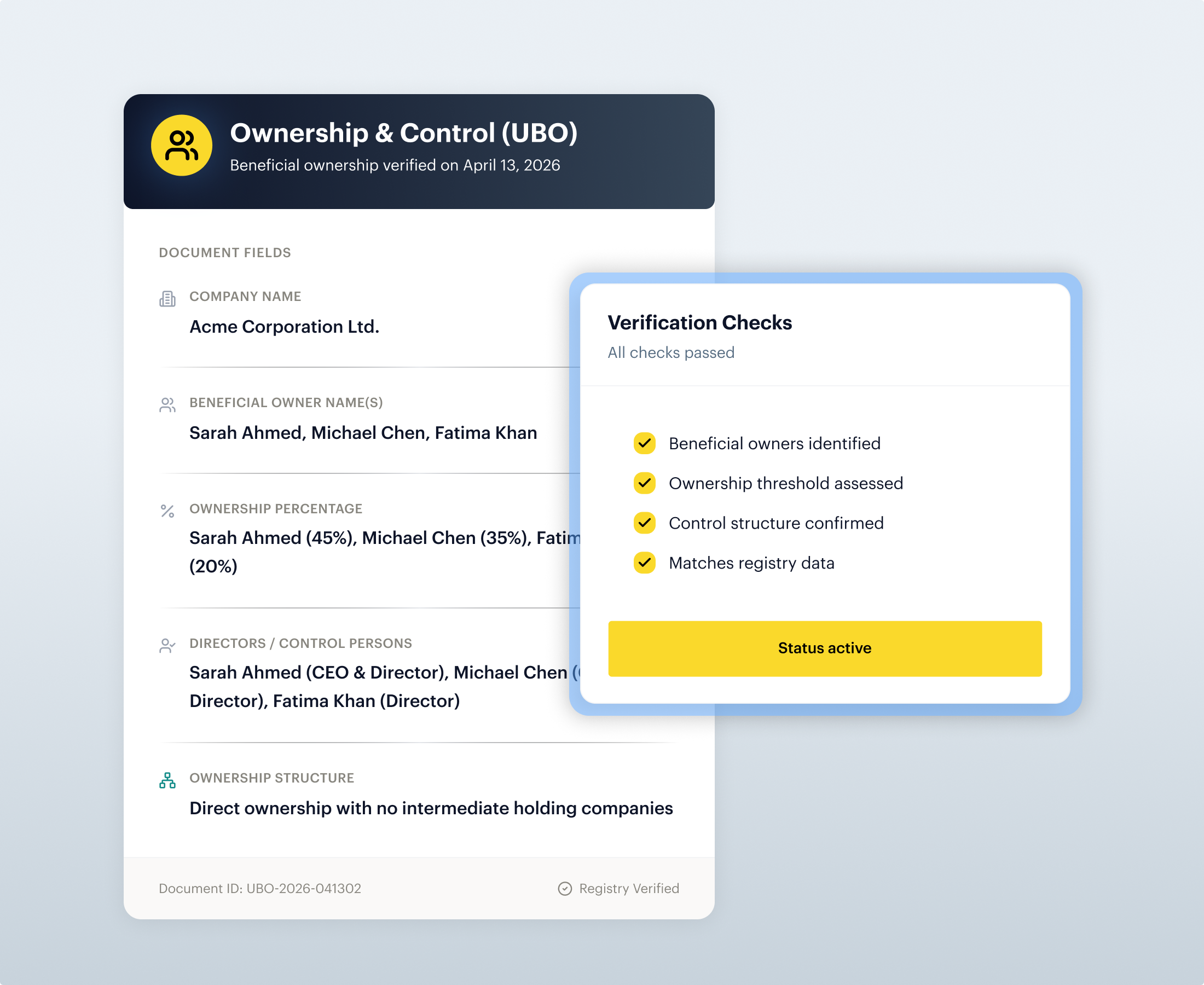
Ownership & Control (UBO)
Commercial Register Extract (RCS) — Shareholder And Management Listings
Maintains records of registered entities, shareholders, and management changes. Provides beneficial ownership transparency consistent with FATF recommendations.
Articles of Association Amendments
Filed with commercial courts when ownership or control structures change. Critical evidence for tracking UBO changes and ownership evolution over time.
Beneficial Ownership Declaration
Formal disclosure of ultimate beneficial owners. Required under Tunisian law and aligned to FATF beneficial ownership transparency reforms, still being operationalised.
Languages We Cover
Arabic-French Bilingual Document Handling
CIN documents contain Arabic (right-to-left) and Latin script. Specialised OCR captures both sections to reduce re-submissions and improve extraction accuracy in identity verification in Tunisia.
Name Matching Across Arabic Script And Latin Transliteration
Handles transliteration variants where Arabic names appear under multiple Latin spellings. Reduces false negatives in sanctions screening and improves KYC matching accuracy.
Evidence Consistency Across KYC And CDD Steps
Identity data reconciliation across document capture, address verification, and AML screening in the case file. Supports audit defensibility and regulatory compliance.
GOVERNANCE & CONTROLS
Audit-Ready Decisions, Lower Operational Drag
Fewer Avoidable Re-Submissions
CIN bilingual capture guidance reduces extraction failures and re-verification requests across Tunisia's primary identity document, improving completion rates.
Cleaner Audit Trails
Structured eKYC and KYB case files retrievable for CTAF and BCT examinations with decision reason codes aligned to Organic Law 2015-26 requirements.
Better Name Matching Outcomes
Handles Arabic-Latin transliteration variants and reduces false positives in sanctions and PEP screening across multiple name representations.
One Workflow, One Back Office
eKYC, KYB, and anti-money laundering screening consolidated in one system for fintech compliance, reducing manual handoffs and evidence loss between teams.

CIN-First Flow Design
Tailored CIN capture and extraction for Tunisia's primary identity document, enabling evidence-led and repeatable compliance decisions.
Tunisia IDV/KYC Challenges

Bilingual Document Capture
CIN extraction requires handling Arabic and French text. Glare and script-switching challenge standard OCR and increase manual review without proper technology.

Informal Economy Opacity
60% of transactions occur in cash; the informal sector represents 30% of GDP. This limits transaction traceability and complicates ongoing AML monitoring under the law.

Opaque Corporate Structures
SME ownership structures remain unclear. Limited public access to beneficial owner information complicates Know Your Business due diligence.

Document Fraud Prevalence
CIN counterfeiting, identity tampering, and synthetic fraud are prevalent. Advanced biometric verification is essential to block repeated fraud attempts.
Shufti’s IDV/KYC Solutions for Tunisia
KYC Solutions

Face Verification
Prevents CIN misuse through biometric verification, strengthening eKYC evidence across Tunisia's financial institutions, banks, and fintech platforms.
.
Age Verification
Selfie-based age estimation with document fallback. Supports financial services, gaming, and alcohol products while keeping user onboarding frictionless.
.
Address Verification
Verifies bills from SONEDE, STEG, Ooredoo, Tunisie Telecom, and statements from BIAT, Attijari Bank for identity verification and residency validation.
.
Document Verification
Supports bilingual CIN, passports, licenses, and residence permits with MRZ extraction for eKYC Tunisia. Improves fraud detection through structured data fields.
.KYB Solutions

Business Verification
Validates entity status through the commercial register (RCS) and IF/MF identification numbers. Supports fintech KYC Tunisia through beneficial ownership screening.
.
Enhanced Due Diligence (EDD)
Escalation workflows for high-risk entities, politically exposed persons (PEPs), and cross-border exposure. Produces audit trails aligned to standards.
.AML Screening

Business AML Screening
Screens entities and controllers against CTAF lists, UN sanctions, and PEP datasets. Documents match decisions for audit review and regulatory submissions.
.
Transaction Monitoring
Ongoing monitoring aligned to Organic Law 2015-26 and CTAF escalation. Detects structuring patterns and high-risk counterparty flows under AML compliance.
.Built to Fit Tunisia's Compliance Landscape

Central Bank of Tunisia (BCT)
Regulates banking and payment institutions. Shufti supports BCT-aligned onboarding by evidencing customer due diligence and producing reviewable audit trails.

Commission Tunisienne des Analyses Financières (CTAF)
Tunisia's FIU was established by Organic Law 2015-26 for anti-money laundering in Tunisia. Shufti preserves evidence supporting suspicious transaction reports to CTAF.

Conseil du Marché Financier (CMF)
Financial market regulator supervising securities issuance and brokers; an IOSCO member. Shufti operationalises CMF governance through KYB evidence structuring.

Instance nationale de protection des données personnelles (INPDP)
Data protection authority enforcing Organic Law 2004-63 and processing standards. Shufti aligns through encryption, access controls, and retention governance.

Comité Général des Assurances (CGA)
Regulates insurance and reinsurance companies. Shufti supports insurance compliance through structured KYC workflows aligned to regulatory requirements.

Instance Nationale des Télécommunications (INTT)
The telecommunications regulator grants operating licences and enforces service quality. Shufti supports telecom provider biometric onboarding requirements.
Deployment Choice
Cloud deployment via the North Africa region or on-premises is available. No major cloud providers operate confirmed in-country data centres in Tunisia currently.
Regulatory Alignment
Aligned to Organic Law 2004-63 on personal data protection and Organic Law 2015-26 recordkeeping obligations enforced by INPDP and the Central Bank of Tunisia.
Retention Controls
Configurable retention settings aligned to Organic Law 2015-26, minimum 10-year recordkeeping obligation for AML and KYC records post-relationship termination.
Encryption Posture
Strong encryption applied to personal and financial data in transit and at rest, consistent with Organic Law 2004-63 and draft 2025 reforms alignment.
Data Controls & Privacy for Tunisia
Tunisia AML Sources That Strengthen Decision

House of Representatives of Tunisia

Tunisia Stock Exchange

Tunisian General Labour Union (UGTT)

Tunis Governorate
National Commission for the Fight Against Terrorism, Tunisia — National Sanction List

Tunisia Numerique

La Presse

Business News Tunisia
House of Representatives of Tunisia
Tunisia Stock Exchange
Tunisian General Labour Union (UGTT)
Tunis Governorate
National Commission for the Fight Against Terrorism, Tunisia — National Sanction List
Tunisia Numerique
La Presse
Business News Tunisia
House of Representatives of Tunisia
Tunisia Stock Exchange
Tunisian General Labour Union (UGTT)
Tunis Governorate
National Commission for the Fight Against Terrorism, Tunisia — National Sanction List
Tunisia Numerique
La Presse
Business News Tunisia
Frequently Asked Questions
What is CTAF, and what are the AML reporting requirements in Tunisia?
CTAF is Tunisia's Financial Intelligence Unit established by Organic Law 2015-26. Banks, money exchanges, notaries, lawyers, and accountants must report suspicious transactions to CTAF within 10 days. CTAF is a member of the Egmont Group and shares intelligence with international FIUs.
What is Organic Law 2015-26, and how does it affect KYC compliance in Tunisia?
Organic Law 2015-26 combats terrorism and money laundering. It mandates customer due diligence (CDD), enhanced due diligence (EDD) for high-risk customers, beneficial ownership identification, and 10-year minimum retention of KYC and transaction records post-relationship.
What is the primary identity document used for KYC verification in Tunisia?
The Carte d'Identité Nationale (CIN) is the primary identity document for KYC verification, issued by the Ministry of Interior to citizens aged 18+. It is mandatory and contains both Arabic and French text, requiring specialised OCR technology for reliable extraction.
How are business entities verified in Tunisia under KYB requirements?
Business entities are verified through the commercial register (RCS), which maintains records of registered entities, shareholders, and management. The IF/MF tax identification number is required for tax identity. Beneficial ownership identification is guided by FATF recommendations.
What is the data retention obligation for AML and KYC records in Tunisia?
Financial institutions regulated under Organic Law 2015-26 must retain customer due diligence records and transaction documentation for a minimum of 10 years following the end of the customer relationship. The Central Bank of Tunisia (BCT) enforces this obligation.
What AML screening requirements apply to financial institutions in Tunisia?
Financial institutions must perform customer due diligence (CDD) at onboarding and enhanced due diligence (EDD) for high-risk customers. Screening includes CTAF lists, international sanctions lists (including OFAC), PEP datasets, and domestic watchlists with ongoing transaction monitoring required.
How does name matching work for Arabic-French bilingual documents in Tunisia?
The CIN contains Arabic (right-to-left script) and Latin script (left-to-right) text. Name matching must account for transliteration variants where the same Arabic name appears under multiple Latin spellings. Specialised OCR and transliteration-aware matching rules reduce false negatives and improve KYC accuracy.
What is eKYC Tunisia, and how does it support fintech compliance?
eKYC Tunisia refers to digital identity verification and Know Your Customer conducted electronically. Shufti's solution enables fintech platforms and banks to verify identity and conduct KYC through digital documents and biometric verification, reducing onboarding time while meeting Organic Law 2015-26 compliance.
Build a Tunisia-ready KYC, KYB & AML programme with Shufti
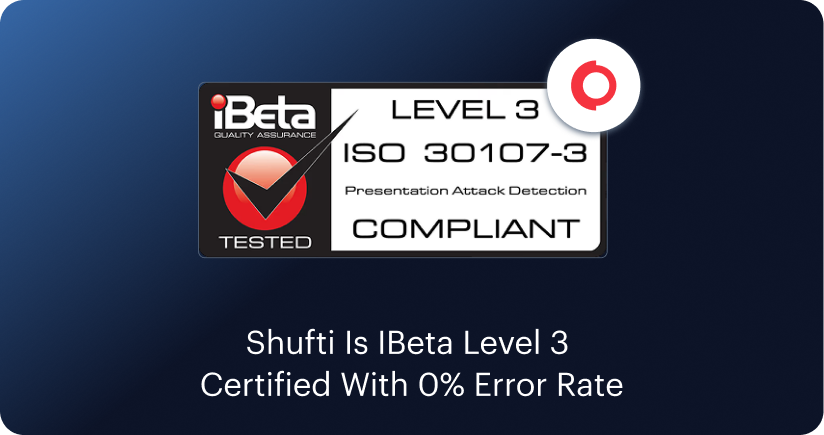
INDEPENDENTLY AUDITED. GLOBALLY CERTIFIED.
Certified to Global Standards






PROVEN WORKFLOWS
Use Cases for Regulated Growth in Tunisia
Accelerate Growth, Eliminate Friction
Onboard users in seconds, not days. Deploy tiered address verification flows that maximise completion rates for genuine users while filtering out synthetic fraud.


Onboard Global Traders in Real-Time
Verify investors across 240+ countries & territories. Ensure compliance with international financial regulations while preventing identity theft and high-risk chargebacks.



Secure Trust at Every Transaction
Automate KYC and AML workflows to reduce manual onboarding costs. Strengthen residency checks while delivering the frictionless digital experience modern customers expect.

Power a Fair & Secure Player Experience
Reduce bonus abuse and multi-accounting rings at the door. Enforce location rules and trigger step-up checks without disrupting the player journey.



Build a Trusted, Verified Workforce
Screen freelancers and drivers at scale. Verify residency and reduce onboarding friction while maintaining trust between users.



Scale Your Exchange with Confidence
Balance anonymity with compliance. Instantly verify user jurisdiction to meet Travel Rule obligations and help stop abuse without slowing down legitimate trading volume.



Reduce fraud without blocking growth
Shufti supports marketplace integrity by verifying seller and buyer identities, enabling age-gated journeys where needed, and preserving evidence to support investigations, disputes and risk-led enforcement actions.




Accelerate Growth, Eliminate Friction
Onboard users in seconds, not days. Deploy tiered address verification flows that maximise completion rates for genuine users while filtering out synthetic fraud.
Onboard Global Traders in Real-Time
Verify investors across 240+ countries & territories. Ensure compliance with international financial regulations while preventing identity theft and high-risk chargebacks.
Secure Trust at Every Transaction
Automate KYC and AML workflows to reduce manual onboarding costs. Strengthen residency checks while delivering the frictionless digital experience modern customers expect.
Power a Fair & Secure Player Experience
Reduce bonus abuse and multi-accounting rings at the door. Enforce location rules and trigger step-up checks without disrupting the player journey.
Build a Trusted, Verified Workforce
Screen freelancers and drivers at scale. Verify residency and reduce onboarding friction while maintaining trust between users.
Scale Your Exchange with Confidence
Balance anonymity with compliance. Instantly verify user jurisdiction to meet Travel Rule obligations and help stop abuse without slowing down legitimate trading volume.
Reduce fraud without blocking growth
Shufti supports marketplace integrity by verifying seller and buyer identities, enabling age-gated journeys where needed, and preserving evidence to support investigations, disputes and risk-led enforcement actions.
Accelerate Growth, Eliminate Friction
Onboard users in seconds, not days. Deploy tiered address verification flows that maximise completion rates for genuine users while filtering out synthetic fraud.
Onboard Global Traders in Real-Time
Verify investors across 240+ countries & territories. Ensure compliance with international financial regulations while preventing identity theft and high-risk chargebacks.
Secure Trust at Every Transaction
Automate KYC and AML workflows to reduce manual onboarding costs. Strengthen residency checks while delivering the frictionless digital experience modern customers expect.
Power a Fair & Secure Player Experience
Reduce bonus abuse and multi-accounting rings at the door. Enforce location rules and trigger step-up checks without disrupting the player journey.
Build a Trusted, Verified Workforce
Screen freelancers and drivers at scale. Verify residency and reduce onboarding friction while maintaining trust between users.
Scale Your Exchange with Confidence
Balance anonymity with compliance. Instantly verify user jurisdiction to meet Travel Rule obligations and help stop abuse without slowing down legitimate trading volume.
Reduce fraud without blocking growth
Shufti supports marketplace integrity by verifying seller and buyer identities, enabling age-gated journeys where needed, and preserving evidence to support investigations, disputes and risk-led enforcement actions.
Let’s Tailor your journey
Just a few quick questions to guide your Shufti experience.

Shufti
Market Positioning and Commercial Assessment

Industry stands at 1.7rating

Best ID Verification Innovator

TOP 10 KYC Solution Provider
Best Client Onboarding Solution

Samer Al Tamimi@CEO of Safwa Bank
We take our client's privacy very seriously and always look for new innovative solutions to ensure a safe banking experience. Working with Shufti feels like a breath of fresh air, as their 100% in-house tech keeps our customer's data free from vulnerabilities and fully safe and protected.




PROVEN PLAYBOOKS
Explore Practical KYC & AML Resources
16 August, 2025
5 minutes read
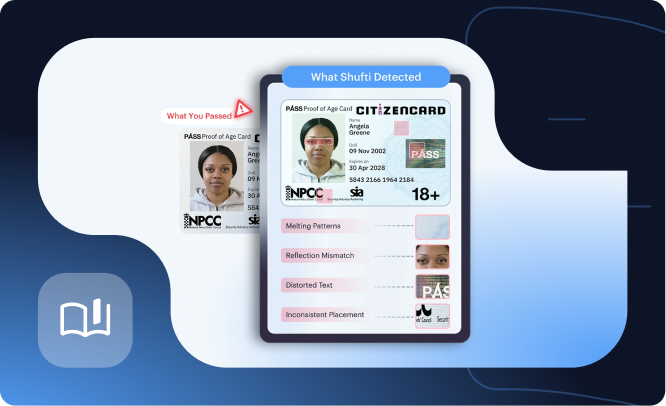
How Much of What You’ve Verified Is Actually Real?
Shufti’s Deepfake Blindspot Audit now runs fully inside your AWS environment, auditing historic KYC for manipulation signals without moving sensitive data off-prem.
whitepapers