








 AMLR Solutions
  AMLR Consultation
 EUDI Wallet
 Onboarding
 Ongoing Monitoring
 FRAML
FRAML KYC
KYC KYB
KYB KYI
KYI Age Assurance
 Workforce IAM
 Candidate Verification
 Account Takeover
 Bonus/ Promotion Abuse
 Chargeback Fraud
 Deepfake
 Document Fraud
 Fraud Networks
 Impersonation Fraud
 Money Mule Activity
 Multi-Accounting
 Party Fraud
 Regulatory & Compliance Risks
 Synthetic Identity Fraud
 Adult Content
 Banking
 Crypto
 Fintech
 Forex
Forex Compliance
 Fraud prevention
 Trust & safety
 Global expansion
 Compliance Officers
 Developers
 Fraud Analysts
 Product Managers
 Journey Builder
  Global Trust Platform
 Customer Profiles
 Vendor Comparison
 IDV Case Management
 AML Case Management
 Regulatory Reporting
 Agentic Rule Builder
  AI Compliance Co-Pilot
  Fraud Analytics
 Fraud Hub
  OCR
OCR Shufti AI
 Bank Account Verification
  Biometric Duplication
 Database Checks
 Document Intelligence
 Government ID
 Mobile Driver's License
 NFC
NFC Selfie Liveness
 Brand Personalisation
 Deployment Options
 Identity Methods
 IDV Modes
 Multi-tenancy
 On-Premise IDV
 Secure Capture
 Shufti MCP


- Algeria
- Angola
- Argentina
- Armenia
- Australia
- Austria
- Azerbaijan
- Bahrain
- Bangladesh
- Belarus
- Belgium
- Bolivia
- Brazil
- Bulgaria
- Cambodia
- Cameroon
- Canada
- Chile
- China
- Colombia
- Costa Rica
- Croatia
- Cyprus
- Czech Republic
- Denmark
- Dominican Republic
- Ecuador
- Egypt
- Estonia
- Eswatini
- Ethiopia
- Finland
- France
- Germany
- Greece
- Haiti
- Hong Kong
- Hungary
- India
- Iraq
- Ireland
- Indonesia
- Italy
- Japan
- Jordan
- Kazakhstan
- Kenya
- Kosovo
- Kuwait
- Latvia
- Lithuania
- Luxembourg
- Malaysia
- Malta
- Mauritius
- Mexico
- Micronesia
- Moldova
- Mongolia
- Montenegro
- Morocco
- Mozambique
- Myanmar
- Namibia
- Nauru
- Nepal
- Nigeria
- Nicaragua
- Niue
- Norway
- Netherlands
- New Zealand
- Oman
- Pakistan
- Palau
- Palestine
- Panama
- Papua New Guinea
- Paraguay
- Peru
- Puerto Rico
- Philippines
- Portugal
- Poland
- Qatar
- Republic of Congo
- Romania
- Russia
- Rwanda
- Samoa
- San Marino
- Saudi Arabia
- Senegal
- Serbia
- Seychelles
- Sierra Leone
- Singapore
- Slovakia
- Slovenia
- Somalia
- South Africa
- South Korea
- South Sudan
- Spain
- Sri Lanka
- St Kitts and Nevis
- St Maarten
- St Lucia
- Sweden
- Switzerland `
- Syria
- Taiwan
- Tajikistan
- Tanzania
- Thailand
- Timor Leste
- Togo
- Tonga
- Trinidad and Tobago
- Turkey
- Turks and Caicos
- Turkmenistan
- Tunisia
- Tuvalu
- UAE
- Uganda
- Ukraine
- UK
- USA
- Vietnam
- Zambia
Uganda
Identity Verification & KYC For Uganda
Shufti supports Know Your Customer, Know Your Business and Anti-Money Laundering compliance aligned to Uganda's Bank of Uganda, FIA and Anti-Money Laundering Act 2013 framework.
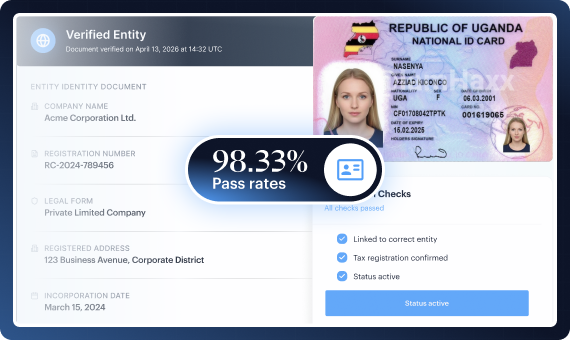
Operational performance for Uganda KYC
Our Numbers Speak Volumes
<5 sec
Verification Time
98.33%
Pass Rates
90%
eIDV Coverage
Evidence-Ready Checks Across People & Businesses
Individual Documents We Verify
Shufti supports 3 Ugandan document types.
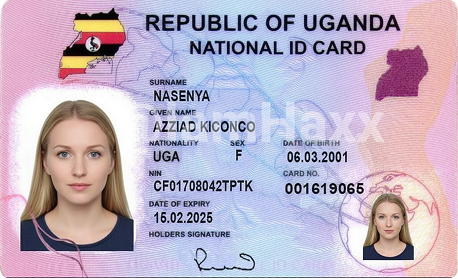
View All Supported DocumentsNational Identification Card
Biometric machine-readable card issued by NIRA to citizens aged 18+; contains fingerprint and facial recognition data; primary document for KYC verification.
Passport
Issued by the Directorate of Citizenship and Immigration Control, proof of citizenship and international travel is accepted for customer identity verification.
Driver's Licence
Issued by Uganda Driver Licensing System; mandatory for vehicle operation; contains name, address, date of birth and class; accepted fallback for KYC.
Business Entity Identity
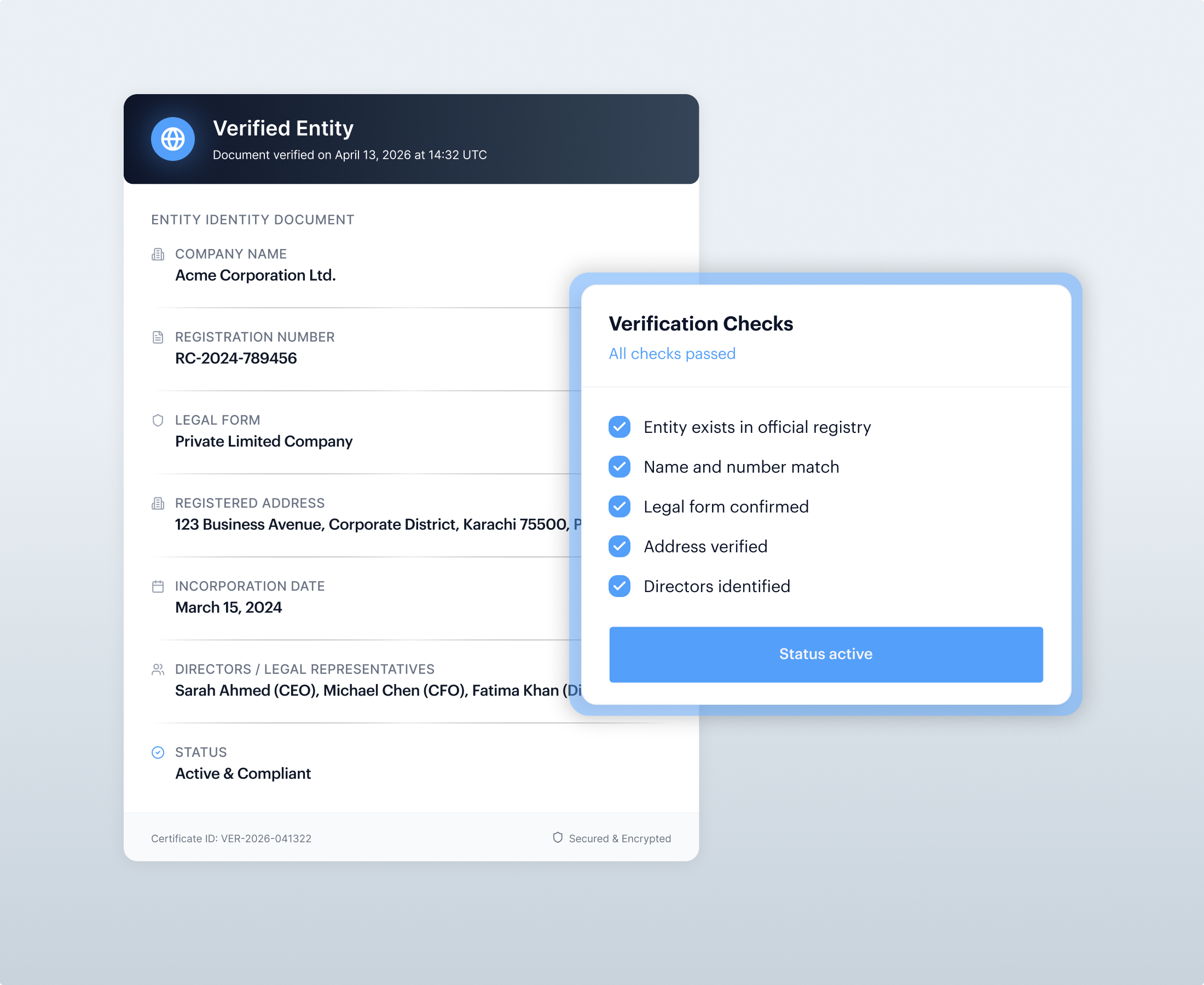
Certificate of Incorporation
Issued by Uganda Registration Services Bureau (URSB); specifies company name, place and date of incorporation; primary evidence of legal business entity status.
Memorandum and Articles of Association
Filed with URSB at incorporation; sets out company objectives, internal governance rules and share structure; required for business KYB verification.
Business Tax Identity
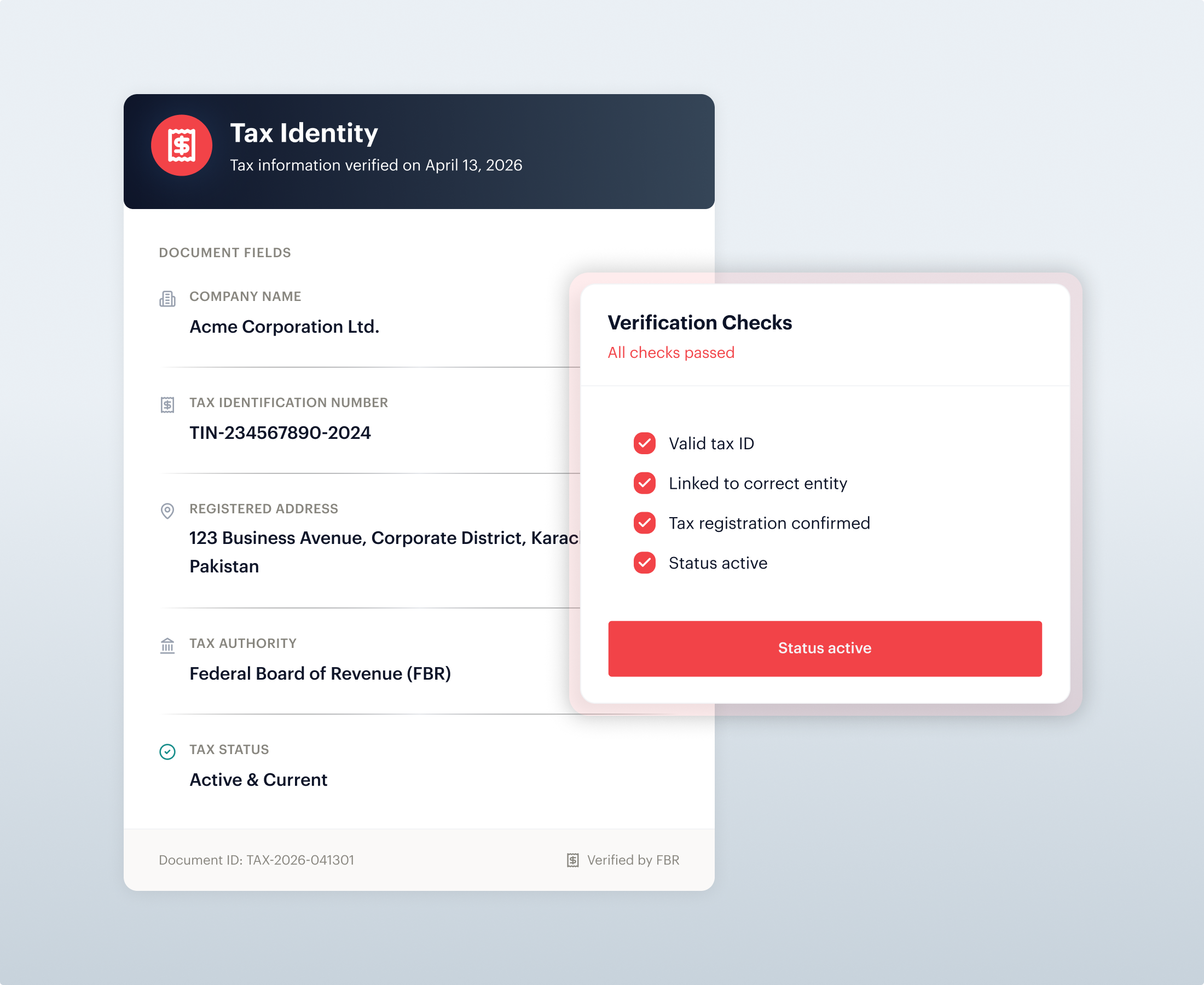
Tax Identification Number (TIN)
10-digit unique identifier issued by Uganda Revenue Authority; applies to companies and partnerships; required for tax administration and business verification.
VAT Registration Certificate
Issued by Uganda Revenue Authority to VAT-registered entities; confirms tax status and turnover threshold compliance; used in KYB to verify commercial scale.
Ownership & Control (UBO)
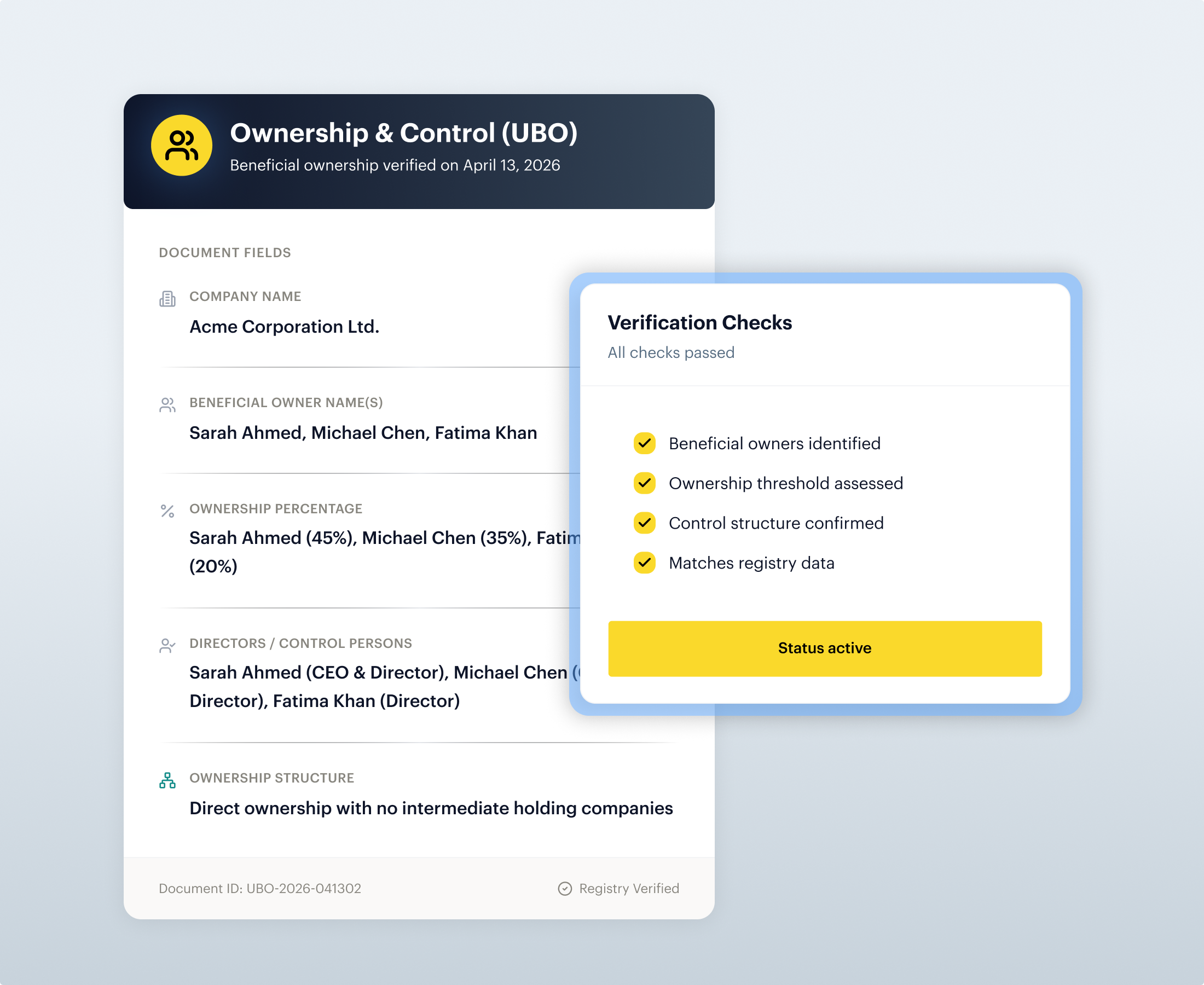
Beneficial Ownership Register
Required by Companies (Amendment) Act 2022; filed with URSB within 30 days; discloses beneficial owner information, nature of ownership and control changes.
Register of Members
Maintained by every company under the Companies Act 2012; lists shareholders with share allocations and transfer history; used to confirm the ultimate ownership structure.
Languages We Cover
English-First Document Handling
Ugandan identity documents are issued in English. Shufti captures and stores structured data fields directly, eliminating translation friction in KYC workflows.
Name Matching With Luganda Support
Shufti handles Latin-script Luganda names alongside English to reduce false positives in sanctions and politically exposed persons (PEP) screening controls.
Evidence Consistency Across CDD Workflows
Identity data is reconciled across document inputs, beneficial ownership disclosures and screening outputs in one unified case file for audit compliance.
GOVERNANCE & CONTROLS
Audit-Ready Decisions, Lower Operational Drag
Fewer Avoidable Re-Submissions
Biometric National ID-first capture design reduces failure rates linked to Uganda's geographic identity access limitations in verification workflows.
Cleaner Audit Trails
Structured CDD case files meet Financial Intelligence Authority examination requirements and anti-money laundering recordkeeping standards comprehensively.
Better Name Matching Outcomes
Handles Luganda and English name variants, transliteration and diacritics to minimise false positives in sanctions and PEP screening controls.
One Workflow, One Back Office
KYC, KYB, sanctions screening and AML case management consolidated in one system with Bank of Uganda and FIA compliance mapped.

National ID-First Flow Design
Biometric National ID as primary verification pathway aligns with Uganda's digital identity infrastructure and regulatory compliance expectations.
Uganda IDV/KYC Challenges

Digital Identity Access Gap
A significant portion of Ugandans lack valid national IDs; geographic access to NIRA services is limited to 112 of 146 districts across the country.

Biometric Verification Limits
Banks cannot perform real-time facial verification against the NIRA database; live photo matching to national ID photo remains significantly constrained.

Rural Infrastructure Gap
Weak internet coverage in rural districts restricts access to online verification systems and real-time digital KYC platforms for customer onboarding.

Regulatory Interpretation Gap
Discrepancies exist between Bank of Uganda regulations and Anti-Money Laundering Regulations 2015; inconsistent fintech and money remitter onboarding standards.
Shufti’s IDV/KYC Solutions for Uganda
KYC Solutions

Face Verification
Reduces impersonation and synthetic identity fraud in customer onboarding; strengthens due diligence evidence against Uganda's documented fraud patterns.
.
Age Verification
Selfie-based age estimation with document verification fallback for regulated products; supports Uganda's risk-based customer due diligence framework.
.
Address Verification
Shufti can verify address-bearing documents, including Ugandan utility providers such as UEDCL (electricity), NWSC (water) and MTN Uganda; major banks.
.
Document Verification
Supports Uganda's primary identity documents, including biometric National ID with MRZ extraction, passports and driver's licences aligned to NIRA standards.
.KYB Solutions

Business Verification
Validates entity status through URSB registry data; corroborates TIN evidence; captures beneficial ownership disclosures per Companies Act compliance.
.
Enhanced Due Diligence (EDD)
Structured escalation workflows for high-risk entities and politically exposed persons; produces reconstructable audit trails aligned with FIA standards.
.AML Screening

Business AML Screening
Screens entities and controlling persons against OFAC, UNSC sanctions lists and global politically exposed persons datasets per anti-money laundering.
.
Transaction Monitoring
Supports ongoing monitoring aligned to Uganda's goAML reporting platform obligations and suspicious activity monitoring in mobile money platform operations.
.Built to Fit Uganda's Compliance Landscape

Bank of Uganda (BoU)
Regulates banks and non-bank financial institutions; enforces KYC and AML/CTF compliance in the banking sector. Shufti outputs align with BoU examination standards.

Financial Intelligence Authority (FIA)
Uganda's primary AML authority receives, analyses, and disseminates financial intelligence via the goAML platform. Shufti supports FIA-compliant escalation.

Capital Markets Authority (CMA)
Regulates securities, capital markets and investment firms; licenses broker-dealers and fund managers; enforces AML. Shufti provides audit-ready CDD evidence.

Insurance Regulatory Authority (IRA)
Supervises insurers, reinsurers and brokers; enforces AML/CTF compliance in the insurance sector. Shufti supports customer verification for insurance operations.

Uganda Microfinance Regulatory Authority (UMRA)
Licences Tier-4 microfinance institutions and money lenders; promotes sound non-banking sector development. Shufti streamlines KYC for microfinance onboarding.

Uganda Revenue Authority (URA)
Enforces tax collection and administers TIN allocation and business formalisation requirements. Shufti validates TIN evidence and business registration.

Personal Data Protection Office (PDPO)
Data protection authority enforcing the Data Protection and Privacy Act 2019. Shufti logs consent and supports data subject access requests per PDPO requirements.

National Identification & Registration Authority (NIRA)
Issues biometric National ID Cards with fingerprint and facial recognition data. Shufti extracts MRZ and captures biometric fields per NIRA standards.
Deployment Choice
No major cloud provider operates data centres in Uganda; the closest infrastructure is in South Africa. Regulated entities typically require on-premise deployment.
Regulatory Alignment
Aligned to the Data Protection and Privacy Act 2019 and Anti-Money Laundering Act 2013 recordkeeping obligations and requirements enforced by PDPO and FIA.
Retention Controls
Minimum 10-year retention period mandated by the Anti-Money Laundering Act 2013 for account files, correspondence, customer due diligence and transaction records.
Encryption Posture
Data Protection and Privacy Act 2019 requires appropriate technical measures; compliance relies on industry-standard encryption practices and assessments.
Data Controls & Privacy for Uganda
Uganda AML Sources That Strengthen Decision

Parliament of Uganda

Uganda National Council for Science and Technology

Kabale District Local Government

Local Government of Napak District

Ministry of Local Government
New Vision

Daily Monitor

The Observer
Parliament of Uganda
Uganda National Council for Science and Technology
Kabale District Local Government
Local Government of Napak District
Ministry of Local Government
New Vision
Daily Monitor
The Observer
Parliament of Uganda
Uganda National Council for Science and Technology
Kabale District Local Government
Local Government of Napak District
Ministry of Local Government
New Vision
Daily Monitor
The Observer
Frequently Asked Questions
What are the KYC requirements for financial institutions in Uganda?
Financial institutions must conduct Customer Due Diligence (CDD) to verify customer identity using National ID, passport or driver's licence; assess beneficial ownership for companies; determine risk levels; and apply enhanced due diligence for high-risk customers and politically exposed persons under the Anti-Money Laundering Act 2013.
What is the role of the Financial Intelligence Authority (FIA) in Uganda's AML compliance?
The FIA is Uganda's primary authority for preventing and combating money laundering and terrorism financing. It receives, analyses and disseminates financial intelligence through the goAML platform and enforces compliance with the Anti-Money Laundering Act 2013 and Regulations 2015.
How do financial institutions in Uganda verify national identity cards for KYC purposes?
Financial institutions verify National ID cards using biometric data capture, machine-readable zone (MRZ) extraction and corroboration against NIRA records where access is authorised. Approximately 74 financial institutions currently access the NIRA database for digital KYC verification.
What are Uganda's Anti-Money Laundering Act requirements for beneficial ownership?
The Companies (Amendment) Act 2022 requires every company and limited liability partnership to maintain and file a Beneficial Ownership Register with URSB within 30 days of incorporation, disclosing beneficial owner information, nature of ownership and control changes.
What documents are accepted for identity verification in Uganda?
Primary documents are the National Identification Card, Passport and Driver's Licence issued by government authorities. Secondary documents include Voter's Card, Refugee ID and Certificate of Identity for KYC verification where primary documents are unavailable.
How long must financial institutions retain KYC and AML records in Uganda?
Financial institutions must maintain detailed KYC and AML records for a minimum of 10 years from the transaction date or account closure, as mandated by the Anti-Money Laundering Act 2013 for all account files and customer due diligence documentation.
What is eKYC (electronic Know Your Customer) and how is it implemented in Uganda?
Electronic KYC (eKYC) is remote digital customer verification using electronic methods rather than in-person onboarding. It is formally recognised under the Anti-Money Laundering Act 2013 amendments, enabling financial institutions to verify customers via NIRA database access and biometric document capture.
What are the penalties for non-compliance with Uganda's AML regulations?
Non-compliance with the Anti-Money Laundering Act 2013 can result in administrative fines, licence suspension, regulatory restrictions and criminal penalties, including imprisonment. Penalties vary based on violation severity and are enforced by FIA, Bank of Uganda and sectoral regulators.
How does customer due diligence (CDD) work in Uganda?
CDD requires financial institutions to identify and verify customer identity using reliable, independently sourced documents; assess beneficial ownership for companies; determine risk levels (low, medium, high); and apply enhanced due diligence measures for high-risk customers, politically exposed persons and cross-border exposure.
Build a Uganda-ready KYC, KYB & AML programme with Shufti
INDEPENDENTLY AUDITED. GLOBALLY CERTIFIED.
Certified to Global Standards








PROVEN WORKFLOWS
Use Cases for Regulated Growth in Uganda
Accelerate Growth, Eliminate Friction
Onboard users in seconds, not days. Deploy tiered address verification flows that maximise completion rates for genuine users while filtering out synthetic fraud.


Onboard Global Traders in Real-Time
Verify investors across 240+ countries & territories. Ensure compliance with international financial regulations while preventing identity theft and high-risk chargebacks.



Secure Trust at Every Transaction
Automate KYC and AML workflows to reduce manual onboarding costs. Strengthen residency checks while delivering the frictionless digital experience modern customers expect.


Power a Fair & Secure Player Experience
Reduce bonus abuse and multi-accounting rings at the door. Enforce location rules and trigger step-up checks without disrupting the player journey.



Build a Trusted, Verified Workforce
Screen freelancers and drivers at scale. Verify residency and reduce onboarding friction while maintaining trust between users.



Scale Your Exchange with Confidence
Balance anonymity with compliance. Instantly verify user jurisdiction to meet Travel Rule obligations and help stop abuse without slowing down legitimate trading volume.



Reduce fraud without blocking growth
Shufti supports marketplace integrity by verifying seller and buyer identities, enabling age-gated journeys where needed, and preserving evidence to support investigations, disputes and risk-led enforcement actions.




Accelerate Growth, Eliminate Friction
Onboard users in seconds, not days. Deploy tiered address verification flows that maximise completion rates for genuine users while filtering out synthetic fraud.
Onboard Global Traders in Real-Time
Verify investors across 240+ countries & territories. Ensure compliance with international financial regulations while preventing identity theft and high-risk chargebacks.
Secure Trust at Every Transaction
Automate KYC and AML workflows to reduce manual onboarding costs. Strengthen residency checks while delivering the frictionless digital experience modern customers expect.
Power a Fair & Secure Player Experience
Reduce bonus abuse and multi-accounting rings at the door. Enforce location rules and trigger step-up checks without disrupting the player journey.
Build a Trusted, Verified Workforce
Screen freelancers and drivers at scale. Verify residency and reduce onboarding friction while maintaining trust between users.
Scale Your Exchange with Confidence
Balance anonymity with compliance. Instantly verify user jurisdiction to meet Travel Rule obligations and help stop abuse without slowing down legitimate trading volume.
Reduce fraud without blocking growth
Shufti supports marketplace integrity by verifying seller and buyer identities, enabling age-gated journeys where needed, and preserving evidence to support investigations, disputes and risk-led enforcement actions.
Accelerate Growth, Eliminate Friction
Onboard users in seconds, not days. Deploy tiered address verification flows that maximise completion rates for genuine users while filtering out synthetic fraud.
Onboard Global Traders in Real-Time
Verify investors across 240+ countries & territories. Ensure compliance with international financial regulations while preventing identity theft and high-risk chargebacks.
Secure Trust at Every Transaction
Automate KYC and AML workflows to reduce manual onboarding costs. Strengthen residency checks while delivering the frictionless digital experience modern customers expect.
Power a Fair & Secure Player Experience
Reduce bonus abuse and multi-accounting rings at the door. Enforce location rules and trigger step-up checks without disrupting the player journey.
Build a Trusted, Verified Workforce
Screen freelancers and drivers at scale. Verify residency and reduce onboarding friction while maintaining trust between users.
Scale Your Exchange with Confidence
Balance anonymity with compliance. Instantly verify user jurisdiction to meet Travel Rule obligations and help stop abuse without slowing down legitimate trading volume.
Reduce fraud without blocking growth
Shufti supports marketplace integrity by verifying seller and buyer identities, enabling age-gated journeys where needed, and preserving evidence to support investigations, disputes and risk-led enforcement actions.
Let’s Tailor your journey
Just a few quick questions to guide your Shufti experience.

Shufti
Market Positioning and Commercial Assessment

Industry stands at 1.7rating

Best ID Verification Innovator

TOP 10 KYC Solution Provider
Best Client Onboarding Solution

Samer Al Tamimi@CEO of Safwa Bank
We take our client's privacy very seriously and always look for new innovative solutions to ensure a safe banking experience. Working with Shufti feels like a breath of fresh air, as their 100% in-house tech keeps our customer's data free from vulnerabilities and fully safe and protected.




PROVEN PLAYBOOKS
Explore Practical KYC & AML Resources
16 August, 2025
5 minutes read
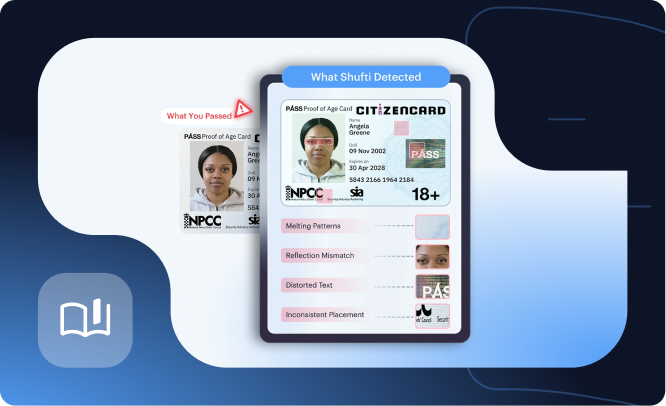
How Much of What You’ve Verified Is Actually Real?
Shufti’s Deepfake Blindspot Audit now runs fully inside your AWS environment, auditing historic KYC for manipulation signals without moving sensitive data off-prem.
whitepapers