








- Afghanistan
- Albania
- Algeria
- Andorra
- Angola
- Argentina
- Armenia
- Australia
- Austria
- Azerbaijan
- Bahrain
- Bangladesh
- Belarus
- Belgium
- Belize
- Bolivia
- Bosnia and Herzegovina
- Brazil
- British Virgin Islands
- Brunei
- Bulgaria
- Cambodia
- Cameroon
- Canada
- Chile
- China
- Colombia
- Costa Rica
- Croatia
- Curaçao
- Cyprus
- Czech Republic
- Denmark
- Dominican Republic
- Ecuador
- Egypt
- El Salvador
- Estonia
- Eswatini
- Ethiopia
- Finland
- France
- Georgia
- Germany
- Greece
- Haiti
- Hong Kong
- Hungary
- India
- Iraq
- Ireland
- Indonesia
- Italy
- Japan
- Jordan
- Kazakhstan
- Kenya
- Kosovo
- Kuwait
- Latvia
- Lithuania
- Luxembourg
- Malaysia
- Malta
- Mauritius
- Mexico
- Micronesia
- Moldova
- Monaco
- Mongolia
- Montenegro
- Morocco
- Mozambique
- Myanmar
- Namibia
- Nauru
- Nepal
- Nigeria
- Nicaragua
- Niue
- Norway
- Netherlands
- New Zealand
- Oman
- Pakistan
- Palau
- Palestine
- Panama
- Papua New Guinea
- Paraguay
- Peru
- Puerto Rico
- Philippines
- Portugal
- Poland
- Qatar
- Republic of Congo
- Romania
- Russia
- Rwanda
- Samoa
- San Marino
- Saudi Arabia
- Senegal
- Serbia
- Seychelles
- Sierra Leone
- Singapore
- Slovakia
- Slovenia
- Somalia
- South Africa
- South Korea
- South Sudan
- Spain
- Sri Lanka
- St Kitts and Nevis
- St Maarten
- St Lucia
- Sweden
- Switzerland `
- Syria
- Taiwan
- Tajikistan
- Tanzania
- Thailand
- Timor Leste
- Togo
- Tonga
- Trinidad and Tobago
- Turkey
- Turks and Caicos
- Turkmenistan
- Tunisia
- Tuvalu
- UAE
- Uganda
- Ukraine
- UK
- USA
- Vanuatu
- Vietnam
- Zambia
Scale Identity Verification and KYC Operations in Georgia
Verify citizens and non-residents through ID card and passport NFC chip reads, PSDA data checks and 10,000+ foreign ID document types, run KYB on NAPR-registered companies and their real owners, and monitor transactions and sanctions lists. One platform runs compliance and fraud prevention across the full customer lifecycle for NBG-supervised firms.
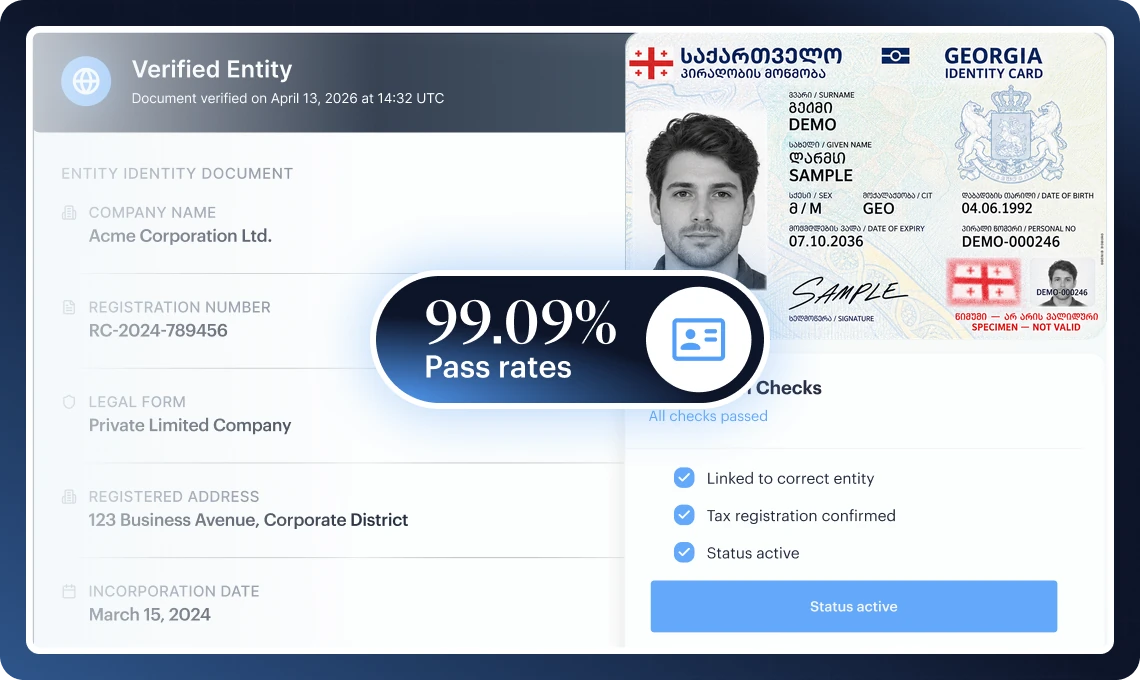


Operational Performance for Georgia KYC
Our Numbers Speak Volumes
99.09%
Pass
Rates
Under 5 secs
IDV
Verification
100%
Omni-format
Document Recognition
Georgia IDV/KYC Challenges

Georgian Names Take Several Latin Spellings
KYC in Georgia starts with names written in Mkhedruli and transliterated into Latin, so one surname can appear in several spellings across a passport, a bank record and a watchlist. Shufti matches names phonetically across scripts, so variants never hide a true match.

NBG Order 104/04 Sets a Detailed Standard for Remote Onboarding
Since April 2025, remote onboarding by NBG-supervised firms has required liveness, a live document check, OCR or NFC data capture and full comparison with PSDA records, plus NBG consent before launch. Shufti's AI Journey Builder runs every step in one configurable flow.

No Central Register Shows Who Owns Georgian Companies
NAPR records each company's partners, but Georgia has no central beneficial ownership register, so firms trace everyone who owns or controls 25% or more themselves under Article 13 of the AML Law. Shufti pulls NAPR partner records live and follows corporate partners up to the people behind them.

Suspicious Activity Must Reach the FMS the Same Day
Article 26 of the AML Law requires a suspicious transaction report on the day suspicion arises, which leaves no time to collect evidence from separate systems. Shufti's case management keeps identity, screening and transaction evidence in one file, ready for filing.
Documents and Languages
Individual Documents Shufti Verifies in Georgia
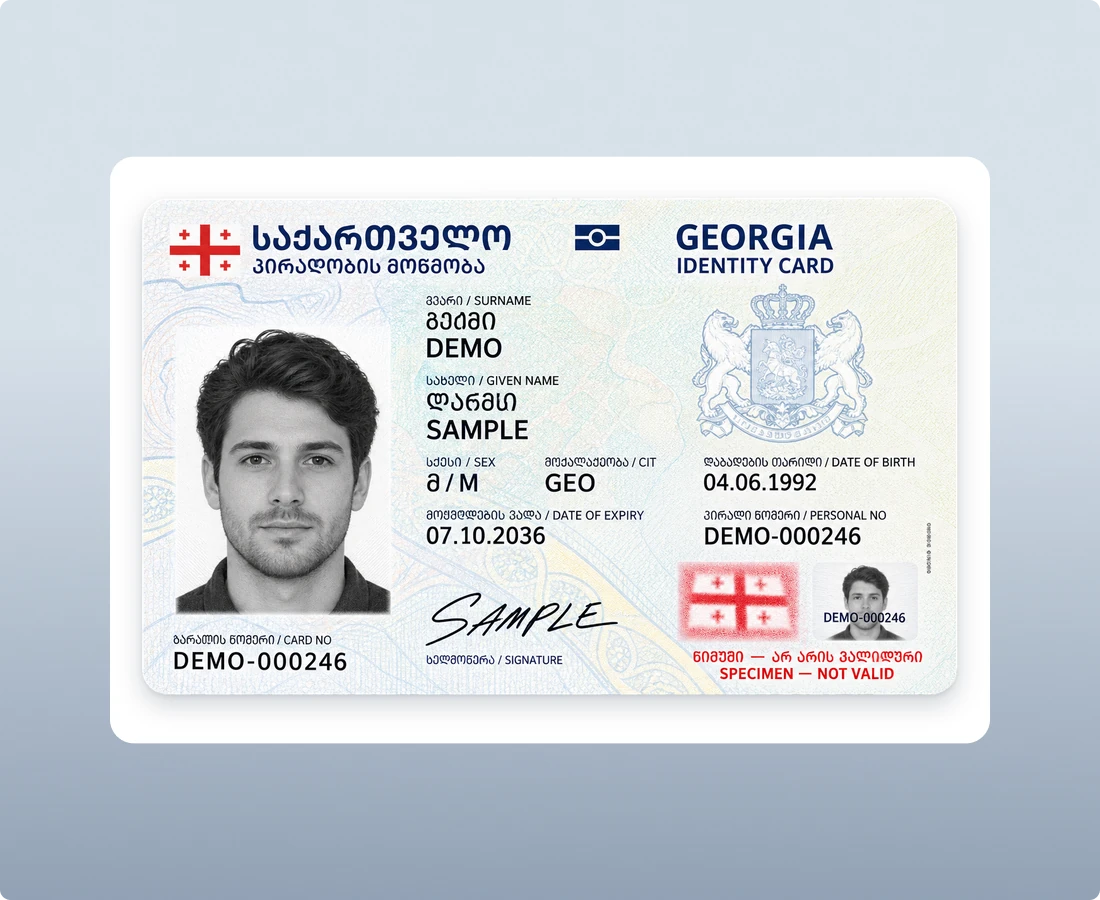
Shufti verifies 5 Georgian identity document types plus passports and ID cards from other countries. The cards below cover the core documents Georgian onboarding relies on, with the full list on the supported documents page.
View All Supported DocumentsElectronic Identity Card of a Citizen of Georgia
The Public Service Development Agency (PSDA) issues the card with an ICAO-compliant chip that also holds authentication and qualified e-signature certificates. Shufti reads the chip by NFC, tests the card for tampering, matches a live selfie and compares each field with PSDA records.
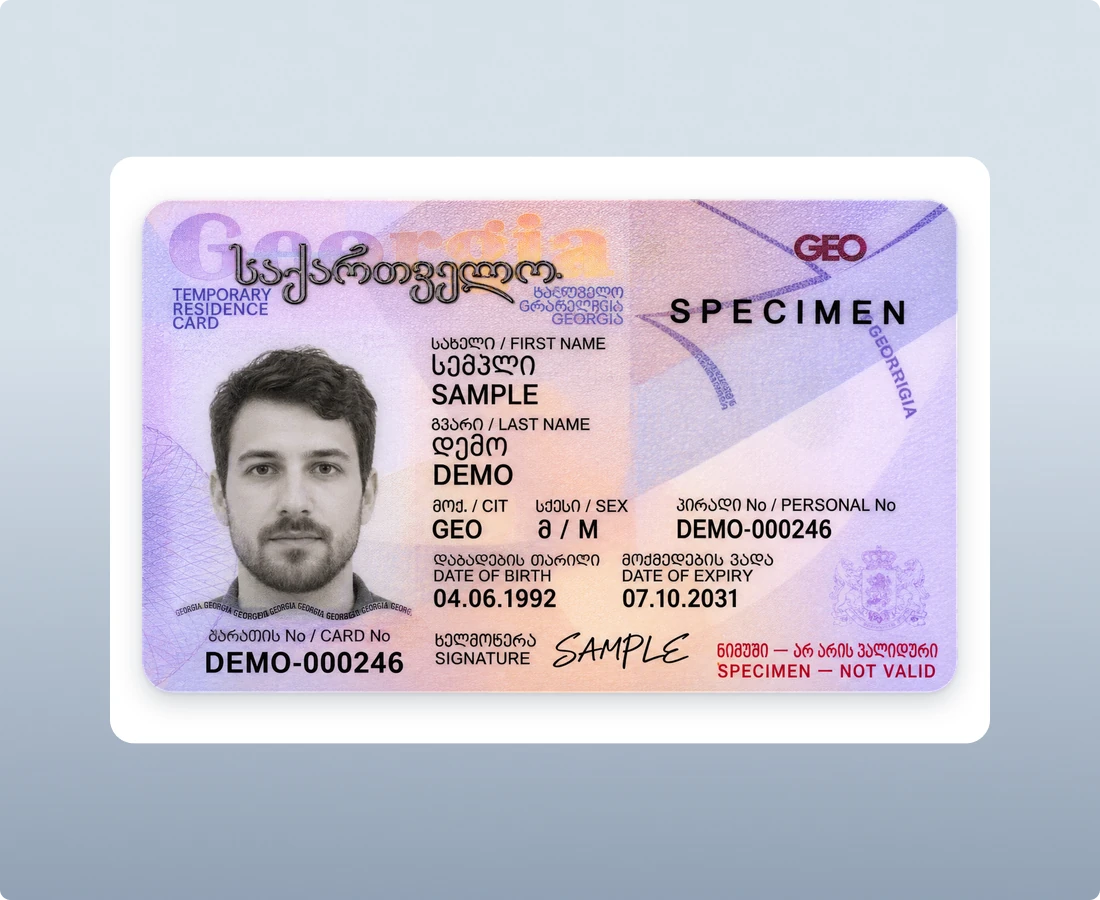
Georgian Residence Card
PSDA issues permanent and temporary residence cards to foreign nationals living in Georgia for work, study, family, investment and other reasons. Shufti authenticates the card, matches the holder by selfie and checks the details against PSDA records, so long-term residents onboard like citizens.
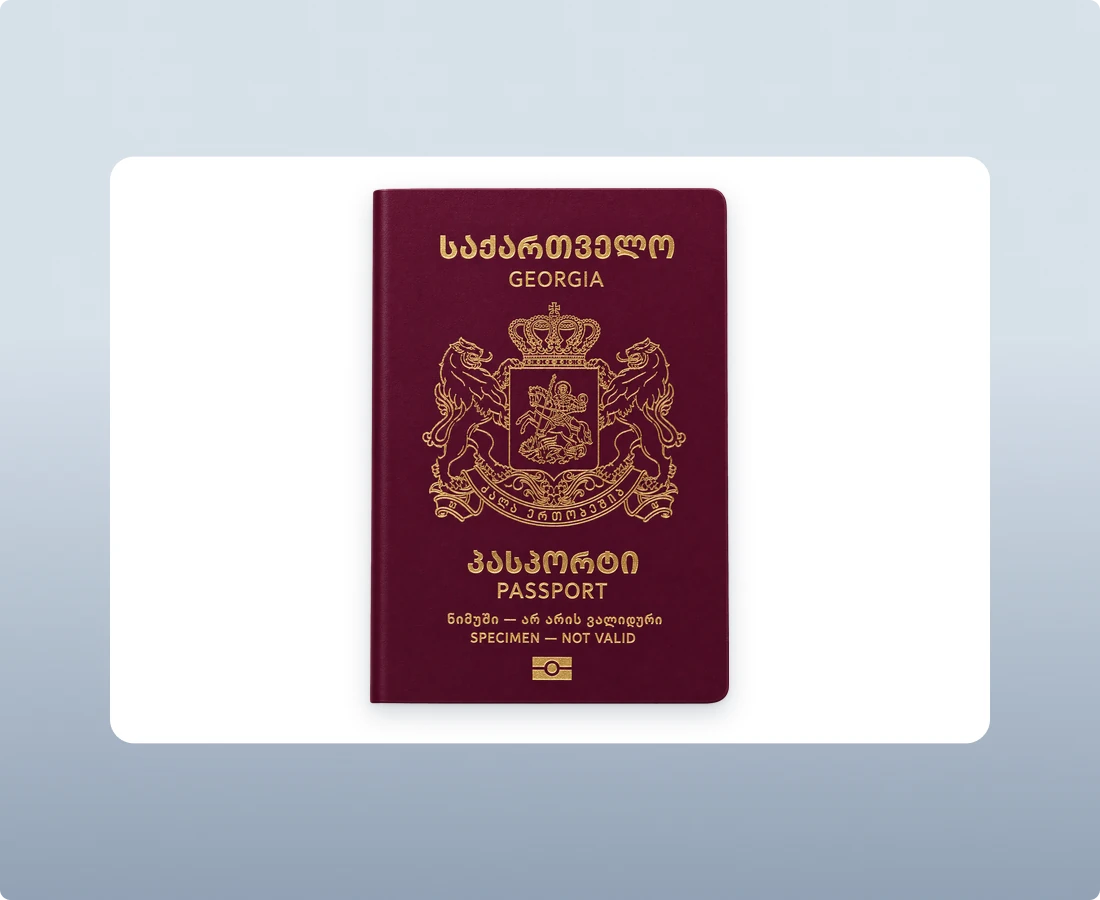
Georgian Biometric Passport
The passport chip stores the holder's facial image and fingerprints. Shufti reads it by NFC and runs nine forensic detection layers, from MRZ checksum validation to hologram analysis, so a cloned or altered passport fails before onboarding.
Stateless Person and Refugee Travel Documents
PSDA issues travel passports to stateless persons and travel documents to refugees, who cannot rely on a national passport. Shufti verifies both formats together with the holder's residence card and a live selfie, giving these customers the same route to an account.

Foreign Passports and National ID Cards
Shufti actively processes 10,000+ ID document types from 240+ countries and territories, and its zero-shot AI learns new document formats in minutes. Non-residents opening accounts remotely, foreign founders and visiting customers use these documents in the same flow as Georgian citizens.

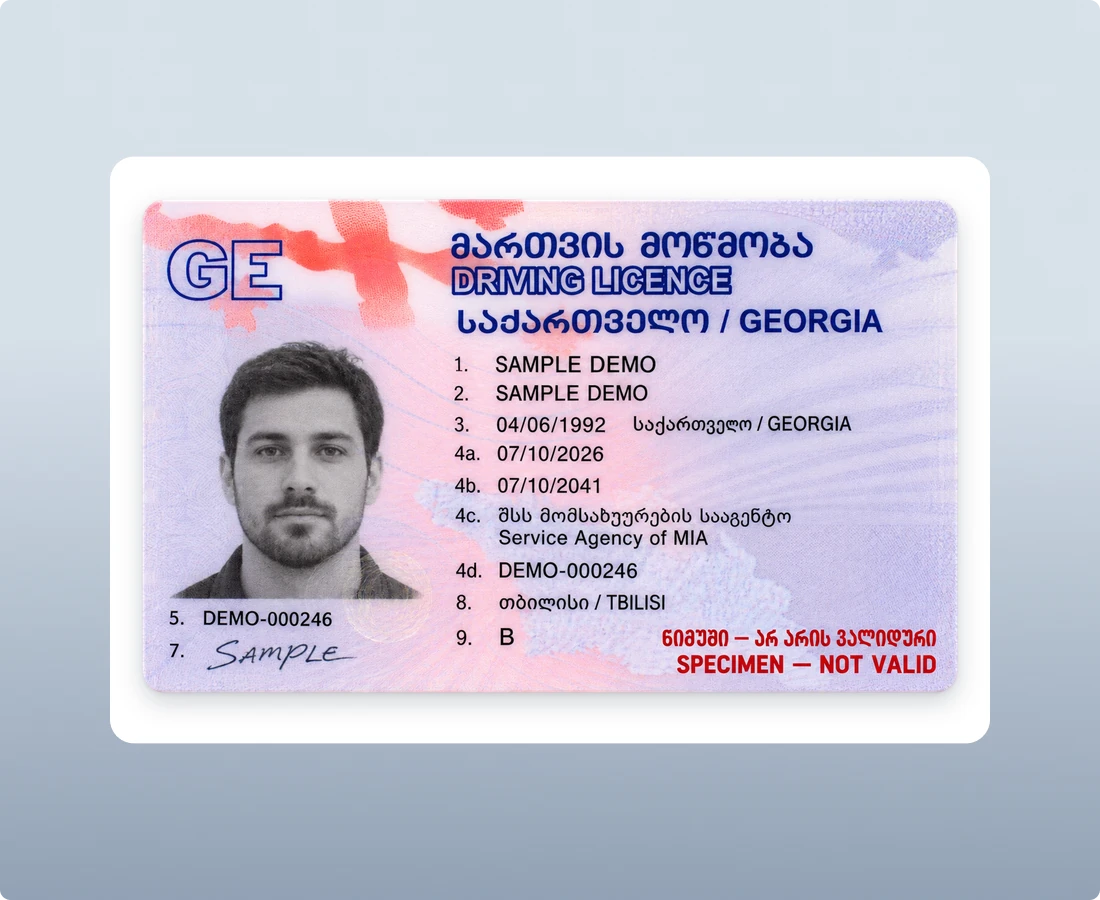
Georgian Driving License
The Service Agency of the Ministry of Internal Affairs issues licenses valid for up to 15 years. Shufti checks authenticity, expiry and the facial match, which makes the license useful supporting evidence and age proof for gaming, car rental and marketplace onboarding.
Entity Identity
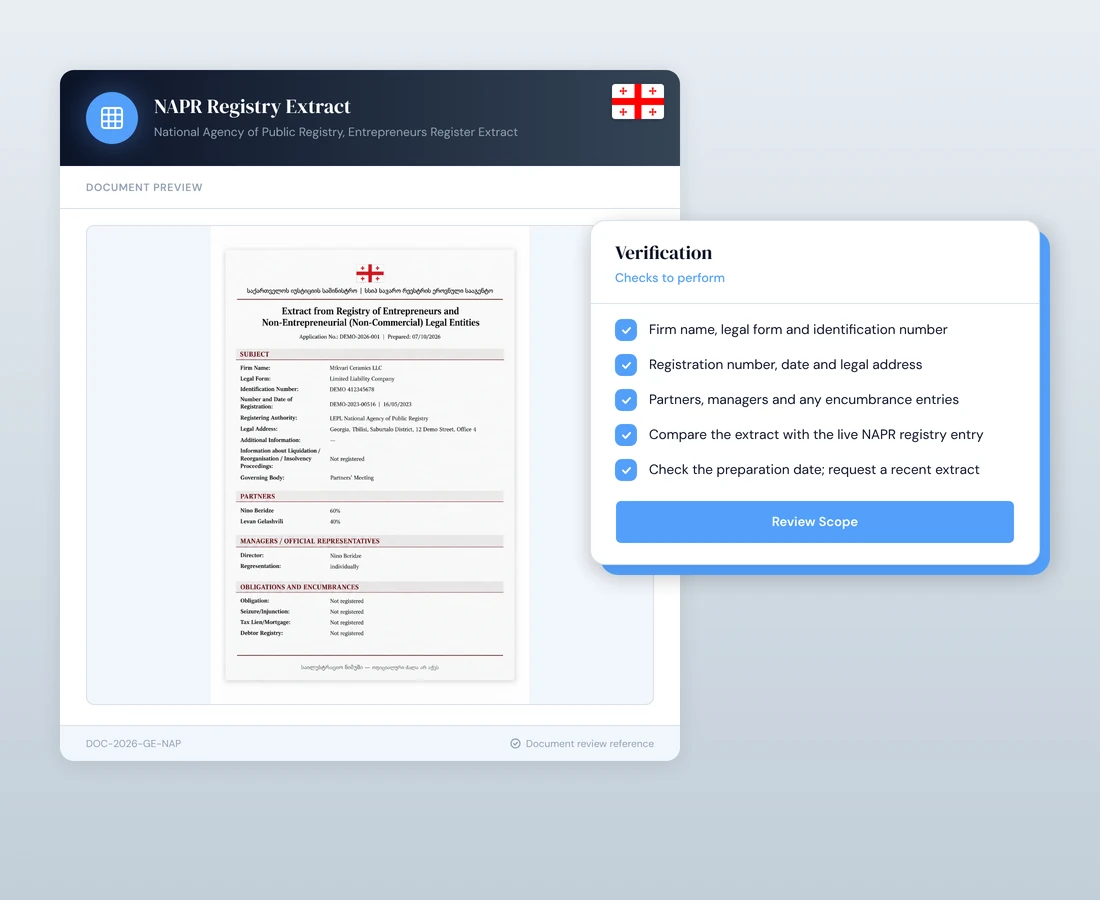
NAPR Registry Extract
NAPR keeps the Registry of Entrepreneurs and Non-Entrepreneurial (Non-Commercial) Legal Entities under the 2021 Law on Entrepreneurs. Shufti calls the registry live at every check, confirming legal form, status, partners and representatives, and flags companies whose registration has been suspended.
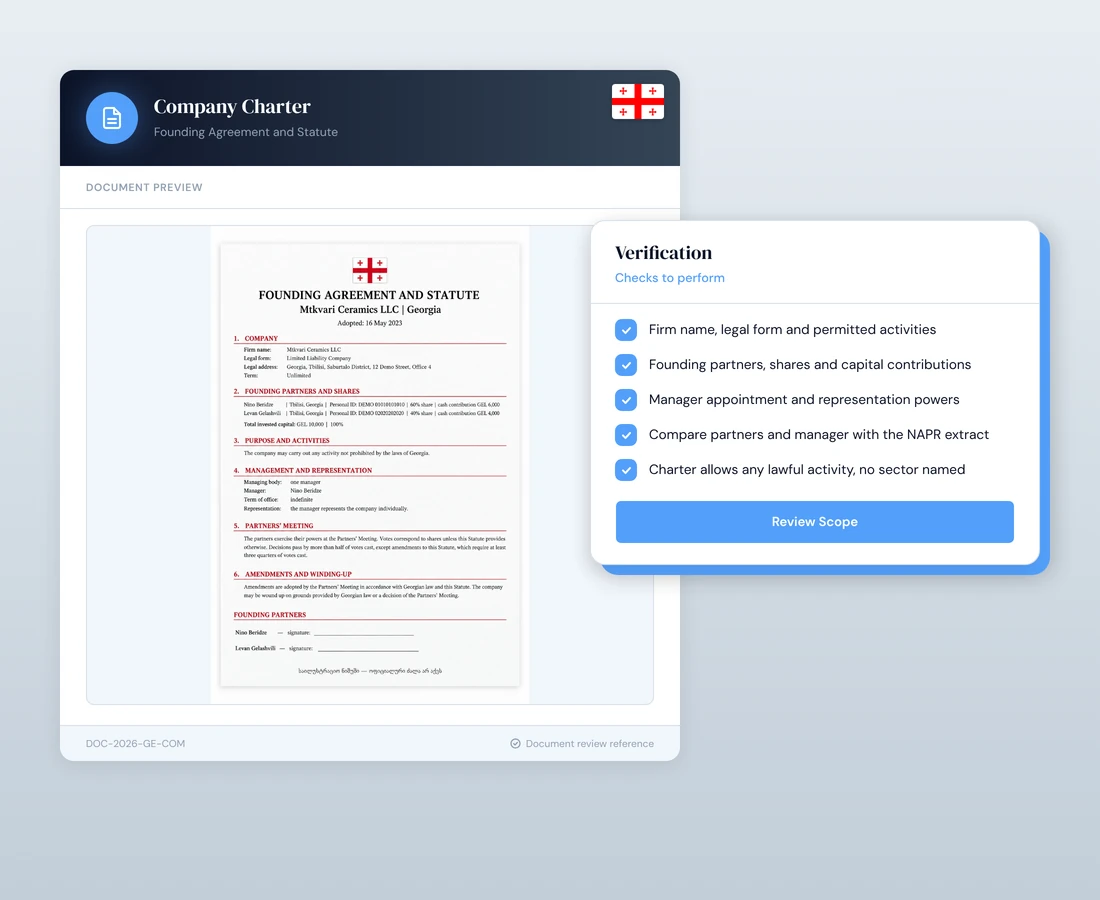
Company Charter
AI-OCR reads ownership, capital and signing authority from the charter and its amendments, and flags GAN-generated or edited pages before a reviewer relies on them.
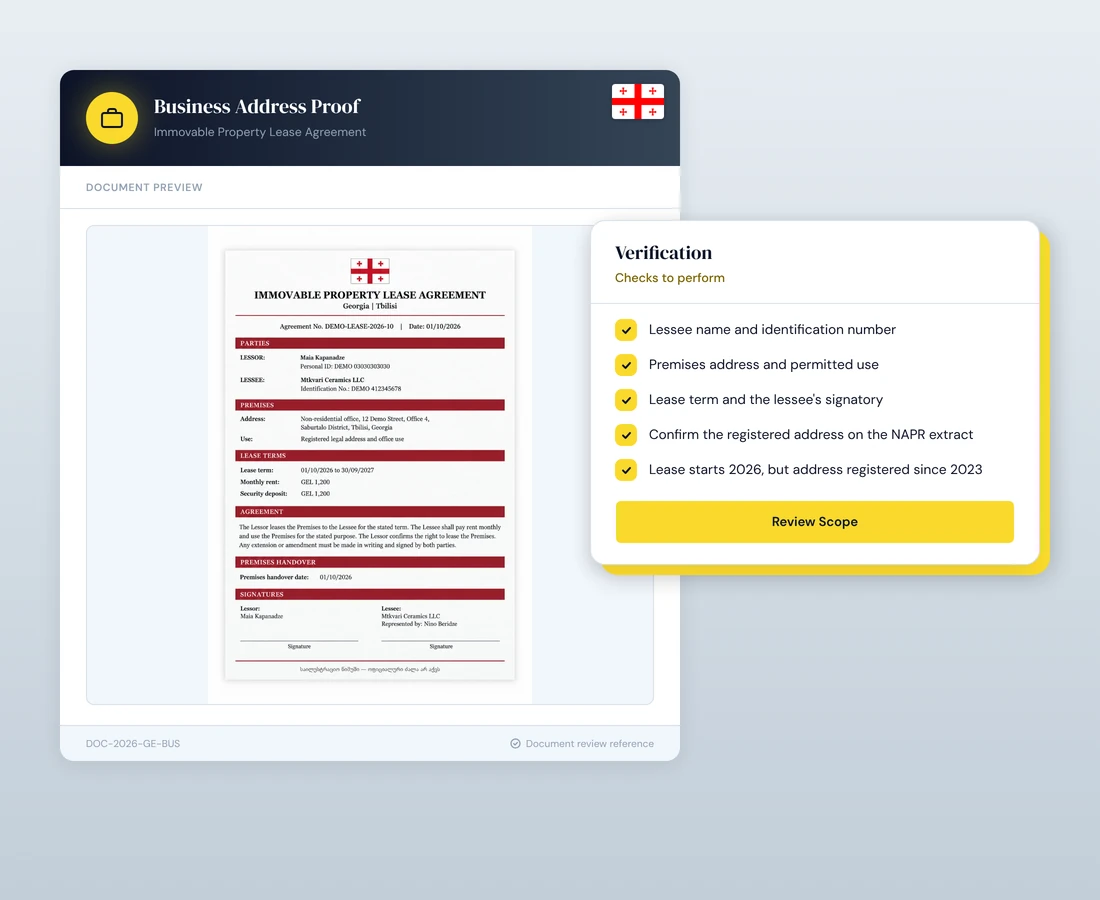
Business Address Proof
The legal address recorded with NAPR is cross-checked against lease agreements and utility bills, so a company's registered and trading addresses match before onboarding.
Tax Identity
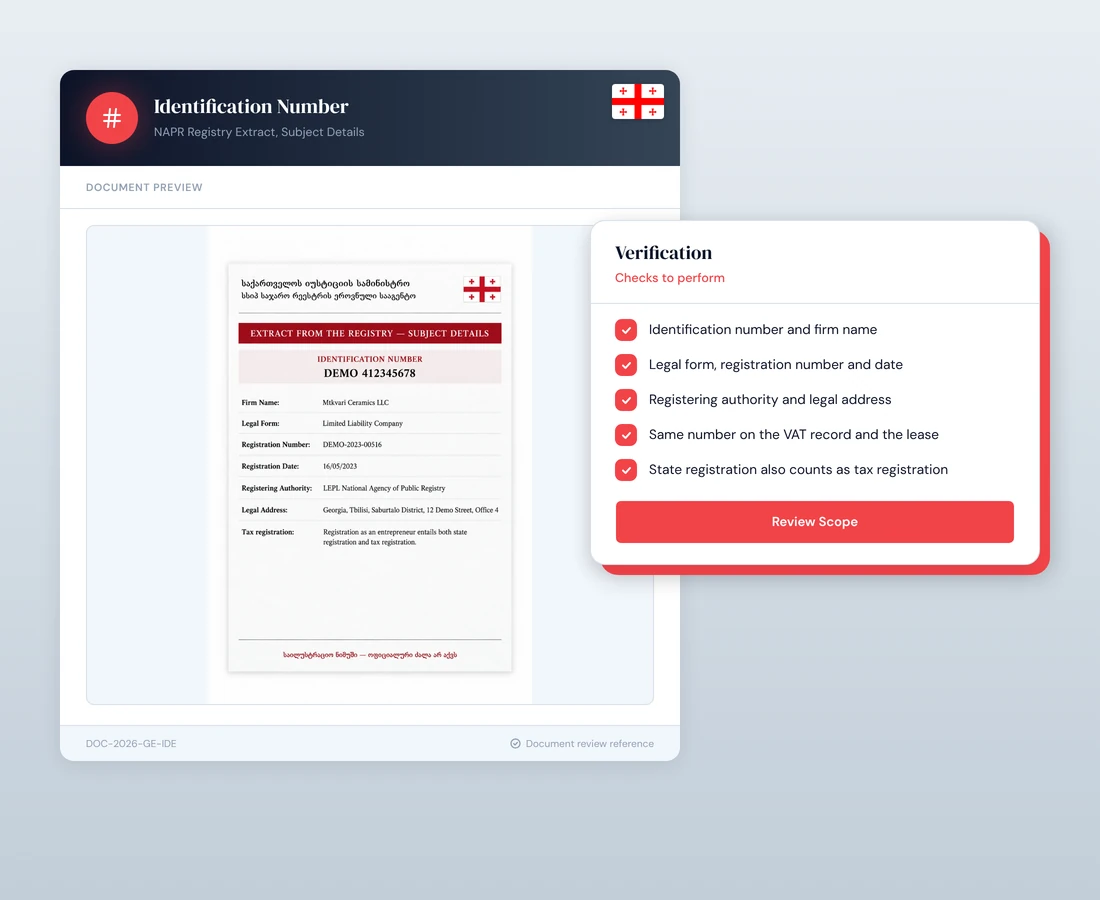
Identification Number
NAPR registration covers both state and tax registration under Article 8 of the Law on Entrepreneurs, and Article 66 of the Tax Code has NAPR assign each registered entity its identification number. Shufti extracts the number and cross-checks it against the live registry record.
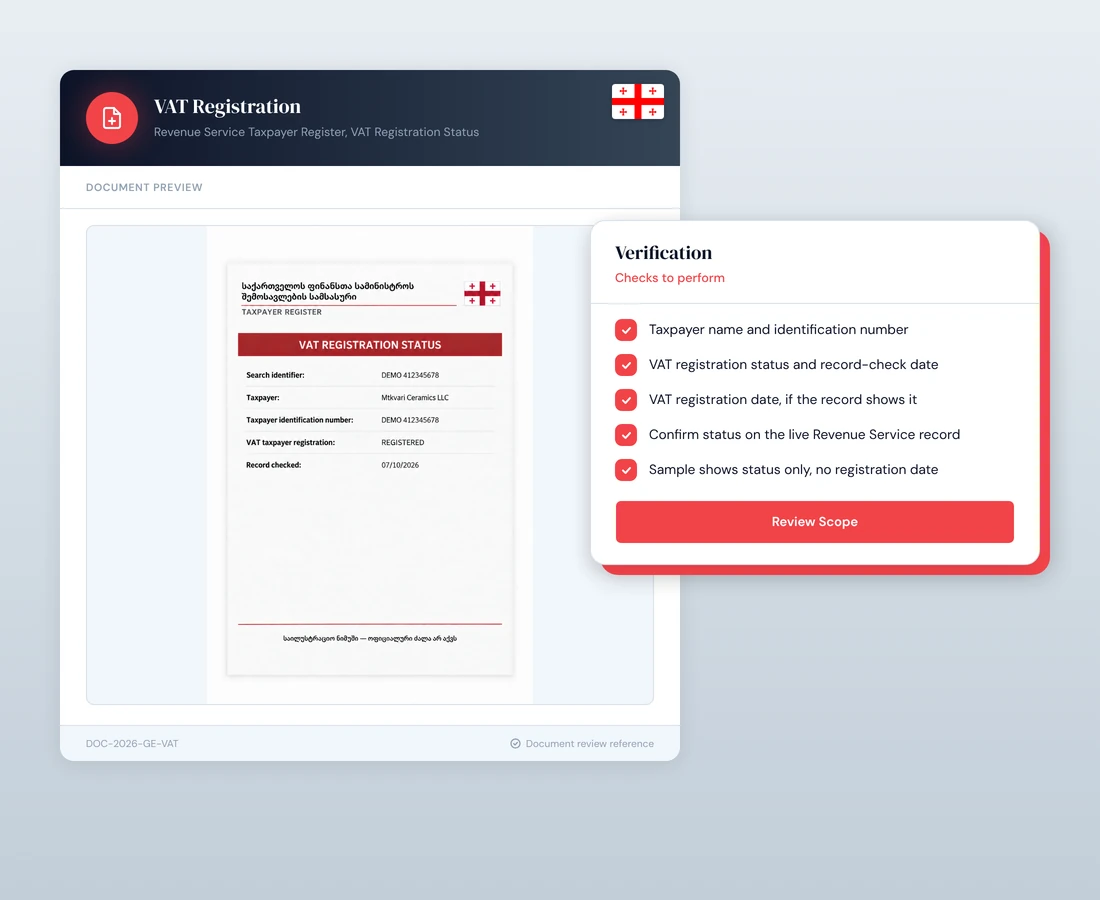
VAT Registration
Article 165 of the Tax Code requires VAT registration once taxable supplies pass GEL 100,000 in any 12 consecutive months. Shufti reads the VAT status a company declares and reconciles it with the company's registration documents.
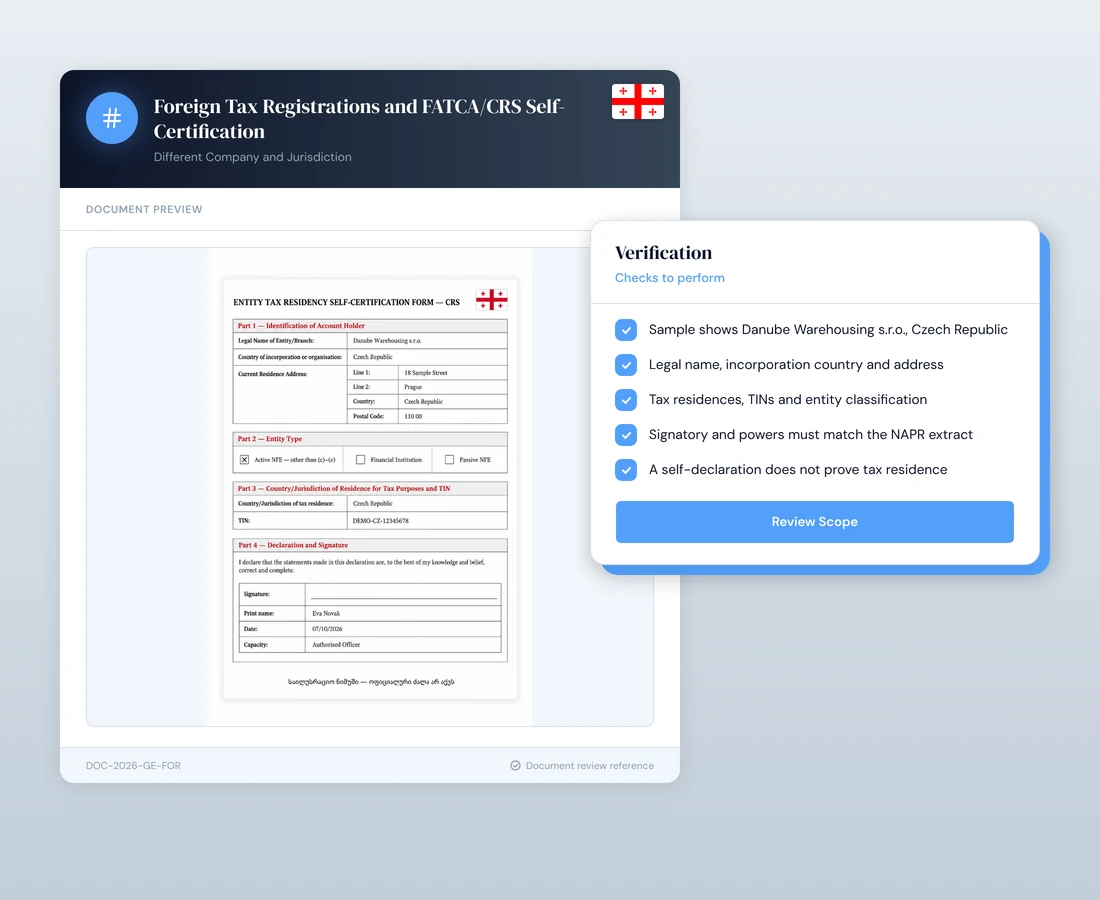
Foreign Tax Registrations and FATCA/CRS Self-Certification
Foreign parents and non-resident partners are verified with their home tax registrations, and FATCA and CRS self-certification forms are collected and checked inside the same due diligence flow.
Ownership and Control
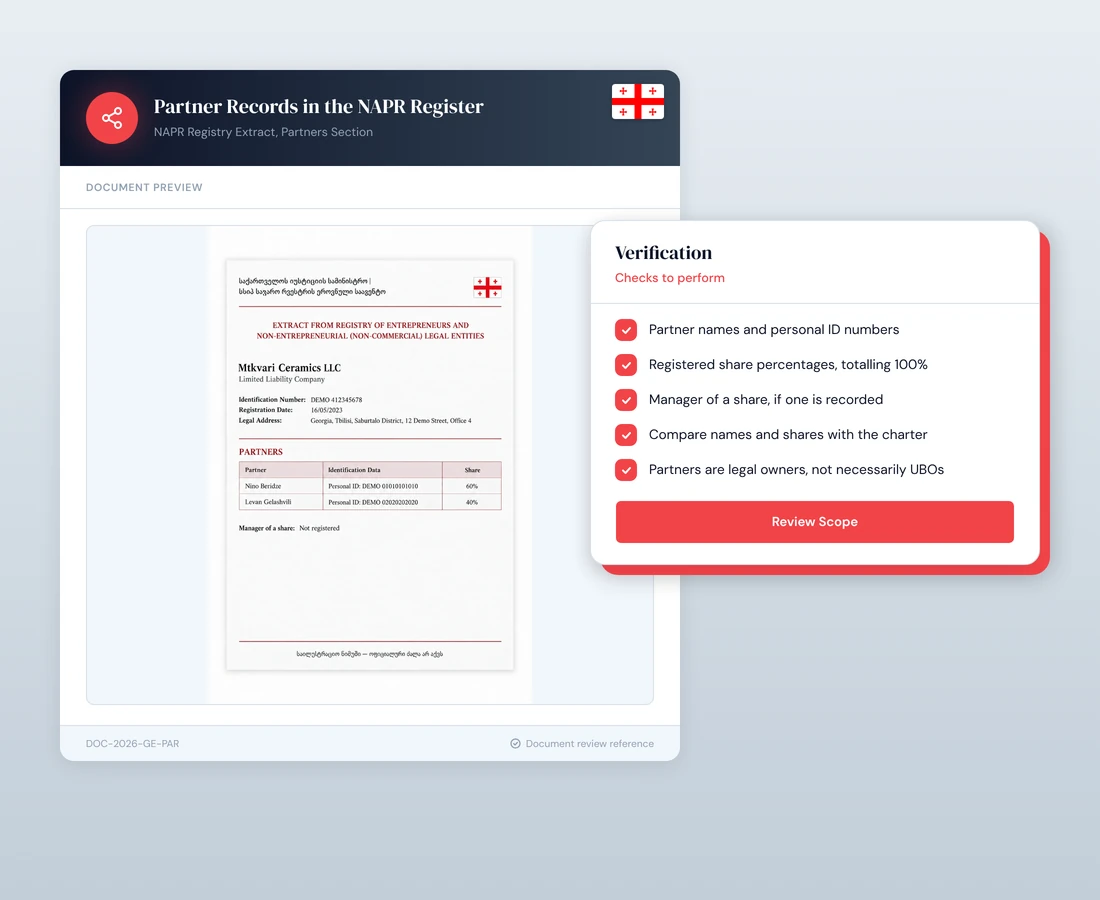
Partner Records in the NAPR Register
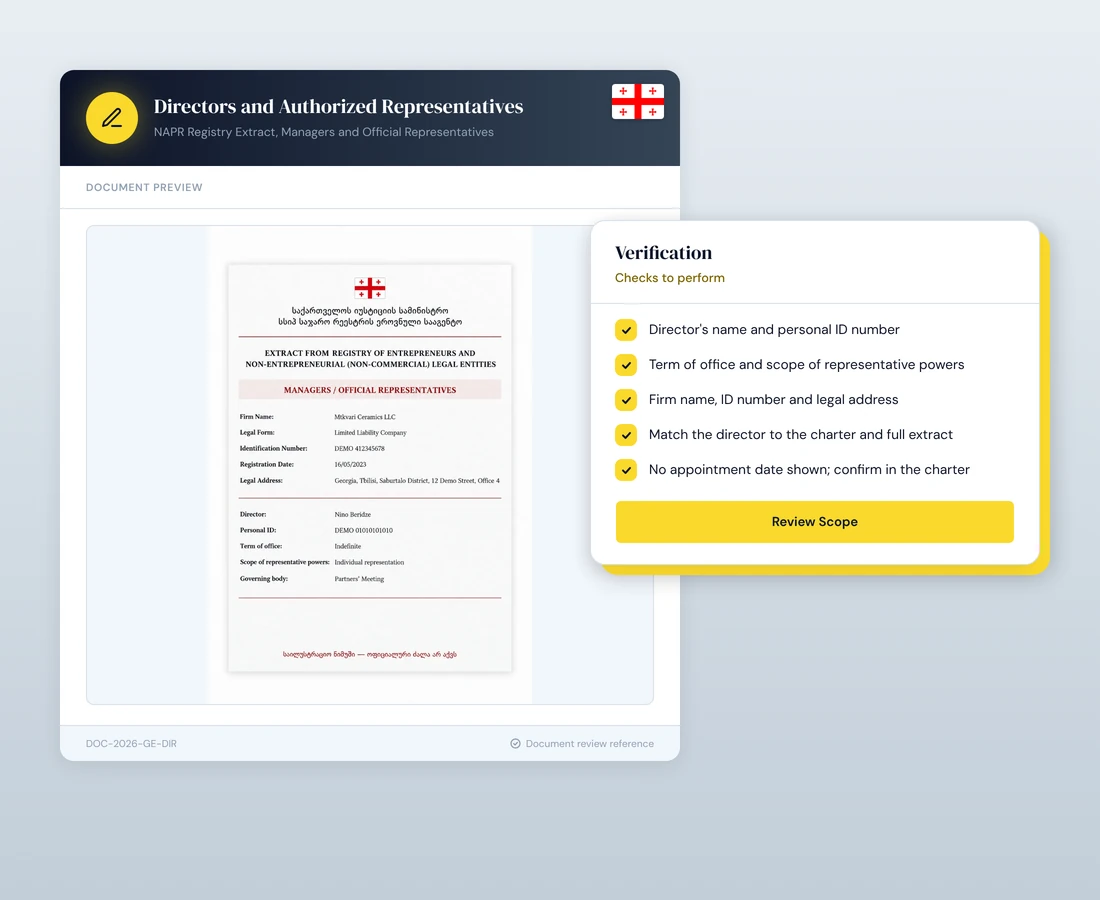
The registry extract lists each partner of a limited liability company with their share. With no central beneficial ownership register to rely on, Shufti follows corporate partners upward to the natural persons at the 25% threshold and screens each one.
Directors and Authorized Representatives
Each director and authorized representative is identity-verified and screened, and Shufti alerts the team when the registry records a change of management or representation.
Languages We Cover
Mkhedruli, English and Non-Resident Document Parsing
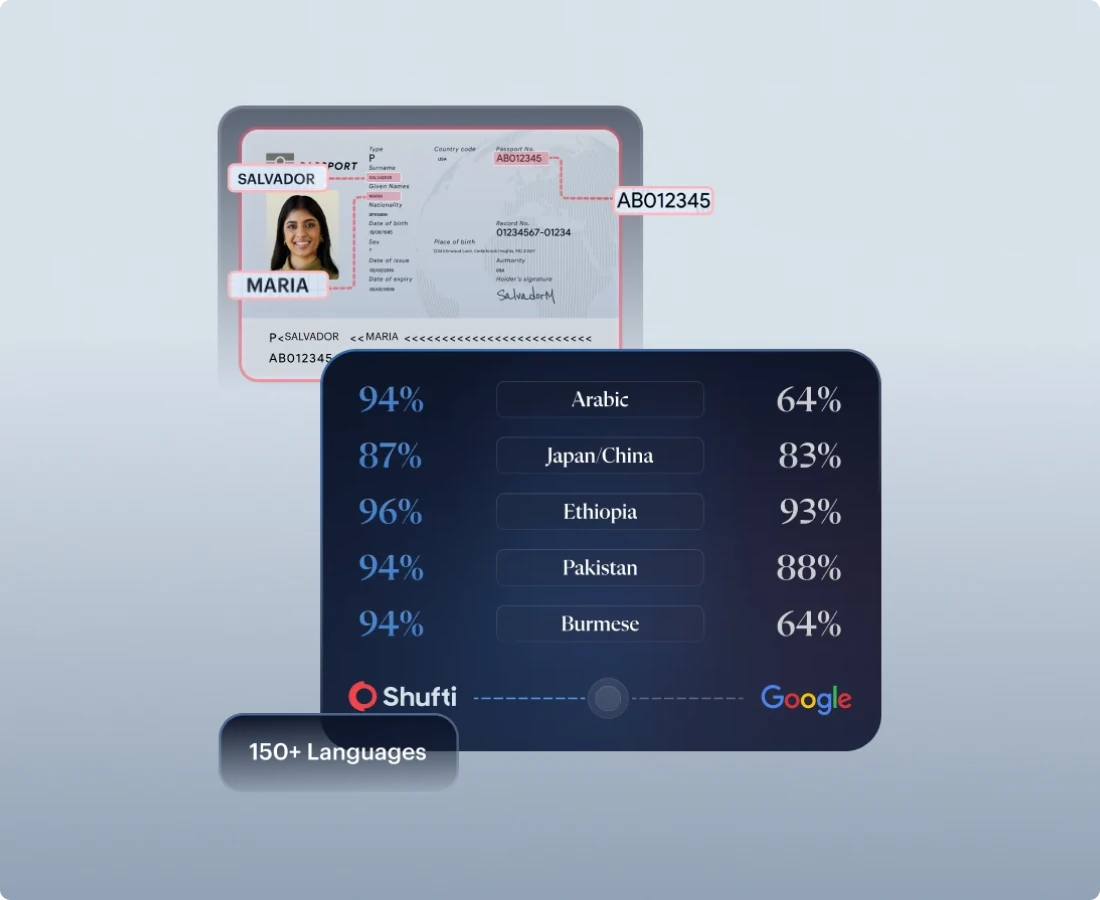
Georgian ID cards, residence cards and passports print data in Mkhedruli alongside Latin fields, and non-residents bring documents in Cyrillic and other scripts. Shufti's OCR reads 150+ languages and scripts at 99.7% accuracy, extracts both versions of every field and averages 93% against Google Vision's 78.4% in its published benchmark. Zero-shot document intelligence reads unseen layouts on first sight, without waiting for a template.
Georgian Name Matching
Surnames ending in -shvili, -dze or -ia transliterate inconsistently into Latin. Native phonetic models for 80+ languages and script-to-Latin transliteration match each variant against sanctions and PEP lists.
Cross-Document Consistency Checks
Names, dates of birth and personal numbers are reconciled across the ID card, passport, residence card and NAPR extract, so a mismatch surfaces before approval.
Independent Validation
Shufti's Recognition Across Independent Evaluations

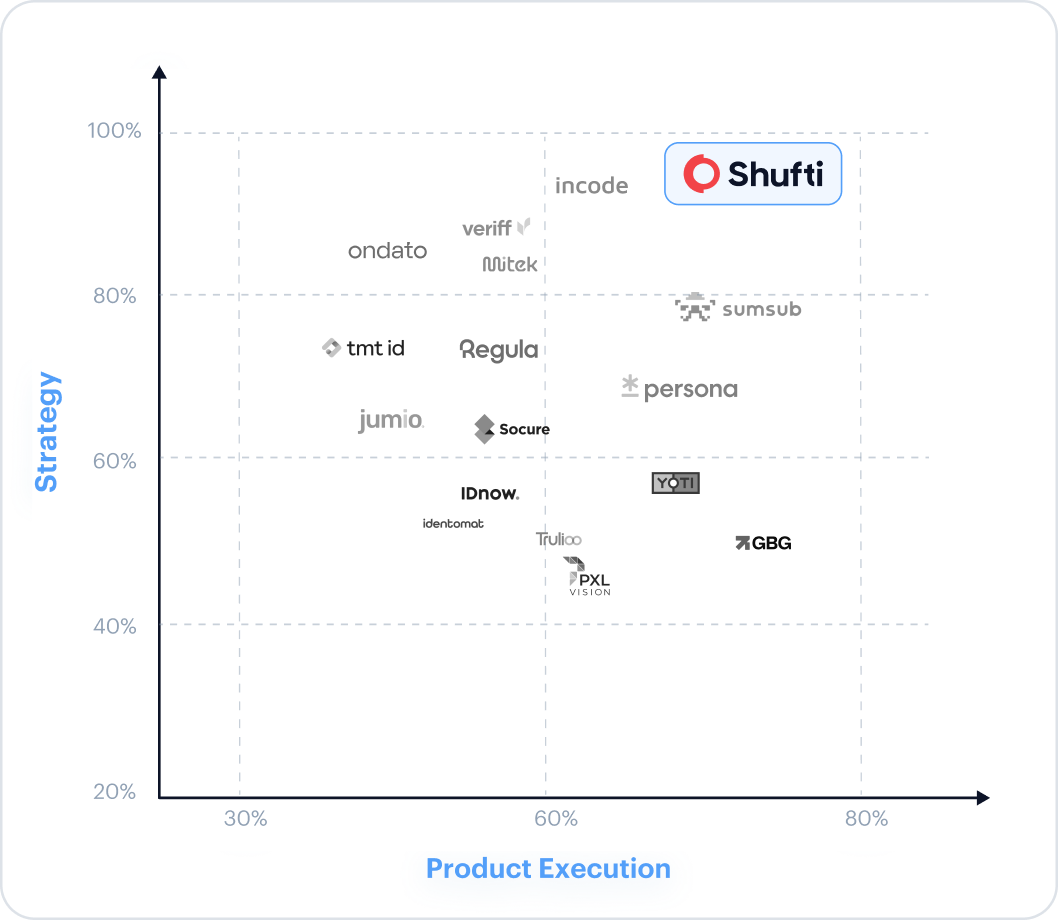
Ranked Exceptional in the Liminal Index 2026 for age estimation
View Report

Differentiated by Gartner on document diversity and country coverage
Read more
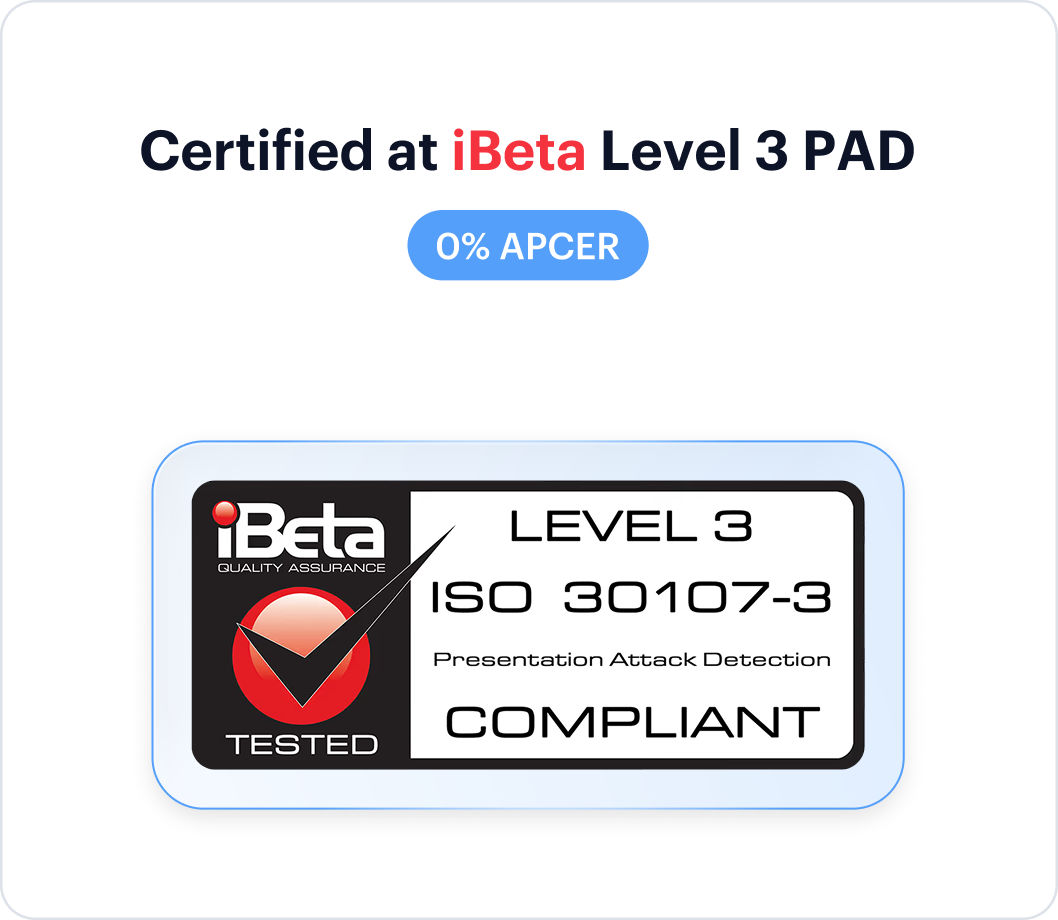
Certified at iBeta Level 3 PAD with 0% APCER
Read Blog
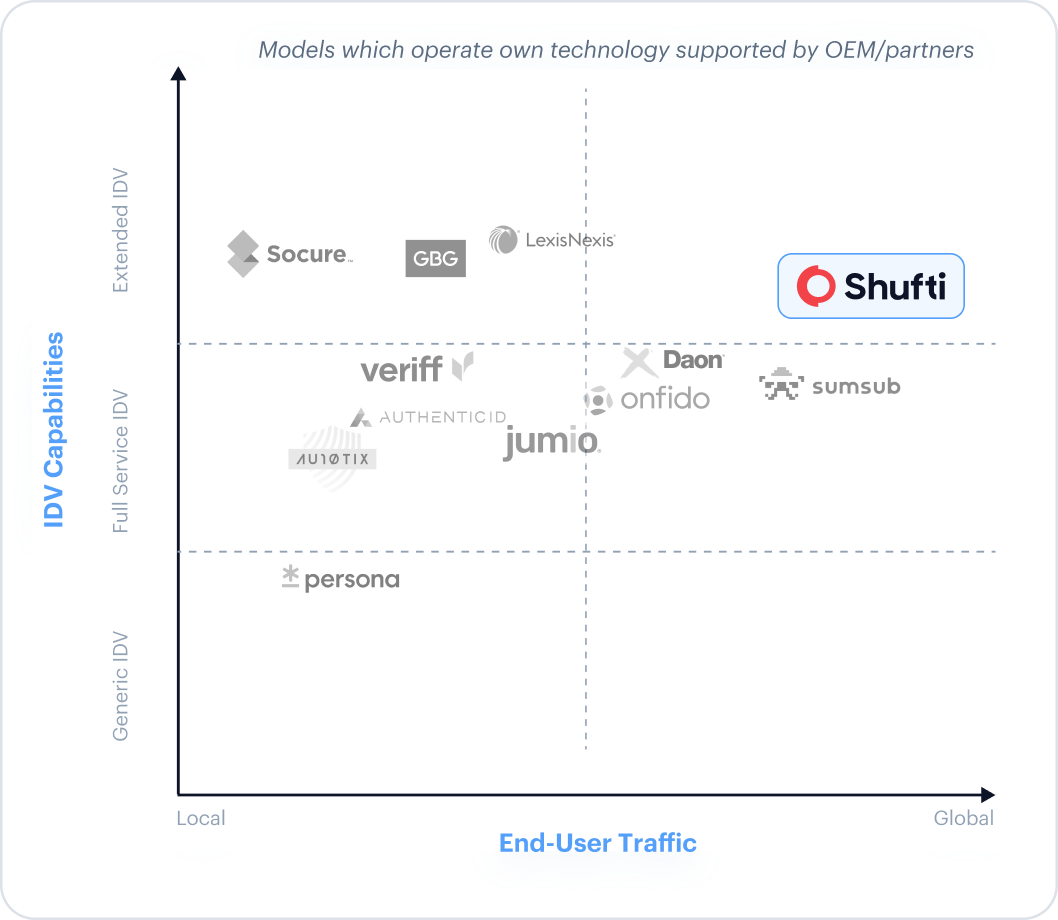
Broadest global reach in the 2025 KuppingerCole Extended IDV report
Download Report
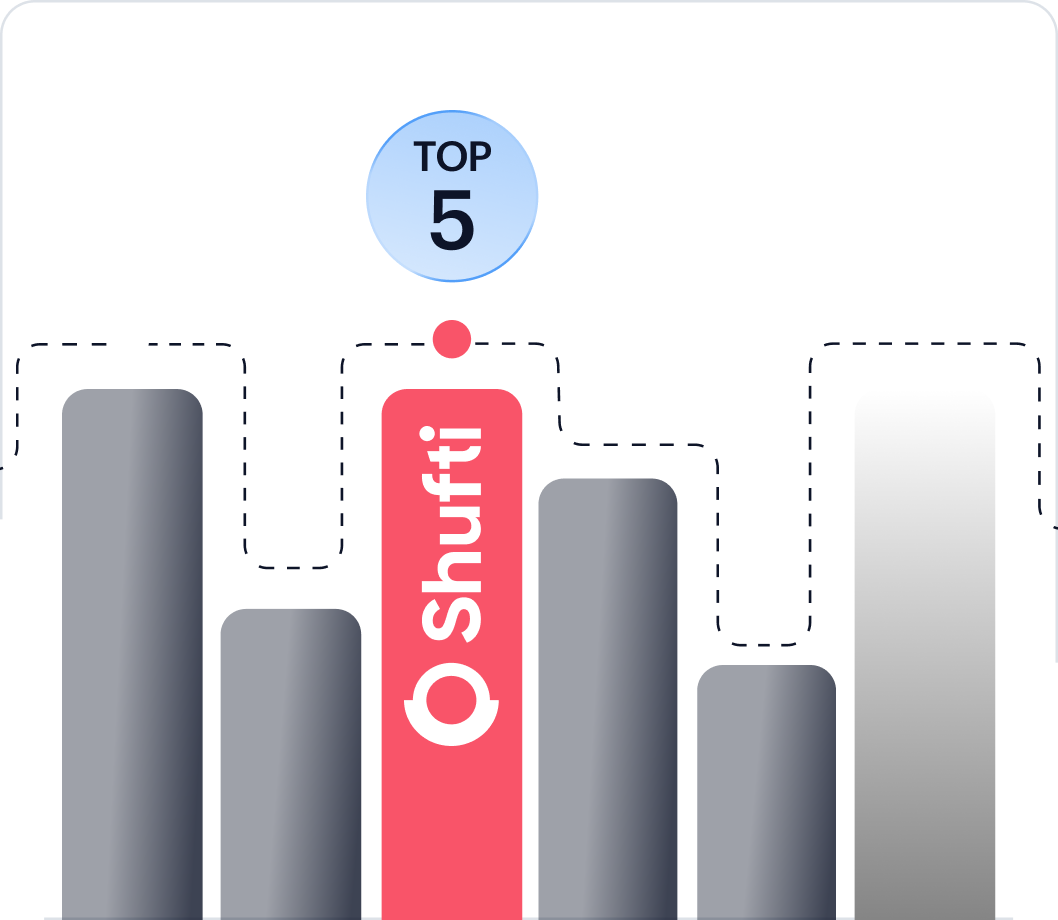
Ranked Top 5 in the DHS RIVR 2025 for identity validation
Read Blog

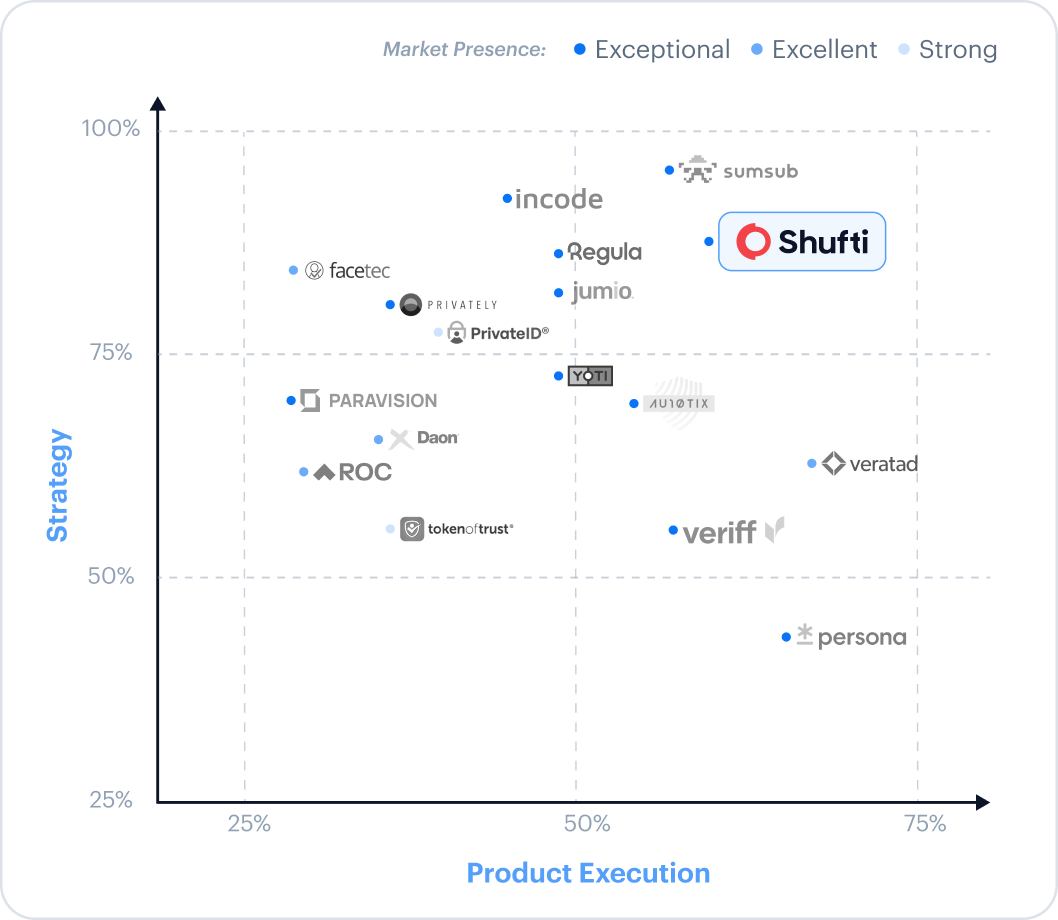
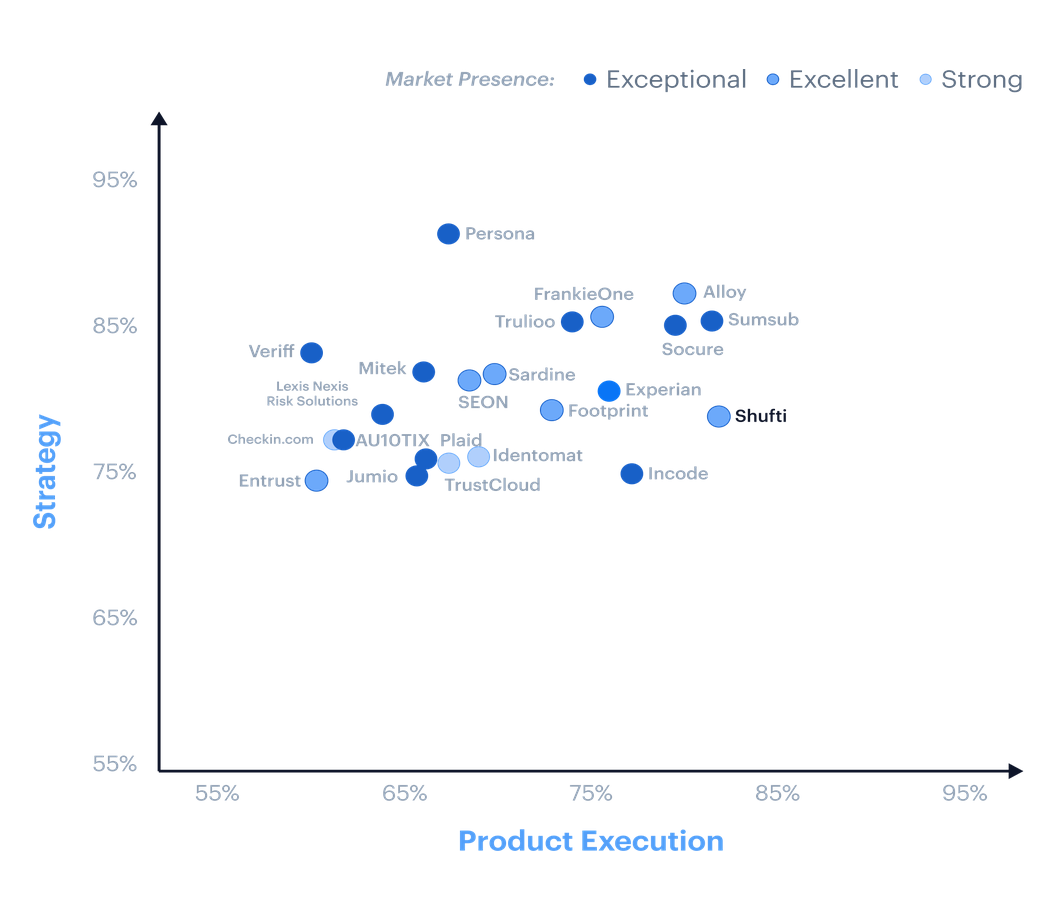
Top Vendor for Product Execution in the Liminal Index for KYC 2026
View Report

Ranked Exceptional for age verification by Liminal Index 2026
View Report

Recognised as a Leader in G2 Fall 2026 reports
Read More






Regulatory Update
Every Verification Route Georgian Regulators Recognize, in One Platform
NBG Order 104/04 lets supervised firms onboard customers remotely through a liveness check, a live document check and a face match against the document or the PSDA photo, with data read by OCR or NFC, or through agent-led video identification. Shufti supports each route, plus passport chip and document routes for non-residents outside PSDA records.
PSDA Database Comparison
LiveThrough your institution's PSDA access, Shufti compares document data and the live selfie with identification data and the photo from the PSDA database, which Article 16 of the AML Law lets firms and their outsourcers use without consent, and stores each result.
NFC Chip Verification
LiveShufti reads the chip in the Georgian ID card, the biometric passport and most foreign biometric passports and checks it against the printed data, the capture method Order 104/04 accepts alongside OCR.
Document Authenticity Check
LiveWith the physical document in the session, Shufti tests security features, MRZ data and print patterns for tampering, and accepts the international biometric passports and ID cards valid for entering Georgia that the order requires from non-residents.
Liveness and Face Match
LiveiBeta Level 3 certified liveness confirms a real person is present before Shufti matches the face to the document and the PSDA photo, blocking deepfakes, masks, replays and injected video along the way.
Fraud Prevention Across the Georgian Customer Journey
Reduce fraud losses and protect customer trust across onboarding, account access, and payments. Shufti connects identity, behavioral, device, network, and transaction intelligence to help Georgian businesses act on risk while keeping legitimate customers moving.
Governance & Controls
Audit-Ready Decisions, Lower Operational Drag
Fewer Avoidable Re-submissions
Capture guidance for ID cards, residence cards and Mkhedruli text catches glare, blur and cropped QR codes before submission, so customers rarely retry.
Cleaner Audit Trails
Shufti's case management records sources, results, timestamps, evidence, analyst notes and decision history, packaged as report-ready bundles for filing through the FMS online reporting system.
One Workflow, One Back Office
Unify KYC, KYB, AML screening and transaction monitoring in one case file, while perpetual KYC/KYB tracks ownership, director and transaction behavior changes.

ID Card Chip and PSDA-First Flow Design
Citizens and residents pass the chip read and PSDA comparison first, while non-residents move to biometric passport verification in the same flow.
Shufti's IDV/KYC Solutions for Georgia
KYC Solutions
Identity verification in Georgia covers citizens and residents whose ID and residence cards are checked against PSDA records, and non-residents opening accounts remotely with biometric passports. One Shufti flow routes each by risk, so nobody faces checks they don't need.
Explore More
Face Verification
Remote onboarding under Order 104/04 depends on a live face matching both the document and the PSDA photo. Shufti's face verification passes 99.5% of genuine users on the first try while stopping deepfakes, masks and injected video, so approvals stand up to NBG review.
.
Age Verification
Georgian law bars citizens under 25 and foreigners under 18 from gambling, so one age threshold does not fit every player. Shufti reads date of birth and nationality from the verified document and applies the right limit in the same check.
.
Bank Account Verification
Payouts and withdrawals fail when a Georgian IBAN or account holder name is wrong. Shufti validates the IBAN structure and checksum and confirms the holder's name in real time, so the account belongs to the customer before money moves.
.
Address Verification
The ID card carries no address, so firms rely on bills and certificates whose layouts differ by provider. Shufti extracts the address with layout-aware OCR and fuzzy-matches it to the application, passing 99.3% of genuine documents.
.
Document Verification
Georgian onboarding draws on ID cards in old and new designs, residence cards, passports, driving licenses and stateless travel documents. Shufti authenticates each format, reads Mkhedruli and Latin fields within seconds and rejects altered or screen-captured copies.
.
Identity Verification
Separate vendors for document checks, selfies, PSDA comparisons and addresses leave one customer spread across several systems. Shufti runs document, biometric, NFC, address and database checks in one API session, giving compliance teams a single decision and record.
.KYB Solutions
Business verification in Georgia means reading the NAPR registry, following partners through holding companies and identifying beneficial owners at the 25% threshold the AML Law sets. Shufti's live registry calls keep each company record current.
Explore More
Business Verification
Onboarding a Georgian company means confirming its NAPR registration, identification number, representatives and everyone who owns or controls 25% or more. Shufti's live registry call confirms the NAPR record and partners, and owners at 25% or more are traced upward through partner records and the declarations the company provides.
.
Enhanced Due Diligence
Layered holdings, PEP links, offshore partners and cash-heavy sectors need a closer look. Shufti's branching questionnaires, configurable risk scoring and UBO verification links gather source of funds and ownership evidence, and route high-risk files to senior approval.
.AML Screening
A customer who is clean at onboarding can land on a list next week. Shufti's perpetual KYC rescreens every customer against 4,000+ watchlists, including the UN Security Council lists the FMS publishes, refreshes sanctions and PEP data every 15 minutes and keeps every alert in one case file.
Explore More
Business AML Screening
A Georgian company's risk often sits with its partners and representatives. Shufti screens the entity and every partner and director against sanctions lists, including the FMS list of sanctioned persons, PEP data and adverse media, and perpetual KYB rescreens the portfolio as records change.
.
Transaction Monitoring
FMS Order No. 1 sets sector-specific threshold reports, from GEL 10,000 transfers linked to high-risk jurisdictions to GEL 50,000 cash deposits at banks. Shufti's 500+ pre-built rules cover structuring, smurfing and mule activity with 60% fewer false positives.
.
Travel Rule
NBG Order 386/04 requires originator and beneficiary data to accompany virtual asset transfers by 31 December 2027, and above GEL 3,000 a VASP must assess who controls a self-hosted wallet. Shufti exchanges that data across major Travel Rule networks and verifies unhosted wallet ownership.
.
AI Compliance Co-Pilot
One common name can return 140+ screening hits. Shufti's AI Compliance Co-Pilot reviews every hit and gives a 0 to 100 confidence score with a written reason, while your AML officer keeps the final call and every override is logged.
.Built To Fit Georgia's Compliance Landscape
Georgia's AML Law and the FMS apply to every obliged entity. NBG AML compliance rules cover banks, payment providers and virtual asset firms, while the Ministry of Finance, the Insurance State Supervision Service and SARAS supervise their own sectors. Shufti maps its KYC, KYB, AML screening and transaction monitoring controls to every regime below, so one platform covers each license your group holds.

Law on Facilitating the Prevention of Money Laundering and the Financing of Terrorism
Law No. 5226 of 30 October 2019 replaced the 2003 AML law. Article 10 sets due diligence including ongoing monitoring, Article 13 defines beneficial owners at 25% or more, Article 16 opens PSDA databases for verification and Article 27 requires five-year record retention.

National Bank of Georgia (NBG)
The NBG supervises banks, microbanks, microfinance organizations, payment service providers, currency exchange bureaus, brokerages, investment firms and VASPs for AML. Its Order 104/04 of April 2025 sets the electronic identification rules, and firms need NBG consent and an independent audit before launching remote onboarding.
Financial Monitoring Service of Georgia (FMS)
The FMS is Georgia's financial intelligence unit. Obliged entities report suspicious transactions on the day suspicion arises under Article 26 of the AML Law, file sector-specific threshold reports within five working days under FMS Order No. 1 of 2020, and submit both online.
Virtual Asset Service Providers (NBG Order 94/04)
VASPs became obliged entities in 2022 and have registered with the NBG since 1 July 2023 under Order 94/04. Order 386/04 adds Travel Rule data duties that VASPs must meet by 31 December 2027, and new capital and risk management requirements reach existing VASPs in 2027.

Insurance State Supervision Service of Georgia
The Insurance State Supervision Service supervises insurers, insurance brokers and pension companies for AML under Article 4 of the AML Law. These firms identify policyholders and beneficial owners, monitor relationships throughout their life and report suspicious transactions to the FMS.

Ministry of Finance of Georgia
The Ministry of Finance supervises lottery and gambling organizers, leasing companies and dealers in precious metals and stones for AML. Under Article 11 of the AML Law, casinos apply due diligence to cash transactions of GEL 5,000 or more and whenever they register a new online player.

Revenue Service of Georgia
The Revenue Service issues gambling permits and keeps the lists of dependent and prohibited persons introduced by the 2021 gambling law reforms, which operators check before accepting players. It also reports cross-border cash and securities movements above GEL 30,000 to the FMS.

Service for Accounting, Reporting and Auditing Supervision (SARAS)
SARAS supervises accountants and auditors for AML under Article 4 of the AML Law. Because each supervisor sets the electronic identification standard for its own sector, SARAS adopted separate rules in November 2023 for identifying clients remotely without meeting them in person.

National Agency of Public Registry (NAPR)
NAPR runs the Registry of Entrepreneurs and Non-Entrepreneurial (Non-Commercial) Legal Entities under the Law on Entrepreneurs of 2021. Companies formed before 2022 had to bring their registration data into line by 1 April 2026, and NAPR suspends the registration of those that did not.

Public Service Development Agency (PSDA)
PSDA, under the Ministry of Justice, issues ID cards, passports and residence cards and keeps the civil registry. Since February 2026 it has issued new-design electronic ID cards carrying fingerprints and a QR code, while earlier cards stay valid until they expire.

FMS List of Sanctioned Persons
Under Article 41 of the AML Law, changes to UN Security Council sanctions lists take direct effect in Georgia once published, and assets must be frozen immediately and without notice. The FMS publishes the list, and a Government Commission set up in 2011 handles domestic designations.
Interagency Commission and National Risk Assessment
Article 5 of the AML Law requires a national risk assessment at least every three years, prepared through the Interagency Commission. The Government approved the latest published assessment in October 2023, and the 2023 to 2026 national strategy and action plan sets AML priorities.

MONEYVAL Evaluation of Georgia
MONEYVAL adopted Georgia's fifth-round mutual evaluation in September 2020 and four enhanced follow-up reports through December 2025. It ended its compliance-enhancing procedures for Georgia with a second CEP report adopted in May 2026, and Georgia was not on the FATF increased monitoring list in June 2026.
Georgia Data Residency and Deployment
Shufti runs on-premises in your own infrastructure, air-gapped if required, or in EU cloud regions on AWS and Microsoft Azure. Hosting locations and transfer safeguards are fixed in your agreement, the details NBG's cloud outsourcing guideline expects banks to settle before contracting.
Law of Georgia on Personal Data Protection
In force since 1 March 2024, the law treats biometric data used for unique identification as a special category, and Article 9 requires its purpose and retention to be set in writing. Incidents go to the regulator within 72 hours. Shufti adds encryption, role-based access and configurable retention.
State Audit Office Oversight
The State Audit Office took over data protection supervision when the Personal Data Protection Service was abolished on 2 March 2026. Shufti's data processing agreement covers Article 37 transfer safeguards and supports the impact assessments Article 31 requires for large-scale biometric processing.
NBG Audit of Outsourced Identification
Order 104/04, as amended in June 2025, requires firms that outsource electronic identification to hold independent audit findings on how the provider stores and deletes data, backups included. Shufti documents those storage and deletion controls for the audit, or runs entirely on your own servers.
Retention Controls
Retention is configurable by client and license, covering the five-year minimum under Article 27 of the AML Law and extensions of up to five years the FMS or a supervisor may request. Statutory minimums are not automatic deletion dates, and legal holds keep records in place.
Encryption and Security
Data is encrypted in transit and at rest, with role-based access and audit logging throughout. ISO 27001:2022 and SOC 2 Type 2 reports support the vendor reviews banks carry out under the NBG cybersecurity management framework, Order 56/04, and its cloud guideline.
Automated Decisions and Biometric Data
Article 19 of the data protection law lets people object to decisions made solely by automated processing and ask for human involvement. Shufti returns verification results and supporting details through the API and back office, so support teams can explain outcomes and escalate disputed results.
Scope of Our Role
Shufti acts as a processor under the data protection law, handling data only on the firm's written instructions under an Article 36 agreement. The firm remains the controller and keeps responsibility for compliance, and Shufti's privacy notice names any activities it carries out as an independent controller.
Data Residency and Privacy Controls in Georgia
Georgia AML Sources That Strengthen Decisions
Financial Monitoring Service of Georgia (FMS)
National Bank of Georgia (NBG)
Service for Accounting, Reporting and Auditing Supervision (SARAS)
Insurance State Supervision Service of Georgia

Georgian Bar Association

Ministry of Justice of Georgia
Ministry of Finance of Georgia
National Agency of Public Registry (NAPR)

Revenue Service of Georgia

National Bureau of Enforcement

Financial Action Task Force (FATF)
Council of Europe – MONEYVAL

Egmont Group of Financial Intelligence Units
United Nations Security Council Consolidated List

International Monetary Fund (IMF)
Turn Georgia Verification Requirements into a Smoother Customer Journey
Share your customer types, risk rules and current onboarding process. A Shufti specialist will show you how to connect identity verification, KYB and ongoing monitoring, reducing operational hand-offs while keeping decision evidence organised for compliance review.
INDEPENDENTLY AUDITED. GLOBALLY CERTIFIED.
Certified to Global Standards




PROVEN WORKFLOWS
Identity Verification Built Around Your Industry in Georgia
Open Accounts Remotely Under NBG's Electronic Identification Rules
eKYC for bank onboarding in Georgia has to combine biometric liveness, a live document check and comparison with PSDA records under Order 104/04. Shufti runs chip, PSDA and video routes in one flow, screens every customer continuously and keeps each decision in a case file ready for NBG inspection.

Frequently Asked Questions
Does Shufti compare customers with PSDA records, and what happens for customers outside them?
Yes. Through your institution's PSDA access, Shufti compares document data and a live selfie with the identification data and photo held in the PSDA database, as Order 104/04 requires for Georgian documents. Non-residents outside PSDA records move to biometric passport NFC checks, document authentication and liveness in the same flow.
Is scanning a Georgian ID card enough, or should verification include its chip?
A scan alone leaves room for edited or replayed images. Order 104/04 requires identity data to be read by OCR or NFC, and Shufti reads the card's chip by NFC, tests its security features and matches the holder's live face to the chip photo.
Can Shufti verify foreign documents or identity formats it has not encountered before?
Yes. Shufti's zero-shot AI adapts to unfamiliar layouts without a template, so a non-resident's national ID or a newly redesigned passport is checked for authenticity and tampering like any known format, alongside the biometric document checks Order 104/04 sets for non-residents.
How accurately does Shufti read Georgian identity documents?
Shufti's OCR reads Mkhedruli and the Latin fields beside it, extracting names, dates and personal numbers from ID cards, residence cards and passports. For documents non-residents bring, Shufti's published benchmark shows it averaging 93% accuracy against Google Vision's 78.4%.
How does Shufti verify ownership when a Georgian company has several corporate layers?
Shufti pulls the NAPR record for each Georgian company in the chain, maps holdings through foreign parents and intermediate companies and identifies everyone at the 25% threshold. Each owner is verified and screened, and a change in the registry triggers an alert to rescreen.
Does Shufti's ongoing monitoring cover more than sanctions screening?
Yes. Article 10 of the AML Law makes monitoring part of due diligence, and Article 12 requires it throughout the relationship. Shufti compares transactions with each customer's profile, rescreens customers as lists change and flags registry, director and ownership changes for review.
How does Shufti keep screening current and handle Georgian name variations?
Watchlists update continuously, including the UN lists that take direct effect in Georgia and the FMS sanctioned persons list. PEP screening in Georgia also covers the domestic officials named in Article 21 of the AML Law, and phonetic matching links Latin spellings of one name.
Can we choose where data is hosted or run verification inside our own infrastructure?
Yes. Choose EU cloud regions on AWS or Microsoft Azure, or deploy Shufti on-premises, air-gapped if required, so identity data stays on your network. The agreement records hosting locations and transfer safeguards, which the data protection law and NBG cloud rules expect you to define.
What controls help us protect identity and biometric data?
Shufti encrypts data in transit and at rest, applies role-based access and logs every access. Biometric data is kept only as long as your configured retention allows, and ISO 27001:2022 and SOC 2 Type 2 reports support your vendor review and data protection impact assessment.
Can we configure different retention periods for different Georgian licenses?
Yes. Retention is set per client, license and record type, so a bank, an insurer and a gambling operator in one group can each keep records for at least five years, with longer periods wherever the FMS or a supervisor requests an extension.
What does Shufti provide when our compliance team needs to prepare an FMS report?
Shufti's case file holds the verified identity, screening results, transaction history, alerts and analyst notes in one place, exported as a report-ready bundle. Your team files it with the FMS on the same day suspicion arises, without rebuilding the evidence from separate systems.
Can we add verification checks without rebuilding our onboarding journey?
Yes. The AI Journey Builder adds or reorders checks such as NFC chip reads, PSDA comparison, video identification or address verification without code changes, and routes customers by product, nationality and risk tier, so new NBG requirements reach production quickly.
How does Shufti make verification queries easier for our customer support team?
Every decision appears in the back office with its reason, the failed check and the captured evidence. Support agents can explain a rejected selfie or document in plain terms, ask for a specific retake and escalate disputed results to compliance without guessing.
Let’s Build Trust Into Your Business
1B+Verifications Processed
240+Regions Actively Processed
99.7%Accuracy Rate
Samer Al Tamimi
CEO of Safwa Bank

“We take our client’s privacy very seriously and always look for new innovative solutions to ensure a safe banking experience. Working with Shufti feels like a breath of fresh air, as their 100% in-house tech keeps our customer’s data free from vulnerabilities and fully safe and protected.”
Trusted. Compliant. Certified


Explore Shufti For Your Business
Get a personalised demo from our experts.
PROVEN PLAYBOOKS
Explore Practical KYC & AML Resources

5 January, 2026
eIDV Global Capability Matrix
Shufti's eIDV coverage across 87 jurisdictions, showing which passive, active and biometric database checks, plus address and age checks, are available in each.
Coverage Sheet